A web log, an æthereal scrap-book if you will, with a somewhat vintage flavour. News items, occurrences, experiences, thoughts and opinions related to Victoriana through to Fifties Americana can all be found here.
With this blog very much back up and running again I think it's time for another selection of topical tunes to celebrate that especially spooky time of year - All Hallow's Eve! In fact, looking back at this blog's post history it seems to have been a frankly astonishing (and almost unacceptable) 8 years since I last did a Hallowe'en-themed entry, so let's put that to rights right now with the following five frightening refrains from the terrifying Twenties and thrilling Thirties.
We kick off with British bandleader Jack Hylton & His Orchestra and their 1929 recording Bogey Wail. One of four sides the band cut on the very un-Hallowe'en date of the 13th February 1929 it features a common motif of the time in the form of the Bogeyman, the æthereal monster hiding under the bed/ in the cupboard and which has scared the pants off generations of children around the world for centuries. This particular recently-uploaded video features some very well done period-style animation which just adds to the overall eeriness of the song.
Jumping forward eight years and something slightly different but no less scary is lurking in the cupboard in this next tune, consummately performed by another great of the British dance band era, Nat Gonella & His Georgians. The Skeleton In The Cupboard was originally recorded a year earlier by Louis Armstrong and His Orchestra for the 1936 Bing Crosby film Pennies From Heaven. The title song rightly went on to become a jazz standard, subsequently recorded by multiple artists over the years, but in the process left the likes of The Skeleton In The Cupboard slightly forgotten - an oversight I'm happy to try to rectify by including Nat Gonella's bouncy version here.
From Bogeymen to skeletons to zombies next in this 1934 recording by the now obscure American dance band leader Gene Kardos. With his orchestra Kardos actively recorded from 1931 until 1938 (with vocalists including Dick Robertson and Bea Wain) at which point he "retired" and went to work for the New York City postal department(!) while at the same time performing in a small Hungarian restaurant in the Manhattan suburb of Yorkville. Cut on the 26th June 1934, Zombie is an early example of the term appearing in musical form and was allegedly inspired by the pre-Code 1932 Bela Lugosi horror film White Zombie.
Another forgotten American band leader features in this next song from 1930, written, composed and performed by Wayne King and His Orchestra. Known at the height of his fame from 1931 to 1940 as "the Waltz King" after his most favoured variety of jazz he slowly faded into obscurity after the early 1960s and although he continued to perform at various venues around America right up to the 1980s he had by then, like Gene Kardos, gone into "early retirement" from the music scene and in between appearances ran a cattle farm and car rental business from his Savanna, Illinois home. Swamp Ghosts is a wonderfully typical example of early 1930s creepy jazz, helped along in this video by some fittingly ghostly images!
For the final tune in this post we return to Britain and another top band leader of the 1930s, Roy Fox and His Orchestra, with their 1934 offering The House Is Haunted. Sung by the equally-noted (and brilliantly named!) British vocalist Denny Dennis it is actually really more of a romantic ballad, as the lyrics suggest, but teamed with some superbly spine-chilling footage from the 1922 film Nosferatu it earns its place here as a suitably supernatural offering.
Well there we have it then - five spooktacular songs from the 1920s and '30s to hopefully help your Hallowe'en go with a swing. I hope you all have as enjoyable an All Hallow's Eve as it's possible to have in these trying times - do let me know what you have planned or what you got up to in the comments. Noseferatu happens to be my favoured choice for the Partington-Plans' 2020 Hallowe'en showing although it's facing some stiff competition this year, with my fiancée pushing for Pride And Prejudice And Zombies (I'm still not sure myself...) or the 2019 animated remake of The Addams Family. Maybe we'll end up doing a triple-bill, we'll have to see...
Well I had planned to give you a long and [hopefully] interesting post about one of my favourite subjects but - whew! - it's almost too hot to think here today (33°C/ 91°F currently) and by Jove do I feel like the title of this song. So instead I'll leave you with Al Starita's Kit-Kat Band from 1927 and the hope that you're all keeping as cool and safe as possible. In the meantime, follow their example and maybe have an ice cream (but not at the beach)!
Period sleuthing (and bow ties) are the order of the day!
TV schedulers have a somewhat macabre sense of humour, I've decided. In the last week I couldn't help but notice on several different channels such unnecessarily topical films as The Andromeda Strain, The Host, War for the Planet of the Apes and Groundhog Day(!), sometimes making multiple appearances. It honestly makes me grateful for my extensive DVD collection (currently rotating between my Harold Lloyd and Thunderbirds box sets and Agatha Christie's Partners In Crime, as the mood takes me) and personal library. How people without access to such things are coping I don't know (but I sincerely hope everyone is keeping as happy and occupied as possible)! Don't watch too much news seems to be the consensus - and I agree (I tend to get mine through the [online] papers, that way I can filter things out more easily).
Since we are all trying to find other things to keep us entertained at the moment, and with the television here in the UK not really stepping up to the crease inasmuch as offering much in the way of escapism (or even erudition), I thought now would be a good time to do a post on another form of media that has been keeping me sane for a while - podcasts. Specifically, podcasts featuring popular music from our favourite era - the 1920s and 1930s!
Vintage music podcasts are something I've been supplementing my own record collection with for some time now and by and large I've found them to be a jolly little fillip to my enjoyment of '20s and '30s jazz. As well as providing an introduction to hitherto unheard-of bands and their music (rather like the equivalent of hearing a new pop group's song on the radio) it's just nice sometimes to hear a friendly voice sharing their enthusiasm for an otherwise sadly overlooked genre and reminding you that you're not the only one out there who likes listening to it! So without further ado I present you with my current list of podcasts and internet radio stations that showcase those toe-tapping tunes from the Jazz Age. Some of them are fairly recent discoveries, others I've been listening to for years, but all are great things to have on in the background while you're busying about the house.
One of my more recent discoveries, 78Man Presents plays a varied selection of music taken - as the name suggests - from his own collection of 78rpm records dating from the 1900s right through to the 1950s. Featuring mainly British dance bands, as is to be expected from a British production; although the focus is sometimes too much on novelty songs for my liking it still features a good selection of tunes from across the first fifty years of the 20th century.
A slightly different format this one, Angel FM is a community radio station based in Havant, Hampshire, broadcasting to the local area on FM & DAB radio but also available worldwide via its website. I featured it in a post back in 2011 when it was still only a "pop-up" station and it is wonderful to see how it has evolved since then, its aims eminently laudable and well worth supporting. Although it claims to focus on providing music for the older generation, we know that this means music that we "old souls" can enjoy as well (nothing from after 1959 - sounds good!) and lo and behold there are a number of shows on throughout the week that play popular standards from the Forties back.
Not available as a podcast per se; you can only listen to or download individual mp3 files from the website from what I can gather. John wright is another British dance band aficionado with an extensive 78rpm record collection that again forms the backbone of these broadcasts, which are nevertheless as enjoyable and informative as any other.
Another internet radio station this one, devoted to dance band music from 1925 to 1945 according to its "About" page. As befits a world wide web wireless it's not just British dance bands either but artists from the USA and even Germany among others. It's also splendid to see the younger generation involved in this enterprise; Jonathan Holmes, presenter of the "British Dance Band Programme", is a particularly welcome ambassador for the genre among young people, coming across as relaxed, well-informed and enthusiastic about his subject. He also has a decent YouTube channel, which I can heartily recommend as well (in fact a separate post for similar channels may well be forthcoming in the future!).
This is yet another internet radio site that I believe you can only listen to online, but one that has been on my radar - and that of some of my followers I think - for some time now. Being Texas-based it focuses largely on dance and swing bands from the United States, however bands from Britain and Germany are also well-represented. While it is generally non-stop music there are also occasional live "Special Broadcasts" from the owner of a local record store, who presents his programme every month or so.
This is the vintage music podcast that started it all for me and the one I have been listening to and enjoying the longest. Presented by Bryan S. Wright, who is an accomplished jazz pianist and music historian, and based in Pittsburgh, Pennsylvania (my aunt's home town - hello Pittsburgh; go Steelers!) these hour-long broadcasts feature a nicely-judged mix of tunes from the 1910s-1950s . While again naturally leaning towards American groups there's a good smattering of British and other bands and just the right number of novelty songs, all introduced by Bryan with friendly, easy-going style and obvious passion and knowledge. It's great to hear the enthusiasm for these songs from a younger person again as well and I tip my hat to Mr Wright for helping to keep the torch alight. Able to be listened to on site or downloaded as an mp3, Shellac Stack is also available on iTunes (although I note there hasn't been a new episode since September, so I hope all is well with him - still definitely worth a listen, anyway!).
A further new find and one that is fast becoming a favourite (albeit again it hasn't been updated since November, so we can only hope that it is not short-lived!). Presenter Neil Starr again delves into his personal collection of 78rpm records and, although being a British production, bands from both sides of the Atlantic are featured in good balance. It's nice to hear some informative speech in between records as well and the mix is precisely right to make the hour pass enjoyably and just briskly enough. This podcast is also available on iTunes (as well as other podcast programs).
That, then, is one type of [vintage] media that has been keeping me entertained these last few weeks (and beyond) and it is my hope that you find something among them all to divert you if only for a time. Enjoy the music and let me know in the comments what you've been up to - and if there are any stations or podcasts I've missed from this list!
First of all, a thousand apologies for the two months of radio silence as I rather let things go here at Eclectic Ephemera. Rest assured I am alive and well, but unfortunately finding many distractions that conspire to keep me away from blogging as often as I would like. I've always felt it to be an awful cop-out to blame a full-time job for stopping me from writing a blog, since I know so many of my favourite fellow vintage bloggers also have regular paid employment and that doesn't stop them from posting once a week! But alas I do find myself with less time to spare at the weekends now my weekdays are once again taken up by honest toil - having had every day to myself for so long (albeit enforced through ill-health) it's come as a bit of shock to have to condense all that I would do in a week into the two days of the weekend! Still, I must have done it before so I'm sure it'll become normal to me again soon.
In the meantime my new plan is to do one post as-and-when (note the deliberate vagueness!), covering two or three vintage-related news articles and/or anything of similar interest that may have happened in my life recently (highly unlikely, that!). Now, let's see if I can remember how to do this...
I picked this tune for a few reasons, not least because it's so toe-tappingly good! The title somewhat reflects this place for the last couple of months too (!), but it's mainly because I've recently been on something of an early Bing Crosby kick. For, yes, it is perhaps somewhat little known (and sadly so too) that on a lot of the classic 1920s jazz numbers featuring the noted (and tragic) cornetist Bix Beiderbecke recorded with Paul Whiteman (among others) the vocal accompaniment is performed by none other than a young Bing Crosby. Often appearing as part of a trio known as "The Rhythm Boys" the twenty-something Bing was soon spotted as an emerging talent and by the beginning of the 1930s was singing solo more often than not, as he started down the path towards greatness.
source
Bing Crosby with Al Rinker and Harry Barris
as "The Rhythm Boys"
I now have three CDs chronicling these early years of Bing's career - Bix 'n' Bing with The Paul Whiteman Orchestra and The Earliest Bing Crosby Volumes 1 & 2 - and all of them absolute crackers (but not always easy to get hold of - Amazon Marketplace is your friend!). It's fascinating to hear the genesis of Bing's inimitable voice, particularly in its early stages, in the somewhat unusual setting of 1920s jazz. It's hard to pick a favourite song, but this is one of the stand-outs in my opinion. If you're a fan of the 1990s Jeeves & Wooster TV series with Stephen Fry and Hugh Laurie (and let's be honest, if you're reading this you probably are) you'll recognise more than a couple of tunes. To complete the Bing-fest I also ended up getting a box set of his films as well!
Oh, and in other news I'm off to Eastbourne in Sussex the week after next (17th) for one week as a birthday treat - my first real holiday in ten years (which is why I'm playing it safe with the south coast)! I understand the area in and around Eastbourne is something of a vintage hotspot, so I'm hoping for some retro fun, frivolity and maybe a vintage find or two! Any tips on places to visit, hidden gems etc., please let me know (the De La Warr Pavillion is on the list, I need hardly say)!
Well, I was going to go on to summarise two or three interesting vintage news stories from the last couple of months but looking back at this post I think I've said enough about me (oh, the vanity!) to be going on with for now, so as with all good things (oh, the vanity again!) I'll leave you wanting more (I hope!).
Speaking of good things, let me just end by asking how many of my UK-based readers have been watching and enjoying the B.B.C.'s new adaptation of Agatha Christie's Partner's In Crime stories, starring David Walliams and Jessica Raine as Tommy and Tuppence Beresford? I was highly sceptical when the series was first announced, since I can't stand Walliams in anything else he's had a hand in and I wasn't too sure about the updated suburban 1950s setting. I must admit now to having not yet read any of the original books (set at first in the 1920s but unusually for Christie actually progressing in real time, ending in the 1970s with the protagonists in their seventies) so had based my whole outlook on the early 1980s ITV series. However I will admit I was pleasantly surprised - this is a rip-roaring little series; David Walliams can actually act, Jessica Raine is as lovely as ever and the plot and setting work well (not to mention the outfits - I bet you girls are having a field day!). I'm looking forward to tomorrow's episode as I type.
It's Christmas Eve, which must mean we're long overdue for another selection of festive ditties from down the years! Well, you didn't think I would forget what is fast becoming an Eclectic Ephemera Christmas tradition, did you? Once again I have delved into my Christmas music collection and scoured the dusty corners of YouTube to bring you some lesser-known Yuletide tunes, plus an extra special treat.
The [now rare] double CD Vintage Christmas Cracker, which I was fortunate enough to obtain before it became rarer than turkeys' teeth and which has formed the basis of my last four annual posts on the subject, once again provides a number of songs - but this time with a slight difference. I'm sadly running out of dance and swing band versions of classic Christmas tunes so by way of a change this year I'll be focussing on some of the more traditional choral pieces that were also recorded during the 1930s.
"Uncle Mac's Christmas Carols" is a splendid collection of carols, some less well-known than others, sung by St Brandon's CDS Choir in Bristol. With wonderful introductions by announcer Derek McCulloch, this medley was broadcast on the B.B.C. Light Programme in November 1939.
This version of Sleep, My Saviour, Sleep was a best seller in October 1932, when it was recorded by a ensemble singers calling themselves "The Celebrity Quartet". They were: Isobel Baillie (soprano), Muriel Brunskill (contralto), Heddle Nash (tenor) and Norman Allin (bass).
A Christmas carol without a boy soprano is like Christmas Day without turkey (says the man having beef). Master Dennis Barthel takes the vocal here, with Herbert Lawson on the organ, at an unspecified location in London, October 1930.
John McCormack was a famous Irish tenor who was very popular on both sides of the Atlantic from c.1905-1930. Here he performs O Come, All Ye Faithful in (sung in Latin as Adestes, Fideles), recorded in Camden, New Jersey almost one hundred years ago - 31st March 1915.
With a great deal of festive talk focussing on the centenary of the "Christmas Truce" on the Western Front, on the first Christmas Eve of the Great War (and British supermarket Sainsbury's moving and very well done Christmas advert) it is only right and fitting that Silent Night should feature here. All the more so that it should be the German version Stille Nacht, Heilige Nacht - to my ears as beautiful, if not more so, than in English - that would have drifted over the trenches one hundred years ago, to be answered in kind by the British soldiers with the result we know. This version was recorded in Berlin, in September 1932, by the incongruously-named close-harmony group "The Comedy Harmonists".
A few years ago I featured two versions of Winter Wonderland, both recorded within a month of each other at the end of 1934 when the song itself was only months old, including the very first recording made for RCA by Richard Kimber and His Orchestra (the other version being Ted Weems'). At the time I rued the fact that the third, most successful version - performed by Guy Lombardo & His Royal Canadians in the same year - was the only one not on YouTube. Well, now it is! I'd not heard this arrangement before - quite jolly, don't you think?
Finally, I happened across this lovely video featuring everyone's favourite frog, singing one of my favourite songs from one of my favourite Christmas films - The Muppet Christmas Carol! Funnily enough on Channel 4 earlier this evening (although I will be watching my old uncut *shakes fist at Disney executives* VHS copy later). I can do no better than to echo the sentiment therein and wish you all, readers, followers, visitors, friends - a very Merry Christmas!
Last week was another busy one for me, culminating in a trip to my local seaside resort of Southend for a job interview followed by lunch and a trawl of the charity shops with mater. Putting aside my career prospects I shall move right along to the post-interview portion of the day, the results of which will be far more exciting and interesting to you, I feel sure!
We began the afternoon with a late lunch; deciding that the the BHS cafe wasn't up to much ("horrendous", I believe mother described the food as looking) we came upon a hitherto-unknown-to-us bistro just opposite and what good fortune it was that we did, for we have now a new favourite refreshment stop in Southend. The Remedy Tea Shop turned out to be a charming little tea room that had just recently sprung up in the high street and we both enjoyed some very nice sandwiches, paninis and - of course - tea! The selection of the latter was impressively extensive (albeit wasted on Mum, who - used to plonking a teabag in a mug of boiling water - requested "plain old English [breakfast] please". But I mustn't talk deprecatingly about her on here, she doesn't like it!). I must admit my plan to test one of the less common blends backfired on me, however - the "Russian Caravan" Ceylon/Darjeeling/China mix leaning a little to much towards the Darjeeling for my tastes. I should have stuck to the Assam I know and love!
The place was beautifully decorated and laid out in a manner that perfectly reflected its aim of being "a haven of tranquility" and really was like a traditional English tea room of old. A well-judged mixture of tables and chairs, armchairs, cabinets and even a fireplace all added to the homely feel of the place. Highly recommended!
After our enjoyable repast it was ho! for the charity shops. Sadly for such a large town Southend has surprisingly few such shops - only two on the actual high street. Fortunately my interview had taken me down one the many side roads that bisect the main thoroughfare and which had two further beneficiary boutiques (not to mention two more restaurants that will require further investigations, Bacchus and Old Hat - the latter of which looked to be just on the verge of opening a vintage shop opposite its main business). Mother scored a £1 M&S summer shirt for my stepdad in the first store, but the main event was the large Havens Hospice a couple of doors further down. Occupying fully two shop fronts, one of which was devoted solely to books (like a library, it was!) it was the kind of charity shop one could easily spend half the day in. The day had almost been and gone by the time we got there, though, so we weren't able to make much of a dent in the place - very unfortunate considering that the other side of the shop had half a wall's worth of CDs, DVDs and... a dozen boxes of 78rpm records at 50p a disc! As I rifled through the first two baskets I quickly divined that they must have been some old boy's life collection - a mixture of 1930s dance bands and classical compositions from what I could see. Time was against us, though, so not being able to make a proper selection I went for the alternative - an 8 LP box set The Golden Age of British Dance Bands!
With the hour now well past 4 and both of us needing to get home, I paid the princely sum of £3 for the set and we hot-footed it out into the street - only for me to suddenly realise I'd left my umbrella inside. Popping back in to grab it I decided to make my way back out through the book department (quicker to the street - honest!) only for something I'd somehow missed the first time to suddenly leap out at me:
How could I have overlooked this - and how would this not be coming home with me when it was priced at a faintly unbelievable £2?! I fair snatched it off the shelf, dashed to the till (mother was pacing, tight-lipped, outside) and threw the money at the young lad behind the counter.
I didn't get a chance to look at the book more closely nor listen to the LPs until the weekend and I'm pleased to say I'm over the moon with two of the best scores I've had in a long while. The book in particular is an absolute steal - I think it was wrongly marked by the shop as 1963 when it is quite clearly 1930s (although I do have a habit of mixing up the last two digits of a number when I'm in a hurry, so they may have got it right). There's no date to be found in it anywhere, but references to "the late King" [George V] and the autogyro pioneer Juan de la Cierva would certainly point to 1936.
Thrills of the Skyways is a real "Boys' Own" affair, published by Dean - the same people who later (re)printed some of the "Biggles" books and although there are none with that name (nor indeed authors' details of any kind) there are several First World War stories in a similar vein and it would not surprise me in the least if W.E. Johns wrote one or two of the articles.
It's a wonderfully evocative book and takes its place as one of the jewels of my collection, up there with my 1933 Modern Boy magazine, 1929 Tit-bits Yearbook and 1938 Power & Speed almanac. It's written in the positive, effervescent style so typical of one of our favourite decades and provides a fascinating insight into the history of aviation in the 1930s (albeit aimed at young boys - aren't we all young at heart, though?). There are facts and pictures therein that even I knew nothing about. I was amazed to see that a Cierva autogyro was fitted with floats and operated successfully from water, for example. Some of the predictions for the future are grin-inducing too. Where, I ask, are our floating island landing strips, hmmnn?!
Some predictions were less rosy, though, as the dark clouds of a prospective second war were already looming large judging by the article above.
I will thoroughly enjoy delving into this book while listening to (and converting to mp3!) over 120 of the best toe-tapping Thirties tunes and I can't wait to see (and hear) what further gems both these splendid finds impart. And I may just have to go back again soon for some of those 78s!
A bit later than planned thanks to the two previous exciting news items, this event had in any case already taken place by the time it came to my attention but I still think it deserves mention here as another splendid example of 1920s jazz performed for a new generation.
Pre-eminent modern bandleader and jazz music revivalist (what a great term!) Vince Giordano - who has previouslyfeatured a couple of times on this blog - and his Nighthawks band recently took the opportunity to mark the 90th anniversary of the first performance of George Gershwin's composition Rhapsody in Blue. Originally debuted by Paul Whiteman and His Orchestra, with Gershwin himself at the piano, on the 12th February 1924 the piece was performed once again by Mr Giordano and the Nighthawks (doubled from the band's usual 11 musicians to 22 - just as Paul Whiteman did - plus a special guest conductor) at the Manhattan Town Hall - 90 years later to the day.
As well as this recreated version of Rhapsody in Blue Giordano and his band also played some of their standard set pieces and the whole event sounds like it was an absolute hoot - the perfect way to mark such a musical milestone. It is always splendid to see that this early jazz music is still appreciated and enjoyed - hopefully sparking the enthusiasm of a new generation. With this performance and others in films like The Great Gatsby and Manhattan, plus a possible biopic in the works, the Jazz Age as epitomised by George Gershwin seems to show no signs of being forgotten - and a jolly good thing too!
I stumbled across this item at the weekend and it instantly put me in a Big Band mood, as well as delighting me with the news that one of the seminal live concerts of the 1930s (and in the history of jazz in general) is going to be reproduced at Cadogan Hall in London this year. I was less pleased to note that it's being put on in less than a week's time - the 26th January (although to be fair that does mark as near as dammit the 76th anniversary of the original performance). Thanks for that advanced bit of reporting, Daily Telegraph(!).
However, this looks to be not the only Big Band concert playing at Cadogan Hall in 2014; thanks to this article I've discovered there's also a 100 Years of Big Band Jazz concert on 15 June as well as another Carnegie Hall revival on the 14th November, this time celebrating the 1939 performances of Benny Goodman's and Glenn Miller's Orchestras (plus selections from Louis Armstrong's and Count Basie's appearances).
Well done to Pete Long and his colleagues for helping to keep these wonderful bands' songs alive. It's splendid to see this music of the 1930s & '40s still performed for audiences of today with such enthusiasm - and this is only at one venue! Who knows what other events are on elsewhere in the country? (Seriously, do tell if you know of any!).
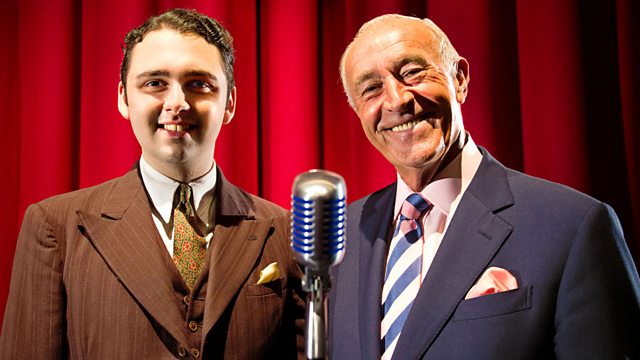
Could 2014 in fact be a renaissance year for early 20th century jazz, I wonder? Viewers in the U.K. have already been treated to the excellent B.B.C. Four programme Len Goodman's Dance Band Days, broadcast over Christmas (and already expertly covered by Mim over at Crinoline Robot; eagle-eyed readers will also have spotted Matt from Southern Retro in the above clip), and I note that off the back of it Mr Goodman will be appearing with Michael Law's Piccadilly Dance Orchestra at Littlecote House, Buckinghamshire, on the 25th July.
Clare Teal's Sunday night Radio 2 show has also evolved nicely even if she still doesn't play the early British dance bands that her predecessor Malcolm Laycock did and there are more and more DAB and Internet radio stations appearing that are devoted to early dance and big bands (such as Angel Radio and Radio Dismuke - again, if you know of any others do give them a mention).
All these events and broadcasts popping up gives me great hope for a jumping and jiving year ahead. Now I'm off to listen to more Benny Goodman. Let's Dance!
With the Twelfth Day of Christmas nearly upon us and the New Year now 4 days old this will be my last Christmas post as I take the opportunity to showcase some of my more vintage-y presents. I expect you want to see what I got, so here we go:
Christmases have been fairly lean for us the last few years and tend to be celebrated quietly but so long as the family is together at some point that's all that truly matters. My sisters have both come up trumps again this year, though, with a calendar from each of them - one scenic, one Steampunk! I shall have to alternate between them, I think(!).
Another sororal present, the silent 1928 film The Wrecker has featured on this blog before and now (finally) makes it into my DVD collection. I've watched it already and it's a cracking bit of 1920s fun & action. The villain can be spotted from a mile off, the plot is both quaint yet serious, there are many long smouldering looks to camera and just in case there was any doubt about the hero's bona fides he turns out to be an ex-Lancashire cricket captain and therefore beyond reproach. Plus, of course, plenty of trains (including that crash!) and buses too. The feature, as previously mentioned, has been lovingly restored and given a new accompaniment by noted silent film music writer/composer Neil Brand. He's even done the same for the abridged 14-minute home movie version (above) and there are plenty of other extras on the DVD to do with the film as well as other staged locomotive crashes and the old railway line on which parts of The Wrecker were filmed.
Am I A Chap? was given to my by nan and a jolly interesting and amusing little tome it is, just as I had hoped. A welcome addition to my bookshelf, where it will join other books from the same stable - The Chap Manifesto and The Best of The Chap.
I've occasionally considered submitting myself to the critical eye of The Chap magazine's editor Mr Gustav Temple in the Am I Chap? feature but always fear what would surely be his withering opprobrium at my effort. It's the tweed within rather than without that really counts as the Chaps also say and I am in agreement with that. Still, maybe one day...
There were also other gifts not featured in the lead photograph for certain reasons. Some are still en route from the supplier. Others have no physical form. I refer to the noted South American river and online retailer, who offer a splendid service whereby you can download music direct to your iPod. As much as I enjoy having a CD in my hand (and a couple of new acquisitions included both) there's definitely something to be said for the space-saving qualities of direct mp3 downloads. They also tend to be cheaper and in the case of music from the 1920s and '30s Amazon are to be commended for offering it in that format and thereby giving a new lease of life to these old songs.
I was thus able to obtain four new albums this way - Mr B The Gentleman Rhymer's latest, Can't Stop, Shan't Stop; Caro Emerald's new The Shocking Miss Emerald and two splendid compilations - Hits of 1930 and Vintage Charleston. There's nothing like starting the New Year with some new music and these tunes will certainly keep me entertained for a long while.
I'm sure you all received some perfectly wonderful gifts too and I look forward to hearing about them as well. In the meantime I'm off to do a bit of Charlestoning. Toodle-pip!
Christmas is nearly upon us, which means it must be time for another medley of festive classics from the Big Band period of the 1930s-1950s. I seriously thought 2012 would be the final time I'd be able to do one of these posts, seeing as Yuletide tunes from that time were thin on the ground anyway and I had all but exhausted both my knowledge and YouTube's. I've dug deep this year, though, and consequently am able to bring you another selection of seasonal songs from our favourite eras.
Little information seems to be available about Jimmy Ray & his Orchestra, which is a shame as these two Christmassy numbers - both recorded at the same session on the 19th November 1937 - are a couple of topping tunes. I Want You For Christmas also appeared in my festive post from 2011 when I featured the Dick Robertson version; it must have been a popular standard of the late Thirties as it was also recorded around the same time by Russ Morgan and Mae Questal - but I think I'll keep those in reserve for next year if you don't mind!
Recorded nearly a year later on the 11th November 1938 (Don't Wait 'Til) The Night Before Christmas is another rare Christmas-titled tune by Sammy Kaye and his orchestra (styled "Swing and Sway with Sammy Kaye"), the vocals taken by The Three Barons - a singing trio from Cleveland, Ohio (Howard Greene, Edward Parton and Joe McGhee) who also performed as The Three Riffs.
Christmas just isn't Christmas without a Crosby song or three but although Bing has rightly endured and remains popular to this day, his bandleader brother Bob is less well-known now. It's only fair, then, to include his orchestra's recording of Let It Snow, Let It Snow, Let It Snow from early in 1946 when the song was riding a crest following Vaughn Monroe's chart-topping version.
Although not expressly mentioned on this YouTube video, Bob Eberly was most closely associated in the 1930s, 1940s and early '50s with the Jimmy Dorsey Orchestra so it's a fair bet that's who's playing here. Bob Eberly was in fact a brother of Ray Eberle, the singer with Glenn Miller and his Orchestra (it was Bob who actually recommended the young Ray to Glenn when the latter was looking for a new lead vocalist in 1938). You can certainly hear the similarity!
I was somewhat surprised that Artie Shaw didn't get in to the Christmas music act until the early 1950s, but this version of Jingle Bells from August(!) 1950 is the only example I can find from that otherwise popular bandleader (although there may be others that I've yet to discover). Leaning more towards the really big band sound of the Fifties it nevertheless retains enough of Shaw's trademark sounds to make it worthy of inclusion here.
It only remains, then, for me to wish you all a very Merry Christmas. I hope you all have a ripping time and, for those of you in the UK, batten down the hatches and stay safe from that awful winter weather we're all due to get later today (and that goes for anyone else in the world experiencing the worst of the hiemal conditions). I may return briefly on Christmas Day itself but in the meantime I hope Father Christmas visits you all and leaves you lots of presents (I can't wait to see what we all get, myself)! Enjoy the music!
Apologies for another long period of radio silence (what is it this time, 3 weeks - but who's counting?). A little hiccough rendered me slightly indisposed again but now normal service can resume, although regrettably health will probably not permit my attending this weekend's Barrelhouse Stomp - still, there will be other events of that I have no doubt.
In the meantime here's a jolly little 1932 ditty by Roy Fox & his band featuring Al Bowlly and Nat Gonella, a favourite of mine which poses the musical question I'm often asked (and ask of myself). Cheerio for now!
And it goes without saying that so should you, if you're out making the most of this summer weather. Boaters, Panamas, pith helmets - but not baseball caps! - it doesn't matter so long as your bonce is covered.
Health advice dispensed, it's time for me to move on to the meat of this post. Summer has most definitely arrived here in Britain and is making up for lost time by posting several consecutive hottest days of the year. What better time then, in the lack of any other interesting news at the moment, to post a few of my favourite sunny, summery songs from the 1930s.
The song that lends itself to the title of this post, The Sun Has Got His Hat On is still well-known as a nursery rhyme but was originally written by Noel Gay and Ralph Butler in 1932 and recorded by two of the top British bandleaders of the time - Bert Ambrose and Henry Hall (the latter well-known for his child-friendly nursery-rhyme recordings). The lyrics have, unfortunately, in one place in particular not dated well as you will undoubtedly hear (I shouldn't have to tell you to remember, of course, the time in which this song was recorded and the different attitudes and sensibilities that existed then but I will mention it just in case...!) and in later versions the offending line was changed to "roasting peanuts".
The Henry Hall recording remains my favourite of the two but they're both still jolly good fun!
Another jolly solar-themed recording from 1932 (was that also a "hottest year", I wonder? Looks like it was a bit) is this cracking number by Jack Payne & His Band. Easily matching the pep of The Sun Has Got His Hat On this tune fairly trots along!
What summer soundtrack would be complete without the great, inimitable Noël Coward and his wonderful song Mad Dogs and Englishmen. Recorded here in November 1932 (again!) it was written the year before and first performed by Beatrice Lillie before Coward incorporated it into his cabaret act and made this version with the Ray Noble Orchestra.
Sadly I'm not much of an Englishman in this regard as I'm not overly fond of the heat and tend to avoid the blazing sun at its zenith (in all seriousness, for those of you in London and its environs the Department of Health has just officially declared this a Level 3 heatwave and advised people to stay out of the sun as much as possible between 11am - 3pm) and even now I'm finding it almost too hot to type!
Red Sails in the Sunset is another firm favourite and a popular song of 1935, since when it has been recorded by a multitude of artists including Guy Lombardo, Bing Crosby, Al Bowlly and Vera Lynn. Once again I find myself drawn to the Ambrose version, though, and the images it conjures of stylish, relaxing summer evenings on holiday at the likes of Burgh Island, Cannes, or Le Touquet.
On the other side of the Atlantic, Glenn Miller recorded several songs with "Sun" in the title including Sunrise Sunset, Sunrise Serenade (originally written by Frank Carle and first performed by Glen Gray and the Castle Loma Orchestra in 1939 it was successfully recorded by Miller the same year as a companion "B-side" to Moonlight Serenade) and Sun Valley Jump. Sunrise Sunset isn't on Youtube but the other two are and as I can't put a pin between them for preference here they both are:
Sunrise Serenade I always find particularly evocative, lending to my mind's eye images of "sunrise on the farm" in some little American homestead - the first rays just peeping over the barn, cockerels crowing and the farmer starting out for his fields on a tractor, that sort of thing.
I'll finish with a song that extols you to keep On The Sunny Side of the Street. First written and performed in 1930 (its Depression-era roots are even more apparent in earlier, slower versions like this one by Ted Lewis) it became a more up-tempo jazz standard by the end of the decade and is performed in this instance by Lionel Hampton & His Orchestra:
Regardless of whether you enjoy this level of heat or not (and with apologies to those of you who might not be enjoying such sunny conditions where you are) I hope you all continue to walk "on the sunny side of the street" - with your hats on, of course! - and have a great summer.
The starting of a new job seems to have coincided with a bit of a downturn in vintage news (not to mention my third cold in as many months!) - hence I have been absent from the blogging circuit for nearly two weeks, for which I must continue to crave forgiveness! I still haven't forgotten about you all though (I read all your posts of an evening, or at the weekend, as something very much to look forward to) nor this blog of mine.
Sitting on the train during the commute into work I often find myself thinking of potential subjects for this site and, while listening to my portable i-gramophone last week, it occurred to me that the very mode of transportation I was using - and the music I had playing - would make an excellent topic.
The railway train has always had an instantly recognisable rhythm and one that naturally lends itself to a musical beat. There have been countless songs over the years featuring trains and rail travel to some extent or another but it is the half-a-dozen or so favourites in my music collection that I intend to focus on here.
The first song, Choo-Choo, neatly sums up the steam train in typical Thirties onomatopoeic style and is wonderfully redolent of period rail travel. Written and recorded by American bandleader Frankie Trumbauer in 1930, it was almost immediately cut by a multitude of other bands on both sides of the Atlantic. While the original Trumbauer recording is excellent, my favourite from the U.S. is Paul Whiteman's version, above, made in the same year.
In the U.K. the two Jacks - Jack Payne and Jack Hylton - both recorded versions of Choo-Choo a year later in 1931 and again, while Jack Payne's version is wonderful, Hylton's arrangement just shades it for me.
Arguably a more famous "Choo-Choo" is Glenn Miller's brilliant 1941 record - Chattanooga Choo-Choo, a song that instantly conjures up images of transcontinental railway journeys in the 1940s and '50s.
A year or two earlier Glenn Miller had had similar success, reaching number 1 on the U.S. Billboard chart with another train-themed number - Tuxedo Junction. The song had actually been written in 1939 by American bandleader Erskine Hawkins and while his original version made it to number 7 in the charts it remains less well-known today than the classic Miller arrangement.
Another railway tune that has become inextricably linked to its [co-]composer - so much so that it is invariably called his "signature song" and found in every compilation of his music - is Duke Ellington's Take The 'A' Train. It is a reputation that it thoroughly deserves, being one of the defining examples of 1940s big band music never mind rail-based songs.
One of my very favourite "songs of the track", though, is this one - Honky-Tonk Train Blues. Although written and first recorded as long ago as 1927 by the noted early boogie-woogie pianist Meade Lux Lewis, this 1938 arrangement by Bob Crosby (Bing's brother) with Bob Zurke on the piano really rolls along splendidly.
For me all of these help rekindle some of the fun and romance that seems to have been lost from modern train travel, as I commute to and from work in a characterless and brightly-coloured plastic tube. Sometimes I can even imagine seeing something steaming past the station platform, or pulling the far more luxurious carriage I picture myself travelling in... porter! My case please!
It's an obscure source I have to thank for becoming aware of the singers who form the main subject of this post and I'm certainly glad to have done so.
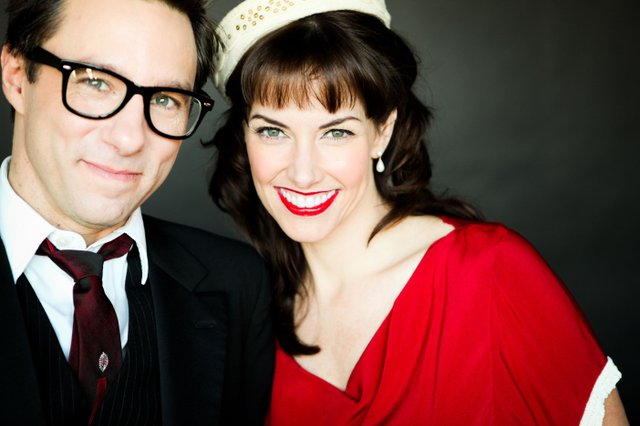
Hailing from the American Midwest, Kansas City musicians Jeff Freling and Erin McGrane - aka Victor & Penny - have formed a wonderful act performing songs from the 1910s, '20s and '30s in splendid style. They've really captured the feelings of the period, as is mentioned, with their choice of songs but also proved how immediate and popular they can still be. This is reflected in the term they have coined to describe their music - "antique pop"! (I suppose it's as good a description as any; I've often wondered about the idea of shifting musical categories - what is classical, jazz, pop etc. relative to the passage of time?).
Regardless of how you'd define it it's certainly got a great sound about it, with both performers really acquitting themselves well in all aspects - vocals, ukulele- and guitar-playing. Not to mention being an attractive couple, decked out in the proper clothing too! It sounds as if they are proving popular in the States too, with two albums of songs under their belts and a hefty national tour in the offing. Obviously professionals who enjoy what they're doing, it's jolly nice to know that such music is still appreciated so much today both by artists like Victor & Penny and the listening public alike. Good luck to Victor & Penny in 2013, say I, and perhaps we will see them come across the Pond one day in the future?
In other vintage music-related news Dutch singer Caro Emerald - who I first mentioned on this blog back in 2010 when her debut album (which has since gone five times platinum in her native Netherlands) made it on to B.B.C. Radio 2's playlist - has released her new single Tangled Up, which previews her upcoming second album The Shocking Miss Emerald due for release in May. I think we can safely say from this performance that she is on fine form and if the rest of the album is as good then she's got another best-seller on her hands. Have a listen and tell me what you think:
Thanks also to my listening to Radio 2 I've also had the good fortune to hear another young girl singer, this time from the UK, who is very much in the same vein as Miss Emerald - Hannah Garner, aka Miss 600. Jolly nice too, I think you'll agree!
As one final thing before I finish up this post, I feel bound to mark the passing of noted British musician Kenny Ball who passed away last week at the age of 82. Performing with his Jazzmen he was at the forefront of the "trad jazz" movement that proved surprisingly popular in the 1960s and '70s, in 1962 even scoring a Number 2 hit both in the U.S. and Britain with his band's recording of Midnight In Moscow. With his contemporaries Acker Bilk and Chris Barber, among others, he was instrumental (no pun intended!) in the jazz revival that began at the height of 1960s Beatlemania. A popular musical guest on The Morecambe & Wise Show throughout the 1970s he continued to work right up to a few weeks before his death, touring the country and performing both solo and with his trad jazz peers. He was also an Essex lad like myself, living in the same town that I did for about 10 years (and which is still only ten minutes from where I am now) and passing away at my local hospital.
Thank you, Kenny Ball, for helping to keep the music alive.
Two songs now - which I picked before I went away to help continue filling the expected gaps, unnecessarily as it turned out - and they're a couple of favourites, especially as the messages they contain have helped me get through some rough patches in the past.
Jack Hylton is one of my favourite British band leaders of the 1930s. He was also active in the 1920s - when he first started out in 1923 - through to the Second World War, after which he changed careers somewhat and moved into the production management and impresario side of entertainment where he worked with many London theatres, ITV and the likes of Morecambe & Wise, Shirley Bassey, Tony Hancock and Liberace.
It is his bandleader years that are of the greatest enjoyment for me, however. I would certainly rate him higher than the other Jack - Jack Payne, whose compositions were often more of the "novelty" variety - although there are some standards of his that are very good too.
Returning to Jack Hylton (whose first wife Ennis Parkes was a bandleader in her own right, recording as "Mrs Jack Hylton") these two songs I have selected are among the best of what is often considered Hylton's golden period of the late 1920s and early 1930s. If You Want The Rainbow was recorded on the 27th November 1928 with long-time Hylton vocalist Pat O'Malley singing the refrain and It's A Great Life was cut on the 21st October 1930 with the great Sam Browne taking the lead (I love how he stops himself from saying a then-rude word part of the way through!). Although they were made two years apart - and If You Want The Rainbow a year before the 1929 Crash and the start of the Great Depression - they were both obviously written at a time when hardships and difficulties were often encountered on a day-to-day basis. I have written before (and so have others) about just how impossible it is to imagine how tough life was at that time for a large section of society; music was obviously one of the few escapes people had and it's no wonder that the tunes were often so jolly and full of positiveness.
Although I continue to consider myself fortunate to live in the 21st century with all its advantages, there are times even today when we all need a little fillip - especially after what I went through recently - and for me these two songs still have that much needed verve to help push through the tough times.
*The entire Jack Hylton (and Mrs Jack Hylton) discography is available to listen to and download at www.jackhylton.com*
Hello everyone! Yes, this is the author writing - live, alive and if I do say so myself quite well! Huzzah!
I can't begin to tell you how pleased I am to be able to say that things seem to have gone smoothly this time - so well in fact that I was kicked out of the hospital after only one week, on the day my first scheduled post was published as it happens! I almost needn't have bothered; talk about sink or swim!
If I never see the inside of a hospital again it will be too soon and looking at the admittedly fascinating pictures accompanying one of my favourite Red Nichols/Charleston Chasers numbers above I'm as relieved as ever to be living at a time when I can be satisfactorily fixed up and continue to enjoy a good normal quality of life - something I know only too well would not have been the case 80-90 years ago.
The song title says it all (just a dull stitch-like ache among other things, really) and the upbeat tempo chimes perfectly with my hopes and happiness for a healthier future. It's still early days (two weeks yesterday) but it's looking positive. I'm certainly back in the Blogosphere, although there's still one or two scheduled posts that I'm going to let run while I find my feet again.
All that remains is for me to thank everyone for their kind thoughts, messages and comments (comments will revert to being moderated again now - I didn't get the flood of spam I expected but there were one or two and I like/find it easier to read what people have written before I hit the "Publish" button - so worry not if they don't appear right away) they really did help and mean a lot to me during my recovery. I'm pleased to see Eclectic Ephemera continued to enjoy frequent patronisation while I was away (I had a record 1,109 page views in one day - perhaps I should leave the thing on autopilot more often!) and rest assured normal service will be resumed very shortly.
Until then and with a full heart I bid you - tinkerty-tonk!
We're well in to December now, the tree's up and decorated and if the weather forecast is to be believed the snow is just around the corner - so what better time for another selection of Christmas tunes?!
I'd like to think this could become a festive blog tradition, but I'll hold off making it that yet in case I run out of songs next year! For now, though, here are some that I didn't cover in previous years.
We start with some blues - not perhaps a genre usually linked to Christmas, but in this case I think an exception can be made especially when the singer is the delightful Bessie Smith. There's something quite upbeat and celebratory about her rendition of At The Christmas Ball, recorded in New York on the 18th November 1925 with Fletcher Henderson at the piano, despite its obvious blues tempo.
Back in my first Christmas selection of 2010 I mentioned a 30th June(!) 1930 recording of the Savoy Christmas Medley, which I have on CD. I couldn't find the actual Ray Noble and the New Mayfair Orchestra version so used the original 1929 Debroy Sommers one instead but now someone has obliged and put up the Ray Noble/New Mayfair version, so here it is!
Jumping forward almost four years - 17th April 1934 to be precise (what is it with so many festive songs being recorded in the middle of Spring/Summer?) - we get to spend Christmas Night in Harlem with Jack Teagarden, Johnny Mercer and Paul Whiteman's' Orchestra.
The inimitable Artie Shaw doesn't disappoint with this cracking wintry arrangement from 1936.
While searching for these music videos I stumbled across a bandleader new to me - Eddy Duchin. Quite popular in the 1930s and '40s, I've a feeling we would have heard more of him if his life hadn't been tragically cut short in 1951. As it is he and his band recorded two seasonal tunes (which unfortunately I can't date, although When Winter Comes might be from as late as 1947).
Woody Herman and his Orchestra produced two cracking versions of classic Yuletide songs - Santa Claus Is Coming To Town from 1942 and Let It Snow another 3 years later.
That's it for this year - I have to keep some in reserve for 2013, pre-1950s Christmas music is rare enough as it is! Once again I couldn't have found half of these without the aid of YouTube and it's been a pleasant surprise to stumble across some more Christmas ditties that are new to me (and, I hope, to you). Here's wishing you all a jazzy Christmas!
I'd actually been following this project for a while now, then like an eejit I forgot that the CD was released this week!
What am I going on about? Well for some time now the music press has featured the occasional news item about a forthcoming album from British pop singer Bryan Ferry, he of Roxy Music fame. Nothing so unusual in that, you might think, as Bryan Ferry has been releasing albums every few years since the 1970s both as a solo artist and with Roxy Music. In recent years, though, he has shown a growing interest in the music of the 1920s and '30s, beginning with As Time Goes By in 1999 which had him singing 1930s standards by the likes of Cole Porter.
Now his latest venture has him re-recording some of his and Roxy's earlier songs in - a 1920s jazz style! Incredibly successful it looks (and sounds) to have been too! There are no vocals on the recordings, I'm given to understand, so we don't actually hear Mr Ferry stretching the old larynx, but he has done a tremendous job in surrounding himself with some supremely talented musicians well-versed in the genre and who have helped him in rearranging his pop songs to get an authentic 1920s sound. The result is an album featuring 13 Bryan Ferry/Roxy Music tracks as you've never heard them before and, if you weren't familiar with the originals, could be forgiven for mistaking as actual 1920s songs.
It is definitely a welcome addition to a increasingly popular style of music, that of modern songs performed in the Twenties and Thirties fashion.
I've only heard two of the tunes in their entirety - The Only Face and Don't Stop The Dance-and only snippets of the rest but even from that I am really very impressed. I've never been what you might call a dyed-in-the-wool Roxy Music fan - I recognise their more well-known recordings and sing along and tap my feet whenever one comes on the radio, but that's about it. The Jazz Age has certainly caught my attention, however - enough to earn it a place on my Christmas list! - and I heartily recommend it if you happen to be (or know someone who is) a fan of Twenties jazz and/or Bryan Ferry & Roxy Music.
*The Jazz Age was released in the UK on Monday 26th November*
Well the clocks have gone back one hour to good old Greenwich Mean Time and thoughts have turned to the fast approaching night of 31st October - All Hallow's Eve! Inspired by a recent post by Mim over at Crinoline Robot, I thought I'd do for Hallowe'en what I did for my last two bloggy Christmases so I've cobbled together a selection of spooky songs from the 1930s and '40s by some of my favourite artists of the day.
Mysterious Mose was an early Betty Boop cartoon from the Fleischer Studios (who would later have further successes with their famous Popeye and Superman cartoons). It in turn was inspired by this song, written by Walter Doyle and also released in [April] 1930, originally by Rube Bloom and His Bayou Boys but swiftly recorded by a number of bands including Harry Reser, Cliff Perrine and and Ted Weems (with their respective Orchestras).
The great Cab Calloway features here twice - first in the seldom-heard 17th June 1931 recording of The Nightmare and then the later (28th February 1939) recording of The Ghost of Smokey Joe.
Me And The Ghost Upstairs often appears on Fred Astaire CD anthologies but was actually cut from the film in which it featured, 1940's Second Chorus. Luckily the raw footage still exists, albeit in pre-production quality and not subject to the final Astaire polish (not that you'd notice!) so we can see Fred jitterbuggin' and lindy-hopping with a ghost (actually his long-time friend and choreography partner Hermes Pan shrouded in sheets and wearing high heels!).
One from our English bandleader Henry Hall, who was well-known for doing child-friendly songs such as The Sun Has Got His Hat On and The Teddy-Bears' Picnic and who here performs a splendid rendition of Hush, Hush, Hush, Here Comes The Boogeyman, with singer Val Rosing, from 1932.
Tommy Dorsey and His Orchestra are on fine form in this sweet version of a Larry Clinton composition from 1937, Satan Takes a Holiday.
We finish with the wonderfully-titled Celery Stalks At Midnight, originally recorded in 1940 by Will Bradley and His Orchestra but in this version from a year later (6th February 1941) masterfully sung by Doris Day, with Les Brown and The Band of Renown.
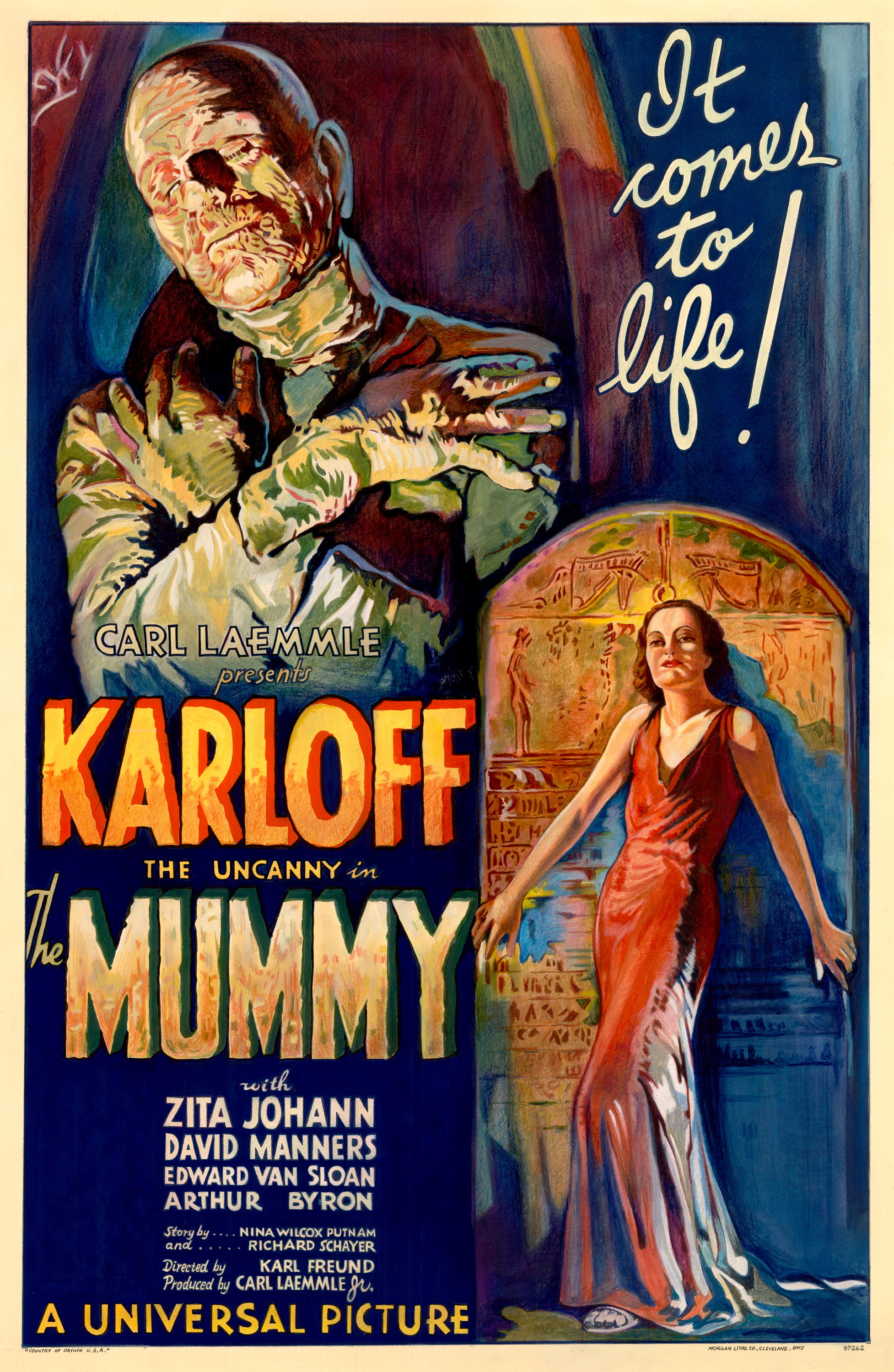
As well as playing these cracking and creepy tunes I have also lined up a Boris Karloff-fest for Wednesday night with a programme featuring Frankenstein, The Bride of Frankenstein and The Mummy (plus Ghostbusters, of course - if I can fit it in!). Have a spooktacular time, everyone!





.jpg)