Showing posts with label big band. Show all posts

Monday, 20 January 2014

Benny Goodman 1938 concert revived


Benny Goodman 1938 concert revived

I stumbled across this item at the weekend and it instantly put me in a Big Band mood, as well as delighting me with the news that one of the seminal live concerts of the 1930s (and in the history of jazz in general) is going to be reproduced at Cadogan Hall in London this year.  I was less pleased to note that it's being put on in less than a week's time - the 26th January (although to be fair that does mark as near as dammit the 76th anniversary of the original performance).  Thanks for that advanced bit of reporting, Daily Telegraph(!).

However, this looks to be not the only Big Band concert playing at Cadogan Hall in 2014; thanks to this article I've discovered there's also a 100 Years of Big Band Jazz concert on 15 June as well as another Carnegie Hall revival on the 14th November, this time celebrating the 1939 performances of Benny Goodman's and Glenn Miller's Orchestras (plus selections from Louis Armstrong's and Count Basie's appearances).

Well done to Pete Long and his colleagues for helping to keep these wonderful bands' songs alive.  It's splendid to see this music of the 1930s & '40s still performed for audiences of today with such enthusiasm - and this is only at one venue!  Who knows what other events are on elsewhere in the country?  (Seriously, do tell if you know of any!).
source - BBC Four

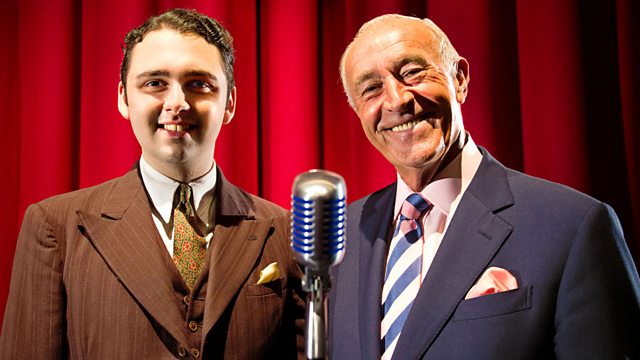
Could 2014 in fact be a renaissance year for early 20th century jazz, I wonder?  Viewers in the U.K. have already been treated to the excellent B.B.C. Four programme Len Goodman's Dance Band Days, broadcast over Christmas (and already expertly covered by Mim over at Crinoline Robot; eagle-eyed readers will also have spotted Matt from Southern Retro in the above clip), and I note that off the back of it Mr Goodman will be appearing with Michael Law's Piccadilly Dance Orchestra at Littlecote House, Buckinghamshire, on the 25th July. 

Clare Teal's Sunday night Radio 2 show has also evolved nicely even if she still doesn't play the early British dance bands that her predecessor Malcolm Laycock did and there are more and more DAB and Internet radio stations appearing that are devoted to early dance and big bands (such as Angel Radio and Radio Dismuke - again, if you know of any others do give them a mention).

All these events and broadcasts popping up gives me great hope for a jumping and jiving year ahead.  Now I'm off to listen to more Benny Goodman.  Let's Dance!


Monday, 23 December 2013

Christmas Eve, Eve and Song

Christmas is nearly upon us, which means it must be time for another medley of festive classics from the Big Band period of the 1930s-1950s.  I seriously thought 2012 would be the final time I'd be able to do one of these posts, seeing as Yuletide tunes from that time were thin on the ground anyway and I had all but exhausted both my knowledge and YouTube's.  I've dug deep this year, though, and consequently am able to bring you another selection of seasonal songs from our favourite eras. 


Little information seems to be available about Jimmy Ray & his Orchestra, which is a shame as these two Christmassy numbers - both recorded at the same session on the 19th November 1937 - are a couple of topping tunes.  I Want You For Christmas also appeared in my festive post from 2011 when I featured the Dick Robertson version; it must have been a popular standard of the late Thirties as it was also recorded around the same time by Russ Morgan and Mae Questal - but I think I'll keep those in reserve for next year if you don't mind!


Recorded nearly a year later on the 11th November 1938 (Don't Wait 'Til) The Night Before Christmas is another rare Christmas-titled tune by Sammy Kaye and his orchestra (styled "Swing and Sway with Sammy Kaye"), the vocals taken by The Three Barons - a singing trio from Cleveland, Ohio (Howard Greene, Edward Parton and Joe McGhee) who also performed as The Three Riffs.


Christmas just isn't Christmas without a Crosby song or three but although Bing has rightly endured and remains popular to this day, his bandleader brother Bob is less well-known now.  It's only fair, then, to include his orchestra's recording of Let It Snow, Let It Snow, Let It Snow from early in 1946 when the song was riding a crest following Vaughn Monroe's chart-topping version.


Although not expressly mentioned on this YouTube video, Bob Eberly was most closely associated in the 1930s, 1940s and early '50s with the Jimmy Dorsey Orchestra so it's a fair bet that's who's playing here.  Bob Eberly was in fact a brother of Ray Eberle, the singer with Glenn Miller and his Orchestra (it was Bob who actually recommended the young Ray to Glenn when the latter was looking for a new lead vocalist in 1938).  You can certainly hear the similarity!


I was somewhat surprised that Artie Shaw didn't get in to the Christmas music act until the early 1950s, but this version of Jingle Bells from August(!) 1950 is the only example I can find from that otherwise popular bandleader (although there may be others that I've yet to discover).  Leaning more towards the really big band sound of the Fifties it nevertheless retains enough of Shaw's trademark sounds to make it worthy of inclusion here.

It only remains, then, for me to wish you all a very Merry Christmas.  I hope you all have a ripping time and, for those of you in the UK, batten down the hatches and stay safe from that awful winter weather we're all due to get later today (and that goes for anyone else in the world experiencing the worst of the hiemal conditions).  I may return briefly on Christmas Day itself but in the meantime I hope Father Christmas visits you all and leaves you lots of presents (I can't wait to see what we all get, myself)!  Enjoy the music!

Saturday, 13 April 2013

All aboard the song train

The starting of a new job seems to have coincided with a bit of a downturn in vintage news (not to mention my third cold in as many months!) - hence I have been absent from the blogging circuit for nearly two weeks, for which I must continue to crave forgiveness!  I still haven't forgotten about you all though (I read all your posts of an evening, or at the weekend, as something very much to look forward to) nor this blog of mine.

Sitting on the train during the commute into work I often find myself thinking of potential subjects for this site and, while listening to my portable i-gramophone last week, it occurred to me that the very mode of transportation I was using - and the music I had playing - would make an excellent topic.


The railway train has always had an instantly recognisable rhythm and one that naturally lends itself to a musical beat.  There have been countless songs over the years featuring trains and rail travel to some extent or another but it is the half-a-dozen or so favourites in my music collection that I intend to focus on here.

The first song, Choo-Choo, neatly sums up the steam train in typical Thirties onomatopoeic style and is wonderfully redolent of period rail travel.  Written and recorded by American bandleader Frankie Trumbauer in 1930, it was almost immediately cut by a multitude of other bands on both sides of the Atlantic.  While the original Trumbauer recording is excellent, my favourite from the U.S. is Paul Whiteman's version, above, made in the same year.


In the U.K. the two Jacks - Jack Payne and Jack Hylton - both recorded versions of Choo-Choo a year later in 1931 and again, while Jack Payne's version is wonderful, Hylton's arrangement just shades it for me.


Arguably a more famous "Choo-Choo" is Glenn Miller's brilliant 1941 record - Chattanooga Choo-Choo, a song that instantly conjures up images of transcontinental railway journeys in the 1940s and '50s.


A year or two earlier Glenn Miller had had similar success, reaching number 1 on the U.S. Billboard chart with another train-themed number - Tuxedo Junction.  The song had actually been written in 1939 by American bandleader Erskine Hawkins and while his original version made it to number 7 in the charts it remains less well-known today than the classic Miller arrangement.


Another railway tune that has become inextricably linked to its [co-]composer - so much so that it is invariably called his "signature song" and found in every compilation of his music - is Duke Ellington's Take The 'A' Train.  It is a reputation that it thoroughly deserves, being one of the defining examples of 1940s big band music never mind rail-based songs.


One of my very favourite "songs of the track", though, is this one - Honky-Tonk Train Blues.  Although written and first recorded as long ago as 1927 by the noted early boogie-woogie pianist Meade Lux Lewis, this 1938 arrangement by Bob Crosby (Bing's brother) with Bob Zurke on the piano really rolls along splendidly.

For me all of these help rekindle some of the fun and romance that seems to have been lost from modern train travel, as I commute to and from work in a characterless and brightly-coloured plastic tube.  Sometimes I can even imagine seeing something steaming past the station platform, or pulling the far more luxurious carriage I picture myself travelling in... porter! My case please!

Friday, 13 July 2012

Musical Interlude: Glenn Miller & His Orchestra - A String Of Pearls (1942)


Partly because I haven't done one of these in a while and partly because I don't want another seven days to slip by between posts, I thought it about time for another one of my desert island discs.

Frankly I had a bit of a job just selecting one Glenn Miller song (I very nearly went with my original plan for this post - Fletcher Henderson or 'Red' Nichols numbers - but as you'll see I've in fact selected four, plus my main choice, Miller tunes for this post so I'll save them for another time) as he and his band had so many hits between 1938 and Glenn's untimely death in 1944.  I could easily have picked one of his most famous arrangements - In The Mood or Moonlight Serenade for example - but as much as I like them all I've settled upon the 1942 classic A String Of Pearls.  To me it is one of the most complete examples of the Miller "sound" and an almost seamless composition.  In fact I rather like his more obscure recordings (like Sun Valley JumpSlow Freight, Sunrise Serenade or Boulder Buff, for instance, which I'm generously going to throw in to this post for you).


While it could be said that Glenn MIller's music has become so synonymous with the Second World War that it borders on cliché (what documentary doesn't feature a snippet of one of his songs to get the viewer into a wartime mood?!) I think it is a testament to the uniqueness and quality of his musicianship that it can still be fresh in the minds of people today (and not forgetting that actually Miller had nearly 4 years of [American] peacetime success before he formed The Army Air Force Band).


The sound of Glenn Miller & His Orchestra was, in fact,one of the first aspects of vintage that this blogger was exposed to, over 15 years ago (God that makes me feel old!).  The exact first when and where is lost to the mists of time - perhaps it was one of those war documentaries, perhaps it was helping out my nan at the local WRVS luncheon club where it was played constantly; I forget (I do vaguely remember picking up an original LP of the The Glenn Miller Story in a charity shop, since when my collection of Miller records has grown inordinately).  But along with Laurel & Hardy it set me on a path and that has led to this point and which continues to stretch into tantalisingly into the distance.  For that reason alone this music will always have a special place in my heart.

Sunday, 11 December 2011

Swingin' round the Christmas tree

Inspired by Mim over at Crinoline Robot and Lily at Lil Vintage Me posting up their favourite Christmas songs, and finally feeling a bit festive having put the tree up, I thought now would be the time to add a few more of my own Yuletide tunes.  Last year I did a post around one of my vintage Christmas CDs A Vintage Christmas Cracker: 47 Original Mono Recordings 1915-1949, now sadly out of print (keeps your eyes peeled, charity shoppers!) so this year I intend to include a few that I stumbled across on Youtube that aren't on any of my compilations and may not even be on any CD at all!

The reason why there is not a lot of "modern" Christmas music to be found much before the 1930s is simply because it hadn't been written or recorded yet! (The exception being Jingle Bells which, being written in 1857, was recorded as early as 1898).

Everything changed in 1934, however, when both Santa Claus Is Comin' To Town and Winter Wonderland were written, the former by John Frederick Coots and Haven Gillespie (both of whom also penned You Go To My Head, and Gillespie Breezin' Along With The Breeze) and the latter by Felix Bernard and Richard B. Smith.

Through October and November of 1934 these songs were all cut by several different bands.  Harry Reser and His Orchestra were the first to record Santa Claus Is Comin' To Town on the 24th October 1934 and it featured in my Christmas music post last year; they beat George Hall and the Hotel Taft Orchestra by just under three weeks.  That version was recorded on the 13th November 1934 and sounds like this:


A year later in 1935 it was recorded by Tommy Dorsey and His Orchestra:


In the same year Benny Goodman and His Orchestra also recorded the classic Jingle Bells and for my money it is one of the best arrangements I've ever heard:


As well as that much-loved Christmas standard Goodman also recorded in 1935 a Johnny Mercer composition, Santa Claus Came In The Spring:


Winter Wonderland meanwhile really took off and was promptly recorded by no less than three bands, representing the three big record labels of the time.  RCA was the first with Richard Himber and His Hotel Ritz-Carlton Orchestra on the 23rd October 1934.  It was a happy accident - the vocalist Joey Nash stumbled across the handwritten manuscript and a homemade recording given to him by the brother of Richard B. Smith and convinced Himber to include it in the 23/10/34 recording session.  Unfortunately technical problems meant they ran out of time before Winter Wonderland could be recorded and Himber left the studio.  Nash was so enamoured with the song, however, that he convinced the rest of the band to stay behind and finish the recording.  They agreed on the one condition that if any mistake were made there would be no second chances.  Therefore what you hear now was made in one take, without the bandleader(!):


Ted Weems and His Orchestra recorded Winter Wonderland for Columbia on the 11th November 1934, but it was Guy Lombardo and His Orchestra on the Decca label who had the biggest hit, making the top 10 at the time.  Typically, the most successful version is the one that's not on Youtube, but here is the Ted Weems version:


Moving on a couple of years to 1937, Dick Robertson and His Orchestra recorded another rare seasonal composition on the 19th October - I Want You For Christmas:


Jumping forward a few years again to 1941 we return to Benny Goodman and His Orchestra who on the 27th November 1941 recorded this wintry number with Peggy Lee and Art Lund singing the vocals:


Finally, we find ourselves in 1947 with Frank Carle and His Orchestra who recorded this seldom-heard number, with Marjorie Hughes taking the vocals:


So there we are - enough songs there to make a CD I reckon, but alas few if any are available in that format.  Still, it's nice to think that people were swinging along to Christmas tunes like this in the Thirties and Forties and that they can be found today with a bit of searching.  Maybe there's hope for a CD yet.  In the meantime thank goodness for Youtube is all I can say.  I hope these classic tunes put you in the vintage Christmas mood, as they have me.

Tuesday, 5 October 2010

A gem of a singer

I tend to listen to my iPod more than the radio these days as, even with all this DAB nonsense, there aren't many stations that play the kind of music I like (swing, dance and big bands - early jazz, in case you haven't guessed!). I do listen to Classic FM when the mood takes me but often I find myself listening to the Ken Bruce show on BBC Radio 2 (about the only decent thing left on that network these days).


This week I'm particularly glad I tuned in, as it's introduced me to this delightful singer, whose début album Deleted Scenes From The Cutting Room Floor is being featured this week. Her name is Caro Emerald and she hails from The Netherlands, where the album has been at number one in the charts practically since its release in January(!).

Her style (not to mention her looks) is really appealing, with a great '40s/'50s big band sound to it but with a modern twist. It rather reminds me of the Swing Revival that was popular in the mid- to late-90s, but I hope Miss Emerald will be more successful than that (I'm sure, with her unmitigated achievement in her home country, that she will be). From what I've seen and heard so far, Caro Emerald deserves a mention on this blog and I believe she will have a great following here as well as in mainland Europe. I for one highly recommend her and on the strength of her performance her album has just made it on to my Christmas list! Have a listen and let me know what you think.


** Deleted Scenes From The Cutting Room Floor will be released in the UK on the 18th of October and is the Album of the Week on the Ken Bruce Show this week. **

Followers

Popular Posts