Showing posts with label centenary. Show all posts

Wednesday, 12 March 2014

British teen's 1914 diary from Paris brought to life on Twitter

source

British teen's 1914 diary from Paris brought to life on Twitter

Hello All!  Well, another busy start to the month has seen ten days fly by but now here I am again with a new post.  I say "new" but the subject was first reported on as far back as January-February.

The 100-year old diary of Olive Higgins, a teenage girl from Kent studying in Paris, has recently come to light after over ten years in the possession of a London journalist & writer, who spent that time researching the girl's tragically short life following the discovery that they both happened to come from the same area. 

Margate girl Olive Higgins' diary put online at 100th anniversary of death

To celebrate the centenary of Olive's writings the journalist, Rob McGibbon, came up with the splendid idea of publishing the daily entries on Twitter (@OlivesDiary1914) - as well as creating a website with every day reproduced in full as well as further information about Olive Higgins, her family and how Mr McGibbon came to be interested.

The diary and the project it inspired have a poignant ending, however.  Barely two months in to her Paris adventure Olive Higgins was struck down by double influenza and sadly died on the 25th February.  Consequently her diary entries stop halfway through that month, as she struggled to recover.

Nevertheless her record of those first few weeks in Paris make for fascinating reading - a real insight into the thoughts of a 16-year-old student one hundred years ago, yet revealing teenage feelings and insecurities still familiar a century on.  Mr McGibbon's project has certainly been a worthwhile one not only from his personal point of view but also as a valuable piece of social history and a fitting & timely tribute to Olive Higgins' life.

Saturday, 11 January 2014

My Great War reads for the 100th anniversary

When I wrote a couple of weeks ago about my latest book find just before Christmas, I mentioned that it was about something very pertinent to this year's centenary of the First World War (news and events relating to which have already begun to appear, so expect this blog to become heavy with them in the coming months!) - namely the collected early war letters of RNAS pilot Lieutenant Harold Rosher.  I added that it would become a welcome addition to my war library and stated my intention to read all the books in my collection that relate to World War One by the end of 2014.


Well, the other day, with the germ of an idea for a post in my mind, I got out all said books (including In The Royal Naval Air Service, 3rd row far right) and laid them out to take a picture of them for this blog.  I think I may have to revise my target!  The end of 2018 seems more realistic now I've reacquainted myself with the number books I have on the subject!

As you can see most of them focus on the aeronautical aspect of the Great War; no surprise really as that has always been my abiding area of interest.  In fact all but three are purely about aerial warfare.  True World War I Stories (2nd row from top, 3rd from left) is just that and was picked up from a library sale a few years ago for 50p.  Before Endeavours Fade by Rose E. B. Coombs (top, 3rd from left) was given to me by my stepfather several years back and is actually something of a guide book to the battlefields, detailing towns, landmarks and other locations that saw action as well as the innumerable memorials throughout Belgium and France.  Although now nearly 40 years old this book will doubtless be interesting and a still-useful guide if I should choose to visit the areas covered.

Once I realised just how many books I had, I got that nagging feeling that there were probably one or two more lying around somewhere that I'd forgotten about and such proved to be the case! 

Goodbye to All That is an autobiographical account of the the First World War (and the author's early pre-war life) by Robert Graves, the poet, scholar and author who served in the Royal Welsh Fusiliers and was good friends with Siegfried Sassoon.  I picked up this copy for a few pence in Homebase (yes, the DIY people - my local store has a small second-hand book concession by the tills!) a year or so ago and it has been sitting patiently in my "to read" pile.

The rest all focus on the RFC and/or the Deutsche Luftstreitkräfte (except In the Company of Eagles, a novel by Ernest K. Gann about a duel between French and German pilots) with no less than four devoted solely to Manfred von Richthofen.  These include his own [translated] memoirs and a fascinating in-depth record of his 80 career victories.

German War Birds is a splendid book from the 1930s, written by the mysteriously pseudonymous "Vigilant" (generally agreed to be one Claud W. Sykes and probably a serving RAF officer hence the name), details of some of the lesser-known German pilots of the Great War and is written in wonderfully charming Thirties style.  I picked it up in 2003 from the wonderful book stalls that can still be found underneath Waterloo Bridge.

Many of the other books are written by well-regarded aviation/military historians such as Peter Hart, Alan Clark and Norman Franks.  Then there are the famous wartime memoirs of Cecil Lewis (Sagittarius Rising) and Victor Yeates (Winged Victory), not to mention James McCudden's Flying Fury.  Finally there is, of course, Biggles - who nearly 20 years ago introduced me to the fascinating world of dogfights, biplanes and heroic flying that I would later go on to read so much more about.  The First World War stories fully deserve their place here, being inspired by true events and stories that the author W. E. Johns (himself a bomber pilot in the war) saw or heard.

Finally, as a bit of light relief, Practical Flying is a good read - it being a facsimile of the standard training manual given to pilots joining the RFC.  I doubt there'll ever be any call for me to fly a Sopwith Camel, but you never know!  I actually got it (and a real hip flask!) with the old PC simulator, Flying Corps, way back in the late '90s and am pleased to report that the old game still runs so I can at least take my bus up for a spin virtually if not in reality(!).  Incidentally I'm amazed to see how far computers and graphics have progressed - the modern equivalent of Flying Corps, Rise Of Flight, looks incredibly realistic and expansive.

Just as soon as I've finished reading my current tome, Waiting For Hitler, which is an equally enthralling series of accounts from the first year of the Second World War when the invasion of Britain looked likely, I shall begin working my way through these Great War books.  Don't be surprised if you don't hear from me for a while!  But no, in all seriousness, I really looking forward to doing this; in the centenary year of the start of the Great War it just seems the "right" way to go about commemorating the occasion.  I may even post a review or two up along the way.  Then there's my film collection too, I haven't even touched on that yet.  If that's not enough the Daily Telegraph is also marking the anniversary by making available online copies of every one of its newspapers from 1914 to 1918, each day for the next four years!

What have you got planned for the 100th anniversary and are there any more(!) books you would recommend I seek out?
Wednesday, 18 December 2013

A century of shirts - one hundred years of Hawes & Curtis


A gentleman's shirt is arguably a design classic - the bedrock of a chap's outfit, from which the tie hangs (or under which the cravat goes) and over which the jacket sits.  Over the decades collars may have lengthened, widened, shortened or changed styles in numerous other ways and colours come and gone but the crisp cotton shirt has by and large always remained a timeless garment.  No chap's wardrobe is complete without a good selection of shirts and mine is no exception, with a mixed line-up ranging from high street to Jermyn Street (sometimes via the high street...!).

Ah, Jermyn Street - the centre, the Savile Row of British shirtmaking.  The list of businesses occupying this famous street is a long and illustrious one, a chap's dream shopping destination.  One name in particular, however, has celebrated a noteworthy anniversary this year.

Hawes & Curtis, who currently occupy numbers 33-34 and 82 of Jermyn Street (as well as several more locations in London and around the country), have recently marked 100 years in business - their first shop having opened in 1913.

Established in that year by two experienced cutters, Ralph Hawes and Freddie Curtis, the original store was situated just around the corner from Jermyn Street in the equally-renowned Burlington Arcade.  This combination of proven skills and a favourable location proved immediately successful and the House of Hawes & Curtis' reputation was cemented practically from the off.  It received an even greater boost nine years later, in 1922, when no less a person than the Prince of Wales - later Edward VIII / the Duke of Windsor, without doubt one of the best-dressed chaps of the era and a gentleman's style icon to this day - visited the shop and left with a selection of suits, blazers, flannels, handkerchiefs and of course shirts.  So impressed was he that he became one of the company's most famous patrons and recommended them to many of his friends and relations including the future King George VI and Earl Mountbatten.  Hawes and Curtis in turn created the now-familiar spread collar, designed specifically to accommodate his ties and the knot he inspired - the Windsor.  Later, the Duke of Windsor awarded them a Royal Warrant and his coat of arms was added to the shop.

source
Other famous customers of the time read like a Who's Who of this blogger's favourite style icons.  Fred Astaire, well-known for buying his clothes from London's tailors, became a regular visitor after seeing H&C's new design of backless waistcoat (designed to be worn under a tailcoat) although the story goes that the garment was so popular he had to wait in line with everyone else!  No-one ever looked better in a pin-collar shirt, either.

 Cary Grant was another Golden Era Hollywood actor who bought his clothes from Hawes & Curtis, beginning at the rise of his career in the late 1930s, and who runs Astaire close in the shirt stakes.

Robert Donat's splendid hounds-tooth suit, which he wore in 1935's The 39 Steps, also came from H&C (as did the short-trousers replica that Hitch presented to Donat after he complained once too often about the real one being ruined through all that running about over the Scottish moors!).

source

To celebrate this milestone Hawes and Curtis have not one but two Collections in their formal shirt range that take inspiration from their rich heritage - the 100 Years Collection and the 1913 Collection.  Both feature various nods towards a century of shirt design with a good mix of traditional and modern styles and colours.  Hawes and Curtis were kind enough to provide me with an example to review as part of this post so, taking inspiration from the chaps above, I selected their Plain White Twill Slim Fit Limited Edition Tie Bar shirt from the 100 Years Collection.

Plain White Twill Slim Fit Limited Edition Tie Bar,
from Hawes & Curtis' 100 Years Collection, £39.50
(or 2 shirts for £60)
This is my second H&C shirt (the other a 2 ply 100's cotton from their Warwick tailored fit range - a beneficiary boutique find from a couple of years ago) and my first experience of the slim fit style (in the past I've tended to stick with the standard classic fit).  But the side darts are well put together and the cotton twill is up there with the best I've experienced.  The fit is - as promised - trim without being too pinched at the waist; slightly more defined but no less comfortable or easy to work with than the classic fit.  "1913-2013" labels integrated into the side hem gussets are a nice addition too.  H&C's "silk touch finish" is no gimmick either - it adds a pleasant sheen to the fabric and gives it a soft, light quality (theirs have a "put it on and forget" feeling I've not encountered elsewhere) similar to that found even on their two-fold cloths, although perhaps not quite so pronounced.  Certainly it is one of the easiest shirts to iron that I've ever owned!

The pin collar is well-defined and looks like it should be easy to maintain.  The bar is designed, as you probably know, to sit under the tie knot and so push it outwards thereby giving an extra dimension to your necktie.  It also, I think you'll agree, has a classically dapper 1920s/1930s look to it too!  I can see this working well with many an outfit (although be warned, chaps, it still better suits a thinner tie or smaller knot).  H&C are also to be commended for being rare among shirtmakers of my experience in also offering it in a colour/fabric other than white twill, namely a light blue herringbone.  The mother-of-pearl buttons are a nice touch (they really do look better than plain old plastic ones), sitting well with the fabric, and the entire garment is thoroughly in keeping with one's expectations of a Jermyn Street shirtmaker with so many years' experience.

Nowadays selling mainly shirts, but also other items of menswear including coats and jumpers, H&C's focus on this essential men's garment coupled with their 100 years in the trade certainly seems to have kept them in the upper echelon of shirtmakers (yet with comparatively reasonable prices).  Ladies need not feel left out either, for like many modern shirtmakers H&C also sell women's shirts (with their own 100 Years Collection, I might add!) and accessories.

Based on my experiences I see no reason why Hawes and Curtis shan't celebrate many more anniversaries and I doubt that this will be the last of their shirts to make it into my wardrobe.  On the whole, this is a company that should be on every chap's (and chapette's) radar, and here's to their next one hundred years!

*This was a sponsored post in collaboration with Hawes and Curtis*

Monday, 16 December 2013

'Unsung' London war bus brought back to life


'Unsung' London war bus brought back to life

With the centenary of the beginning of World War One now only a matter of months away, there will doubtless be many fascinating and worthy projects on the go in addition to those already announced by the Government.  Here's one now, in fact, involving the restoration of a 1914 London omnibus.

source
A very special and, today, rare model the London General Omnibus Company (LGOC) B-type was in many ways the Routemaster of its day.  Arguably the first mass-produced 'bus it was an advanced machine for its time, able to travel faster even than the speed limit of the time (12mph - the B-type could top 16mph, although apparently 30-35mph was not unheard of!) thanks to its light weight and modern running gear.  Able to seat up to 34 people, including 18 on the top deck's weatherproof canvas-covered seats, over 3,000 B-types were produced; that and the model's reliability allowed for an expansion of routes and the introduction of the night bus with the B-type getting electric lighting inside and out from 1912/13.

source
A B-type converted into a pigeon loft for use in
Northern France and Belgium during the Great War, c.1916.
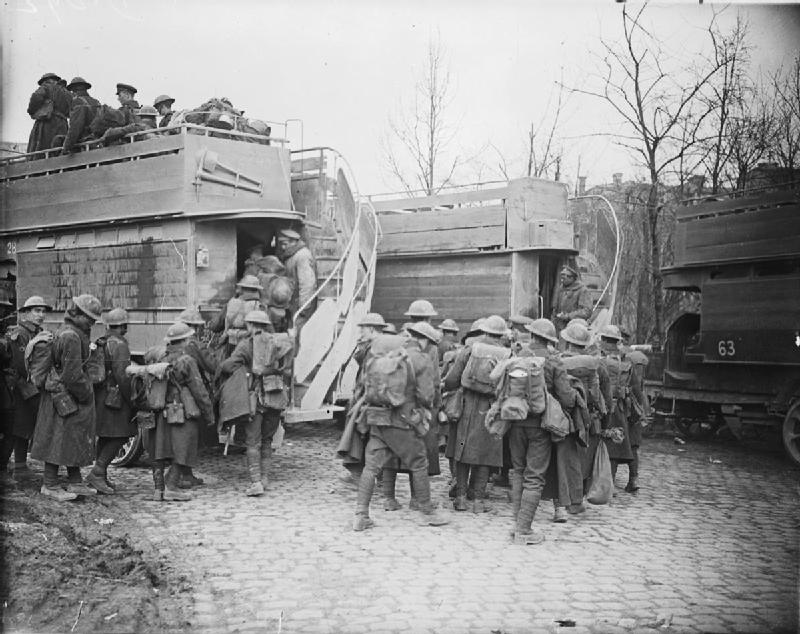
Almost as soon as war broke out in August 1914 up to one-third of the entire B-type fleet was requisitioned for military purposes and shipped over to France (and from there also to other far-flung theatres like Palestine and Greece) - quite a logistical feat if you think about it!  Over the ensuing four years they were pushed far beyond the design's limits - trading smooth London streets for rutted & waterlogged mud tracks, coming under enemy fire, being converted into anti-aircraft gun platforms or carrier pigeon lofts, not to mention providing transport for two-dozen fully-equipped soldiers (the hastily-erected window boards were in fact installed to stop the glass getting broken by the soldiers' guns and packs)!

source
Troops in Arras go back for a rest having
taken part in the Battle of Arras, May 1917.

Now only four B-types are known to exist.  B43 "Ole Bill", a 1911 model, served in France until 1919 when like so many it helped to transport soldiers back across the Channel and was bought back by LCOG, shortly afterwards being retired and used as a commemorative vehicle (on the 14th February 1920 it became the first bus to boarded by a monarch, King George V inspecting it as part of the peace celebrations).  It was donated to the Imperial War Museum as long ago as 1970, where it remains to this day.

source
B340 resides at the London Transport Museum and it is here that it will soon be joined by the one undergoing recommissioning at the moment.  This latest restoration looks to be the quite the project, having come about through a remarkable series of events.  It will also differ from its companion by being rebuilt to military specification, to honour the memory of the men its type helped transport to and from the front lines. 

An excellent undertaking, then, particularly for the Great War anniversary but also for 2014's Year of the Bus.  I'm glad to see the London Transport Museum taking such effort to bring back to life another of these forgotten buses and in order to commemorate those who took part in such an important date in our history.  It bodes well for the centenary events next year and I look forward more than ever to seeing them (and the B-type bus!).

Thursday, 17 October 2013

WWI airfield Stow Maries to be restored


Crikey, has it really been 4 weeks since my last post?  Between a little bit of work, a little bit of play and re-learning how to knit (yes, I've tentatively picked up the needles again after a near twenty-year gap - more on that later!) I've not had much chance to blog lately, for which I again apologise.  Now's the time to get going again, though, with this excellent article about a First World War airfield right here in my home county of Essex. 

WWI airfield Stow Maries to be restored

With the 100th anniversary of the start of the Great War less than a year away now, the wheels have already begun to be set in motion to mark this important centenary.  The B.B.C. has announced over 2,500 hours of related programming and the government has pledged £50,000,000 to remembrance commemorations, with commenters from every corner of the country discussing what should or shouldn't be done and how the money should be spent.  (Personally I'm delighted to see the Imperial War Museum London earmarked to get even more "massive" improvements and major events all around the country mooted too.  Not to mention the all-important educational aspect as well.  It all sounds good so far!)   

Stow Maries WWI aerodrome saved by £1.5m grant

RFC Stow Maries, c.1914
source
Already a small part of that £50m has been well spent saving an original First World War aerodrome in Stow Maries (near the town of Maldon in the mid-east of Essex) with the aim of restoring it to its 1916 condition in time for the commemorations.

One of only ten remaining from the total 250 RFC stations built during the war, Stow Maries is the most complete example in Britain with all of its buildings still intact - more than 24 in total, many with their original windows and other features still intact as you can see in the accompanying clip.  Built for one of the new Home Defence squadrons - otherwise known as "Zeppelin Busters" - to counter the new menace of aerial attacks by airships and Gotha bombers, Stow Maries was ideally placed to allow quick interception of zeppelins bound for London, Southend and northern towns.  Along with Suttons Farm (later RAF Hornchurch and from where Lt. William Leefe Robinson became the first pilot to shoot down a zeppelin on the 2nd-3rd September 1916),  Hainault Farm (RAF Fairlop), North Weald and Rochford aerodromes and also Joyce Green aerodrome in Kent, Stow Maries made up part of the London Air Defence Area.


Stories still abound of zeppelins bombing Southend and Purfleet, being spotted over Canvey Island and perhaps most famously being shot down in Billericay so it is wonderful to see this locally and nationally important historical site preserved and restored for future generations.  Already there is talk of using it as the base for some flying WW1 exhibits at future Southend airshows and the plan to have it as a place to teach the restoration skills needed to keep these aircraft airworthy is inspired.  I can't wait to see what else Stow Maries has in store!

By remaining unused (save for the occasional farm storage purposes) and overgrown from the end of the Second World War until only four or five years ago Stow Maries has managed to survive miraculously untouched.  It was on the market only a year ago with the very real risk of being redeveloped but it is now in the safe hands of aviation & history enthusiasts and successful businessmen, the Stow Maries Great War Aerodrome Trust and the Friends Of Stow Maries Aerodrome.  Thanks to the National Heritage Memorial Fund it is now in a position to begin realising its full potential as a fully restored First World War aerodrome, working museum and of course a lasting memorial to all the brave men (and women) who fought and served in the "war to end all wars".

Sunday, 11 March 2012

Women pilots celebrate first English Channel flight


Women pilots celebrate first English Channel flight

Oddly enough I was thinking just the other day, after reading several blogs celebrating International Women's Day on the 8th, who my heroines are.  Then I remembered all the female pilots of the early 20th Century and the pioneering flights they undertook - a microcosm of women's general battle for equality.  Names like Amy Johnson, Amelia Earhart and Diana Barnato-Walker sprang to mind; now this commemoration and accompanying article from the B.B.C. adds another woman to that list - Harriet Quimby.

Even before she became the first woman in the United States to have a pilot's licence Harriet Quimby was already doing what was, at the time, still a very male-orientated job - journalism.  As a theatre critic for various San Franciscan and New York newspapers and later an author of several early Hollywood screenplays Quimby was obviously possessed of an imaginative and enquiring mind so perhaps it should come as little surprise that she became interested in aviation, particularly with her links to the media which was so enamoured with powered flight in the years following Kitty Hawk.

After learning to fly in 1910 Quimby continued to work in between aviating and even used the latter as an advertising gimmick when she appeared in a unique purple aviatrix outfit to promote a new soda drink.

On the 16th April 1912 Harriet Quimby performed another flying first by becoming the first woman to fly across the English Channel and it is the centenary of this feat that female pilots from around the world commemorated in Kent yesterday - as well as the wider-ranging Women of Aviation Worldwide Week - and which is reported in the accompanying article.

Sadly less than three months later aged only 37 Harriet Quimby was killed in a flying accident in Massachusetts when for some unknown reason her aeroplane suddenly pitched forward at 3,000 feet and threw Quimby and her passenger out.  With no parachutes at that time, there was no hope of survival.

It is only right therefore that this lady and her inspiring first flight is celebrated as part of the wider acknowledgement of the history of women in aviation and it is wonderful to see so many female pilots having turned up to commemorate both this remarkable event and worthy cause.  Here's to many more flying femmes and the memory of the first few aviatrices who paved the way.

Harriet Quimby in the Moisant monoplane in which she learned to fly

Thursday, 8 December 2011

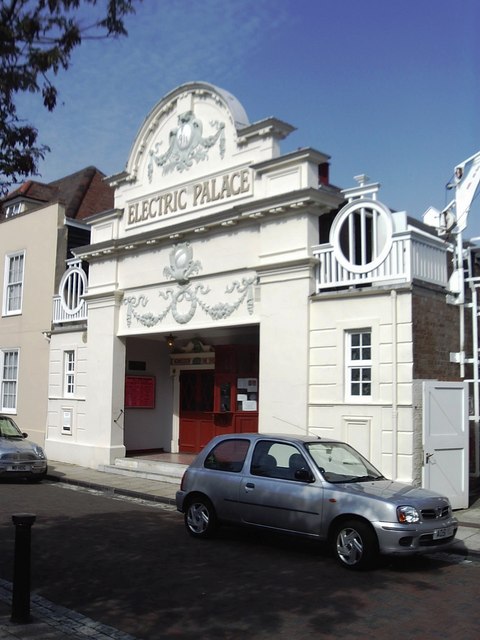
Electric Palace cinema in Harwich celebrates centenary

Electric Palace cinema in Harwich celebrates centenary

An Edwardian cinema in an Essex port town celebrates its 100th birthday now in this article from the B.B.C.  

The Electric Palace also has a remarkable history and its very existence is testament to the care and knowledge of local film enthusiasts and the goodwill and understanding of the current Town Council.  Once again we see good old-fashioned civic pride making it possible for this beautiful building to still be here a century after it first opened.

Designed by architect Harold Ridley Hooper (who went on to help create several buildings for Butlins Holiday Camps in the 1930s) the Electric Palace was built to show the "Bioscope" moving pictures of former travelling fairground showman Charles Thurston.  This soon expanded into showing films of the period and the Palace did a roaring trade throughout much of the Great War years.  It did less well from the 1920s on, despite the addition of mains electricity in 1924 and sound in the 1930s (the original pre-1924 Crossley gas engine and 100V DC generator can still be seen, unrestored, inside the building) and remained virtually unaltered from its original form.  Then in 1953 it was the victim of the infamous East Coast floods when seawater got inside the cinema.  By 1956 it had closed completely and it was to remain derelict for almost twenty years before being "rediscovered" by a local university lecturer.  Along with the Harwich Society he managed to get the Palace listed as "a building of sociological interest", much to the annoyance of Harwich Town Council who had intended to demolish it(!).  Even some of the townspeople were in favour of it being pulled down, citing its then run-down appearance, and the whole thing apparently made the national news!  Thankfully historical merit prevailed and the Electric Palace Trust was formed in 1975, staffed entirely by volunteers.  The reluctant council granted a "repairing lease" and it took 5 years to restore the cinema to its former glory; the grand reopening taking place on its 70th anniversary in 1981 with the Blue Peter team (and the original accompanist on the piano!) in attendance.

Today the cinema is still almost completely run by volunteers, with the freehold now in possession of the Trust.  Due to the way in which the Palace is run it only shows films on Wednesdays and at the weekend, supplemented with regular jazz concerts.  It also retains two original 60 year-old 35mm projectors which it still uses to show modern films in that format as well as historic films from the British Film Institute.  A new digital projector will ensure that the Electric Palace continues to show new films for many years to come.

It is heartwarming to see how a community has come together with the local council over a period of many years to preserve such an important historical landmark and get it to its centenary.  It must be quite an experience to watch a film - particularly an old one - in so stunning a building.

Followers

Popular Posts