Showing posts with label Biggles. Show all posts

Thursday, 24 April 2014

Exploits of WW1 'Boy's Own' flying aces emerge

As an unashamed fan of the "Biggles" stories by W. E. Johns (some of them splendid snapshots of the Great War from a serving pilot's [1930s] perspective - and not just for young boys!) and with a burgeoning library of First World War-themed books leaning disproportionally towards the aerial aspect of the conflict, the thrilling tales that have come to light in these two articles perhaps come as little surprise to me but are still nonetheless as amusing and amazing as any I have read before.

Exploits of WW1 'Boy's Own' flying ace emerge 

Some of the things that went on over the skies of France and Belgium throughout the war were deeply astonishing if the accounts in the various books in my collection are anything to go by.  Johns himself was at pains to point out that aerial warfare during the Great War really was "stranger than fiction" and some of the stories he touches upon in the preface of his very first Biggles book The Camels Are Coming - not to mention some of the true-to-life adventures our hero gets caught up in - really do defy belief.  Therefore to read about the real-life experiences of Major Robert Loraine is to be reminded that they are no exaggeration and that war-flying one hundred years ago was genuinely hair-raising stuff!   

source
Major Robert Loraine, RFC
The fact that Robert Loraine can be credited with a number of aeronautical "firsts" also drives home the fact that these men were truly at the beginning of a new technology, learning as they went and doing things that no human being had ever done before.  Loraine himself was flying across the Irish Sea barely seven years after the Wright brothers had travelled a few hundred feet on that first ever powered flight at Kitty Hawk.  The technological advancement of the aeroplane - still only a decade old at the start of the war - during the four years of fighting is astounding to the modern observer, for whom aircraft design has changed substantially little in the last 50 years (and it's such a shame that war is a catalyst for progress!).

Loraine was ahead of the charge by all accounts, though, and it is heartening to see that his pioneering achievements all came before the war and were peaceful in nature.  We also now know who to thank for the term "joystick", although it still isn't clear how the word came to be derived (and there are still other claims for the origin of this word).  His war service, as already mentioned, was hugely heroic too and I'm glad to see he came out of it all right - and on to the London stage (& screen) of all places!

How daredevil British pilot 'buzzed' the Kaiser

The second series of recollections, committed to paper some forty years after they occurred (just weeks before the outbreak of hostilities) but unseen until now, read even more like the most humorous "Biggles" stories.  A very cheeky chappie, the wonderfully-named Eric Gordon England sounded!

source
Eric Gordon England in 1913
One can only wonder what the Kaiser must have thought on that day in early June 1914, upon seeing a British aeroplane diving down towards his yacht before pulling up and over a passing zeppelin!  Nothing complimentary, I should think!

The relaxed feelings of peacefulness and prosperity that so characterised the "golden summer" of 1914 in England can be readily felt through this story, I think.  Not only by the actions of Gordon England in so comprehensively teasing the Germans both in the air and on the ground but also the sheer fact that Britain was still keen to provide aircraft to what would in barely a month's time be its most hated enemy.  (I don't know if those of you in the UK managed to catch the excellent three-part drama 37 Days on B.B.C. Two earlier this year but to my mind that did a fantastic job of showing how quickly and ridiculously the whole run-up to war unfolded.)

The unearthing of these kinds of fantastic tales is one of the best aspects of the increased interest in the First World War as a result of the centenary.  They serve to remind us of the human acts of courage and good old-fashioned derring-do that took place amid the carnage and decimation of 1914-18 and it is as excellent as ever to see them rediscovered for a new generation.  Now I'm off to re-read some of my Biggles books, and maybe some more new accounts by the real airmen who inspired his creation!

Saturday, 11 January 2014

My Great War reads for the 100th anniversary

When I wrote a couple of weeks ago about my latest book find just before Christmas, I mentioned that it was about something very pertinent to this year's centenary of the First World War (news and events relating to which have already begun to appear, so expect this blog to become heavy with them in the coming months!) - namely the collected early war letters of RNAS pilot Lieutenant Harold Rosher.  I added that it would become a welcome addition to my war library and stated my intention to read all the books in my collection that relate to World War One by the end of 2014.


Well, the other day, with the germ of an idea for a post in my mind, I got out all said books (including In The Royal Naval Air Service, 3rd row far right) and laid them out to take a picture of them for this blog.  I think I may have to revise my target!  The end of 2018 seems more realistic now I've reacquainted myself with the number books I have on the subject!

As you can see most of them focus on the aeronautical aspect of the Great War; no surprise really as that has always been my abiding area of interest.  In fact all but three are purely about aerial warfare.  True World War I Stories (2nd row from top, 3rd from left) is just that and was picked up from a library sale a few years ago for 50p.  Before Endeavours Fade by Rose E. B. Coombs (top, 3rd from left) was given to me by my stepfather several years back and is actually something of a guide book to the battlefields, detailing towns, landmarks and other locations that saw action as well as the innumerable memorials throughout Belgium and France.  Although now nearly 40 years old this book will doubtless be interesting and a still-useful guide if I should choose to visit the areas covered.

Once I realised just how many books I had, I got that nagging feeling that there were probably one or two more lying around somewhere that I'd forgotten about and such proved to be the case! 

Goodbye to All That is an autobiographical account of the the First World War (and the author's early pre-war life) by Robert Graves, the poet, scholar and author who served in the Royal Welsh Fusiliers and was good friends with Siegfried Sassoon.  I picked up this copy for a few pence in Homebase (yes, the DIY people - my local store has a small second-hand book concession by the tills!) a year or so ago and it has been sitting patiently in my "to read" pile.

The rest all focus on the RFC and/or the Deutsche Luftstreitkräfte (except In the Company of Eagles, a novel by Ernest K. Gann about a duel between French and German pilots) with no less than four devoted solely to Manfred von Richthofen.  These include his own [translated] memoirs and a fascinating in-depth record of his 80 career victories.

German War Birds is a splendid book from the 1930s, written by the mysteriously pseudonymous "Vigilant" (generally agreed to be one Claud W. Sykes and probably a serving RAF officer hence the name), details of some of the lesser-known German pilots of the Great War and is written in wonderfully charming Thirties style.  I picked it up in 2003 from the wonderful book stalls that can still be found underneath Waterloo Bridge.

Many of the other books are written by well-regarded aviation/military historians such as Peter Hart, Alan Clark and Norman Franks.  Then there are the famous wartime memoirs of Cecil Lewis (Sagittarius Rising) and Victor Yeates (Winged Victory), not to mention James McCudden's Flying Fury.  Finally there is, of course, Biggles - who nearly 20 years ago introduced me to the fascinating world of dogfights, biplanes and heroic flying that I would later go on to read so much more about.  The First World War stories fully deserve their place here, being inspired by true events and stories that the author W. E. Johns (himself a bomber pilot in the war) saw or heard.

Finally, as a bit of light relief, Practical Flying is a good read - it being a facsimile of the standard training manual given to pilots joining the RFC.  I doubt there'll ever be any call for me to fly a Sopwith Camel, but you never know!  I actually got it (and a real hip flask!) with the old PC simulator, Flying Corps, way back in the late '90s and am pleased to report that the old game still runs so I can at least take my bus up for a spin virtually if not in reality(!).  Incidentally I'm amazed to see how far computers and graphics have progressed - the modern equivalent of Flying Corps, Rise Of Flight, looks incredibly realistic and expansive.

Just as soon as I've finished reading my current tome, Waiting For Hitler, which is an equally enthralling series of accounts from the first year of the Second World War when the invasion of Britain looked likely, I shall begin working my way through these Great War books.  Don't be surprised if you don't hear from me for a while!  But no, in all seriousness, I really looking forward to doing this; in the centenary year of the start of the Great War it just seems the "right" way to go about commemorating the occasion.  I may even post a review or two up along the way.  Then there's my film collection too, I haven't even touched on that yet.  If that's not enough the Daily Telegraph is also marking the anniversary by making available online copies of every one of its newspapers from 1914 to 1918, each day for the next four years!

What have you got planned for the 100th anniversary and are there any more(!) books you would recommend I seek out?

Friday, 20 January 2012

Can Biggles sweep the skies again?


Can Biggles sweep the skies again?

With men like those in the article making sure that an aircraft linked to the Biggles mythos can continue to fly, surely the answer must be yes. 

Although it is a shame that a 1960s feature film was never made, at least part of it still survives in the form of this replica built to star in the proposed production.  Now thanks to years of painstaking work by two generations of the same family this reproduction BE2c biplane can and will fly again.  It may not have been able to take to the air for the B.B.C but as the above footage shows, it certainly can fly.

The wider question posed by the article is perhaps of even greater interest.  Should there be a new Biggles movie?  I say yes (well I would, wouldn't I?)!  An attempt was made in 1986 with the somewhat lamentable Biggles: Adventures in Time (almost a "so bad it's good" film, it is rarely spoken about - and even then in hushed tones - by Biggles fans) and a planned big-budget trilogy was in the early planning stages before being canned back in 2001.  But with the recent success of the Harry Potter and Sherlock Holmes films amongst others, perhaps the time is right for a new big screen Biggles adventure.  Imagine what a Biggles film could look like with today's special effects!

In the meantime the 98-odd Biggles books still exist to provide many a film in one's mind, and minor triumphs such as that of "Biggles' Biplane" can help to ensure that this dashing British airman is not forgotten, until hopefully there comes a time when he gets his own film(s) worthy of his exploits.  Chocks away chaps!

Friday, 16 December 2011

Books, ties and heroes

I'm on a bit of a roll with the old charity shop finds this week, it seems.  Went back in to town yesterday and had a look around the two other second-hand stores therein and came back with two ties and two books, all for less than £10.  More on the ties in a later post, I think; for now I will use the books as a basis for this post.

The latest addition to my bookshelf
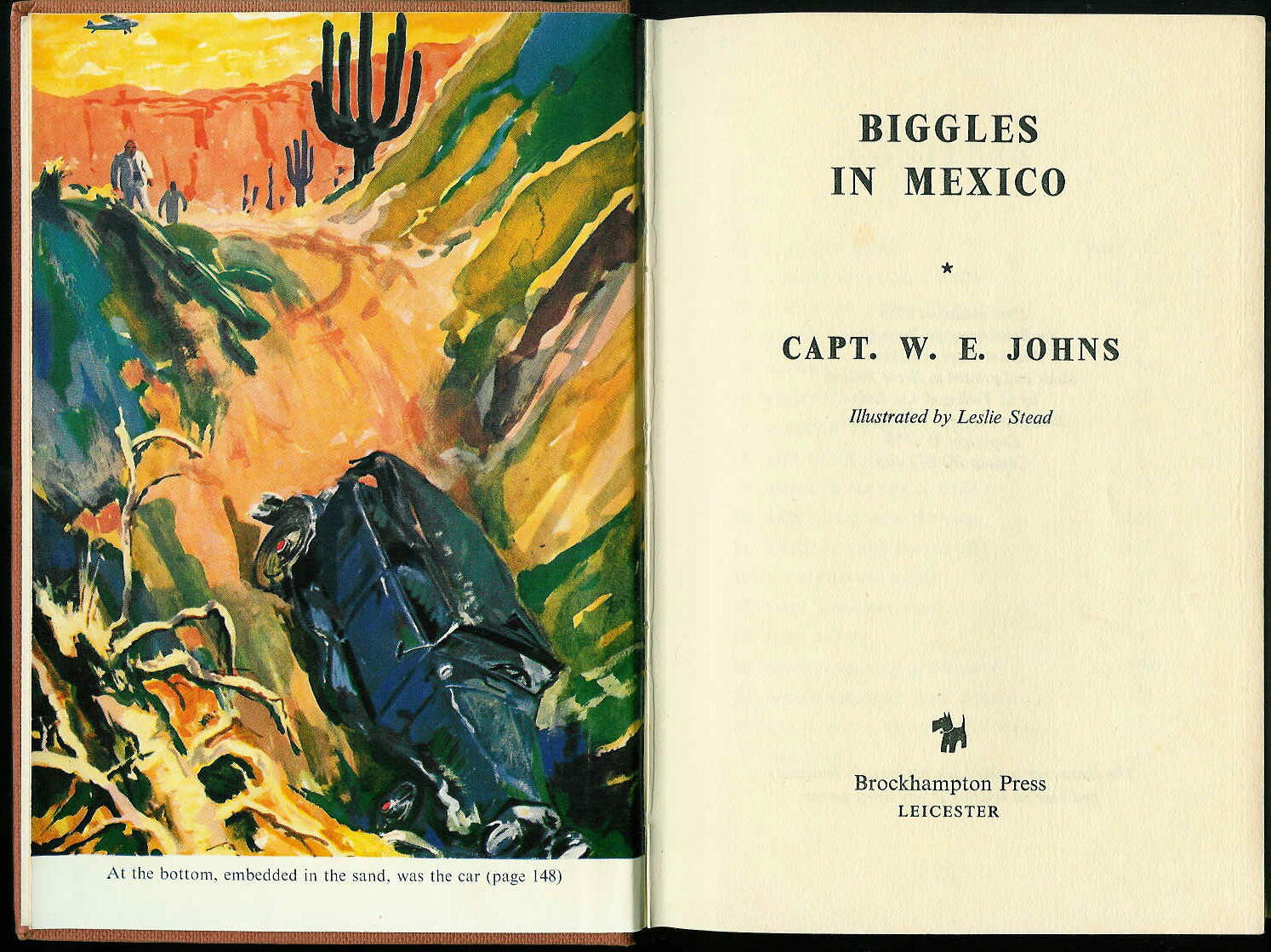
These two tomes are by a favourite author of mine and one of them features my literary hero.  The author is William Earl Johns, more commonly known as Captain W. E. Johns (and for those of you who might not have heard of him, or know little about him, here is a short biography of the man).  If you haven't heard of Johns, you may at least know his most famous creation and the aforementioned literary hero  - Biggles.

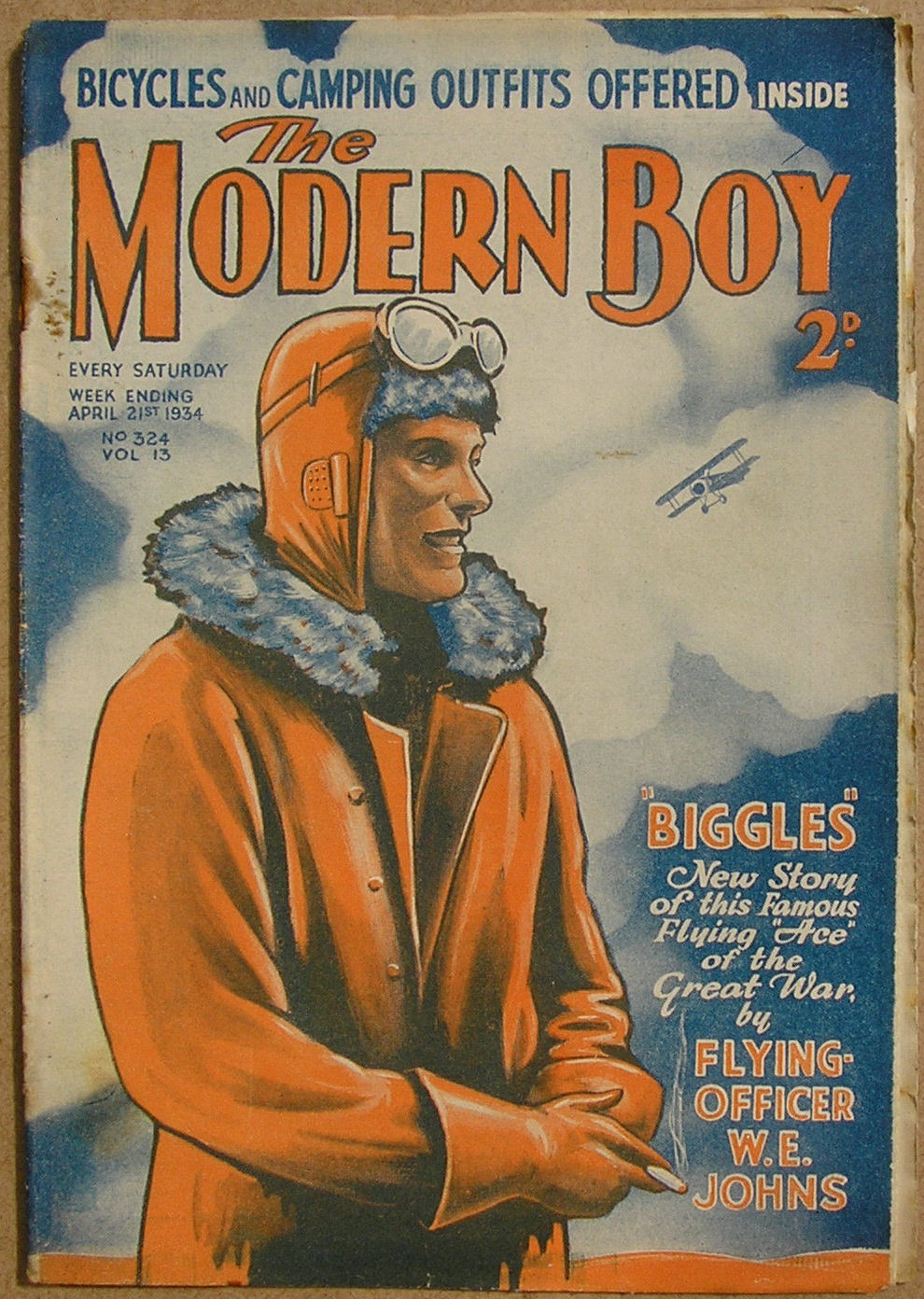
I make no apologies for my love of the Biggles stories.  If grown men can read Harry Potter with apparent impunity then I can jolly well read Biggles books.  Not many people know that the Biggles series actually started off aimed at adults - they were hard-hitting war stories recalling many incidents and adventures of the First World War, some of them quite grim.  It soon became apparent that the stories appealed to young boys too and so the early tales migrated from Popular Flying magazine where they first appeared to The Modern Boy and thence in to book form (with some alterations to make them less graphic).

17 years of reading and re-reading have taken their toll
Biggles first entered my life at the Imperial War Museum Duxford back in the early '90s.  We'd gone there on a school outing, it was the end of the day and we were allowed to look around the gift shop prior to leaving.  I was searching for something inexpensive but memorable to take home with me and my eye was drawn to a display full of some of the then-new Red Fox (Random House) republished Biggles books.  What 11-year-old boy, already with an interest in military history and aeroplanes, could resist this cover (left)?!  I'd never even heard of Biggles prior to that, but before long I was hooked and lapped up any Biggles stories I could find.  Seventeen years and 47 (out of approximately 98) books later and I still get a thrill of enjoyment from reading the escapades of this famous fictional airman.  I'd even go so far as to say that he influenced me growing up and helped make me the person I am today.

The Biggles books have been accused by the PC brigade of being racist, sexist and imperialist but this, as always, is a misapprehension and glosses over some of the facts - not least the era in which the stories were written.  Putting these spurious claims to one side (before this becomes an essay - a more detailed Biggles post will have to wait, it seems!) Biggles essentially champions the traditional values of bravery, honesty and fair play.  We need more like him.

Followers

Popular Posts