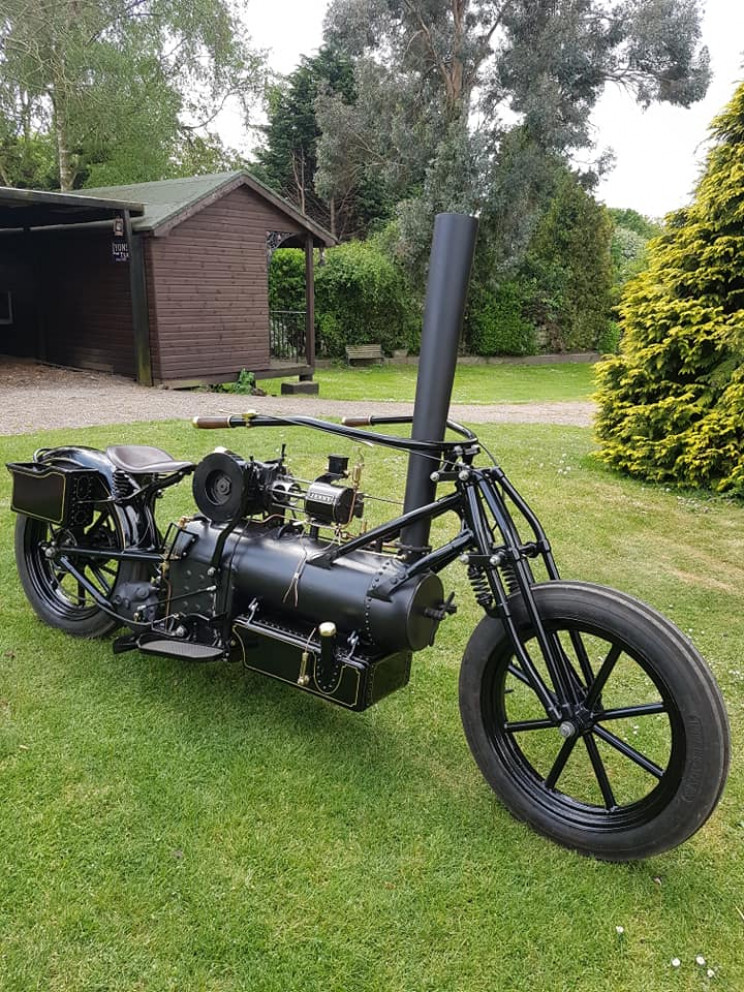
Bespoke Bentley that rewrites the rules of giant cars
Inspired by the above article and with the feeling that I ought to blog about something really masculine to counterbalance recent posts featuring women's fashion I thought I'd gather together some of my favourite examples of "giant cars" - vehicles old (and new) that are powered by aeroplane engines.
1909 "Blitzen Benz"
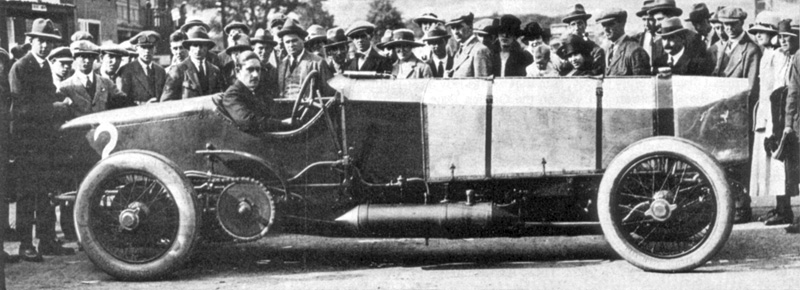
The 1909 Blitzen Benz was not actually powered by an aeroplane engine, but rather a development of Mercedes' grand prix engine at the time. The aim was to build a car that could exceed 200km/h (124mph), for no other reason than to see if it could be done, one supposes. The standard in-line 4-cylinder 150hp racing engine (and remember, this is 1909, over 100 years ago!) was found to be unequal to the task, however, so Mercedes did the usual thing when an engine was not powerful enough for the job - they increased the displacement. To 21½-litres. That's right -
twenty-one point five litres. Power jumped to 200hp at 1,600rpm (a modern Ford Focus 1.6 develops its full 180bhp at 5,700rpm) and on the 9th November 1909 at the Brooklands race circuit, a Blitzen Benz set a new record of 202km/h (126mph) over 1km. Then two years later at Daytona Beach another one was clocked at 228km/h (141mph) over 1 mile, a record that stood for 8 years. A total of six Blitzen Benzes were built with many of them surviving to this day and one can be seen at the Mercedes Benz World museum at Brooklands in Surrey.
1924 Fiat Mefistofele
Another monster that began life as a grand prix car, this time a 1908 Fiat with an original displacement of 18 litres, which you'd think would be big enough as it is. When that engine exploded in 1922 (quite spectacularly, according to
contemporary reports) the car passed into the ownership of one Ernest Eldridge. He promptly replaced the shattered 18-litre engine with an in-line 6-cylinder Fiat aeroplane engine of 21.7-litres capacity, more normally found in airships and heavy bombers. This was then modified further, resulting in power increasing from an already heady 260hp to a scarcely believable 320hp, again at the ridiculously low rpm of 1,800. Despite weighing 2 tons and with no front brakes, Mefistofele hit 146mph on the 12th July 1926 taking the world speed record at the time. Fiat bought Mefistofele from the descendants of Eldridge in the late 1980s and it is now in their Turin museum, with occasional guest appearances elsewhere.
1921-1927 Chitty Bang Bang
A series of four cars that inspired the well-known story of
Chitty Chitty Bang Bang, all owned by a
Count Louis Zborowski. The exact source of the car's name is unknown, it was either an onomatopoeic appellation taken from the noise of the car's engine or it was based on a bawdy First World War song.
Regardless of how the name came about, Chitty Bang Bang began life in 1921 as a Mercedes-based race car fitted with a 23-litre Maybach in-line 6-cylinder aeroplane engine. In this configuration it eventually achieved a top speed of 120mph (190km/h). The second Chitty was slightly smaller both in length and engine size, making do with an 18.8-litre Benz aero engine; the third incarnation was similarly equipped and lapped Brooklands at 112mph.

The fourth car to bear the name went all-out with a 27-litre V12 Liberty aero engine of 450hp and a gearbox and chain-drive taken from one of the Blitzen Benzes. After Zborowski's death this car was bought by Welsh racing driver and land speed record holder John Godfrey "J.G." Parry-Thomas who renamed it "Babs" and on the 28th April 1926 used it to take the world land speed record at Pendine Sands in Wales with a speed of over 170mph (270km/h). A year later on the 3rd March 1927, after the record was broken again by Malcolm Campbell, Parry-Thomas attempted to reclaim the title but was killed in the attempt. The car was wrecked and later buried in the sand. It remained there for almost 40 years before eventually being recovered and restored (not without difficulty considering the terrible condition it was in) during the 1960s/70s; it is now shared between the Pendine Museum of Speed and Brooklands.
1931 Rolls-Royce Phantom II Merlin
Starting out as a standard 1931 Phantom II this particular example was modified to accept a 27-litre V12 Rolls-Royce Merlin engine (of Spitfire fame) some time in the 1970s. Restored in the 2000s it recently sold at auction for $410,000 (£263,500). With an estimated 1,100hp on tap performance was described as "unbelievable" and on one occasion this 1931 Rolls-Royce was able to out-accelerate a 1958 grand prix car!
1933 Napier-Railton and 1968 Napier-Bentley
The 1933 Napier-Railton was built especially for racing driver
John Cobb by renowned automotive engineer
Reid Railton (what a name!); both men would later work together on the land-speed record-beating Railton Special.
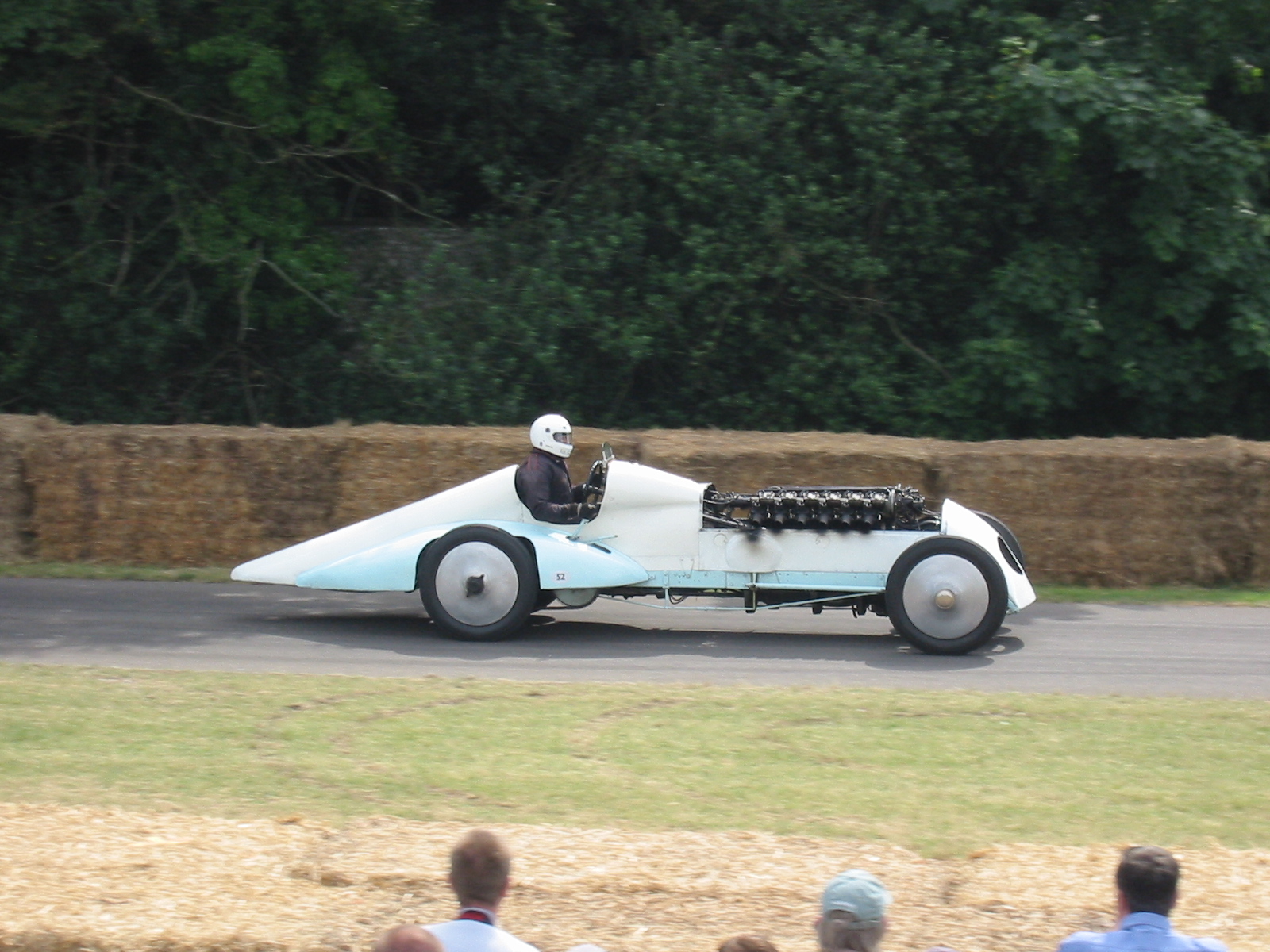
The Napier-Railton had a 23.9-litre W12 Napier Lion aeroplane engine and put out more than 500hp. At the Brooklands track in 1935 Cobb set a lap record of 143mph (231km/h), a mark that stands to this day. Theoretically capable of a maximum speed of 168mph, the Napier-Railton has been in the possession of the Brooklands Museum since 1997.
The Napier-Bentley was built as an homage to the Napier-Railton in 1968, originally based on a Sunbeam but later rebuilt using a Bentley chassis. It uses the same engine as the Railton and so has practically the same performance but is in private hands, although it makes frequent appearances at Brooklands and elsewhere. (I have been lucky enough to see both in action at the Brooklands Centenary celebrations back in 2007 - or was it 1937?).
1953 Swandean Special
Built by a man called Michael Wilcock of Worthing in Surrey out of two army Daimler scout cars and a 27-litre V12 Merlin engine bought from a scrapheap for £50, this took part in several time trials up and down the country, once being clocked at 150mph - in third gear! Fitted with a supercharger it reputedly made 1,600hp at 3,000rpm. Later made its way through several American collectors before being restored to pristine condition in time for the 2008 Pebble Beach Concours d'Elegance.
2010 Packard-Bentley "Mavis"
Obviously not satisfied with owning the aforementioned 24-litre Napier-Bentley, automotive enthusiast
Chris Williams has since built a successor to that car and one that fully deserves the title of "monster". Again, not really an aeroplane engine, but rather a variant of a Packard V12
42-litre engine in marine form taken from a Second World War PT boat. With
fifteen hundred brake horsepower and 2,000lb ft (2,700Nm) of torque, nothing can come close to this imposing beast. It's a wonder the 1930 Bentley 8-litre chassis can handle it, even with all the modifications it has had to have. You might want to turn the volume down (or up, if you're so inclined) a bit for this one, it's LOUD!
1925 BMW "Brutus" Experimentalfahrzeug
Well, perhaps
almost nothing can touch "Mavis" (oo-er missus!). Meet Brutus. Wouldn't they make a lovely couple?(!).
After its defeat in 1918 and the signing of the Versailles Treaty a year later Germany was not allowed to produce armed aircraft, which meant a lot of surplus aero engines lying about. Nothing was mentioned in the treaty about cars (except of the armoured variety) however, so BMW took one of its redundant V12s and plonked it on to a 1908 American-LaFrance racing chassis. With
46-litres and 12-cylinders the result is 740hp and the ability to do 60mph at 800rpm (about where your car idles).
I was going to include the bespoke aero-engined land speed record cars like the Railton Special, the Golden Arrow and Malcolm Campbell's various
Blue Birds but I think I've gone on for far too long, so I'll save them for another time. As it is I've got an urge to don some white overalls, leather hat and goggles and tinker about with some big-engined cars. Vroom-vroom!