Showing posts with label Steampunk. Show all posts

Thursday, 29 October 2020

Historic Detroit Hotel elevator discovered during remodel in St. Petersburg, Florida


Historic Detroit Hotel elevator discovered during remodel in St. Petersburg, FL

On the face of it the headline of this article appears to be somewhat convoluted so let's begin by putting any confusion to bed and solving this apparent geographical jigsaw puzzle.

source - Tampa Bay Times
What we have here then is an 1890s-vintage elevator (or lift, as we call it on this side of the Pond) made by the Warner Elevator Company of Cincinnati, Ohio and which has recently been unearthed during the refurbishment of the Detroit Hotel - located not in Illinois but rather in St Petersburg.  Not the Russian city of St Petersburg though, but the town of St Petersburg in Florida.  All this confusion can be laid squarely at the door of the town's founders Peter Demens and John C. Williams, who as the article explains reached an agreement in 1888 to build the hotel as part of an important railway deal for the then new town.  Russian-born Demens, who was instrumental in bringing the railway to St Petersburg, gave the town its name in honour of his birthplace.  Williams, meanwhile, hailed from Detroit City and in exchange for buying the land from Demens decided to name the subsequent hotel after his home town.  I'm sure it all makes perfect sense to the native Floridans but, my word, they could have made it easier by just coming up with some original names!

Anyway, with the hope that that's at least partially cleared up any lingering misunderstanding (and not added to it) let's move on to the main discovery detailed in this article - and what a discovery it is!  It is nothing less than a fantastic find - a near 120-year old electrically-operated lift that has lain undisturbed for decades, boarded up and hidden behind some later remodelling work.  Now as part of some extensive works being carried out to turn the building into a steampunk-themed pub restaurant - an excellent and by the sounds of it welcome idea for the town - the original compartment, doors, motor and even cables (albeit long-since cut) have been uncovered by workmen brought in to gut the interior.  In addition many more early features were revealed during the renovations including an old staircase, fireplace, telephone switchboard complete with handwritten room numbers and even some sections of hand-painted wallpaper!

These revelations alone are remarkable for - as local historians have said - there is little left in St Petersburg of its early history, so a discovery such as this is especially significant and rightly of great importance to the town.  The unearthing of something on this scale is arguably of even greater scope than mere regional interest, for there cannot be that many buildings left in the world of such an age that are still hiding such wonderful gems and in America especially where something of this age is considered practically ancient it is a particularly noteworthy find.

source - Tampa Bay Times

I'm therefore delighted to see that not only have these incredible vestiges of the hotel's early years been found but that everyone involved in their rediscovery, from the owners to the contractors, recognise the importance of them and what is more are keen to incorporate them into the building's redesign.  Everything looks likely to be inventively saved in one form or another - the lift to be converted either into a private dining table or photo booth, the stairs kept on show as a centrepiece and even the wallpaper framed.  That the theme of the new venue is to be a steampunk one is indeed a splendidly fitting coincidence and has assured these valuable relics will be preserved for the people of St Petersburg to enjoy for years to come.  The whole project sounds most impressive and I look forward to seeing the end result; should I ever find myself in St Petersburg, Florida I would certainly make a point of visiting the finished eatery. 

Saturday, 27 June 2020

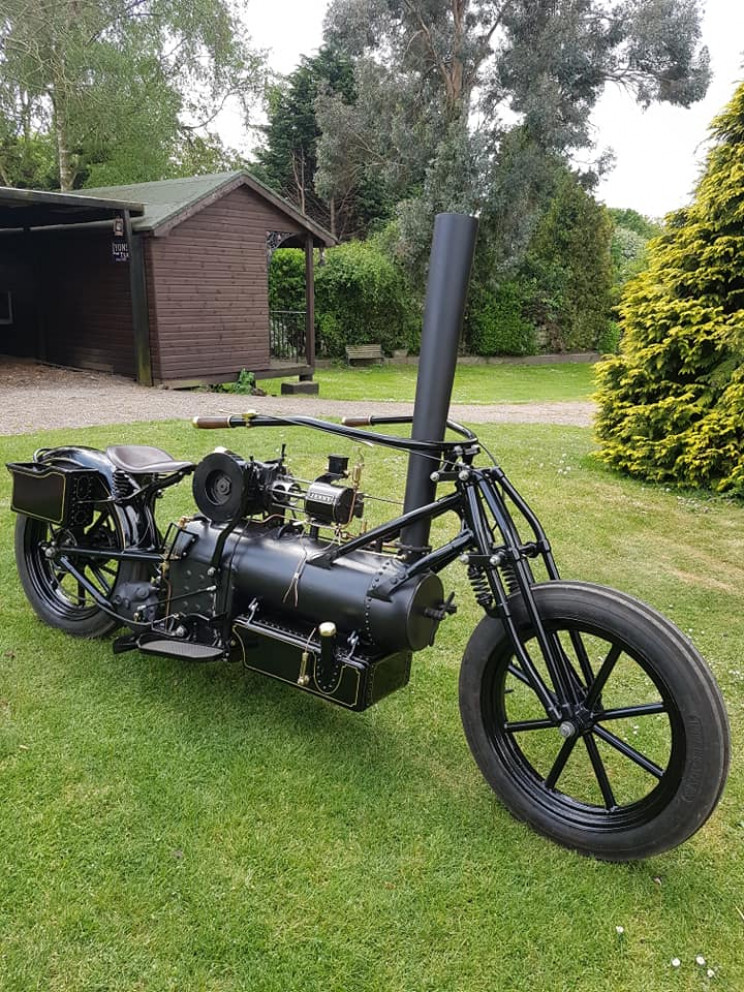
Coal-fired steam motorbike built by technician is a Steampunk dream

source - Interesting Engineering

This Coal-Fired Steam Motorbike Built by Technician Is a Steampunk Dream

There hasn't been much in the way of Steampunk-themed articles featured on this blog of late (mind you I've only been back for three months) but this one about a beautiful home-built, steam-powered motorcycle more than makes up for it.

The creation of a steam engine enthusiast from Carlton in North Yorkshire, this fantastic machine is all the more remarkable for having been built from scratch over the course of four years - including the engine which was pieced together from various sources!  It's a testament to the skill and the vision of Mr Sanderson that the end result is such a professional example of Victorian engineering in a wonderful Steampunk design and he should be justly proud of his achievement.


It does look quite a brute of a machine, though, doesn't it - and I can't get over (and no doubt wouldn't be able to see over) the size of that chimney!  I imagine that it must interfere with forward visibility just a tad...  What it must be like to sit astride a high-pressurised boiler full of steam and hot water I wouldn't like to guess, either; I only know I would be a little nervous - although not above giving it a go I suppose.

source - Interesting Engineering

Still I can only express again my admiration for the thought and workmanship that has obviously gone into this incredible machine over such a long period of time.  The world is a fuller place for its existence and that of skilled enthusiasts like Mr Sanderson and it can rightly take its place alongside any of the one-off and custom-made Steampunk motorbikes that are out there and mentioned in the accompanying article.

Finally, to prove it's a real runner and not just a stationary engine (ha-ha, did you see what I did there...?), here to finish with is footage of the happy owner taking his fantastic steam-powered motorcycle for its first test drive:


Toot-toot!  Full steam ahead, sir!

Thursday, 19 July 2012

Riders of the lost Art

I must begin by apologising for what is turning into one of the quietest months of blogging I've experienced in a long time.  It's been partly due to work and other calls upon my time but mainly because there has been little vintage news to blog about!  Perhaps everyone is bracing themselves for looking forward to a certain event starting at the end of the month...  As it is I've almost forgotten how to do this blogging lark, so I'm sorry if this post isn't up to snuff(!). 

I've had the idea for this post buzzing around my head for some time now, having come across several motorbikes I really like the look of (and think you would too) - both real and imaginary.  Time to get them off my mind and into this blog!

Dad's last classic 'bike, a 1960 AJS.  Sold in 1997, sadly.

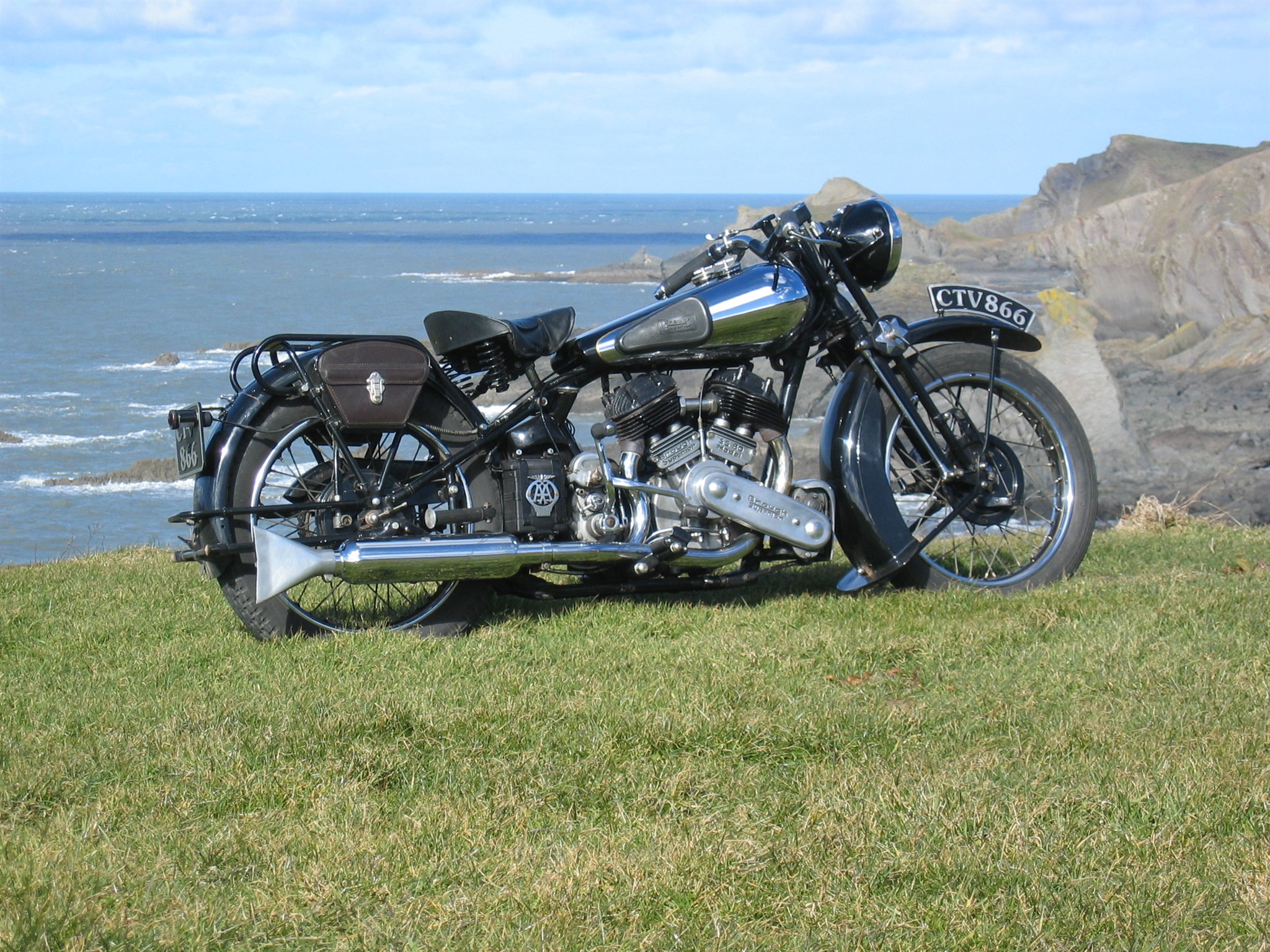
Motorcycles aren't really my area of expertise (I prefer my vehicles to have at least 3 wheels under them!); they come more within the purview of my father, who's been riding the things since the 1960s.  Being mechanical objects I have a passing interest in them but with these modern 'bikes I couldn't tell a Honda from a Hayabusa.  I much prefer motorbikes from the first half of the 20th century (naturally!), particularly the classic-styled British makes of which there were so many - Ariel, BSA, Matchless, Royal Enfield, Rudge and Vincent to name but a few.  Not to mention "the Rolls-Royce of motorcycles" - the Brough Superior (T. E. Lawrence's motorbike of choice and the type on which he met his death). 

source

It is still possible to find some vintage-style motorcycles among the mass of plastic-clad, sport-position superbikes if you look hard enough.  These examples in particular take my fancy:

Triumph Thruxton

source

Triumph is a justly famous name in British motoring history, dating back to 1902, and today Triumph Motorcyles Limited is the largest remaining UK motorbike manufacturer (although its present incarnation only really dates back to 1983 when the original Triumph company went into receivership and the rights to the name were bought by British entrepreneur John Bloor).  Their range of 'bikes is impressive but are generally sporting and look to the future (Tiger, Speed, Street, Daytona, Sprint and Trophy), the immediate past (Bonneville and Scrambler) or across the Pond to the cruiser style of America (America, Rocket III, Speedmaster and Thunderbird).  Only one model really stands out to me and that is - the Thruxton.  Unashamedly retro its style harks back to the café racers of the 1960s - just the sort of 'bike my dad would have coveted, I should think.   One of the classic designs from the end of an era.

Royal Enfield

A classic British motorcycle manufacturer as mentioned previously, Royal Enfield lives on - in India.  Originally an offshoot of the British Royal Enfield company, who set up an Indian operation in Madras during the 1950s (originally to supply the Indian police), Royal Enfield (India) has been in business ever since outlasting even its parent company (which closed its doors in 1971).  Now thanks to various investments Royal Enfields are once again available to buy in Britain.  Some models have hardly altered in style since their British heyday, and my picks would be the Bullet Classic Chrome (also available in Battle Green and Desert Sand for the Army re-enactors amongst you!) or the Bullet Electra Deluxe

Royal Enfield Bullet Classic Chrome

Royal Enfield Battle Green Bullet Classic (also in Desert Sand Beige)
Royal Enfield Electra DL

Indian Chief Classic

From one sort of Indian motorcycle to another now.  While Harley-Davidson is arguably the most well-known of the American cruisers, their modern offerings have always seemed a trifle too "butch" (for want of a better word) for my taste and it can't be denied that the 'bikes tend to conjure up images of Hell's Angels and the like.  (Born to be Mild, that's me!).

source

No, for me it has to be that other great American motorcycle manufacturer - Indian.  The equal of Harley-Davidson for the first half of the 20th century, Indian's fortunes declined and the original company went bankrupt in 1953.  Numerous abortive attempts to resurrect the brand were made between then and 2006, when a new Indian Motorcycle Company was formed (oddly enough with the help of a London-based private equity firm but since 2011 under American ownership).  Early days, then, but judging by the look of their current 3-bike range I think they should do well.  I certainly hope so!  The Indian Chief Classic is definitely my favourite.  I can't resist wheel spats (but draw the line at the tasselled saddle and bags of the Vintage and Dark Horse models)!

Orphiro

Never heard of them?  Neither had I until I did this post.  Dutch firm Orphiro looks to be a very interesting company; one to keep an eye on.  Their prototype electric motorcycle embodies an ethos I have spoken warmly about in the past - the merging of vintage design with modern practices.  With this remarkably well-fashioned cruiser-style 'bike Ophiro makes electric motorcycling look incredibly attractive.  Hopefully the technology will prove to be a match for the design, but for now - I like it a lot!

source

So from the current motorcycles that would sit in my dream garage I'll now turn to some of the beautiful and unusual designs that existed during my favourite decades.

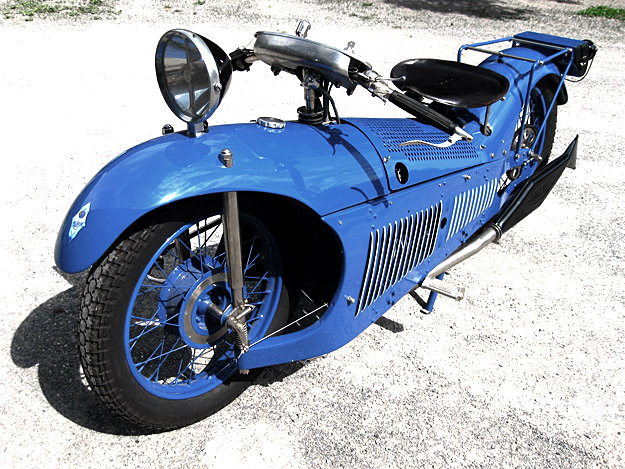
1929 Majestic

Image by Paul d’Orléans, courtesy of Bike

Without a doubt one of the most beautiful examples of the Art Deco æsthetic ever applied to a motorcycle the 1929 Majestic could only ever have come from the country that first brought us that wonderful design movement - France.  Incredibly advanced for its time, with a riding position more akin to modern sports 'bikes, the Majestic is one of the earliest examples of motorcycle streamlining.

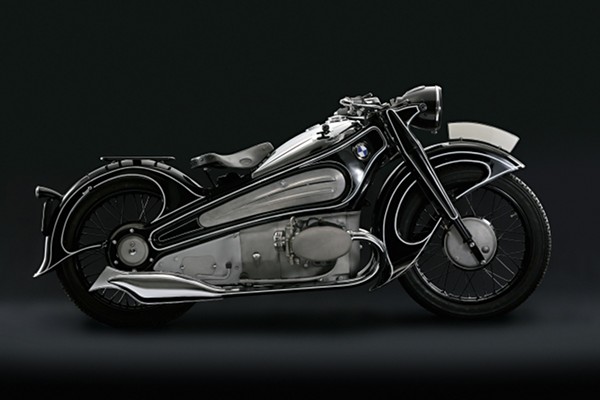
1934 BMW R7

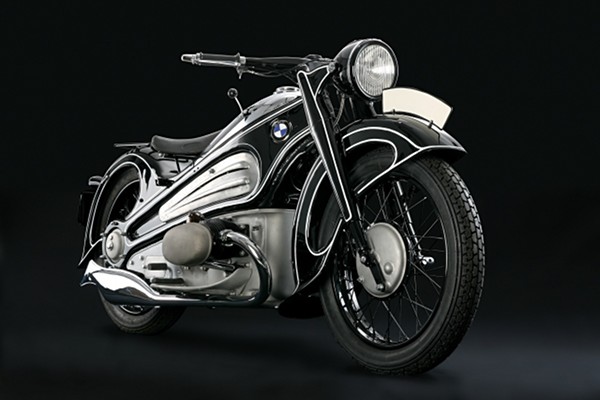
BMW have been making motorcycles for longer than it has been making cars, starting production of two-wheelers in 1923 (five years before their first car).  Today BMW Motorrad is a hugely successful arm of the Bavarian company and during the 1930s BMW motorbikes were the equal of many of the British makes.  The 1934 R7 was a prototype intended to show the future mechanical and design direction BMW's 'bikes were going to take.  Foreshadowing the "all-in-one" body design that was to become the norm in future decades and with many highly-advanced features the R7 made liberal use of the Art Deco style, a style that was perfectly suited to this fast, modern motorcycle.

source

Only the one prototype was ever produced, however, due to the prohibitive costs which Depression-hit BMW could not afford.  This brutally gorgeous one-off was cannibalised of its parts for production BMWs with the remaining 70% packed away in a crate.  It was not until 2005 that it was uncovered, in shockingly bad condition (rust had taken hold of much of it exacerbated by the battery which had split open and left corroded acid all over the place).

source

Fortunately BMW knew the historical value of the R7 and with help of BMW Archives, who still held the original drawings and blueprints, their specialists were able to painstakingly rebuild and restore the R7.  The result, which took 3 years of hard work, you can see here.

1936 Henderson

source

A one-off custom build that looks like it would be at home in a pulp story, this amazing motorcycle started life as a standard 1930 Henderson (another American motorbike maker, from 1912-31) before it was mind-blowingly altered by an O. Ray Courtney in 1936.  It has been restored by Frank Westfall out of Syracuse, New York.  Who if you ask me is a very lucky man to have such a lovely - and completely, if somewhat unwieldily useable - machine.  If the Majestic was the beginning of Art Deco streamlining on motorbikes, the Henderson is surely the last word.

source

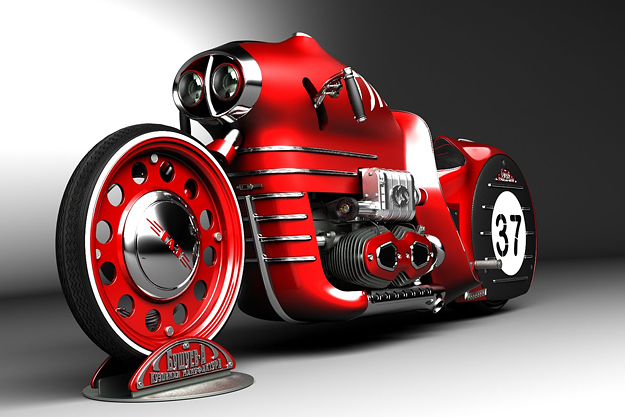
Finally, having waxed lyrical on a subject mechanical again (funny how these sort of posts end up more like essays!),  I leave you with a few examples of motorcycles from the imagination.  Steampunk and Dieselpunk designs that exist on paper, or as static displays, and which may well not even function as a motorbike were they to be produced but which nevertheless amaze and astound in equal measure.

source

Russian artist Mikhail Smolyanov has designed a whole glut of Steampunk and retrofuturistic motorbikes.  To do them all justice would be impossible (and at least double the length of this post - "oh no!", I hear you cry) so I shall direct you to The Retronaut who covered them last year and suggest you have a look at Mikhail's blog if you like what you see.

source

In a similar vein to Mikhail Smolyanov's Black Widow design, Harley-Davidsons have been customised in the Steampunk æsthetic, like the one above.

All in all, I think I'm going to need a bigger garage!
Sunday, 12 December 2010

What does vintage mean to me?

There has been a great deal of talk about the "modern vintage scene" on the vintage blogosphere recently and at least one troll has come up from under their bridge to attack one of the finest proponents of the vintage lifestyle. Rather than repeat my point of view on half a dozen blogs, I thought instead that I would write a post about it.

"What sparked your interest in vintage?" is another popular question at the moment and for me it started at an early age. Around the age of 8 I started watching Laurel & Hardy and Harold Lloyd comedies. I loved not only the comedy but also the fashions, the cars, the cities and the buildings; in short, I became enthralled with the 1920s and 1930s. By the time I was eleven I was listening to the likes of Glenn Miller over more popular modern music and reading anything I could lay may hands on that was set in or about the period.

Where this fascination came from I have no idea as there's no-one in my family who's shared this interest (in fact I have long been described as "weird", "strange", "odd" - charming, eh?!). I enjoyed staying with my grandparents and going with them to their social club far more than I ever did socialising with my peers, but whether that is a reason or just a product of something that was already there I can't say. I have always had old-fashioned manners and clear-cut morals, probably from my father's side; there is also a slight theatrical/musical history on my maternal family's side that perhaps may account for some small influence in regards to my interest in period fashion and culture, although it's only been in the last 3 or 4 years that I've started seriously looking at proper vintage fashions and ideas for myself.

"You were born in the wrong era" is something I too, along with many others I've found, have been told time and again and this seems to be the crux of the discussion. Now, I'm a scientific, rational kind of chap (although I like to think I keep an open mind) but there have been times in my life when I have seriously wondered about past life, forms of reincarnation, that sort of thing. There have been occasions when a song, a film or a news item from 80-odd years ago has engendered such a sense of affinity in me that it feels like I've lived it and I suddenly feel really out of step with the modern age. That kind of thing and the lack of any real outside influence on my interests sometimes makes me wonder but it is a whimsical theory, nothing more.

What I would not have liked, in accordance with pretty much every other vintage blogger it seems, would be to go back and live in that time permanently. I think the reasons why are fairly clear and have been done to death on other blogs; in my own case having been up and down health-wise in the last couple of years I may not have even survived in the '20s and '30s. Even we vintage aficionados know that we have a lot to be thankful for in the advancements of science, medicine and social mobility. This (finally, you'll be pleased to hear) brings me to the nub of the matter for me and, I believe, the majority of vintage fans: we look back and appreciate from the time what appeals to our tastes - the fashions, the machinery, the architecture, the art etc. whilst acknowledging the bad parts - poverty, racism, war etc., take the best parts and transpose them into our lives today. If that's having your cake and eating it, then all I can say is - YUM!

This is what has also led to my interest in the Steampunk movement and retro-futurism - the marriage of Victorian (Edwardian, 1920s through 1950s) morals and aesthetics with modern technology. It is also what drew me to the Chap movement; although somewhat tongue-in-cheek and self-deprecating behind it all there is a kernel of truth. I think we would all agree that present-day society is lacking something compared with that of 60-100 years ago - manners, morals, politeness, style. These are the things we see in the past and long for again and for me keeps me interested in trying to live the vintage way, in the modern world.

Monday, 6 December 2010

Book of the week(end)

Or rather, books.

This weekend I visited my parents and Saturday found me in the local library returning a book. The perennial book sale trolley was by the door and at a glance appeared to contain all the usual suspects - 6-year-old travel guides and computer manuals, large print mystery novels and - I had to laugh - a mint copy of Katie Price's autobiography. Ah, schadenfreude! Still, I had a closer look; there was a pile of books toward the back that looked promising and it always pays to have a delve about, even if nothing automatically catches your eye. It turned out to be one of those funny yet welcome occasions where the first couple of books were nothing of interest, then - oh! that's a good one, and the next one too, ah! and the third... I ended up uncovering four books in a row from this little pile that I cradled in my arms and took to the desk.

The first was a clean copy of Curtain: Poirot's Last Case, the final Poirot mystery by Agatha Christie. I've a few Poirot stories in my collection (not to mention the David Suchet DVD box set!) but I haven't read this one since I left college almost 10 years ago. I look forward to reacquainting myself with this final story.

Then came Philip Reeve's award-winning 2001 novel Mortal Engines (left). I'd heard good things about this story from the Steampunk community as apparently it is set in some far-off alternate future where cities have become giant floating airships(!). Although ostensibly a children's book, many are written in such a style that they can be enjoyed by adults; certainly I have read several supposedly "children's" books - most notably the Biggles stories - and found them engrossing and not at all unsophisticated. Mortal Engines is the first of a series of 4 books, so I will be interested to see if I enjoy this with a view to reading the others.

The first of the big-money books (by which I mean "jackpot!" rather than expensive - at 50p each they certainly weren't!) - Fashion Sourcebooks: The 1940s. This little gem contains 329 duotone illustrations charting the year-on year progress of men's and women's fashions from 1940 to 1949 in wonderful detail. Split into Day Wear, Evening Wear, Sports and Leisure Wear, Accessories, Underwear and Wedding Wear, each picture has detailed descriptions and summaries of colours, cut, necklines, lapels, sleeves, pockets, fastenings, buttons - you name it! I shall certainly be drawing some sartorial inspiration from this book, let me tell you! There is also a 1930s edition (and ones for every decade up to the 1970s), which I shall be keeping a lookout for.

By far the greatest find, though, was this mint (well, the library's plastic jacket was torn, but the book itself was fine) hardback The Orient Express: The History of the Orient Express Service from 1883 - 1950. A veritable treasure-trove of facts, figures, enthralling stories and over 100 rare photographs. One that particularly caught my eye as I leafed through it was this photo from 1929 (below), rather apt considering the recent weather conditions I thought! The Orient Express has always held a fascination for me and it would be my dream to travel on its spiritual successor - the Venice-Simplon Orient Express - one day. Until then I can now lose myself in this wonderful book.

It never ceases to amaze me how the library service can come to part with such recent, fresh copies of books like this but a glance at the infrequent loan history on the inside page gives a clue as to why. In many ways it's a pity but then, their loss is my gain! The whole lot came to less than £1.50 (the Orient Express book alone was £16.99 new!) and I came away a very happy chappy.

Monday, 25 October 2010

Why typewriters beat computers


Why typewriters beat computers

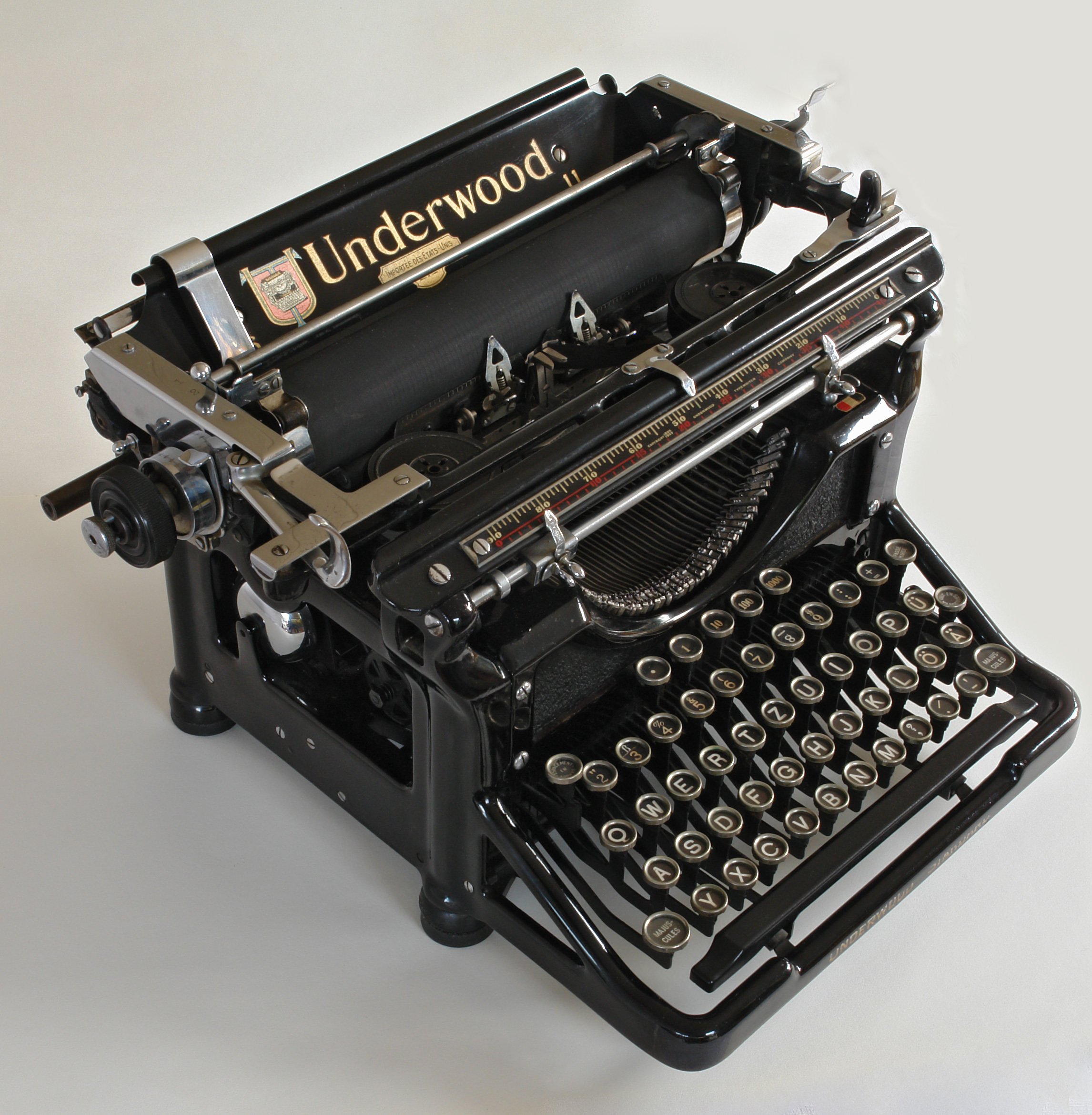
Now this is more the kind of thing! A splendid article from the BBC that highlights the benefits (yes, there are such things!) of a typewriter over a personal computer. And they haven't even touched upon the finer aesthetic qualities of the typewriter compared to the black/beige box that is the PC. "Clunky" and "dirty" indeed! Why, just look at the picture above - how beautiful is that?

As you may have worked out by now, I am somewhat passionate about typewriters, just as I am about most early- to mid-20th Century machinery. I have one myself, an Imperial 66 that I'm ashamed to say is rather battered and has seen better days, as you can see (left). It still works though! If anyone knows the name of a good restorer, however...

I can quite understand why some people prefer typewriters over more modern devices (I would love to use my own more often) and the users featured in the article make quite pertinent yet funny points regarding the shortcomings of newer technology. However it is surprising (but understandable) to see that typewriters still retain some popularity among students. Nevertheless the writer of this piece has, at least in my case, hit the nail fairly firmly on the head in his description of aspiring typists and aficionados of the machine(!). The chap mentioned in the article, Richard Polt, is well-known and highly-regarded in typewriting circles and ironically the Internet has allowed groups and collectors to flourish all over the world. Adventures In Typewriterdom, Fresh Ribbon, Retro Tech Geneva and Strikethru are just a few examples of the blogs I have stumbled across in my travels.

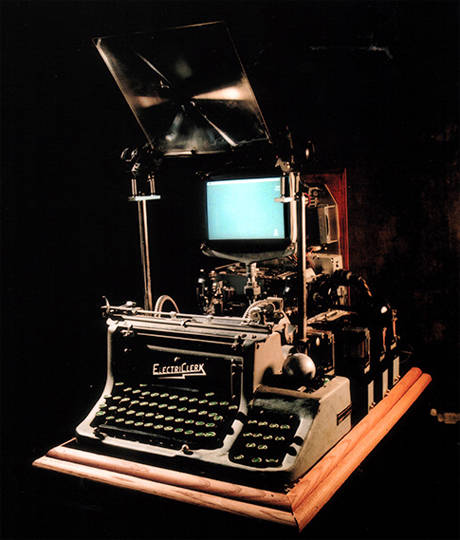
It is a sad inevitability that typewriter sales are declining, probably to a point where they will soon cease to be made new, but so long as there are those out there with a passion for these machines their future is assured. Of course there is another avenue - one that has been explored by the Steampunk movement in particular - and that is the merging of typewriters with computers. This has been done to varying levels of ingenuity and success, from programs such as Virtual Typewriter, through the wonderfully detailed ElectriClerk (above), to the chap who has managed to convert old typers to work with iPads, Macbooks and the like (below).


Finally, one more little thought-of advantage typewriters have over computers is that they make a delightful noise. Which allows me to finish this post with a fantastic typewriter history lesson in sound. Close your eyes and get ready to be taken through... The History of the Typewriter:


Friday, 15 October 2010

Campaign builds to construct Babbage Analytical Engine

Campaign builds to construct Babbage Analytical Engine

An exciting proposal, reported here by the BBC, to create a full-size replica of what is rightly regarded as the world's first computer, as conceived by Charles Babbage in 1837.

It is incredible to think that the foundations for the computer age were laid down as long ago as the mid-19th Century, but Babbage's designs and creations were to all intents and purposes embryonic computers, albeit very large and steam-powered. This picture (above) illustrates only part of the Analytic Engine; as the article mentions a full-size version has never been built and could easily be the size of a small lorry!

Once again it begs the question of "what if?". Had Babbage succeeded in creating a complete working Analytical Engine, what would it have meant for the Industrial Revolution and the British Empire? Might there, as Dr Swade also wonders, have been an information age in the latter part of the 19th Century? Where would we be now if it had been so?

These kinds of questions are, in part, what led to the formation of the Steampunk movement which does indeed image an alternate universe in which Babbage's machines not only worked but became commonplace; in which steam remained the main motive power and allowed amazing adventures to take place with all the majesty and pomp of Victorian Britain through the 19th Century and beyond.

Even if a scale replica is successfully built and operated it will still be some years off yet and, sadly, unlikely to precipitate us into a Steampunk future (sorry chaps!). It does have the potential to be a major engineering undertaking, though, with the great possibility of rewarding knowledge and understanding of the processes and abilities of these early behemoths. Good luck to them, say I!

Friday, 10 September 2010

Steampunk chip takes the heat

Steampunk chip takes the heat

From the New Scientist magazine comes news which proves that the old ways are sometimes still the best. Who would have thought that 150-year-old technology, which has formed the basis for a whole modern (albeit now mainly aesthetic) movement, should end up having a practical use in something as high-end as US Defence projects?

It just goes to show that sometimes modern electronics have their limits and it falls to good old-fashioned mechanical constructions to take the strains which leave more highly-advanced but often fragile devices broken and burnt out. So to sum up: modern technology (above) = rubbish; Victorian technology (below) = the future! Huzzah!

Seriously though, it's heartening to see today's scientists still looking to the technologies of the past and adapting them for use in the present, rather than simply disregarding them. Progress is sometimes not just about inventing the next new thing but also looking to previous designs and breakthroughs to see if they can be adapted or reused to help further existing advancements. The use of such tried and tested designs in these new developments also allows us to follow a timeline of modern technology, from Charles Babbage's original Difference Engine to today's computer chips, and so appreciate the progress that has been made over the last century-and-a-half while still noting the inherent basic similarities between these old and new mechanisms.

Tuesday, 30 March 2010

Steampunks gather for Great Exhibition

Steampunks gather for Great Exhibition

News here of a recent party, held in London, called The Great Exhibition - a gathering of Steampunks, retro-futurists, Chaps and other splendidly turned-out ladies and gentlemen. The good Herr Döktor was the BBC's man on the spot, and many more people went along too. It all looks hugely enjoyable, I think you'll agree, if a trifle bizarre to those not familiar with the Steampunk movement. But with coverage like that given by the BBC perhaps it is starting to emerge from relative obscurity and enjoy a wider following, or at least a greater understanding. Let us hope so!

Monday, 30 November 2009

Tech Know: Flashback to the future


Tech Know: Flashback to the future

Well, after a few days of respite where not much of interest has happened that I feel is worthy of comment, along comes this from the B.B.C., detailing the wonderful æsthetic movement that is Steampunk. A splendid group of ladies and chaps all round, I'll warrant, and what fantastic creations, I think you'll agree! The perfect marriage of Victorian style and modern technology. Form and function. If only it could all look like this. To see more of the same, I recommend this fellow, whose creation you can see illustrated here, in addition to the links within the article itself. I admire anyone who takes the modern, anodyne designs that befoul our lives and put in so much effort to make them into works of art in their own right. Carry on!

Followers

Popular Posts