Showing posts with label Wales. Show all posts

Tuesday, 21 March 2023

Vintage loco comes to the rescue after popular Snowdonia path washed away by floods


Another welcome return to this blog for one of my favourite sort of happenings - the "vintage machinery comes to the rescue" story.  We have seen it before, mainly with steam traction engines and road rollers but sometimes with steam trains and here is another instance of the latter.

On this occasion the engine in question is Lilla, a feisty mid-sized 0-4-0 quarry locomotive originally built in 1891 for hauling slate from the Nantile Valley near Gwynedd in North Wales.  This she continued to do for the next sixty-four years, moving a few miles northeast to the Penrhyn quarry at Bethesda in 1928, before finally being retired in 1955 following a failed boiler test.  Purchased by a private individual in 1963 Lilla spent the following 9 years undergoing restoration before returning to the heritage railway network in 1972.  Moving around the country she finally found herself in her current home at the Ffestiniog & West Highland Railway in 1993 where she has been well cared-for over the intervening three decades.  This has included numerous overhauls and replacement of worn parts, with a brand new boiler being fitted in 2004. 

source - Wikimedia Commons/Hefin Owen

It is no doubt this high level of preservation that allowed Lilla to step up and come to the aid of the National Trust when recent flooding caused part of a nearby tourist trail to be washed away.  Already a common sight on the F&WHR line pulling everything from quarry wagons to carriages full of children, Lilla seemed the obvious choice to haul the 30 tons of aggregate needed to repair the damaged path and I am delighted to see that she performed the task as though she'd never been away, proving once again how - provided they are maintained in good condition - vintage machines can still fulfil their original purpose.  Kudos must also go to the National Trust Cymru for approaching the F&WHR with the idea of using Lilla to help out - the sort of thinking one is glad to see in a heritage (or indeed any) organisation and one which I hope we will continue to see more of, as people realise that machines like Lilla still have a lot left to give.

Monday, 24 August 2020

Footage shows 'forgotten' aerodrome from before WW2


Vintage aircraft footage of 'forgotten' pre-war aerodrome

Here we have another interesting article both in and of itself and also as a further example of modern technology being put to good use in boosting knowledge of the past.

As with the recent story about "Facts Discs" for classic cars the technology is again the ever-present QR code, which allows smartphone users to access information digitally from a website or online database.  In this case, however, the information takes the form of historic and previously lost footage of one of Wales' first aerodromes.

source - B.B.C. News

When Llandrindod Wells had more flights than Cardiff

Only rediscovered three years ago this remarkable piece of film - shot by a local chemist and amateur photographer and donated by his daughter - is the surprising proof that the small mid-Wales town of Llandrindod Wells was at the forefront of British aviation in the years between the wars, with its own airfield based in the town's Rock Park.  As the article explains, the expansion of civil aviation in Britain just before and immediately after the First World War meant that towns and cities up and down the country were queuing up to get municipal airports built in their vicinities, off the back of aerial tours such as Sir Alan Cobham's Flying Circus (coincidentally I recently just finished reading the autobiography of journalist and filmmaker William Courtney (entitled Airman Friday) who served as organiser and press officer for Cobham (as well as for Amy Johnson and Jim Mollison) and who wrote at length about his and Cobham's efforts to encourage local authorities to invest in airports in the '20s and '30s).  Clearly Llandrindod Wells was no exception, thanks to its forward-thinking and air-minded councillors who foresaw the benefits of having an aerial link from an otherwise remote part of the country.  That link quickly blossomed to include daily flights to such national hubs as London, Birmingham and Cardiff, not to mention the provision of local joy-rides and regular air displays.  It must have been a truly exciting and inspiring sight for the people of this little Welsh town to see aeroplanes taking off regularly from their local park to destinations around the country.  The optimism of the idea is almost palpable and who knows where it would have led had not the Second World War intervened?  But intervene it did and, along with advances in aircraft design, it signalled the death knell for many grass strip airports like Rock Park. 

source - B.B.C. News

Now thanks to the fine work of local history site History Points the people of Llandrindod Wells and visitors to Rock Park can learn about this fascinating aspect of the town's history when they take a trip there by scanning QR codes placed at the site of the airstrip, which will allow them to view this incredible footage of a pioneering airport that - if only for a short time during the Golden Age of aerial travel - put this little corner of Wales on the map.  Once again this is a welcome use of "smart" tech to help teach future generations about local history in a relevant, engaging way and is something I hope we continue to see more of.

Saturday, 4 July 2020

Sanitiser maker's links back to Victorian cough cure

source - BBC News

Sanitiser maker's links back to Victorian cough cure

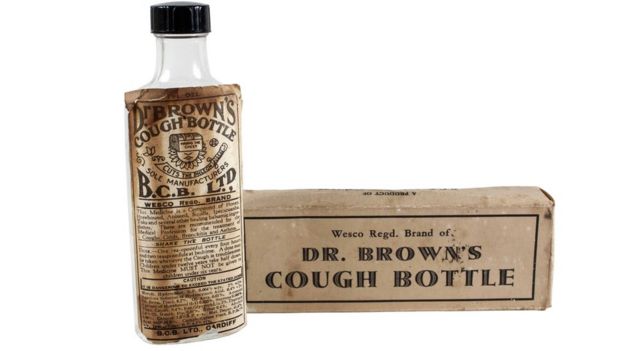
Perhaps unsurprisingly there has been very little in the way of interesting vintage-inspired news to come directly out of the coronavirus crisis so this article about an historic company making hand sanitiser for the NHS is a rare and welcome example.  There are many facets of this story that make it worthy of inclusion here, not least the historical interest surrounding the Victorian "cough cure" that started the company in question on the road to where it finds itself today, taking inspiration from its founder and helping to provide much-needed equipment for those dealing with Covid-19 in hospitals up and down the country.

source - Flickr

As with so many all-purpose medicines that began to appear in the 19th century, Brown's Cough Bottle included among its ingredients several classic Victorian standbys such as laudanum (opium + alcohol), cannabis and chloroform.  The result, as was to expected, was a rather addictive drug as the accompanying article explains.  The classic style of advertisement from the time (above) using its alternative and more accurate name of Chlorodyne, shows just what wide-ranging a treatment it was marketed as - able to treat anything from a simple cough right up to gout and rheumatism (probably would have shined the furniture up a treat, too).
source

Nevertheless it was obviously doing something right (beyond getting the user hooked on opioids!) as despite changes to the content causing an initial downturn in its popularity the medicine still lives on today - albeit under the control of a different company - as J. Collis Browne's Mixture for coughs and stomach complaints (and with a slightly less addictive 1mg of morphine).

BCB International, which can still trace its origins back to Collis Browne and his cough medicine (BCB originally standing for Brown's Cough Bottle), now owes more to his other major interest - yachting and open air pastimes - by manufacturing adventure equipment and emergency supplies, with the cough mixture now produced by a separate but still family-owned branch of the business.

source - BBC News

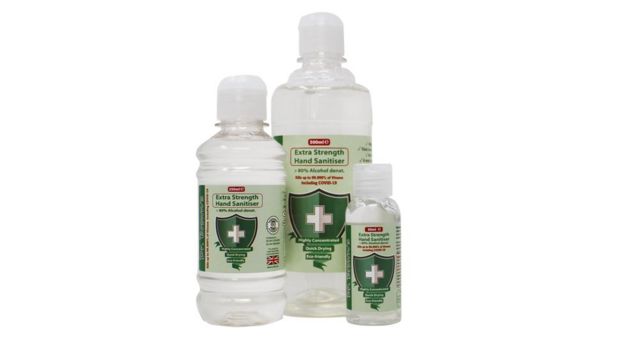
Now BCB has stepped up to the crease during the pandemic and used its facilities and experience in producing emergency equipment to swiftly start production of hand sanitiser and PPE for use in hospitals and by key workers.  In a fine tribute to the man who started it all for them 172 years ago - and who I'm sure would be proud and astounded were he around today - they have branded the hand gel Dr Browne's Hand Sanitiser.  All in all then a splendid piece of good news for these trying times, with a vintage twist; I take my hat off to BCB International for taking inspiration from their past in helping to produce equipment that will help ensure many people's future.


To finish on a somewhat humorous note the name J. Collis Browne was not unknown to me before this news item appeared on my radar, although from a rather different source quite unrelated to its actual origin.  Without doubt one of the more bizarre CDs in my music collection, Collis Browne's Jamboree contains an eccentric selection of songs and performances by the creator of The Chap magazine Mr Gustav Temple and some of his chums.  Produced back in 2003, when The Chap movement was but a mere 4 years old, it was originally only available to order through the magazine but I was able to pick up a used copy online a few years ago.  It truly is an eclectic mix of ukelele covers (Champagne Charlie and The Kinks' Dedicated Follower of Fashion among others) and weird recitals such as Collis Browne's Recipe, above.  Quite where Mr Temple and his cohorts got their inspiration for this frankly weird record from I don't know but clearly they must have come across the name J. Collis Browne somewhere along the way (I sometimes wonder if they found a stash of Dr Browne's original mixture, necked the lot and came up with the CD in an opium-fuelled stupor one afternoon...).  The result is this strangely appealing disc, which is a valued part of my chappist musical collection and my first introduction to the name of Collis Browne.

Sunday, 2 June 2013

Replica Victorian carriage makes debut on Snowdon Mountain Railway


Replica Victorian carriage makes debut on Snowdon Mountain Railway

From New York subways to Welsh mountain railways now, in what is fast becoming a rail-themed weekend here at Eclectic Ephemera.

While Lily the Heritage Carriage may look several decades older than the New York Transit Authority's 1930s stock, its main body is in fact brand new - only recently completed by a group of highly-skilled workers who have pulled out all the stops to ensure a truly accurate replica of a carriage that would have travelled along the picturesque Snowdon Mountain Railway back in the 1890s.  That it is mounted on an original 1920s chassis is, as the accompanying report says, a splendid amalgamation of old and new.

Looking every inch the true Victorian carriage, with details to die for all beautifully crafted by expert engineers, Lily is now ready to take passengers on the equally beautiful journey to the top of Wales' highest mountain.  It certainly looks absolutely glorious and one can just imagine the same trip being undertaken 120 years ago, although the idea of there originally being no windows is less appealing! 

Congratulations to Snowdon Mountain Railway and their associates in getting this wonderful carriage designed, built and running on the line.  The beauty of the Welsh mountains, which I can certainly attest to having been there myself, has only been enhanced with the introduction of this 19th century replica and I hope one day to return to Snowdonia and experience a trip up the mountain in it myself.

Monday, 27 May 2013

Forgotten aviation pioneer’s aircraft to take to the air once more

source

Forgotten aviation pioneer’s aircraft to take to the air once more

History can be a fickle thing at times, as these two recent articles about a previously unheard-of 1900s Welsh aviator show.  While the names of Wright, Alcock & Brown, Lindbergh and Earhart will forever be writ large in the annals of aviation those who came before even them, the "nearly men" of powered flight - John Stringfellow, George Cayley, Otto Lilienthal and Octave Chanute to name but a few - remain obscure at best.  The subject of this story, Welshman Christopher Carlyon, would likely have remained buried in that same list were it not for the efforts of the aviation enthusiast and fellow countryman mentioned in the articles who is determined to see a replica of Carlyon's aeroplane built - and more importantly, fly.

The eccentric engineer and the 'pioneering' Valleys flight that never was

Although his design came after the Wright brothers' famous flight at Kitty Hawk Carlyon's aircraft apparently contained several features far in advance of the Wright Flyer, which there is little doubt would have had a positive effect on its flying ability.  That Christopher Carlyon was just a 17-year old colliery worker at the time, with little experience of the mechanics of flight, makes his attempt to fly all the more remarkable and the unfortunate destruction of the machine during a heavy storm in 1910 particularly heartbreaking. 

Christopher Carlyon: Pontycymer's unsung aviation pioneer

Reading these two pieces one thing that strikes me is how easy it is to forget just how new and unknown powered flight must have been at the turn of the last century.  The Wrights had the earlier works of glider pilots like Lilienthal and Chanute to use as a basis plus the mechanical know-how gleaned from their experience with bicycles, printing presses and so on.  But even a large chunk of their research was based on studying pictures and reports of the early gliders and it seems this is what Carlyon did when news of the Wright's breakthrough flight reached Pontycymmer - plus he also travelled to see the Flyer when it came to London in 1904.

It is a strong reminder, over a century later and with powered flight now utterly commonplace, of just how thrilling, exciting and inspiring mankind's sudden ability to travel through the skies was at the time.  I can imagine a young Christopher Carlyon being one of thousands to go up to London to see this amazing new machine, being moved to build one of his own and damn well nearly succeeding too.

source

While the events that led to the destruction of the Carlyon glider and Carlyon's own life after this remain tragic it is splendid to see that there are those out there intent on seeing that his achievements are not totally forgotten, especially by attempting to build and fly a full-scale replica.  I hope Mr Thomas Maddock (above, with his 1/3rd scale model) is successful in honouring - and proving right - a fellow Pontycymeran inventor and pioneer pilot.

Tuesday, 20 November 2012

Britain's 'last typewriter' produced

UK's 'last typewriter' produced


Five reasons to still use a typewriter

We (that is, the family) had a Brother electric typewriter back in the early 1990s, prior to the advent of affordable personal computers.  'Fraid I can't remember the model though (could have been an early Wrexham CM1000, in fact - they all look alike to me!  Not as huge a fan of electric types as I am of the good old manual typewriter.).  Still ours was used fairly frequently, mainly by mother for work but also by me for schoolwork (always enjoyed the auto-correct function, I must admit!) and to give the old Imperial a bit of a rest now and then!

Britain's 'last typewriter' produced

The demise of British typewriter production does have a personal aspect then, as it also seems to in a wider sense for a great many Britishers who remember using [manual] typewriters and the U.K.'s manufacturing heyday.  From my point of view (and, I suspect, a number of my readers') it has the added layer of interest tinged with sadness as the sphere of the typewriter grows slightly smaller still.  As such it may not be the kind of jolly story this blog values and is known for, but it is a little bit of noteworthy technological history in the making and deserves to be documented here.

The typewriter will no doubt continue for many more years to come both in its existing modern form and in its previous incarnations thanks to the concerted efforts of the Typosphere.  From now on, though, only the latter will exist in Britain.

Monday, 17 October 2011

Victorian kitchen found untouched at Cefn Park, Wrexham

Victorian kitchen found untouched at Cefn Park, Wrexham

This has been sitting in my draft folder for weeks (and yet I haven't seen it anywhere else, but all the better for me!) so it's rather old news - although you could say that everything I blog about is "old" news(!).

Still, it's nothing compared with how long this 19th Century kitchen has lain unused in the old Wrexham house featured in this news story.  The thrill of finding all those culinary items that hadn't seen the light of day for at least 70 years must have been immense, not to mention the general surprise that the owners would have felt having grown up there without ever realising this amazing room even existed.

It's a fantastic window into the world "below stairs" one hundred years ago and it almost seems a shame that the renovation is going ahead, rather than the room being left as a kind of time capsule, although I'm sure that the work will be sympathetic to the original kitchen.  I'm not sure I'd fancy cooking 19th Century-style anyway, if I'm honest!

Nevertheless, it's another wonderful story about an interesting historical discovery which proves, if nothing else, that there are these untouched gems still out there to be uncovered.

Monday, 13 September 2010

Building a bomber plane in just a day

Building a bomber plane in just a day

As part of the commemorations marking the 70th anniversary of the Battle of Britain and the London Blitz there have been many events and programmes in memory of "The Few", the fighter pilots of the RAF who bravely and heroically repulsed the Luftwaffe attacks in 1940.

However there are also articles and programmes such as this one from the B.B.C., which tell the story of the workers in the factories and their ongoing job of building aeroplanes and war material for the Allied forces. In particular it focuses on one amazing example of people pulling together for the greater good and performing a Herculean task in order to prove that they were the best in the world and that they wouldn't give up even in the face of constant adversity.

To build an aeroplane the size of a Vickers Wellington in 24 hours sounds an almost impossible target even today, so for the workers of the Welsh Vickers factory to have done it 70 years ago is beyond admirable.

This is yet another story well-deserving of being told, to remember the thousands of men and women who worked in factories up and down the country to provide the necessary machines and equipment to ultimately win the war.

*For British viewers, Wellington Bomber airs on Tuesday 14th September at 8p.m. BST on B.B.C. Four and will of course be on iPlayer for a week thereafter.*

Followers

Popular Posts