Showing posts with label France. Show all posts

Thursday, 7 March 2024

Airships around the world!


Going back a mere 12 years for the origins of this next post we switch from the road to the air and a mode of transport oft-championed by this blogger; one that is slowly (as is its wont!) continuing its renaissance in a new 21st-century reimagining but still with positive links to its past - the airship.

Even more of an enthusiast of this form of lighter-than-air travel than yours truly (and in a far better position to do something to promote it!), Texas native Don Hartsell has spent over 40 years dreaming and nearly 20 years planning the inaugural World Sky Race for airships.  As reported back in 2012, Hartsell had been attempting to raise commercial and financial interest for his fantastic scheme since at least 2006, with the nascent plan to have the race ready to begin from London in 2014.  Alas, as is often the way with these sorts of huge undertakings, that vision was forced to go by the wayside (as had an earlier start date of 2011) due sadly to a lack of necessary funds.      


Now, however, Mr Hartsell seems confident enough to speak again publicly about his marvellous idea - with what would seem to be some credible expressions of interest from a variety of parties representing all different sorts of markets and the advantage of a far more advanced airship industry that looks poised to take on this epic challenge to their (and the world's) benefit.  Things seem to have progressed to such a degree that Mr Hartsell has even bought six(!) airships for use by any entity who might wish to join the race and I genuinely wish him the very best of luck in his search for entrants into his World Sky Race.  The chances of that seem all the more heightened thanks to the remarkable number of airship manufacturers that have sprung up over the last fifteen years or so and the progress they have all made in that time.


French concern Euro Airship is just one of several companies at an advanced stage of airship development and to promote their latest vessel Solar Airship One have, in a similar vein to Mr Hartsell, announced their intention to undertake a 20-day long nonstop flight around the world without using any fossil fuels whatsoever (as the name suggests, the airship is 100% solar-powered). Wouldn't it be a wonderful thing if the two were to team up, or at least for Euro Airship to enter the World Sky Race?!  What a boost it would be for the industries involved - not only airship design and application but all the associated machinery that goes with it; a true melding of old and new technologies, a showcase for 21st-century know-how in a long-neglected pre-war ideal!  I look forward to continuing to follow the progress of Euro Airships as they gear up for the planned 2026 launch - they certainly seem to be well set to succeed, with some experienced aviators signed up to the project (not least famed French adventurer Bertrand Piccard).  This is definitely one to watch!  


Likewise, fellow Gallic airship engineering business Flying Whales (great name!) seem well on their way to becoming airborne, their new Large Capacity Airship scheduled to gain its type certification within the year with the aim to be fully operational by 2027.  They already have an eye on the international cargo market with plans to set up production plants in Canada and Australia to complement their Bordeaux HQ; I wouldn't bet against them either!

British-based Hybrid Air Vehicles, working out of the old airship hangers at Cardington in Bedfordshire (where the R.101 was built and departed from on its ill-fated maiden flight to India in 1930), is another airship manufacturer that has spent the last fifteen years refining its own designs into the Airlander 10.  Now they have finally reached the exciting stage of applying for type certification with the UK's Civil Aviation Authority which, if given, should allow HAV to begin full-scale production with commercial flights envisaged to start in around four years' time.  Airships gracing the skies of Britain (and the world) again before the end of the decade?  What's not to like?!


Never ones to be left behind in any race - technological or otherwise - American expertise is also working on its own airship design with the US company Aeros' Dragon Dream concept having been in development since 2013 and although the prototype suffered a setback in 2015 when it was damaged in a hanger accident it would seem the company is still pushing ahead with the search for a production site; I see no reason why we should not see their eVBAs criss-crossing the globe again within a similar timescale.  


EDIT 09/03/24: I knew I'd forgotten one - and how embarrassing that it should be the largest of the lot!😳 (I say, emojis - are they new?  Sorry, I'm digressing!)  Apologies to LTA (Lighter Than Air) Research, the brainchild of Google co-founder Sergey Brin, whose Pathfinder 1 prototype has recently taken its initial steps towards regular test flights over its California base after 10 years in development.  Once again utilising the very latest in aeronautical technology the Pathfinder nevertheless retains much of the traditional airship design and will doubtless make a mightily impressive sight sailing over the San Francisco Bay area.  That an even larger Pathfinder 3 is planned - and to be headquartered at Akron, Ohio (to the USA what Cardington is to Britain) - is almost too much to imagine but I'll wager that, with this level of backing, if anyone can do it these chaps can!  A fleet of Pathfinders, joining with the other airships mentioned above to deliver urgently-needed cargo to inhospitable areas, carry passengers to anywhere in the world - or even just take part in an around-the-globe World Sky Race! 😉 - feels more and more like an attainable goal if these projects achieve their potential, as I'm sure they must.  

As well as the many commercial enterprises that are pursuing the 21st-century airship concept, so smaller businesses and private designers have also recently been reimagining them for modern personal use in the wonderfully futuristic form of "air yachts" - the term dating from the golden age of pre-war flying boats, especially the smaller private variety, but now meaning an airship/boat hybrid!  While admittedly the idea of superyachts in this day and age is understandably looked upon in some circles as vulgar and unnecessary one has to admit the engineering, not to mention the execution, can still stir the soul and remind one of the technical skills and spirit of adventure that mankind possesses.


Swiss-based company AirYacht (a relative newcomer formed in 2017), is one of the few airship designers to be exclusively targeting the passenger market with its AirYacht concept.  Attractively billed as "the sky's cruise ship" and again harking back to the glory days of international luxury travel, the AirYacht seems to be intended for private owners or select travellers wishing to take small group holidays and sightseeing tours to otherwise remote places - as with all of these ventures much being made of the sustainability, advancements and slower pace afforded by the application of modern technology to these incredible craft.  Although I fear that, at least initially, a flight in the AirYacht will be beyond the reach of most of us mere mortals it is to be hoped that again success will lead to similar, more accessible craft taking to the skies and so to greater economies of scale in the future.  I certainly wouldn't say no, given the opportunity!


Another airship enthusiast (witness his reference to the 1924 airship Norge, which I also previously blogged about) and imaginer of airship-yacht crossovers, Perpaolo Lazzarini's Colossea is his second design following his 2022 concept but, whereas that was intended to land directly on the water, so the Colossea has a separate airship attached to a boat's superstructure, able to detach at will to fly independently!  Again aimed at the ultra-luxury mega-yacht market the Colessea nevertheless boasts some fantastic modern engineering again married to traditional airship design and - if one must have these things - I can't help but again feel enthusiastic that such a project even exists. 

With all these at various advanced stages of development I can't see why Mr Hartsell's World Sky Race shouldn't have a whole slew of entrants from across the private and commercial sectors lining up to take part.  What amazing publicity it would be for all these airship manufacturers to be involved in such a great adventure, circumnavigating the globe and showing whole new generations the wonderful potential of airships and so finally throwing off the terrible images of the Hindenburg and R.101 - tragic though they were - that have unfairly dogged this mode of transport for too long.  The airship cannot - must not - go on being judged in such outdated fashions (to be fair, I feel that these have been somewhat overrated in recent times - I fancy that the younger generation will be far more open to this revised mode of transport, particularly given its new ecological credentials) and a World Sky Race featuring the best current lighter-than-air design has to offer has to go some way towards continuing the revival of this splendid form of travel.  Could the 2020s be the decade that airships finally enjoy their long-overdue resurgence?  With all this positive development I think we can do more than hope!   

Thursday, 19 November 2020

Live action Tintin film reportedly on the way

via GIPHY

Live action Tintin film reportedly on the way

Just when I was recently lamenting the lack of a sequel to 2011's The Adventures of Tintin: Secret of the Unicorn from either Peter Jackson or Steven Spielberg along comes the news of a new Tintin film in the works - but not from the source, nor in the format, that one might expect.  


source - IMDb
No, with the promise of a follow-up to Secret of the Unicorn still not forthcoming from either Mr Jackson or Mr Spielberg the door has potentially been left open for a new production (or a "reboot", to use the modern parlance).  Through that door, according to the accompanying articles, may come the little-known (outside of France) director Patrice Leconte and his plans for a live-action Tintin film - the first time such an undertaking has been mooted since Tintin and the Blue Oranges was released nearly 60 years ago in 1964.

source - IMDb
That film was in fact the second of a planned trilogy of live-action Tintin stories, beginning with 1961's Tintin and the Golden Fleece.  Both films had original storylines not featured in any of the books but featured all the main characters including Tintin, Captain Haddock, Professor Calculus, Thomson & Thompson and of course Snowy(!).  The title character was played by a young (then aged only seventeen) unknown Belgian Jean-Pierre Talbot who, while working as a sports instructor on an Ostend beach, had been spotted by a talent scout who noticed the useful resemblance to the boy reporter.  Introduced to the great Hergé himself the two quickly became firm friends and Talbot's role was assured (although this was to be his only foray into acting; after The Blue Oranges he returned to relative obscurity and later became a teacher.  Now aged 77 and retired, he still lives in his home town of Spa).  He was the only actor to play the same character across both films, with Captain Haddock being portrayed by Georges Wilson in The Golden Fleece and Jean Bouise in The Blue Oranges.  Professor Calculus likewise was played by Georges Loriot in the first film and by Félix Fernández in the second.  Some confusion still surrounds the actor(s) who played Thomson & Thompson in the first film as they were only listed in the credits as "Incognito", while IMDb would have us believe they were both played by the same man - the mysteriously-named "Gamonal" (although there is some suggestion that they may have been Les Frères Gamonal (i.e. the brothers Gamonal).  Certainly they appear to be two separate actors in the film.)  In the case of each movie all the supporting actors were made-up to some extent so as to better approximate the look of their characters while still retaining the live-action æsthetic - the success (or otherwise) of which I will leave for you to decide, both films being currently available on YouTube here and here.

source - IMDb

The Golden Fleece
sees Captain Haddock inherit a ship (the Golden Fleece of the title) from a recently deceased friend, which soon leads to all sorts of adventure in the search for lost treasure (so although ostensibly a stand-alone plot it does seem have been inspired by the two-parter stories The Secret of the Unicorn and Red Rackham's Treasure).  Following that movie's success the second film, The Blue Oranges, was released three years later and - in an adventure that definitely owes nothing to the books - sees our heroes come to the aid of Professor Calculus and his friend who have hit upon an invention to cure world hunger, which needless to say soon attracts the attention of some villainous types!  A third film was to have been made for release in 1967 but due to the less than positive reviews of The Blue Oranges it was cancelled and so these two cinematic oddities remain for now the only attempts at a live-action Tintin movie.

source - IMDb


source - Wikipædia
Until now, that is, with the exciting news that veteran French director Patrice Leconte has expressed an interest in producing just such a film - this time to be based on one of the actual books, namely The Castafiore Emerald.  Intriguingly this particular story would be very much a set-bound piece, taking place exclusively at Marlinspike Hall - the home of Captain Haddock - and is essentially more of a "who-dunnit" rather than an out-and-out adventure.  How successful that will prove to be remains to be seen (the book itself, a later release published in 1963, was not well-received on account of Hergé breaking with the traditional adventure-style storyline for the first time), especially as M. Leconte is still in early negotiations with Paramount Pictures for the copyright which still lies with Spielberg (look man, if you're not going to do anything with it after nearly ten years at least give somebody else a chance!).  For this reason alone, thrilled though I am at the prospect of a new Tintin film and buoyed by M. Leconte's arthouse credentials (which includes stints as a comic strip writer), I don't hold out much hope for one seeing the light of day any time in the next few years.  I know from previous experience how long it takes for a film that has only just been tentatively announced and may not even be in pre-production to finally make it to our cinema screens and I expect that - if it hasn't died a death in the meantime - I'll still be blogging about its progress well into this decade.  Still, hope springs eternal and despite all this negativity it seems M. Leconte is confident enough to announce some degree of progress - having claimed production has started - although to what level is not clear - and the parts of Captain Haddock and Bianca Castafiore have already been cast.  I wish M. Leconte every success and will be keeping a close eye on this production in the profound hope that we Tintin fans will not be disappointed by a third director!


As this looks likely to be a French-led production (although Paramount may well demand some input in return for the copyright and distribution rights) one imagines that the cast will probably be a largely European one, unknown outside the Continent - although perhaps with one or two big names to aid its popularity.  With that being the case and with M. Leconte allegedly having found his Captain Haddock and Bianca Castafiore, my own ideas on casting for a live-action Tintin film seem even more redundant than they did previously.  However I'm not a man to let that stop me so I will plough ahead and finish this post with my casting director's hat on and my thoughts and suggestions for actors and actresses to play the major roles in any forthcoming live-action production.


source - Wikimedia Commons / 
Gage Skidmore
The difficulty in finding an actor to portray Tintin is that they must by necessity be quite young - our hero is a "boy reporter" of only fifteen, don't forget - or still be possessed of petite, boyish looks despite being well into their twenties or older.  Think Daniel Radcliffe of Harry Potter fame, for instance - although I wouldn't necessarily choose him as I don't think he would have quite the right appearance even with make-up/ prosthetics.  In the case of a series of films this in turn leads to the problem of needing to anchor the character's age over the course of a short period of time in the story arc against the actor's natural aging process during the years of each film's production.  A classic example of this can be seen in the Spider-Man films, beginning with Sam Raimi's trilogy of 2002-07 starring Tobey Maguire, through Andrew Garfield's tenure in The Amazing Spider-Man 1 & 2, to the current incumbent Tom Holland (above).  The character of Peter Parker is in many ways similar to that of Tintin (barring the superhuman strength, ability to stick to walls and web-slinging skills, of course) - a teenage reporter/ photographer getting into all sorts of scrapes and adventures - and so requires the same sort of actor to pull the role off, hence the reason why there have been so many reboots of that particular franchise in little under twenty years.  I happen to rate Tom Holland very highly and for that reason, as well as his matching the criteria I mentioned above, I certainly think he could be an excellent Tintin.

Give him a quiff and you're all set.
source - Wikimedia Commons / 
Greg2600
My first choice for the part of Belgian's famous fictional son, though, would be one of Mr Holland's fellow young British actors - Asa Butterfield (left).  Perhaps best known for his breakthrough role in 2008's The Boy in the Striped Pyjamas and as the eponymous Hugo in that excellent Thirties-set, Steampunkesque film, young Butterfield has for me just the right look about him for the character and has impressed me in everything I have seen him in.  Like Tom Holland I can see him keeping his fresh-faced appearance well into his thirties (both actors being in their mid-twenties now) which would hold him in good stead for any sequels.

sources - Wikipædia/
Gage Skidmore/
Eva Rinaldi
Having ummed and aahhed a bit my pick for Captain Haddock would come down to two established actors who I feel could really relish in the part.  The first is Kiefer Sutherland, who I feel is now of an age at and stage in his career where he could channel some of his father Donald's eccentricities into a challenging character like the good captain.  Just try and imagine him with a bushy black beard and see if you don't get what I mean.  The second - and again my top choice - would be Russell Crowe.  The gravelly voice, the stocky build, the intensity of his acting ability could all be brought to bear with great success in a more light-hearted role that would still test him.  (Honourable mention should also go to Andy Serkis, I feel, who voiced Captain Haddock in the 2011 Spielberg film.  He's very good at playing a broad range of characters and again with a full beard I could easily see him in the role.)


sources - IMDb/ Wikipædia/ Gage Skidmore

For Professor Calculus only one actor comes to mind - Sir Ben Kingsley.  Frankly, to use a modern expression, I think he would smash it out of the park and after Tintin his is probably the one part I would most like to see essayed.  Calculus is arguably the most difficult character to approximate, having such a unique look about him (he was modelled on the eccentric Swiss scientist and aeronaut Auguste Piccard - another subject for a standalone post, methinks!) so as well as being close in terms of looks and stature, requiring less make-up, I reckon Sir Ben's superb acting skills should be more than up to doing justice to the part. 

sources - Wikipædia/ Gage Skidmore/ iDominick

The characters of Thomson & Thompson are equally difficult to cast, I feel, not only for their distinctive appearance but also for the fact that they look identical despite not being twins (that being the joke).  So does one go with a pair of brother actors like the Wilsons (Owen, Luke and Andrew), the Hemsworths (Chris, Liam and Luke) or the McGanns (Stephen, Joe, Paul and Mark) or two unrelated chaps who resemble one another (and more so with the aid of make-up/ prosthetics)?  On balance I favour the latter option and in this instance I would stick with Simon Pegg, who played one half of the "Twins" with long-standing comedy partner Nick Frost in the 2011 film, but this time pair him with noted Welsh actor Michael Sheen.  Both actors have the comedy credentials to really bring the characters to life and I have a suspicion the two would really spark off each other in the roles.

sources - Wikipædia/ Garry Knight/ Diggies99

Two actresses again spring to mind as "The Milanese Nightingale", aka Bianca Castafiore and Captain Haddock's constant nuisance.  Top of the list would be Emma Thompson, whose great range includes a healthy dose of comedy and whimsy which could be brought to bear perfectly in the role.  Her ability to play character parts (e.g. Nanny McPhee) also makes her a shoo-in for this kind of portrayal I fancy.  Second choice would be Jennifer Saunders, who likewise has many of the same qualities and would be equally adept at applying them to the character of Señora Castafiore.

source - Pinterest
Alas I am not up to speed on my canine actors so dear old Snowy (or Milou in the original French), important though he may be, will regrettably have to be side-lined at least until a specialist doggy talent scout can come up with the goods, which it has to be admitted will be more difficult for a live-action production than a CGI or cartoon one.  Needless to say terriers, as with any other dog, can be trained to appear on TV and in film (I'm thinking in particular of "Eddie" in Frasier and "Jack" in The Artist) and I've no doubt a suitable contender could easily be found.  In the meantime, here's a picture of Tintin's faithful companion and the sort of dog (a wire-haired fox terrier) that could portray him.

Those, then, would be my choices for the main cast of a live-action Tintin flick (and if you're reading this, M. Leconte - no charge).  Regardless of who does play the roles of Tintin & Company I sincerely hope that this latest production has legs and makes a successful transition to the big screen sooner rather than later, bringing everyone's favourite boy reporter back into the limelight - maybe in time for his 100th birthday in 2029.  Bon chance, M. Leconte - I shall be watching the progress of this one with a great deal of interest.

***Would you look forward to a new live-action Tintin film?  What do you think of my Tintin & Co casting choices?  Who would you like to see have a go at essaying Hergé's colourful characters?  Let me know in the comments below!*** 

Wednesday, 11 November 2020

100-year-old carrier pigeon message found in France

source - The Guardian

It seems suitably fitting on this Remembrance Day to feature this fascinating article detailing the remarkable discovery of a tiny First World War relic that has defied the ravages of time to be unearthed by chance in a French field a century on.

This is the frankly incredible story of a small metal capsule, as used to send messages by carrier pigeon and no larger than a cigarette end, being found by a couple out walking in the French countryside back in September.  Having remained undiscovered for over 100 years it had against all odds survived in the mud of eastern France where it fell until, as with many remnants of the Great War, the movement and turning over of the earth revealed it to some people of today who happened by.  The miraculousness doesn't end there, however, for preserved within the miniscule container, which continued to protect it from ten decades of decay, is the original message sent off via carrier pigeon by an unknown German soldier.

source - B.B.C. News

That this little slip of paper has managed to survive for so long is nothing short of extraordinary and despite being understandably extremely fragile and barely legible it still offers a fascinating insight into the activities of a small section of the German Army during the era of the Great War.  Sent from the town of Ingersheim - at the time part of Germany but now in the Alsace region of France - it details for the benefit of an unnamed staff officer the movements of "Platoon Plotthof", which seemed to be advancing and retreating under heavy fire in an area referred to as "Fechtwald".  So faint is some of the writing that unfortunately the precise date cannot be determined, with only the 16th July being clear while the year is still up for debate - either 1910 or 1916.  While on the face of it 1916 would seem the more likely -  being in the middle of the war when German troops would have been engaged in battle - the curator of the museum to which the couple took their find, M. Jardy from the Linge Museum in nearby Orbey, is inclined more towards the 1910 date.  On consideration I can understand why since Ingersheim was within German territory at the time and reference is made in the message to a parade ground, which suggests that it was sent as a part of some military training manoeuvres.  Even so that is a striking fact in itself, since it adds to the knowledge that Germany was practising for war years before it finally broke out (and indeed as any student of military history will know, with its Schlieffen Plan Germany had been prepared for another conflict with France for decades - practically since the end of the Franco-Prussian War of 1870, in fact). 

source - B.B.C. News

This noteworthy find has proved to be a timely yet sombre reminder during this period of remembrance of the build-up to "the war to end all wars" and the sacrifices made in the four years of bloody battles that ensued over one hundred years ago.  It also gives one to wonder just what other interesting artefacts are still lying beneath the mud of France waiting to be rediscovered in a similar manner.  In the meantime I remain astounded by this particular discovery and delighted that it has found its way to a local museum dedicated to remembering the fallen from both sides in battles both near and far and hope that it can be preserved for the benefit of generations to come.   

Wednesday, 22 July 2020

French man develops 120-year-old photos he finds in time capsule


French man develops 120-year-old photos he finds in time capsule

An article that combines two of this blog's bread-and-butter stories now - the discovery of a century-old time capsule and the use of a period method to reconstruct an aspect of the past.

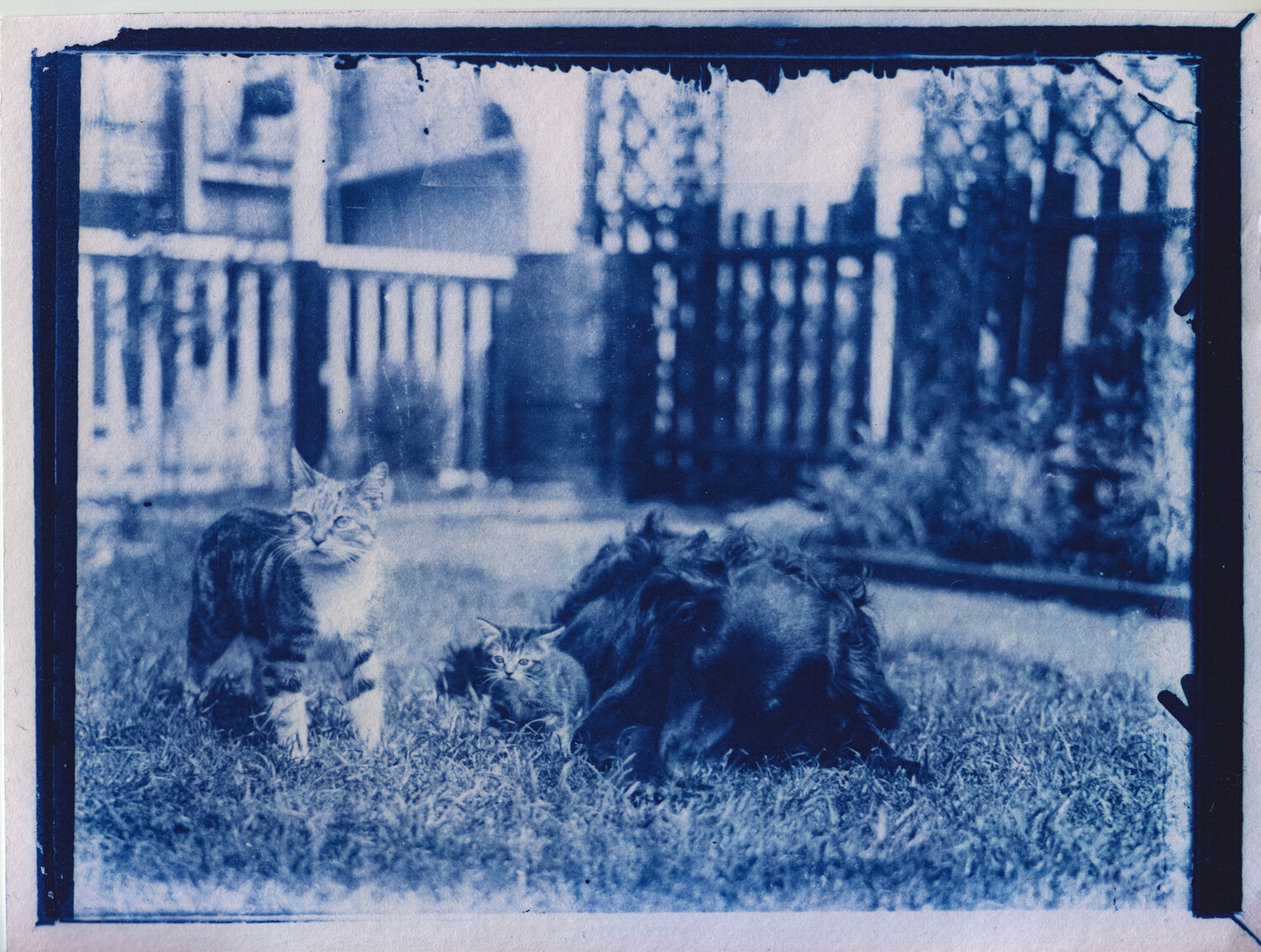
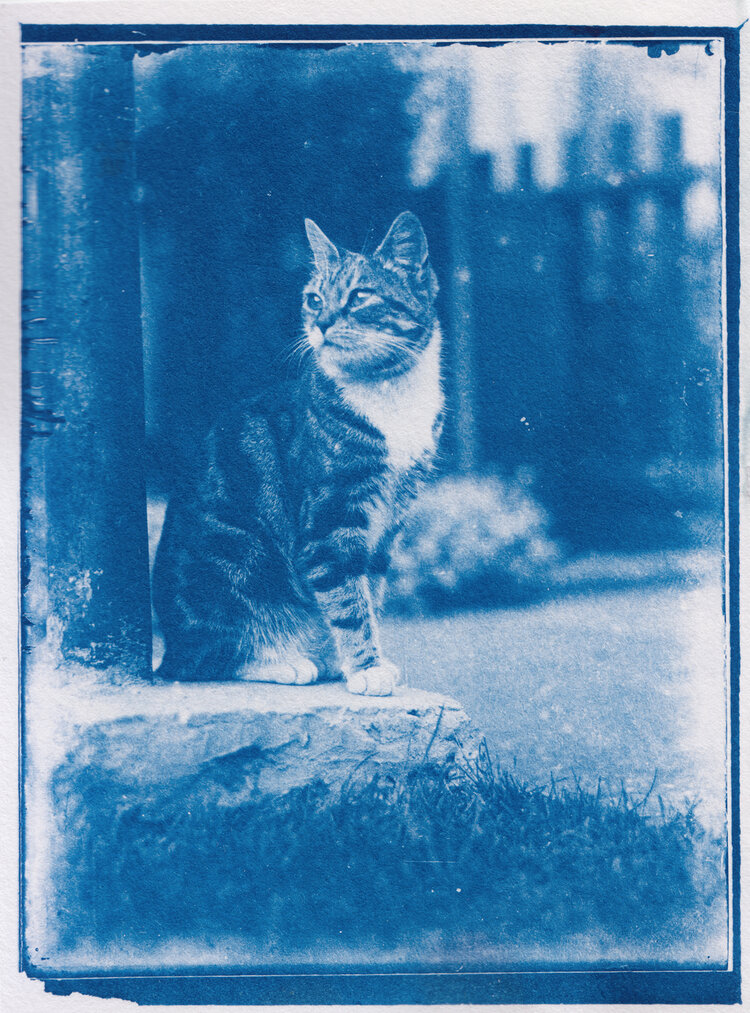
In this instance the hidden box was found in the family home of French photographer and video-maker Mathieu Stern and which somewhat serendipitiously contained several glass negative photographic plates.  Inspired by these previously-unseen slides M. Stern has made full use of his photographic know-how to recreate the images therein using a traditional 19th century process called Cyanotype, to produce a couple of charming pictures that offer a literal snapshot into a little piece of 1900s life.

source - Mathieu Stern

The life was that of a little girl (age unknown) who, judging by what is shown in the accompanying video, clearly took the concept of a time capsule to heart by including all sorts of ephemera from the turn of the last century such as paper cutouts, a coin/medal, pillbox, nib pen and sea shell - not forgetting the aforementioned glass plates.  The contents of the charming little box - which is equally as beautiful - offer a fascinating glimpse into the existence of a young child at the beginning of the 20th century.  Clearly all these things were of great importance to this young girl that she kept them so safe and in such good condition; just as obvious is the emotional attachment of the photographs' subject matter - her pet cats and dog.

source - Mathieu Stern
As M. Stern and others commentators have stated, these images are a wonderful reminder that pets - and especially cats - have been an integral part of [young] people's lives for centuries and the concept of capturing their likenesses for posterity is nothing new - only the medium and devices used have changed in the last 120 years.  One has to wonder if historians in 2140 will be able to look back at images taken on iPhones and the like with quite the same degree of appreciation as us looking at this girl's efforts (or will things get increasingly worse in the next 120 years...?).

In any event M. Stern is to be applauded for preserving these delightful photos and their lovely subjects for posterity while using a photographic technique appropriate to the time and one that would not have been unknown to the original photographer when she took these remarkably contemporary pictures of her beloved companions.  One hope that he will cherish not only the pictures but also the other contents and that this particular time capsule will not be forgotten for another century.

Wednesday, 12 March 2014

British teen's 1914 diary from Paris brought to life on Twitter

source

British teen's 1914 diary from Paris brought to life on Twitter

Hello All!  Well, another busy start to the month has seen ten days fly by but now here I am again with a new post.  I say "new" but the subject was first reported on as far back as January-February.

The 100-year old diary of Olive Higgins, a teenage girl from Kent studying in Paris, has recently come to light after over ten years in the possession of a London journalist & writer, who spent that time researching the girl's tragically short life following the discovery that they both happened to come from the same area. 

Margate girl Olive Higgins' diary put online at 100th anniversary of death

To celebrate the centenary of Olive's writings the journalist, Rob McGibbon, came up with the splendid idea of publishing the daily entries on Twitter (@OlivesDiary1914) - as well as creating a website with every day reproduced in full as well as further information about Olive Higgins, her family and how Mr McGibbon came to be interested.

The diary and the project it inspired have a poignant ending, however.  Barely two months in to her Paris adventure Olive Higgins was struck down by double influenza and sadly died on the 25th February.  Consequently her diary entries stop halfway through that month, as she struggled to recover.

Nevertheless her record of those first few weeks in Paris make for fascinating reading - a real insight into the thoughts of a 16-year-old student one hundred years ago, yet revealing teenage feelings and insecurities still familiar a century on.  Mr McGibbon's project has certainly been a worthwhile one not only from his personal point of view but also as a valuable piece of social history and a fitting & timely tribute to Olive Higgins' life.

Wednesday, 19 February 2014

Bugatti 100P aeroplane reconstructed, will fly again after public debut


Bugatti 100P aeroplane reconstructed, will fly again after public debut

I could barely contain myself at this news, coming the same day as the announcement of another new steam locomotive from the A1 Steam Trust (see yesterday's post), but have managed to wait until today to share it with you.

While the name of Bugatti is most readily associated with luxury cars of the 1920s and '30s, or extreme sports cars of the present, the company's foray into aviation is less well known.  It's sole product, the Model 100, has - as the accompanying media says - been largely forgotten for 70 years; a great shame, considering the beauty, futuristic lines and design of the aircraft (not to mention its story!).

source
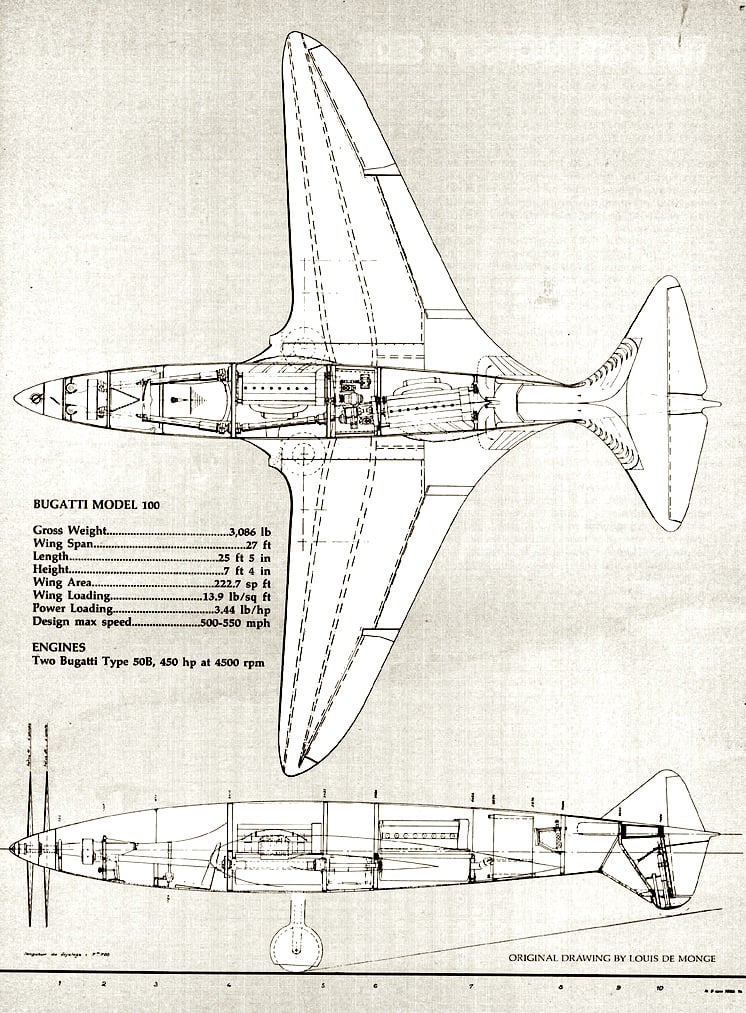
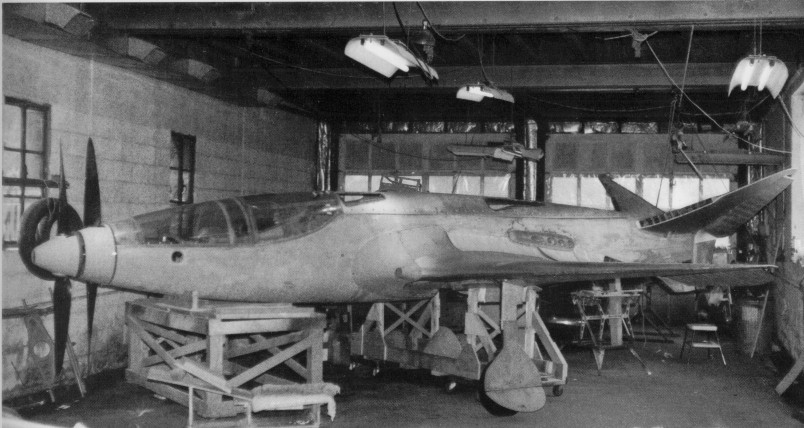
It should come as little surprise that the designer of some of the most magnificent and luxurious cars of the 20th century successfully transferred his skills to create one of the most beautiful aircraft of the 20th century.  Working with brilliant engineer Louis de Monge Ettore Bugatti designed the 100P as a racing aeroplane, similar to the Schneider Cup Supermarines and Macchis of the early 1930s, to win the 1939 Deutsch de la Meurthe Cup air race.  Between them the two men came up with a fantastically advanced design, with swept-forward wings, a V-tail (a design feature not seen on production aircraft for another decade) and two 450hp Bugatti in-line motor-racing engines driving prop shafts that ran past the pilot's seat to two contra-rotating propellors at the front.  Many of these features resulted in patents being filed by Bugatti, five of which endure on modern aircraft.  As a racing aeroplane it was designed to be streamlined and lightweight - the body made of wood composite, the large cockpit fully integrated into the fuselage with the pilot sitting in a semi-recumbent position.

source

source
Sadly the original 100P never flew in the Deutsch de la Meurthe, nor at any other time, thanks to the start of World War II.  Despite a French Government request for Bugatti to adapt the design for a fighter aircraft, the German Army's swift advance on Paris curtailed any such attempt and in June 1940, with the fall of France imminent, the single extant airframe was dismantled and spirited away.  It would remain in storage for the duration of the war.  It then passed through several hands, sadly losing its original engines along the way, before being restored in the early 1970s and passing through several museums before finally ending up at the EAA Airventure Museum in Oshkosh, Wisconsin.  It can be seen there today as a static display; it is no longer airworthy. 

900bhp Bugatti sports plane revived


For the last few years a group of enthusiasts (including, I'm happy to note, the great-nephew of Louis de Monge) have been attempting to rectify this tragic tale, however, by undertaking to build a full-scale replica of the 100P - to almost the same standard as the 1938 original (bar a few modern upgrades/alterations) - that will actually fly!  Now I'm delighted to see that, after a few setbacks, this new Model 100 is close to completion with the final unveiling now scheduled for the 25th March at the Mullin Automotive Museum in Oxnard, California.  Readers may remember that that institute featured previously on this blog, being instrumental in the building of a "new" 1939 Type 64 Coupé.  Quite a suitable venue, then, for the reveal of Bugatti's only aeroplane!

source

Following its March appearance the new 100P is tipped to fly some time later this year and with luck may appear at European events shortly thereafter.  Whether or not it will ever reach the dizzying [projected] 550mph of its predecessor is immaterial - just seeing this wonderful design in the air where it belongs will doubtless be thrilling enough.  I wish continued good luck to the Bugatti100P Project; I can't wait to see more!

Saturday, 12 January 2013

World War I photos found inside antique camera

Photo courtesty of Anton Orlov @ The Photo Palace

World War I photos found inside antique camera

As the 100th anniversary of the start of the First World War moves ever closer (a fact I still struggle to fully comprehend, cf. this earlier post) we will doubtless start to see many stories and articles commemorating the centenary.  Will we see one as fresh and remarkable as this, though?

Over the course of this blog we have seen photographs discovered in shoe boxes, in rubbish skips and in long-forgotten archives.  Now we can add an antique camera itself to that list, as this story of another blogger's discovery tells.

If I understand it correctly the glass-plate negatives found inside this 100-year old camera, picked up at an American antique shop, had previously been processed (otherwise we would not have been able to see them today) but then kept in the camera - where for all we know they may have remained ever since.  Certainly this must be the first time they have been seen for decades - maybe even the first time by people other than the original photographer.  We may never know who took them, or precisely when and where in France they were, but the fact that they have survived all these years is welcome enough news.

Photo courtesy of Anton Orlov @ The Photo Palace

Whatever the history of these pictures they couldn't have ended up in better hands. Photographer Anton Orlov, on whose blog The Photo Palace you can see the full selection of images (as well as some equally fascinating and perhaps even more historically important shots of the same vintage taken in Russia, China and Japan), is clearly a big fan of old-fashioned analogue photography. So much so, in fact, that he has purchased an old yellow school bus with the aim of touring America as a sort of mobile museum/dark room - not only exhibiting the pictures and cameras but also giving talks and running workshops on the early techniques that were used, in the hope of ensuring that knowledge of and interest in non-digital print photography is not lost but rather encouraged. 

Both these and the Eastern photos must surely rank among the top exhibits and I wish Mr Orlov every success in seeing through his endeavour to make them a part of his educational and inspirational scheme.

Tuesday, 15 May 2012

Radio-controlled Spitfire achieves cross-Channel flight

source

Radio-controlled Spitfire achieves cross-Channel flight

A Spitfire crossing the Channel is by no means a new thing - after all they were doing it every day 70 years ago - but this is the first one where the "pilot" has been controlling it from another aeroplane!  Of course, the reason for this is that the Spit in question is in fact a ¼-scale model.

A bit of fun on the part of the aircraft's builder - who quite understandably wanted to undertake the ultimate test-flight - the crossing is also a minor testament to those young men who flew the real thing during the war, ending as it did at the Spitfire & Hurricane Museum at Manston in Kent.

Scale model aircraft have obviously come a long way for one to be able to cross the Channel in under an hour at an average speed of 100mph.  It certainly puts my Airfix models, polystyrene & elastic-band wind-up kits and an old petrol-powered wood-and-papier-mâché Spit that was controlled by two metal wires and which could only be flown around in circles(!) into perspective!

A super-realistic model able to fly over long distances (albeit with the controller in attendance!) must surely be the next-best thing to the real article.  I hope Mr Booth continues to enjoy his aeroplane, and maybe even take it on further long-distance flights.

Friday, 4 February 2011

Excitement in Paris as classic cars go on show


Vintage Cars Go to Auction in Paris

Excitement indeed; if the cars don't get you going the location surely must! What a gorgeous building, and what machinery! How fitting that some of these cars should return to the same place they were shown 110 years ago (and again 60 years later). One can almost image the super-rich of 1901 wandering amongst them and marvelling at the then-new technology. A great showing of the history of the motor car too, I'll warrant. Another reason to hop on the Eurostar to Paris (I wish!).

Lord Raglan's 1930s vintage cars in Paris auction

A splendid selection of motor cars, a slideshow of which can be found here courtesy of Reuters, making up one of the best collections to be sold by Bonhams in quite a while. Too bad about John Lennon's Ferrari, although I can well believe the current owner's reluctance to sell!

A Bonhams automobilia sale is usually something to drool over at the best of times, but for it to take place in the beautiful surroundings of the Grand Palais is likely to make it even more special. The perfect marriage of motoring and architectural history, one might say.

Tuesday, 18 January 2011

The French house untouched for 100 years

The French house untouched for 100 years

This has got to be one of my favourite items of news for a long time! Shades of the 70-year-old Parisian flat I blogged about previously, methinks. What is it with the French and leaving things alone for decades on end? If this had been in Britain the place would have probably been knocked down by now(!). What a fantastic story, and what a fellow Monsieur Mantin must have been to build a huge house, fill it with such a vast collection of ephemera and then insist it be left as a museum so people today could have some idea of his lifestyle? It's the ultimate time capsule!

I get the impression from the article that he is considered something of a morbid eccentric but then as it also says what better way to ensure his immortality? I wish I could do the same, but I doubt my poky little flat and its contents would be of any interest to 22nd Century scholars (or even still standing 100 years from now)! The terms "aesthete" and "gentleman of leisure" are certainly well-deserved though; one could easily add "philanthropist" considering what his legacy has turned out to be and the esteem in which he is held by the townspeople today. It must be a fascinating place to visit - I almost want to hop on a ferry now and cross the Channel to have a look! Certainly a must-see if one is ever in the area.

And to think that a simple misunderstanding went towards making it how it is today, in that M. Mantin only wanted it to be a museum in 100 years time, not that it should be locked up for 100 years. His great niece should also be commended for seeing the cultural and historical importance of the place and ensuring that it was opened in accordance with Mantin's wishes, despite [typical] paper-pushing from the local government. All in all, an incredible memorial to one man's interests and life 100 years ago, and an amazing saga.

Followers

Popular Posts