Showing posts with label car. Show all posts

Tuesday, 30 April 2024

Shop Makes Modern Jeep Wranglers Look Like Weird 1930s Off-Roaders

source - Wikimedia Commons/ Hurtan-club.de


Well, as I sit out in the dappled sunshine gracing my garden it seems I've just about kept my promise from the last post to come back in April (this being the last day)!  That pesky thing called life conspired to get in the way again, although there were some pleasant interludes along the way - not least an enjoyable week away in Scotland (more perhaps on that another time).  Anyway, here we are again and back to it with this latest article that has been languishing in my Drafts folder for the last four months(!). 

Clockwise l-r: Panther J72; NG TD Roadster; Bufori Geneva; 
Devaux Coupe; Wiesmann MF3; Mitsuoka Roadster
source - Wikimedia Commons
(
GTHOAndrew BoneEl monty/Alexander Migl/ WmeinhartDavid Howard)


The market for retro-inspired cars is a remarkably (but perhaps unsurprisingly) popular one - one only has to look at the success of Fiat's 500 range, BMW's MINI brand or Porsche's 911 (not to mention the wonderful anachronism that is Morgan) to see the draw nostalgia still has on the motoring public.  However the desire for producing cars designed to look like machines from a previous age has been around for longer than most people might think, dating back at least as far as the early 1970s.  In Britain companies such as Panther, NG and Dutton rode the wave of popularity that kit cars enjoyed throughout the '70s, '80s and '90s with their models resembling prewar Jaguar SS100s, postwar MGs and Caterhams respectively, all using easily obtainable and maintainable parts usually from Fords or Triumphs.  More recently international manufacturers such as Japan's Mitsuoka, Germany's Wiesmann  and Australian concerns Bufori and Devaux (among many others) have produced beautiful pre- and postwar-inspired vehicles (in Mitsuoka's case based on Nissan platforms; the others relying on bespoke designs) and even more "mainstream" companies like Bentley can't resist dipping into their back-catalogue for the super-rich vintagista.

Hurtan Albaycín T2
source - Wikimedia Commons/ Berthold Werner

However, until now I must admit I had never heard of Spanish-based business Hurtan - despite the fact that they have been producing vintage-styled sports cars since 1991.  Their Albacyin range has, to this author's eyes, a very definite prewar BMW or Mercedes look about it and looks all the better for it (their forthcoming Grand Albaycín has an equally attractive '60s MG vibe, I'd say).  Thanks to this news story I am now fully aware of this little Spanish sports car maker and its latest model - the Vintage.  Based on the already retro-inspired Jeep Wrangler 4x4, the Vintage lives up to its name and goes for the full Thirties aesthetic - with mixed results, it has to be said.  

One problem with attempting to graft older designs on to modern underpinnings is overcoming the differences between the base mechanicals and the bodystyle shape.  In short vintage cars tend to be smaller than more modern ones, with the result that a vintage bodystyle, when placed over a modern chassis, can look somewhat stretched and misshapen.  The track (width) can look too wide, the bonnet/grille can seem a little exaggerated and very often the wheels are (admittedly sometimes by necessity) modern reproductions that tend to be too small and fitted with wider tyres, which only helps to spoil the overall look.

While the Vintage does fall into this trap somewhat, as with so many "modern vintage" reproductions it is something that cannot be avoided and while to the trained eye its Jeep origins are still obvious the aesthetic remains pleasing enough to make me glad that Hurtan created it.  Very much a niche market of one it is perhaps the answer to the question "what if off-roaders had existed in the 1930s?" and enjoys the advantage that all modern reproductions have of combining vintage aesthetics with modern comfort.    


Even more pleasingly I have discovered in the writing of this post that a Hurtan Vintage is plying the streets of Madrid, Toledo and Segovia as a tourist bus, taking visitors around the sights and sounds of those historic cities in suitably old-fashioned and luxurious style.  I congratulate Vintage City Tours on their business idea and choice of vehicle -something that could easily be adapted for other [capital] cities around Europe (and beyond) - and if I ever visit Spain I will be sure to seek both them and Hurtan out.

Wednesday, 13 March 2024

91-year-old car enthusiast, teen bond over restoring vintage Model A Ford

91-year-old car enthusiast, teen bond over restoring vintage Model A Ford

We resume normal service now on Eclectic Ephemera with this heart-warming story from Washington state in America and which initially appeared in June 2023.  Proof, if proof were needed, that age is no barrier to friendship - especially if interests are shared as in the case of the two gentlemen who form the subject of the article.

Serendipitous events like the one which brought this pair of enthusiasts together are the sort of thing that make the world seem a little bit of a brighter place, where two people at the opposite ends of the age spectrum can meet by chance and hit it off in such a splendid manner beneficial to them both.  Quite apart from the obvious rapport that they enjoy Mr Sage gets to pass on his extensive knowledge on the subject of Model A Fords (see below for an example) to the younger generation and so ensure its ongoing perpetuation while Mr Mpare learns valuable skills - both of the life and the mechanical variety - that he has already put to good use building his very own Model A from parts sourced by the Model A Ford Club of America no less!  It is simply joyous to read of how an unexpected meeting has led to this firm friendship, the passing of the torch of experience, the obvious enthusiasm shown by both men for their common interest.  It goes to show that one never knows what Fate has in store for us and that unlooked-for opportunities should be embraced whenever possible - who can tell where they might lead?  Once again it is also splendid to read of another "old soul" - one with a nonetheless very mature outlook on past, present and future, who understands and appreciates the importance of traditional know-how such as this and the rewards he has gained as a result - the companionship of a responsible and grounded gentleman with a lifetime of experience, which in and of itself can be of great benefit to a teenager just starting out in life (a fact that young Mr Mpare and his family clearly appreciates) and, if that wasn't enough, his own antique motor car built with his own hands!  Well done and congratulations to Messrs Sage and Mpare, indeed!  May their friendship continue to blossom and may many more Model A's ultimately get back on the road as a result.

 Dan's Model A

Monday, 4 March 2024

Alvis resurrects 1920s Grand Prix racing car


Alvis resurrects 1920s Grand Prix racing car

Nearly 14 years ago now (yikes, where on earth has the time gone?!) I reported on the then-new owners of the classic British motoring manufacturer Alvis and their simply wonderful scheme to put some of their vintage models back into [limited] series production at their workshop in Kenilworth, Warwickshire - including the stunning 1935 Bertelli Sports Coupé and 1938 Lancefield Concealed Hood in addition to the original Vanden Plas.  Since that time Alvis have also broadened out into some of their post-war models such as the Park Ward Drophead Coupé and the Graber Coupé/Cabriolet but for their most recent project (a definite one-off this time) they have returned to their pre-war motorsport days thanks to the remarkable rediscovery of a truly unique, much-storied racing car that very nearly ended up on a scrapheap - the 1927 Alvis Grand Prix.

With driver George Duller in the cockpit, Number 2 Alvis is readied
for the 1927 Junior Car Club 200 Miles race at Brooklands

The Alvis GP caused a stir right from the start thanks to its then-innovative mechanical layout, being front-wheel drive at a time when almost all cars, both for road and racing, were driven from the rear.  But this was not its most notable technical advance - the front axle, instead of being the solid variety (that is, connecting the wheels with a rigid beam), was composed of four independently-mounted elliptical leaf springs allowing for an equally remarkable eight-cylinder, 1.5-litre supercharged engine to be placed lengthways behind the gearbox thus giving the car an unusual (for the time) long-nosed appearance.

Alvises Numbers 1 & 2 (bottom centre), their distinctive low-slung stance and
long bonnets contrasting noticeably with the other cars', head off at the start of the
1927 JCC 200 Miles at Brooklands, October 1927

Two cars were produced with the intention of both being entered in eligible events of the period, however the advanced engine in particular suffered from reliability issues right from the beginning.  After both failed to make the start of the 1927 British Grand Prix at Brooklands on the 1st October, they took part in the 1927 Junior Car Club 200 Miles race at the same track two weeks later; both cars qualified well - the Number 2 car lapping in excess of 120mph in the hands of experienced racer George Duller to start second, while the similarly proficient Maurice Harvey would be third on the grid in car Number 1.  Initially setting an impressive pace (Number 2 being in the lead at the start before dropping back to third due to a spark plug change) both cars experienced crippling mechanical failures, with Duller having to retire with a shattered conrod (below, now on display at Alvis' in-house museum) on the 52nd lap.


Having removed the engine to diagnose the problem back at the factory, Alvis kept Number 2 in storage for over 10 years, never to be reunited with its original powerplant.  In the late 1930s they decided to cut their losses and sell the car to Coventry-based scrap merchants Roach Brothers, with the firm instruction that it had to be broken up and not sold on.  Thankfully someone at Roach Bros. completely ignored this order and sold the car intact to Bill Pitcher, a motorcycle dealer and Alvis enthusiast from Rugby.  Pitcher's intention was to convert the car to rear-wheel drive - he sourced a 1929 Alvis TT or Le Mans engine and gearbox for the purpose but ended up having to sell the car on in the mid-'50s following the failure of his business.  Another FWD Alvis enthusiast, Nic Davies, picked up the reins and toured the world with the GP before embarking on a full-scale restoration project in 1990.  It took until 2003 for the car to be in a condition to run under its own power for the first time in nearly three-quarters of a century; three years after that it was acquired by current owner of Alvis Alan Stote and Tony Cox, an authority on FWD Alvises.


It has taken a further 17 years, with many an advance in CAD and manufacturing techniques to help along the way, but now I am delighted to see that Alvis GP Number 2 has been fully restored to 1927 racing trim - including a newly-built period-correct engine and gearbox!  Rightly taking pride of place among Alvis's already exceptional collection of original and recreated cars, the GP was publicly revealed at the Automobile Council in Chiba City, Japan in April 2023 with the intention being to have it fully completed and running at Brooklands in time for its 100th birthday in 2027.  All the more reason, I think, to start planning my long-overdue return to that great race track.  A hearty well done to everyone involved in this mammoth project and I hope to see it in the metal in a few years time!

With its designer Captain G. T. Smith-Clarke in 1927 (left) and fully-restored
today (right)

Tuesday, 17 November 2020

Victorian road signs in Cartmel restored by local lengthsman

source - North-West Evening Mail

When I blogged back in July about the restoration of some traditional finger post road signs in the village of Glanton, Northumberland, I ended that post with an expression of gladness that such work was still being carried out, that it was inspiring other communities to do the same and that I hoped another eight years would not elapse before a similar news item came up again for me to mention on here (having previously posted about an antique 1904 road sign in Overstrand, Norfolk, in 2012).  Well I'm happy to say that a mere four months separate the Glanton article from this next, comparable story from the charming Cumbrian village of Cartmel, which lies just north of Morecambe Bay between the towns of Barrow-in-Furness and Kendal.

source - Wikimedia Commons

In this instance the signs are of the "bladed" village name variety as opposed to the directional finger post designs featured in the previous post.  Dating back even further to the Victorian era, some are even as old as 1837.  In other respects though they are largely identical to the later types as seen in Glanton, being of cast iron construction and painted in contrasting black and white to stand out clearly on the rural highway for the weary traveller to see - a role they performed admirably for over a century and which they continue to do today despite the advent of the newer Warboys designs in the 1960s.


As with the Glanton fingerposts the Cartmel signs - four of them dotted around and on the outskirts of the village - have been afforded a new lease of life, ensuring their continued survival well into the future, thanks again to the efforts of the parish council and in this case the services of local lengthsman Archie Workman (surely one of the best examples of nominative determinism I've seen in a long while) and a fellow unnamed road sign enthusiast with a passion for restoring these few remaining links to past travel.  (As an aside this article has been a welcome source of education for your author as it is the first time I've come across the term "lengthsman", which I've discovered is a traditional old English term dating back to beyond the 18th century used to describe anyone employed by parish councils or local landowners to keep a "length" of road clear and passable and which I'm delighted to learn is a job still being carried out today by the likes of Mr Workman.)

source - Twitter / @OldSignPainter

This sterling work is just one part of Mr Workman's aim to restore all such remaining signposts in the Furness area - 26 in all (including another seven around Cartmel), featuring the age-old Lancastrian blade and nipple-top design and originally produced by local steelworkers Thomas Graham & Sons of Preston (who I'm pleased to see are still operating).  It is again wonderful to see these vintage road signs appreciated by locals and visitors alike; that there are still people out there with the interest and more importantly the skills to ensure that they can continue to be both enjoyed and made use of in their original function.  I hope and believe that other local parish councils will be equally as keen as Allithwaite and Cartmel to see their Victorian-era village signs restored to their former glory by Mr Workman and his colleagues and I wish them every success in their time-honoured work.

Saturday, 7 November 2020

Berkeley Bandit: Sports car production to restart after 60 years

source - Berkeley Coachworks

News from Bedfordshire now of the revival of a sports car company you've probably never heard of, which is a shame as Berkeley Cars had the potential to be one of the foremost lightweight sports car manufacturers to have emerged from the fashion for microcars as a result of the Suez oil crisis of the late 1950s, and could have been a real competitor to the likes of Lotus and Austin-Healey going into the 1960s.


Berkeley Cars began life as a between British automotive engineer and designer Lawrence "Lawrie" Bond, who is best known in the U.K. for the three-wheeled microcars that bore his name - the Bond Minicars of the '50s and early '60s, the Model 875 from the late '60s and the quirky Bug that was the company's last bizarre hurrah following its acquisition by rivals Reliant in the 1970s - and Charles Panter, owner of Berkeley Coachworks, then one of the largest manufacturers of caravans in Britain.  Panter has been enjoying much success with the use of glass-reinforced fibre - otherwise known as fibreglass - in the construction of his caravans and was keen to employ it in sports cars, as a supplement the seasonal caravan market.  His collaboration with Bond began in 1956 with the creation of the Berkeley Sports (officially designated the Type SA322, in reference to the engine capacity), a pretty little two-seat roadster that debuted at the London Motor Show in September of that year - 12 months before the similarly-conceived Lotus Elite.

A 1956 Berkeley SA322 Sports (with a Bond Minicar of similar
vintage in the background.
source - Wikipædia

As with all microcars of the period the Berkeley was powered by a motorcycle engine - in the case of the SA322 a two-cylinder, two-stroke, air-cooled British Anzani motor of 322cc that put out all of 15bhp.  While this may sound laughably low for any car even of that time and especially for something purporting to be a sporty roadster, the benefit of the fibreglass used in the three-piece monocoque bodyshell (which did away with the need for a conventional chassis) meant that the Sports weighed in at an incredibly light 274kg - barely ¼ of a ton - with the result of impressive acceleration and a top speed of 70mph (which I'm sure would have felt substantially faster in a little thing like that!). 

1958 Berkeley Foursome
source - Wikimedia Commons

The Berkeley Sports was gradually refined over the course of the following three years mainly through the use of more powerful engines, from the 18hp 3-cylinder Excelsior found in the 1957 SE328 model to the heady 30hp version of the same motor that powered the Twosome and Foursome (SE492) of 1958 - the latter a stretched four-seat variant of the original Sports model.  Top speeds rose progressively to over 80mph while fuel consumption still hovered around the 50-60mpg mark - a useful and welcome performance balance as fuel restrictions continued to bite.  Berkeleys even enjoyed some achievements in international rallies, with Stirling Moss’s sister Pat racing a SE328 in the 1958 Liège-Brescia-Liège Rally.  The brand proved popular in the U.S. export market too, with many examples finding their way across the Pond to America where the small British sportscar was also experiencing much success and where several still survive to this day as the accompanying video (top) shows.

A 1960 Berkeley B95
source - Wikipædia

March 1959 saw the biggest departure from the traditional Berkeley formula to date with the introduction of a new design - the B95 (above) and B105 - at the Geneva Motor Show.  This was the first to use a series of four-stroke 2-cylinder engines again borrowed from a motorcycle manufacturer, this time Royal Enfield's 40bhp Super Meteor for the B95 and their 50bhp Constellation in the B105 (allowing the latter to exceed 100mph for the first time - both cars' names deriving from their official top speeds).

A 1960 Berkeley T60
source - Wikimedia Commons

Later in 1959 Berkeley launched perhaps its quirkiest vehicle but one that so successfully tapped into the prevailing motoring conditions of the time that it became the marque's single most popular model (discounting the combined production of the various Sports versions) with over 1800 built - the quaint little three-wheeled T60.  With the effects of the Suez Crisis still biting and with British motoring law classing any three-wheeled vehicle under a certain weight and engine size as a motorcycle & sidecar, the fact that cars like the T60 could be driven on a motorcycle licence and taxed more cheaply than its four-wheeled competitors made it the sports car of choice for the enthusiast on a budget.  A year on and the T60 was joined by the T60/4 which, like the Foursome, was a stretched version with two occasional seats in the back

The sole surviving 1960 Berkeley Bandit
source - Wikipædia

Unfortunately by the end of 1960 Berkeley Coachworks' fortunes were on the wane, the victim of a downturn in the caravan market that year (combined with the cars' complex engineering and the false perception of the two-stroke engines' unreliability - particularly in the States) which eventually saw the company cease manufacturing entirely and enter administration in December.  Just before the axe fell Berkeley was working on its most mainstream project yet - the Bandit (above), a smart-looking 2-seat roadster that would have used the 1-litre four-cylinder Ford engine also found in the Anglia.  Another advanced fibreglass design the Bandit also had the direct input of Ford's industrial might but this was not enough to save the company from liquidation and only two prototypes were produced (one of which still survives today) before the business collapsed.  Attempts to sell Berkeley as a going concern to Bond Cars' owners Sharps' Commercials Ltd came to naught and although replicas and "continuation models" were produced by various different companies in both Britain and New Zealand into the 1990s the marque has languished in relative obscurity.

source - Berkeley Coachworks

Until now, that is, with the welcome news that Berkeley Cars has returned to its original home base of Biggleswade in Bedfordshire amid plans to produce a limited number of handsome-looking new sports cars that look to pay homage to the original racy microcars of the '50s both in performance and design.  The company appears to be aware of the limitations inherent in the niche sportscar market with its aim to make no more than sixty examples of the new Bandit and although £40-60k may sound a lot for a relatively unknown start-up it is about right for the market particularly given the advanced nature of the construction and powertrains.  I'm especially interested to note the proposed use of plant-based substances in place of more common modern lightweight materials such as carbon-fibre, which should give the new Bandit a very competitive kerb weight and thus excellent performance.  On that front there are more exciting-sounding forward-looking plans, with the suggestion of electric, fuel cell and even hydrogen power being offered alongside more conventional petrol options. 

All in all it looks to be a very interesting proposal and one that I hope succeeds and then some.  An advanced, lightweight roadster which uses modern, sustainable technology while still nodding to its past would be a welcome addition to the British sportscar ranks and I wish the new Berkeley Coachworks business well, with better fortunes than its innovative and inspirational predecessor.

Friday, 28 August 2020

Back on the road with Bertie Wooster and Captain Hastings

By far and away the most popular post ever published on Eclectic Ephemera was my study of the cars driven by two of our favourite fictional (alas!) chaps - Bertie Wooster and Captain Hastings.  Originally composed in June 2014 it has to date racked up a frankly astonishing 19,516 views and continues to attract comments more than six years after publication.  Clearly it has proved popular with both Wodehouse and Hastings fans the world over and it has been some recent comments from a few of the former that has inspired me to revisit the topic once again.

In my original post I focussed on the shared automotive tastes of Messrs. Wooster and Hastings in the form of the two interconnected marques of Aston Martin (Bertie) and Lagonda (Hastings).  At the time I mentioned that neither character's motor was specified in the books and while that may be true in the case of Captain Hastings ("The Cases of Captain Hastings" - now there's an idea for some fanfic!) it was subsequently pointed out to me that Wodehouse did name-check two makes of car in a couple of his Jeeves books so it struck me as the perfect opportunity to make another post out of the fact and to set the record straight.  (I was also corrected in the matter of the car Plum was pictured in outside a friend's home in Norfolk in 1928, which I had initially [mis]identified as a Morris Oxford Bullnose but which in fact was an AC 12hp Tourer.)

Wodehouse in his AC 12hp Tourer (NOT a Morris Bullnose), outside Hunstanton
Hall, Norfolk in 1928.

Bertie Wooster's Sunbeam

I did say in my initial post that "to my certain knowledge" P. G. Wodehouse never referenced the car Bertie drives and only has him allude to "the old two-seater" or "sports model"; this was I admit based on a brief and slightly hazy recollection of all the Jeeves stories I had read over the years and even then there was a nagging doubt in the back of my mind that somewhere there was a reference to a specific model but short of going back through the whole collected works - a not unpleasant undertaking to be sure but rather a big job for a simple blog post! - I wasn't sure how I was going to go about identifying it.

Thanks however to a comment on the original post from an anonymous Wodehousian a couple of months ago my information was updated and memory jogged so that I was reminded that in the short story "Bertie Changes His Mind" (from the book Carry On, Jeeves) the character of Peggy Mainwairing, a schoolgirl Bertie and Jeeves give a lift to, asks of our hero "What's your car? A Sunbeam, isn't it?".  While no further detail is given either in this or later stories Wodehouse scholars have alighted on the 1925 Sunbeam 20/60 Sports as being the most likely candidate and I can certainly understand why (1925 being the year of Carry On, Jeeves' publication for one thing).

source - ClassicCarsForSale

One could easily see Bertie and Jeeves pootling along in such a car as this - the 20/60 being marketed against the equivalent 20hp Rolls-Royce of the period; available in a number of different bodystyles built by either Sunbeam or various coachbuilders on a standard chassis (as was the practice of the time), the Sports model was offered as a two-seater (with a separate dickey seat in the back) and looks every inch the spiffy vehicle that would have appealed to a chap like Wooster.

source - V&P Classic Cars
The history of the Sunbeam cars is a rather convoluted one and would easily fill an entire blog post alone.  Suffice to say that, like so many early 20th century car companies, Sunbeams roots can be found in late 19th century bicycle manufacture - in this case the creation of Wolverhampton businessman and engineer John Marston.  A keen cyclist, in the 1870s he branched out from manufacturing tinplate into making his own bicycles with the name "Sunbeam" being suggested by his wife Ellen.  As with many Victorian entrepreneurs Marston wanted his machines to of the highest quality and Sunbeam Cycles were soon widely regarded as among the best available, a reputation it held on to until bicycle production ceased in 1936.  The company began making motorcars around 1901-1902 but then in 1905 the business was split up, with the newly-formed Sunbeam Motor Car Company Ltd taking over car production while Sunbeam Cycles continued in the ownership of Marston (with motorcycle production lasting until 1956).

Louis Coatalen in his Sunbeam Nautilus, Brooklands 1910
source - Wikimedia Commons
In the years prior to the Great War the Sunbeam Motor Company grew to become a serious contender in the luxury car market, rivalling the likes of Rolls-Royce, Bentley and Daimler.  Under the auspices of French automotive engineer Louis Coatalen, who joined the company in 1909 as chief designer, Sunbeam branched out into motor racing and Land Speed Record cars; during the First World War it also produced aero engines and commercial vehicles (the latter continuing until the mid-1960s and encompassing buses, trams, trolleybuses and even milk floats!).   Following the war's end Sunbeam merged with two competitors, Darracq and Talbot but each would continue as separate entities.  The 1920s were Sunbeam's heyday with its luxury limousines and sports models like the 20/60 proving popular with the well-heeled set of the time.  The 20/60 was produced from 1924 to 1932 in various bodystyles ranging from large 6-seater limousines, through 4-seater open tourers to rarer examples like this drophead coupe - only three of which still exist, including this one currently for sale (and you know what they say - if you have to ask the price...).

source - ClassicCarsForSale

Sunbeam struggled to survive the Depression of the Thirties; in 1934 after a string of financial losses the company was sold to the Rootes Group, one of the first massive automotive conglomerates which already counted Hillman, Humber and Singer among its brands.  Seeing the way the market was going Rootes repositioned Sunbeam as more of an everyman's car, combining it with the Talbot nameplate to create Sunbeam-Talbot, a situation that lasted until the mid-1950s when the Talbot name was dropped and Sunbeam began making sports cars such as the Alpine and Tiger.

source - V&P Classic Cars
Sadly the decline of Sunbeam began shortly thereafter in the 1960s; over the following 20 years the company was sold to Chrysler Europe (who reintroduced the Talbot sub-brand), before being passed on to Peugeot who eventually pulled the plug on both brands in 1981.  But it is Sunbeam's glory days of the 1920s that we are concerned with here and this 20/60 Super Sports DHC from the middle of that decade is fully deserving of Bertie's attention.

Bertie Wooster's "Widgeon"

The only other car to get a name check in the Jeeves books is in Thank You, Jeeves, where Bertie is noted as driving a "Widgeon Seven".  This is definitely a fictitious vehicle (and nothing to do with his friend and fellow Drones Club member Freddie Widgeon) but is most likely to be based on the Austin 7, that brand's ubiquitous small runabout.  I won't go into the history of the Austin brand here (I've already gone on long enough about Sunbeam) and it is unclear why Plum felt it necessary to change the name (if indeed that's what he did) unless he thought - as has been suggested by Wodehouse scholars - that an Austin was somewhat beneath the likes of the moneyed Bertie.  While this may be true of the standard saloon and convertible models, again - like many cars of its time - the Seven was available in a multitude of bodystyles and its cheap asking price and simple, lightweight mechanicals made it popular as an everyday racer with a number being produced in quite sporty designs.  It's entirely possible that one of these could have appealed to Bertie and this may be what Wodehouse was thinking of when he was writing Thank You, Jeeves.

1933 Austin 7 Nippy 2-Seater Sport
source - Wikimedia Commons 

The most sporting of the Sevens were the two-seater Sports models with such wonderful pre-war names like Nippy (Brum, anyone?), Speedy, Brooklands and Ulster - the latter two taken from those models' many successes at the Ards racing circuit in Northern Ireland and at Brooklands in Surrey - and once again one can readily imagine Bertie and Jeeves whizzing along the country roads of England or around the back roads of Mayfair in just such a car.

1925 Austin Seven Super Sports
source - Car and Classic

Surviving examples of Austin 7 Sports variants are also thin on the ground these days; although perhaps not quite so rare as the Sunbeam, with prices starting at around £25,000 for a decent rebuild replica (a modern-build body on an original chassis) rising to £40k for an original Brooklands.  Definitely the best way into owning a set of Wooster wheels considering the prices of Sunbeams and Aston Martins!

source - Pinterest
Captain Hastings' "Elisio Freccia"

Right, on to Captain Hastings and his "other" car now (don't worry, we're nearly at the end!).  Our hero had always been very faithful to his beloved Lagonda so it came as something of a surprise to learn that in The Adventure of the Italian Nobleman he was seriously considering exchanging it for an "Elisio Freccia"!  "Considering" is the right term, too, seeing as he seemed to spend the first half of the episode vacillating over writing the cheque ("I've got it marked in my diary.  It says 'decide about car.'").

Once again the "Elisio Freccia" is a made-up vehicle and not a real make or model, but the car it is based on is certainly one of the most beautiful and rarefied Italian sports cars of the interwar period - the 1935 Alfa Romeo 8C 2900.

1936 Alfa Romeo 8C 2900A Spider
source - Ultimatecarpage.com 

source - IMCDb / Auto Motor Klassiek
The 8C traces its lineage back to the 2300 model of 1931, which was a pure-bred racing car designed for the famous Italian road race the Mille Miglia.  A few two-seaters were produced for sale to the public, as well as single seater Grand Prix types (known as P3 Monopostos) which were entered in the 1932 Italian GP.  In the following years the model was refined as the 2600 in 1933 and subsequently the 2900 in 1935, which is precisely when Captain Hastings comes in as the 8C 2900A was first shown and advertised for sale at the 1935 London Motor Show.  I can just see the good Captain being in attendance and having his eye drawn by this racy Italian beauty, albeit as the fictional "Elisio Freccia".  I can understand his reluctance to part with the cheque, though, seeing as the asking price for an Alfa Romeo 2300 in 1931 was over £1,000 (£70k in today's money).  Having said that he'd be even less likely to spend out on one today - a 1937 8C 2900B selling for a breathtaking $4 million back in 1999, the result of only 33 such models ever having been produced.


In the event, though, our favourite chap ends up keeping his trusty Lagonda after stuffing "his" Elisio Freccia into the villain's Vauxhall (have no fear, though - no priceless classic cars were injured in the making of this film, a jerry-built mock-up being used for the final crash scene) following what has to be the greatest chase scene in the history of film.  Never mind Bullitt, Ronin and all the rest, Hastings' heroics has everything - a flock of geese, broken crockery, a charabanc full of old ladies, not to mention his fantastic finishing move!

"You SWINE!  That's for Miss Lemon!"
source - Pinterest

So there we have it, then - our two top chaps and three more of their favourite voitures.  I hope you've enjoyed reading this post as much as I have writing it (if you've made it this far); it's even given me an idea for a series of blog posts based around the cars of fictional detectives and literary characters (bearing in mind how well - or not! - I get on with series posts), continuing with Margery Allingham's Albert Campion and Dorothy L. Sayers' Lord Peter Wimsey.  Until then we can carry on delighting in the supreme Thirties motoring that these two splendid coves continue to afford us.
Wednesday, 15 July 2020

Northumberland village heritage group seeks to restore old signposts


Northumberland village heritage group seeks to restore old signposts

A further example now of civic pride and an appreciation of history helping to rescue and preserve local landmarks in this lovely story from the Northumberland village of Glanton.  In this case the structures in question are the traditional finger post signs that were among the standard road sign designs in the United Kingdom during the first half of the twentieth century, prior to the comprehensive reform of Britain's traffic signage as part of the Worboys Committee of 1963 that resulted in the styles we know today. 

source - Wikimedia Commons
Fortunately, and in spite of the wide-ranging changes instigated by Worboys, many original finger posts survive - mainly in rural locations where their welcome presence adds to the area's bucolic charm - but some of them have seen better days and are at risk of disappearing altogether as they continue to decay and get swallowed up by nature.  Not so in north Northumberland though, I am pleased to note, thanks to the efforts of the Glanton Heritage Group

In the ten years since it was formed this small local group have adopted and restored their village's red telephone box - something also close to this blogger's heart - as well as publishing a local history book.  Lately their attention has turned to the renovation of the area's finger posts and, after a few early hiccoughs and false starts, they have successfully restored two examples to their former glory and are now looking to replace two more.

source - Northumberland Gazette

Their efforts are to be applauded as the results look absolutely fantastic and seem certain to ensure these beautiful signposts' continued existence for years to come.  As with many a heritage group I find myself in accord with their commendable views on the subject and the fact that they have involved local ironmongers, plus through their actions encouraged other nearby communities to look into restoring their own finger posts, is just the icing on the cake.

I am reminded of a similar article I covered way back in 2012, when Norfolk County Council successfully applied for the Grade II listing of a rare 1904-vintage road sign in the village of Overstrand.  At the time I expressed the hope that more prewar signposts would be preserved in a similar manner (hopefully in the eight years since there have been other incidences that have gone unreported) and despite the passage of time it is wonderful to see that there are still groups out there willing and able to save these delightful reminders of an earlier age for both visitors and future generations of the community alike.

Wednesday, 10 June 2020

New 'Facts Disc' shares classic car information digitally

source

New 'Facts Disc' shares classic car information digitally

To show that modern technology can work hand-in-hand with vintage, and, as in this case, perhaps even enhance it, comes this clever idea for classic cars that reintroduces a small, forgotten aspect of motoring - the tax disc.

source
Phased out in 2014 with the advent of automatic number-plate recognition and automated databases, the tax disc had existed for over 90 years as legal and tangible proof that car owners in the UK had paid their Road Fund Licence (or more properly Vehicle Excise Duty) for a period of 6 or 12 months.  First introduced in January 1921 as part of the Roads Act 1920, the tax disc evolved over the decades to become ever more sophisticated to combat counterfeiting, but always contained the core information about the vehicle it was displayed on (on the nearside of the front windscreen, or in a special holder in the case of motorcycles) - namely the make and registration number, plus details of the amount paid, expiry date, issuing authority and later a barcode containing all such information and more.

source

source
Since their discontinuation in October 2014, following the introduction of a centralised online database, the windscreens of cars up and down the country have seemed all the barer for the loss of this little circular piece of paper (and the government's coffers upwards of £100m per year emptier with road tax evasion reportedly trebling as a result - proof again that maybe modern technology isn't always the best answer to everything and perhaps reason enough to reintroduce the humble tax disc to all cars again... Sorry, rant over.)

source

Car facts disc – a new take on the tax disc

Nowhere is this loss more marked than in the classic car world, however, where the denuded windscreen looks even more out of place - so much so, in fact, that many classic car owners in my experience have kept back or otherwise recreated period tax discs so that they may display them correctly (and did you know that collecting tax discs is a recognised hobby with its own name - velology).  Now a fellow motoring enthusiast has come up with a wizard idea that kills two birds with one stone, not only providing a suitably vintage-looking tax disc-like device to display in the time-honoured place but one that also incorporates modern technology in the form of the now-ubiquitous QR code (nowadays found on pretty much everything from clothes labels to bus stops, it seems) that allows the owner to upload information on the car to an online portal, which can be accessed by and downloaded to any interested party's smartphone.  This can include everything from the car's history, restoration story, right down to whether the car is for sale or available to hire - with pictures, video, the works.


The claim is that this innovation will benefit classic car owners and fans alike by allowing the former to quickly and easily upload all the vehicle's details to one place, so keeping its provenance centralised, while giving the latter easier access to information on the car's history that might not otherwise be obviously available.  Anything that inspires owners to display their pride and joy more regularly and in greater detail or encourages new generations to take an interest in the history of motor cars is to be applauded, although one hopes that this doesn't spell the end for the still welcome display board and badge bar, nor of interesting and enjoyable chats with the owner.  Knowing classic car buffs as I do, however, I foresee this new app working in collaboration with the more traditional display elements and I certainly expect to see a few of these jolly nice-looking Car Facts Discs in evidence when I next visit a vintage car rally.

Saturday, 11 April 2020

Classic car unearthed in Yorkshireman's back garden


Classic car unearthed in Yorkshireman's back garden

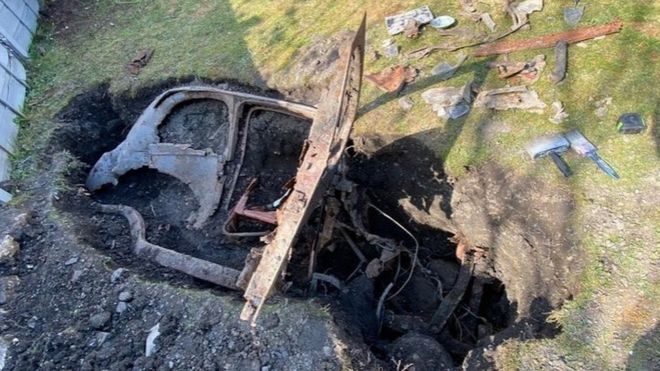
Those who are fortunate enough to have their own gardens have rightly been taking advantage of this to get outside - especially in the lovely Spring weather we're experiencing this Easter - and do a bit of horticultural pottering, but I bet this chap in West Yorkshire wasn't expecting to discover a car when he went to dig his garden! 

source

source
That though was the surprising find as reported in this article - a 1950s Ford Popular that had somehow wound up completely buried in a suburban back garden.  Quite how or why it got there is anyone's guess, although the military vehicle theory is as good as any.  Ford Pops would have likely been used as basic runabouts by the postwar armed forces - perhaps this one went AWOL and was hidden away to be retrieved later.  Such incidents are surprisingly commonplace with pre-war cars whose owners - fearing their potential destruction in bombing raids during WW2 - buried them in their gardens to be retrieved after the hostilities were over only for them to be forgotten until unearthed decades later, but this is a rarer instance of a post-WW2 car being found in such a way.  This is assuming it is a Ford Popular, which I have no reason to doubt, although it would be something if it were to found to be an older vehicle.


Either way it is an amazing (and amusing) find and definitely brightened up my day when I first read about it, hence its inclusion here.  If nothing else it ought to encourage the green-fingered amongst you to get out in to your garden, if you have one, and start digging.  If it sounds too much like hard work you don't even have to rip up your lawn to uncover fascinating treasures, as this similar story from Stoke-on-Trent proves:

Medieval coin found in Stoke-on-Trent garden raspberry patch

It always astounds me to think how these historical artefacts can just resurface (quite literally) after centuries underground, as the movement and cultivation of the earth slowly brings them back to ground level again, to be rediscovered in the sometimes most bizarre of circumstances.  It gives one to wonder just what other treasures are still waiting to be uncovered - perhaps in your own back garden!

A 19th(?) century clay pipe that was dug up in the family back garden in the '90s by
our pet dog Toby(!).

What's the strangest thing you've unearthed in your garden?  Let me know in the comments and if you haven't found anything yet - get your spades on!

Saturday, 21 February 2015

Brooklands race track to return to use with £4.7m grant


Brooklands race track to return to use with £4.7m grant

Well, this has just about made my year and no mistake!  I doubt there'll be any more welcome [vintage] news in 2015 to trump this, and we're not even a quarter of the way through the year.

Yes, this is the overwhelmingly joyous news (which had me bouncing off the walls in excitement, I can tell you!) that the Brooklands race track in Weybridge, Surrey - first constructed in 1907 but defunct as a motor racing ciruit since the start of the Second World War in 1939, when it was largely built over and used for aircraft production - has been awarded nearly £5,000,000 in Heritage Lottery funding for use in restoring some of the track to its original 1930s condition.


Although efforts have been underway for some time now in this regard, confirmation of the Hertiage Lottery Fund's £4.7million contribution means that the projected overall costs of £7,100,000 have very nearly been met and work will begin soon.  This will involve dismantling the Grade II listed Bellman Hanger (erected by Vickers Aviation in 1940 for the production of Wellington bombers and more recently used to exhibit some of the Brooklands Museum's wonderful aeroplanes) and moving it, plus all its contents, several hundred yards where it will be rebuilt and restored to once again house many aeronautical exhibits.  Once this is done the next exciting part of the work can begin - the restoration of the start-finish straight (above).  Unseen and unused since Vickers built their production facilities over it in 1940, it will once again echo to the cheers of spectators and the roar of racing engines for the first time in 75 years.  Connected to the surviving banking at the north-east corner of the circuit it will provide the longest section of usable track since Brooklands' heyday in the 1920s and '30s.


Alas, despite the somewhat misleading B.B.C. article the entire track will not be returned to use since in the intervening decades a retail park and housing estate have been built over other sections.  Still, this is the best news that could have happened for Brooklands and will certainly return the track to as close to its pre-war glory as is possible.  And with this work, who knows what may be in store for the future?  Maybe we will see a complete circuit yet?


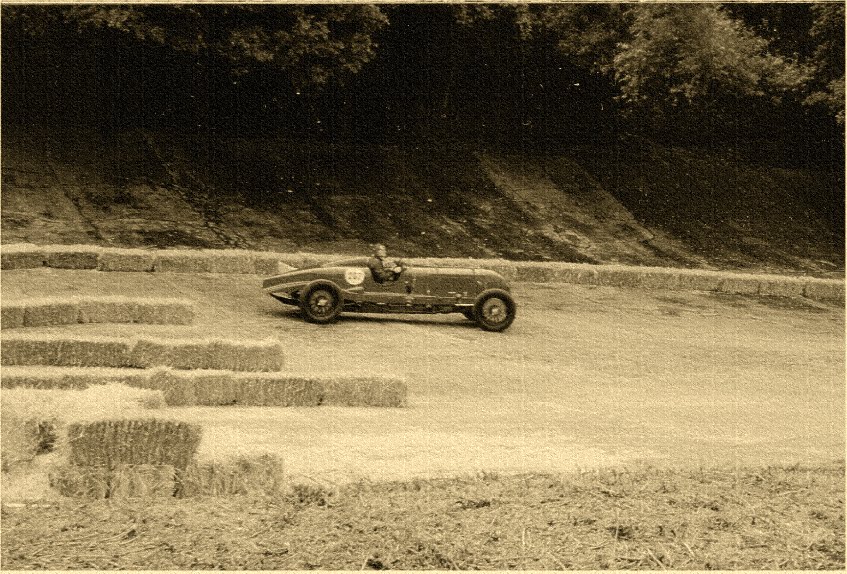
I last went to Brooklands in 2007 when the circuit was celebrating its centenary and what a fantastic day out that was.  Period outfits were worn and famous Brooklands racers including John Cobb's Napier-Railton and the later Napier-Bentley (above).  The Brooklands Musuem put on a fantastic event and is well-worth the visit and, although I didn't have the time or money to experience it on the day, the Mercedes-Benz World complex within the track is reputedly well worth a look-see.  Mercedes' contribution to the circuit's revival should not be overlooked and we owe them a debt of thanks for assisting the Museum in keeping the "Brooklands spirit" alive.


Personally I can't wait to see the results of the "Re-engineering of Brooklands" once it is complete, hopefully by the summer of 2016.  I'm sure it will breathe a whole new lease of life into an already fantastic place and my return there is only a matter of time.  With luck there will be some [period] special events to celebrate the reopening (already Brooklands plays host to many annual events and meetings, including the Double Twelve and 1940s Weekend - which I keep meaning to get along to) and I look forward to seeing the fruits of the restoration - Brooklands 1930s-style!

Followers

Popular Posts