Friday, 11 March 2011

Steam on the c2c line...and beyond

Permission to say "Hurrah!!"
Steam on the c2c line...and beyond

This is my local railway line!  One of the departure stations is my local railway station!!  One of the destinations (Winchester) is my ancestral home city, where I have always wanted to visit!!!  This was playing on my iPod when I was first reading the article (!!!!): 


This is more than serendipity; it's almost spooky!  I simply MUST try to get a ticket!!

Harry Dolman's Flying Flea housed in Bristol's M-Shed


Harry Dolman's Flying Flea housed in Bristol's M-Shed

An amusing footnote in the history of aviation gets a mention in this article from the B.B.C. now, as an example of one of the odder aircraft ever to fly is put on display in a museum at Bristol - itself a well-known location in early British aeronautics.

We may look back now at the "Flying Flea" and laugh but in the 1930s powered flight, while barely 30 years old, was big business and already looked upon as having a great future.  However that vision of the future often took the form of every man and his dog buzzing about the skies in little aeroplanes much as people did (and do) in cars and on motorbikes.  "Flying for the masses", with the aeroplane becoming as ubiquitous as the motor car, was still considered a viable possibility - hence the proliferation of aircraft like this Pou-du-Ciel.

Alas numerous stumbling blocks meant we never got to see "skyways" filled with Joe Public in his little aeroplane (probably for the best!) and now the likes of the Flea remain as static museum pieces, a tantalising glimpse into pre-war attitudes to flying and a vision of a future that never was.

Thursday, 10 March 2011

Bitter Lemon, or: The Revenge of Captain Hastings

In common with almost every other vintage blogger I am, of course, a huge fan of the Poirot TV series.  Got the DVD box set; love the stories, the acting, the settings and, naturally, the fashions.

Now, I know that if I go on reading the blogs of lovely vintage ladies I'm going to come across posts about women's fashion in the Poirot series.  Quite often in fact, it seems.  In particular the fashion of a certain female character - Miss Felicity Lemon, M. Poirot's efficient secretary.

Image courtesy of Flickr

Of course I thoroughly enjoy these dissections of various episodes and the clothes featured therein, even if they come from a feminine point of view (and of course girls will quite rightly focus on the women's fashion).  I am, after all, a reasonable man(!).  But, I am a man and with the best will in the world a red wool jumper with a giant white bow on the front, while very pretty on the right person, is of absolutely no use to me whatsoever. ;-)  Therefore, spurred on by the recent glut of Poirot/Miss Lemon posts pervading the blogosphere, I intend to start my own Poirot-fashion series to counter this perceived Miss Lemon bias. 

Between Poirot's foppish fastidiousness and Inspector Japp's plain, rank-and-file look there lies the well-dressed man, the perfect male foil for Miss Lemon(!), on whom I will focus my attention - one Captain Arthur Hastings, OBE (Hugh Fraser).

So be warned, ladies, as much as I love and look forward to your bloggings - Poirot-based or not - the next time I come across a Miss Lemon-heavy post I will not hesitate to respond with a Captain Hastings one of my own. 

I CAN'T KNIT THIS!!

Monday, 7 March 2011

Forties Fashion #3: Sports & Leisure Wear 1940

I bet you all thought I had forgotten about this series, didn't you?  Well, I nearly did!

Once again though I've delved in to this fashion sourcebook and this time feature the penultimate illustrations for 1940 - that of Sports and Leisure Wear.

These first three lovely ladies are all set for a day of fun and relaxation (or as much as the war would have allowed, at any rate) and from left to right wear the following:

Holiday wear: dress in white linen patterned in red; bloused bodice from above wide shaped inset band; collar and wide lapels, short puff sleeves with padded shoulders; knee-length gathered skirt; small white straw hat with red ribbon trim, worn with red open-mesh cotton snood; white canvas shoes with peep toes.  (Speaking as a chap, it sounds very nice and something I fancy you ladies could get away with today.  There's been a string of red-and-white vintage fashions throughout the blogiverse and on television recently - South Riding anyone? - could there about to be a revival in time for Spring?).

Next, anyone for tennis?!  White cotton two-piece jumper suit consisting of hip-length collarless top with high round neckline, two small patch pockets with buttoned flaps, short inset sleeves & padded shoulders and self-fabric buckled belt; knee-length box-pleated skirt; white cotton ankle socks and white canvas slip-ons.

Still on the tennis courts the third outfit is: a knee-length white linen dress (fly fastening from under collar to hip level, tuck to hem of flared skirt), bloused bodice with welt pockets at chest-level; short sleeves and padded shoulders, self-fabric belt; large hip-level patch pockets with flaps from under belt; white leather wedge-heeled shoes with bow trim.

The final couple are obviously enjoyed a seaside break and wear, respectively: blue and white striped cotton sundress with wide plain white cotton shoulder straps matching bindings of shaped neckline and centre button fastening through hem and trim on angled hip-level shaped patch pockets; knee-length skirt gathered from waist; blue canvas sling-back, peep toe shoes with high-wedge heels.

Single-breasted beige linen-tweed jacket; three-button fastening with patch pockets and narrow lapels; straight-cut light brown flannel trousers with turn-ups; cream cotton shirt with blue and brown tie; natural straw high-crown trilby with blue petersham ribbon band and narrow brim turned up at the back; light-tan leather lace-up shoes.

(Note to self - I may have just found my ideal spring/summer wardrobe in that final outfit...!).

Roll on the warmer months!

Saturday, 5 March 2011

Spitfire celebrates 75th anniversary


Spitfire celebrates 75th anniversary

Today marks a special date in the history of aviation and, ultimately, the history of this country.  On the 5th of March 1936 at Eastleigh Aerodrome, Hampshire  (now Southampton Airport) a single-engined, low-wing monoplane fighter prototype flew for the first time.  That aeroplane, designated Type 300, became the Supermarine Spitfire - designer R. J. Mitchell's magnum opus and the aircraft that went on to define and ultimately help win the Second World War in the air.


The Spitfire can trace its roots back to the successful Supermarine S.5 and S.6/S.6B seaplanes that won the Schneider Trophy in 1927, 1929 and 1931.  Here were the first examples of Mitchell's streamlined, one-piece designs complete with (from the S.6 onwards) Rolls-Royce engines, which would eventually lead to the Spitfire.  Together with the RAF's first low-wing monoplane fighter the Hawker Hurricane, which pre-dated it by a matter of 5 months, the Spitfire became the backbone of Fighter Command in World War Two and has forever cemented itself in our nation's consciousness.


Spitfire flight marks 75th anniversary in Southampton

As part of the celebrations the "Grace" Spitfire performed a flypast over Southampton, where Supermarine was based, and a statue has been commissioned as a permanent memorial.


But the most fitting tribute to this enduring aircraft are the 44 or so (out of total 22,500 manufactured) that still fly and perform at airshows around the world.  Perhaps more than any other aeroplane it has earned an abiding glamour that will, with luck, ensure it remains at the forefront of our cultural heritage for another 75 years.  In the meantime, Happy Birthday Spitfire!

Friday, 4 March 2011

Museum showcases America's gangsters


Museum showcases America's gangsters

More 1920s gangster-related news now, featuring two films made about a year apart - the latest from B.B.C. America and an older one I dug up on Youtube as an addition.

I'm not so sure about the B.B.C.'s assertion that '20s and '30s organised crime doesn't make it into the history books - I've certainly read and own a good few that cover that period in American history - but this is certainly the first I've heard of a museum dedicated to early 20th Century gangdom.

Yet it makes sense that there should be something like this - after all we have museums of warfare and other [sometimes unsavoury] periods of cultural significance, so why not a mob museum?  It's just as important for future generations to know about and appreciate what went on during that time and the social and political influences responsible for the rise of gangsterism.  It's also useful for tourists and foreign visitors such as myself, should I ever visit New York(!), to whom the concept of gangsters and speakeasies is interesting yet at the same time alien.

From what these clips show a museum about gangsters seems a worthy and fascinating addition to the ranks of historical institutions; I applaud Mr Otway and wish him and his museum every success.

Thursday, 3 March 2011

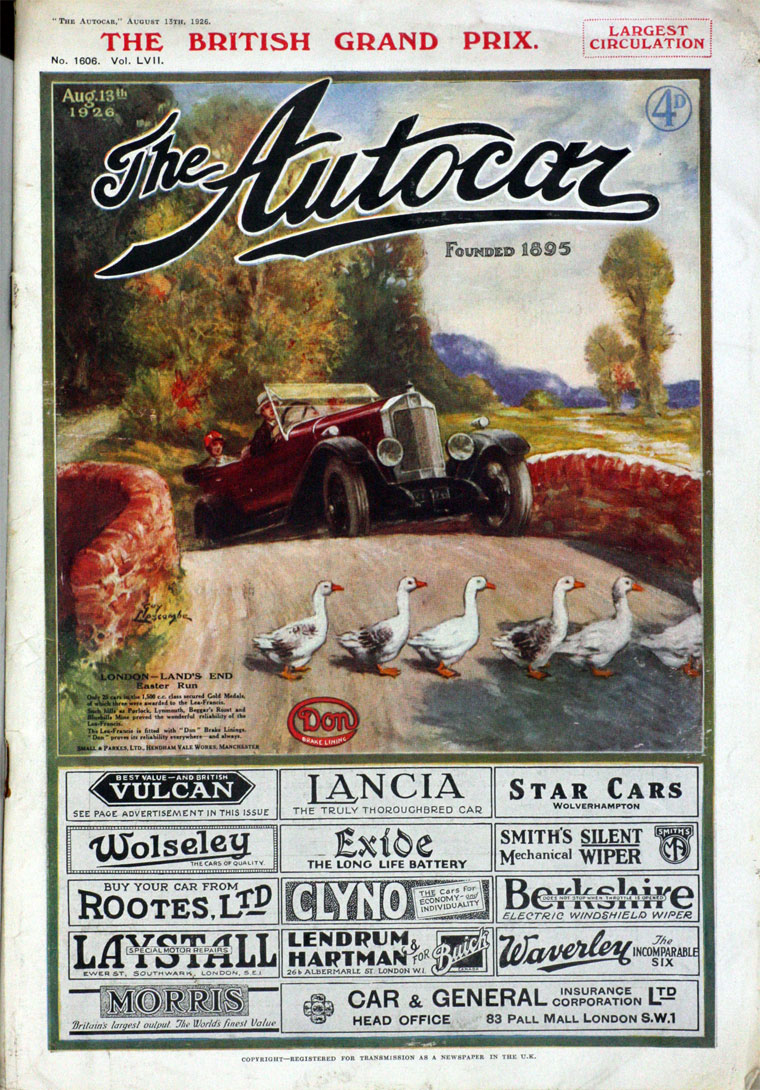
Autocar 1928-2011: Austin 7 'Gordon England' Sunshine Saloon


One of the few periodicals I read on a regular basis is the Autocar magazine.  It satisfies my interest in all things related to modern motoring (despite my not actually having a driving licence or owning a car!) and I've been a subscriber since long before I would legally have been allowed to drive(!).  When I was last employed it was very useful for my work too (in fact, my last two jobs were found through its pages) and I hope it will be again some time soon.

Anyway, this week's copy sees the Autocar reach a very remarkable milestone.  Already laying claim to the record of the oldest motoring magazine in the world, having first been published on the 2nd of November 1895 "in the interests of the mechanically-propelled road carriage", on the 13th of April 1928 it undertook the first ever "road test" - a detailed study of a particular motor car encompassing equipment, performance and driving characteristics which has become the universal standard since then.


The very first car to undergo this examination was the Austin Seven and since then a staggering 5,000 cars have been subjected to the same test (with some improvements over the years, of course).  To celebrate this achievement the latest issue has reprinted 50 of the best road tests of the last 83 years - including, of course, the original 1928 #1 - and sportingly "re-tested" an Austin Seven to see how it might fare today.  It makes for interesting and, I'm pleased to say, not entirely ignominious viewing.  Well done to the little Austin for putting in an impressive performance and congratulations to Autocar - here's to the next 80 years/ 5,000 road tests!

Followers

Popular Posts