Showing posts with label television. Show all posts

Wednesday, 14 June 2023

Women Detectives: Meet The Victorian Female Super Sleuths

Women Detectives: Meet The Victorian Female Super Sleuths


As promised/ threatened, delving back into my Drafts archive has unearthed this post, originally written in November 2020.  The subject: a then-recent feature film which would perhaps normally have appeared on this blog at the time of its release in September of that year - Enola Holmes.   Instead it almost passed me by on its way to Netflix (as so many otherwise cinema-bound movies have, my not having a subscription to these things).  Perhaps it is just as well, as having viewed the trailer I cannot help but have some misgivings about this particular foray into Victorian society and the Holmsian and despite its largely glowing reviews I find myself more in agreement with the few mixed responses I have read, for reasons that I will go on to explain.

I daresay I'm not the core target audience - the film being based on the Young Adult books by Nancy Springer and directed by Fleabag's Harry Bradbeer - and anything that encourages the younger generation to discover the joys of Conan Doyle's writing should be welcomed, but I cannot help but feel that the filmmakers are once again engaged in what amounts to an unnecessary degree of cultural revisionism.  

It is one of the more debatable characteristics of this self-styled enlightened, modern society that the prevailing - and one might almost say arrogant - belief is that we are in every way better than the generations that have gone before.  For my own part I have on multiple occasions put down on this blog my own thoughts on the subject of mixing the positive, still-valued elements of my preferred era with the undoubtedly welcome advancements of the modern day while at the same time recognising the more insupportable aspects.  Although the need to keep defending this outlook continues to bother me I do feel it bears repetition.    

Yes, a great deal of what went on centuries (or even decades) ago - in this instance the treatment of women in 19th century Britain - is in hindsight reprehensible but as the saying goes hindsight is a wonderful thing and it is unfair to judge (one might almost say to find those unable to defend themselves guilty by default) past cultures by modern standards.  I wonder how we would we feel if our social mores - attitudes which we would not give a second thought to being anything but normal - were subject to such levels of criticism by a 23rd-century observer, to whom they might be an anathema?

Being as morally superior as possible will make no difference to what has occurred lifetimes ago.  Deplore it, absolutely, learn from it, certainly, but stop applying 21st-century morals to previous eras.  The past cannot be altered, so better to dismount from that moral high horse and focus on changing the present to make the future an even better place.

Anyway, with that particular rant over I will only say one further thing on the subject of Enola Holmes going by what little I have seen and read.  While I repeat my hope that the appearance of this character on the [small] screen will inspire a new generation [of young women] and motivate them to seek out the works of Conan Doyle I cannot summon the level of enthusiasm I would have hoped a film like this might have instilled in me, mainly for the reasons I have outlined above.  The characters of Sherlock and Mycroft, whom I might be more readily expected to relate with, have inevitably been altered to become more akin to antagonists to the main character.  So much so, in fact, that in the case of Sherlock it has attracted the ire of the Conan Doyle Estate (who one might have assumed would have welcomed anything that would swell their coffers) to the point where they have instituted legal proceedings on the basis that Henry Cavill's characterisation of the Great Detective is too emotional and not in keeping with the character.  While as a traditional Sherlockian I can appreciate their point of view (although not to the point of a lawsuit) I can understand the filmmakers' desire to give the character more depth for a modern audience for whom the idea of an unemotional man simply wouldn't scan.  In any event if they do invest in the original stories off the back of this film they may be surprised to find any number of strong-willed female characters contained therein.  Just off the top of my head I can think of half a dozen such examples, including Helen Stoner in The Adventure of the Speckled Band, Violet Hunter in The Adventure of the Copper Beeches, Violet Smith in The Adventure of the Solitary Cyclist, Lady Hilda Trelawney Hope in The Adventure of the Second Stain, and of course Irene Adler in A Scandal in Bohemia.


source - Wikimedia Commons
Maud West, a female detective active in London
from 1905 to 1939, here photographed disguised as
a Salvation Army worker, circa 1920.
Hmmm, it seems I rather "went off on one" as a result of that film - I do apologise!  It obviously touched a nerve at the time!  I still stand by my comments though - they remain as true to me now as they did two years ago.  Anyway, the article that forms the primary subject of this post highlights a fascinating and oft-overlooked aspect of Victorian society - the existence of real-life female detectives (or "inquiry agents", to use the quaint terminology of the time).  Surely the brave, independent and resourceful women mentioned in this piece are deserving of having their own adventures and achievements chronicled for today's audiences, be that in documentary or fictionalised form.  Even the few stories touched upon in the article sound most intriguing and thrilling and could doubtless be adapted or retold for modern viewers with little difficulty (and in a way that would no doubt appeal to modern values).  Admittedly there have been recent adaptions of The Sally Lockhart Mysteries by Philip Pullman, starring Billie Piper, and four series of PBS-Alibi original Miss Scarlet & The Duke (sometimes available on the Drama channel for UK viewers) but even judging from what little one reads here there remains a mine of real-life incidents worth retelling.  I note that since I first started writing this post Enola Holmes 2 was released on Netflix last year so obviously the character has proved a success; as happy as I am that this is the case, I still can't help feeling that there remains a missed opportunity for the long-forgotten achievements of actual Enola Holmeses to be properly celebrated.  

Friday, 23 October 2020

Colonel March of Scotland Yard


We stay with Talking Pictures TV for this next post (indeed one could easily base an entire blog around that splendid channel, such is the appeal of their excellent vintage-centric output, but perhaps that is a project for another time and place...) as their schedules also recently included an obscure 1950s British B-movie that really appealed to me and which - suitably in the run-up to Hallowe'en - starred one of the greatest horror film stars of the 1930s and '40s, Boris Karloff.

source - IMDb
This little gem amongst gems is Colonel March Investigates, an 80-minute feature made in 1953 with Karloff in a rare non-villainous role as the titular Colonel March, the debonair head of Section D.3 of Scotland Yard - otherwise known as the Department of Queer Complaints (and one of the things that hasn't aged so well of course, these days sounding more like the name of a Channel 4 medical documentary(!).  I keep mistakenly calling it the Department of Queer Goings-On, which at least sounds slightly better to my mind).

Colonel March Investigates was in fact a series of three pilot episodes of a new TV series, Colonel March of Scotland Yard, commissioned with an eye for the then soon-to-be-launched British commercial channel ITV, spliced together into a feature-length film (with extra mid-story scenes of Karloff added in to link the stories together) that was also shown in cinemas.  In each case, Colonel March sets out to solve a set of seemingly impossible mysteries - Hot Money sees him investigate a bank robbery where the money disappears after the thief is seen entering a solicitor's office; Death in the Dressing Room involves the strange murder of a Javanese nightclub dancer and The New Invisible Man sees murder committed by a pair of disembodied gloves!  


These initial episodes were originally shot in 1952 following Karloff's return to England from Hollywood earlier that year, his horror film heyday behind him.  At 65 and beginning to suffer from emphysema as a result of a heavy smoking habit Karloff was looking for an interesting yet undemanding project, plus the chance to settle back in his home country, and was attracted to the role and the opportunity to work for a London-based TV studio.  It can be seen from his on-form performance that he clearly relished playing the part of the be-tweeded, eyepatch-wearing (for which no reason is ever given) Colonel - Karloff is a joy to watch, mixing his trademark levels of subtle menace and sinisterness with a wonderful degree of enthusiasm, mysticality, decency and gallantry.  Despite his advancing years and health problems Karloff still enters into the spirit of things with aplomb - there are several incidences of what for the time could easily be termed action sequences and Colonel March even carries a swordstick umbrella such as another later TV hero sports!  Indeed in many ways Colonel March of Scotland Yard could be seen as a sort of forerunner to The Avengers, with in both cases our debonair protagonists investigating strange and outlandish occurrences.

Cecil Street, Carr's inspiration for the
character of Colonel March
The character of Colonel March was the creation of the American mystery writer John Dickson Carr who wrote The Department of Queer Complaints in 1940 under the nom-de-plume of Carter Dickson, one of several pseudonyms he used for the many different detective stories he would write between 1930 and 1971.  Generally regarded as one of the best of the "Golden Age" detective novelists and the master of the "locked room mystery", the Anglophile Carr set most of his stories in England and based some of his creations on real-life acquaintances or other contemporary crime characters (Dr Gideon Fell, for example, was directly influenced by G. K. Chesterton's Father Brown).  The character of Colonel March was inspired by Carr's friend, former Army officer and fellow mystery writer Cecil Street (who also wrote under the aliases of John Rhode, Miles Burton and Cecil Wayne among others).  Regrettably much of both Carr's and Street's work has now been long out of print and is therefore difficult (and therefore expensive!) to come by, which is a great pity especially as I have now a desire to read The Department of Queer Complaints and maybe a few others.  Both authors have however had a couple of their stories reprinted recently as part of the British Library's excellent Crime Classics series, which includes Street's 1930 offering The Secret of High Eldersham (which I have read) and 1936's Death in the Tunnel (which I haven't) along with the first three of Carr's novels - It Walks By Night, The Lost Gallows and Castle Skull.  Some more reading material to be on the lookout for then, at any rate!  


Although the first three pilots of Colonel March of Scotland Yard were made in July 1952 it was not until a year later in 1953 that the series was finally given the green light by ITV executives, with Karloff again returning to England from America where he had been continuing to appear on TV, film and radio.  Even so it was only in September 1955 that the series finally premiered on British television following the launch of ITV that year -  and then just in the London area where it was first available.  Later broadcasts followed when ITV Midlands began in February 1956 - the same time that U.S. broadcasts started - and even B.B.C. viewers were not left out, with the feature-length Colonel March Investigates being shown in September of that year.

Sadly only one 26-episode series of Colonel March of Scotland Yard was made; on release it garnered largely negative reviews (perhaps somewhat coloured by the general antagonism many people had at the time towards the new-fangled "commercial" television channel) with only Karloff's stand-out performance receiving any positive comment.  Today it seems rightly regarded as something of a [forgotten] cult classic, with good reviews on the likes of IMDb.  As well as having Boris Karloff in the lead role many episodes feature the great and the good of British, American & Canadian TV and film from the 1950s and beyond including Christopher Lee, Dana Wynter, Joan Sims, John Laurie, Richard Wattis, Patrick Barr, Patricia Owens and Hugh Griffith.  Karloff is also ably supported by Ewan Roberts as the sceptical, put-upon Scottish Inspector Ames and Eric Pohlmann as March's opposite number Goron of the French Sûreté.  The three episodes that form Investigates were also directed by Cy Endfield, who would later go on to do Hell Drivers and Zulu in the 1960s.

Certainly I have been thoroughly enjoying both the film and any episodes I have been able to lay my hands on.  I'm told all 26 are on Amazon Prime, if that's your sort of thing, but for now I am happily making do with the nine episodes that are currently available on YouTube.  I can heartily recommend it to anyone who enjoys a bit of Fifties TV mystery drama in the mould of The Twilight Zone and now have another new hero in the form of Colonel March, head of Department D.3, Scotland Yard - the Department of Queer Complaints!

***Colonel March Investigates is available to buy on DVD and will be shown again on TPTV weekly from Saturday 7th November 2020 at 5pm (and which they previously ran daily at 7:30pm a few years ago).  Coincidentally a new illustrated reference book - Colonel March of Scotland Yard: The Series - has also recently been published and seems to be well worth a look.***

Friday, 17 July 2020

It's not a dream, it's Captain Hastings!

Yes, he's back again!!

Now that I've returned to blogging on a regular basis I feel ready to resurrect one of my favourite series of recurrent posts - the fashions and foibles of Captain Arthur Hastings, as played by Hugh Fraser in the excellent TV series Agatha Christie's Poirot.  Judging by this blog's stats page and the number of comments I've received over the years posts featuring the good Captain are well-liked by you the reader too so, by overwhelmingly popular demand, we return now to the adventures of Captain Hastings!

I covered Hastings's all too-brief appearance in The Big Four when it first aired in 2013 and although I have received requests to do Curtain next I have only just come to terms with what happened in that episode and the fact that it was the series finale(!).  More to the point I don't actually have it to hand to screencap at the moment, my Poirot DVD box set being an older edition only going up to series 10 (which is fine by me since Captain Hastings - plus Miss Lemon and Inspector Japp - don't appear after series 8 and the episodes from that point onward veer too much towards the darker end of the spectrum for my taste).  I will keep a lookout for Curtain - it is bound to be repeated on ITV3 at some point - with a view to featuring it on here later.  In the meantime we return to the early days and the next chronological episode to feature our favourite chap, which, it having been so long since I've done one of these, is the series 1 episode (so still lots more to come, hurrah!) The Dream.  Anyway, enough waffling from me - we want Hastings!

In this long shot we can just make out his splendid-looking half-belted sports
jacket and, what is that Miss Lemon's wearing?  Could it be...?
Yes, it's that ruddy bow cardigan again that started it all.  Never mind that, though,
we're here for Captain Hastings and he doesn't disappoint.  One of his best outfits
so far, in fact - a wonderful combination.  Shirt, tie, cardigan, jacket - it all works.

There's so much going on actually that one caption isn't enough to do it justice, so I'll add my thoughts to this outfit here.   I love the blue, red and cream check of the cardigan (which gets further outings in future episodes, so watch this space!), set off against the splendid colours of the striped tie and finished off by the understated grey sports jacket.  Then there's the shirt with its small, understated spearpoint collar and - a nice touch - working single cuffs with cufflinks.  In short, the archetypal 1930s look and one every right-thinking chap should - and could - aim for.  On the subject of cuffs I've encountered conflicting opinions over the years, the general consensus in my experience being that double (or French) cuffs are more formal and therefore more representative of the period, while single cuffs are more informal (except when worn starched with formal evening wear) and the preserve of country attire.  But then I see things like this - Hastings rocking the single cuffs with links - and I begin to see things in a different light.  What we're looking at here is a typical Thirties informal look, so single cuffs are perfectly acceptable especially when set off with a pair of cufflinks.  The trouble is single cuff shirts with the facility for links (as opposed to just button fastenings) can be hard to come by these days.  The only one in my wardrobe is a rather summery Bengal striped number from Peter Christian; other modern makers such as Savile Row Co. also offer the facility for cufflinks with single cuffs, otherwise you're looking at the more "period" suppliers like Darcy Clothing or Revival Vintage.  That's enough about shirt cuffs though - back to the action!


A nice close-up of the jacket, collar and tie combo.

We open the scene with Hastings helping Miss Lemon with the morning mail.  Our man is amused and intrigued by an offer of 'Home Phit' ("That's funny - 'Phit' spelt with a 'ph'".) leather shoes; sadly we never find out if he avails himself of a pair.  Miss Lemon is unamused by the antics of her typewriter - left in the flat by a previous tenant, much to the delight of the thrifty Poirot - which keeps jamming (and am I the only one who constantly mishears her annoyed and terse exclamation of "Bother!" as something rather stronger?!).

Something for the typewriter fans as well - can you identify the recalcitrant model
from this picture (all will be revealed at the end of this post)?  (Note we also get to
see Poirot's full address and telephone number courtesy of this shot.)

The next letter is from a Hugo Cornworthy, private secretary to noted industrialist and pie-maker Benedict Farley, requesting that Poirot comes to his offices so that he may consult him.  The Farley's Food factory is of course in reality the Hoover Building, which has featured on this blog before (and also in the previous episode as the "Parade" film studio - the production company must have done some back-to-back filming there, I think!  As an aside, someone once told me that all the exterior shots of Florin Court (aka Whitehaven Mansions) were done over the course of one long weekend and then simply interspersed throughout every episode, but I cannot vouch for the veracity of that.).

Even in the dark our man's style stands out like a beacon of rightness.  Hat,
belted coat with effortlessly turned-up collar and scarf - oh yes, he's back all right.
No-one pulls off the turned-up collar look better than our Captain Hastings.
The muted earth tones of the scarf set off nicely against the coat, hat and gloves.

Hastings (and Poroit, to be fair) is disappointed to be told that the invitation does not extend to him, so it's back to the car to wait for Poirot to come out.  Poor old Hastings!


Back at the flat the next morning and Miss Lemon takes Poirot to task over the troublesome typewriter, backed up by the good Captain.

A better look at that wonderful knitted waistcoat and, just for the girls, Miss
Lemon's delightful emerald green dress with contrasting asymmetric collar/cuffs
(fellow blogger Porcelina has previously looked at the other fashions in this episode). 

Needless to say it isn't long before there's a corpse to deal with but in the following days Poirot is unable to get a grip on the case, much to his frustration.  Hastings helps out by doing the crossword.

Just as Miss Lemon's bow cardigan is a wardrobe staple in early episodes, so too
is Hastings' grey Prince of Wales check suit it seems. 

When Poirot starts to lament that his little grey cells are dying due to too much "fast living" Hastings is there to (sceptically) comfort him.


Thanks to a second tisane and Miss Lemon nearly breaking her neck looking out the window to check the time Poirot has an epiphany and he and Hastings dash off to Farley's Foods to unmask the murderer.

I do love how a simple change of tie can completely reinvigorate the ubiquitous
PoW three-piece.

Poirot's theory requires Hastings' assistance in quite an exciting manner - our hero is about to swing into action!


While Poirot gathers everyone together for the classic dénouement, Hastings waits for his moment:

The green tie sets off nicely against the grey of his suit.
"The name's Hastings.  Arthur Hastings."  Seriously, why hasn't somebody in the
Poirot fanfic community done this?!  I  may have to do something about it myself...
Single cuffs with links again and a smashing rectangular Thirties wristwatch as our
hero takes aim.

Hastings really does have a lot to do in this episode.  Having so ably helped Poirot to prove his theory, the killer is unmasked and makes a bolt for it (WARNING: if you haven't seen this episode - then what's wrong with you?! - here be spoilers) but once again everyone's favourite chap is on the case.


Alas after what must have been a bruising struggle down a marble staircase, the villain escapes our man's clutches and dashes out into the factory grounds.  Kudos at this point must go to the character of  Herbert, the fiancée of Farley's daughter (Joely Richardson), who turns up on motorcycle and sidecar - suitably dressed in full flying leathers, goggles and scarf - intending to elope but who instead is just in time to chase the murderer down in dramatic fashion.  Captain Hastings would be impressed!


With the case solved it's back to business as usual at Poirot's flat.  Miss Lemon is still battling with the typer when Poirot arrives bearing a suspiciously typewriter-shaped box.

I do love Poirot's expressions in this episode.  One can never get enough of Hastings'
suit, either.  I'm beginning to understand the obsession with that bow cardigan now.
I promised you a closer look at the troublesome typewriter.  Yes, it's an Underwood,
and given its back story, the period setting and four-bar keyboard I'm going with it
being a Number 5.  Would you agree?

You'll have to watch the episode to see if Miss Lemon does finally get a new typewriter out of Poirot(!).  This has turned into quite a monster post - whew!  Well done if you've made it this far but, well, you did ask for it (and I'd forgotten how much I enjoy composing them).  For now we'll finish with a few more gratuitous shots of Captain Hastings and his superlative three-piece suit as we bid farewell to him, Poirot and Miss Lemon until the next time, when we'll return to find them in - Peril at End House.

Thursday, 28 May 2020

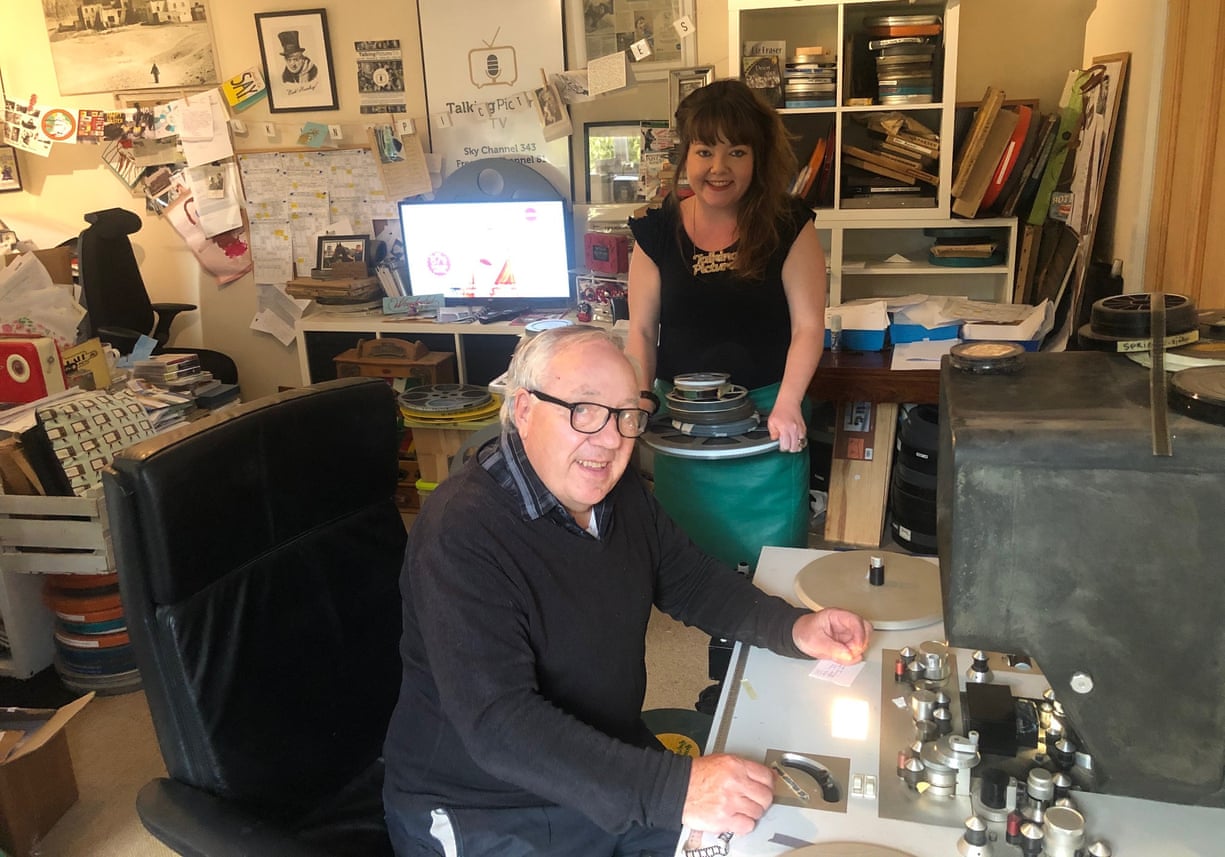
Talking Pictures celebrates its fifth birthday


Inside Talking Pictures, the ultimate in lock-down comfort TV

Five years ago on Tuesday saw the launch in the UK of the best TV channel to hit terrestrial television in ages, one that makes all this Freeview business worthwhile and which should be on the radar of every self-respecting vintage film buff - Talking Pictures TV.

I remember thinking when Talking Pictures was first launched in 2015 what a splendid and long-overdue idea it was and I am delighted to see how it has gone from strength to strength in the intervening time period.  What makes it even more remarkable, as the excellent Observer article explains, is that it is all run by a family of four from a house on the outskirts of Watford!  Proof that you don't need a massive budget or have to jump through loads of hoops (except maybe to placate Ofcom when it comes to the old chestnut of historic cultural norms on film) to run a successful TV station.  It is wonderful to note the obvious enthusiasm and experience running through the whole enterprise, which no doubt contributes in no small part to its success, and I am particularly pleased to read of another new Laurel & Hardy fan in the making!

source
Talking Picture TV founders Neill Cronin and Sarah Cronin-Stanley

There really is something for everyone on this channel, from obscure 1930s British B-movies to classic but long-forgotten 1970s TV dramas.  Tie-ups with the Imperial War Museum have resulted in showings of some enthralling public information films and period docudramas and people even send in old home cine footage from the 1950s and beyond, to be given a whole new lease of life.  More modern but no less pertinent stuff also frequently gets an airing - TPTV recently showed the 2016 documentary film The Man Who Gave A Damn, about the life of Leslie Howard, which I had long been wanting to see.  They even sell DVDs and other merchandise through their Renown Film Club subsidiary, which also runs regular film festivals and other such events.


All in all then, a hearty "well done" and "Many Happy Returns" to Talking Pictures TV - long may it continue to grace our television screens.  It is an oasis of joy and nostalgia amid a sea of mediocrity and I am so glad to see it get some recognition in the popular press.  That Her Majesty is allegedly a fan comes as no surprise and is perhaps the greatest accolade TPTV could hope to achieve.  I for one hardly tune in to anything else these days (on the rare occasions I actually watch television - most of the time it's DVDs or some obscure thing on YouTube) and can thoroughly recommend adjusting your set to channel 81 (Freeview), 445 (Virgin), 306 (Freesat), or 328 (Sky).


*** An honourable mention should also go to Sony Movies Classic, which recently replaced True Movies on Freeview channel 50 (Virgin 424, Freesat 303, Sky 319) and which also shows some decent films from the 1940s onwards. ***

Tuesday, 30 December 2014

The Incredible Adventures of Professor Branestawm: a review


Christmas telly this year was widely derided by critics, most of whom pointed to the large percentage of repeats and "unoriginal programming" that would be clogging up the major channels during the festive period.  While a big amount of Christmas repeats (curse the sprouts!) could well be said to be the norm for most years nowadays, I have to admit I found this year's offerings to be quite good - a decent mixture of old classics and new films plus the odd interesting programme (B.B.C. Four was the place to be for us vintage/jazz aficionados over the holidays, as Mim over at Crinoline Robot foretold).  One little gem of a programme in particular caught my eye on Christmas Eve and so, as it might be of particular interest and enjoyment to my readers, I thought I'd give it one of my impromptu short reviews.

The Incredible Adventures of Professor Branestawm was a one-off hour-long comedy that was broadcast on B.B.C. One on Christmas Eve at 8:30pm.  The story and characters are based upon a series of children's books written between 1933 and 1983 by Norman Hunter.  Now here I have to admit that, while I knew of the character of Professor Branestawm, I've never read any of Hunter's thirteen books that featured him.  (I often think that can be a blessing in disguise, actually, as it meant I approached this programme with no preconceptions.)


Playing the title character was the British comedian Harry Hill.  For those readers not familiar with Mr Hill's work he is probably best known for presenting irreverent comedy sketch shows, often featuring slapstick or absurdist humour and usually mocking pop culture (TV programmes, celebrities etc.) in some way.  I think it's pretty fair to say that his is a particularly British brand of humour, which you either get or you don't.  His best known programmes include The Harry Hill Show and Harry Hill's TV Burp; for the last ten years he has also narrated You've Been Framed, a long-running home movies and funny clips show.  This turn as the literary character Professor Branestawm would, in fact, be his first real acting role.

source

Some kindly critics did point out that the role would not be too much a stretch for Hill, being much like an extension of his comedy persona, but be that as it may I thought he did a very good job bringing the character to life.  He imbued the Professor with just the right amount of absentmindedness (a lot, for this character!) and bumbling confusion; when it came to the few moments that required some [serious] acting he was more than up to the task to in my opinion.  Hill's experience with physical comedy, allied to his [relatively] younger age than the character he played, also helped add to the well-roundedness of the portrayal - especially during the more action-packed moments!

source

Anyway, before I get too far ahead of myself, a quick overview of the main characters in the stories and the basic plot of this latest adaptation.  As mentioned, Professor Branestawm is the archetypal absentminded professor, forever coming up with crackpot inventions that usually form the basis for each book's storyline.  Other recurring characters include his best friend, the eccentric ex-Army officer Colonel Dedshott, and his housekeeper Mrs Flittersnoop.  As you can probably tell, being aimed primarily at children the characters are very exaggerated and the stories often fantastic.  The first two books of the series were written in the 1930s, so it sounds like there should also be a good period feel to the stories; the remaining eleven were written much later, between 1970 and 1983, but I suspect may contain that same air about them.

Despite this, the various elements of the stories were skillfully woven together by the programme's writer Charlie Higson (who also appears as the town's mayor).  Higson - best known in TV-land from the '90s comedy sketch series The Fast Show - has form in this area, having not only helped write the aforementioned programme but also a series of young adult novels featuring a teenage James Bond.  Here he transposes the action to an idealised 1950s version of the professor's home village of Pagwell.

source

It's certainly a beautiful location (actually Shere in Surrey) and one that perfectly complements the storyline.  Despite the latter containing many elements of fantasy it was careful never to go too far overboard, retaining a welcome air of almost-believability.  The comedy was very much in evidence but very well balanced against the plot, never descending into overwhelming physicality.

source

The supporting cast were clearly having a ball:  Simon Day (another Fast Show alumni) was thoroughly enjoying himself as a splendidly chappist Colonel Dedshott; Ben Miller hammed it up excellently as the evil Mr Bullimore, aided and abetted by David Mitchell as the scheming councillor Harold Haggerstone.  It was good to see Miranda Richardson (Queen Elizabeth in Blackadder II) as schoolteacher Miss Blitherington, who featured as part of a sub-plot (slightly laboured, I thought) about the professor's schoolgirl friend Connie (Madeline Holliday) wanting to become a scientist, with the message obviously being "follow your dreams" and the sexist, male-dominated world of the Fifties fair game.


Anyway, I won't give away any more of the main plot beyond saying that the professor and Connie must go up against the council and the devious Messrs. Bullimore and Haggerstone to try and save the prof's "Inventory" workshop - that just about sums up this riotous one-hour programme without leaving any spoilers!  Highlights for me in particular, I will just finish by saying, included the "mobile telephone", "Robot Father" and the results of the "wonderful photo liquid".  In truth the whole 60 minutes was a joy to watch, with some genuine laugh-out-loud moments.  While definitely aimed more at the younger viewer (I was surprised at the somewhat late hour it was initially put out at) it's certainly got something for all ages - including some wonderful '50s fashions! - and is thoroughly enjoyable.  The only pity was that the B.B.C. didn't promote it a bit more (a few trailers several weeks in advance of the 24th and one the night before were all I saw) and that it was only a one-off.  Still, with 13 books in the canon I'm sure there must be a series in there somewhere; let's hope Higson, Hill and most importantly Auntie Beeb can be persuaded to make it.  In the meantime the Professor Branestawm books have found another reader, as I'm off to read the stories on Google Books.

The Incredible Adventures of Professor Branestawm was first broadcast on B.B.C. One at 8:30pm on 24th December.  Another showing will be on CBBC tomorrow at 8:30am and it will also be available on iPlayer for the next 4 weeks.  Those of you without access to the B.B.C. can view the trailers here and here, while the entire episode is here.


Friday, 13 December 2013

Laurel and Hardy inspire BBC drama


Laurel and Hardy inspire BBC drama

It has always been a source of regret to me that I wasn't alive to see two of my favourite comic actors of the 20th century, Stan Laurel and Oliver Hardy, when they toured the theatres of Britain with their live sketch shows during 1952-53.  Although they were in the twilight of their careers, having completed their final film in 1951 - the unholy mess that was Atoll K (also known as Utopia or Robinson Crusoeland, an absolute disaster of a film and no way to have ended a 25-year movie career - a mixed nationality of actors and crew meant that no-one understood one another, The Boys were both ill and in the case of Stan looked it, he also never really got the creative freedom he was promised so the story was weak as well) - by the following year they were in better health and keen to get out and meet the many fans who still enjoyed their comedy genius.  Stan, the creative one of the partnership, had several new ideas for the team but both agreed that another tour of Europe - where they remained popular - was the first step (they had twice before toured abroad, once in 1932 and again in 1947).

In 1952 they performed a sketch written by Stan entitled "A Spot of Trouble" and it proved so successful that in 1953 they returned with a new performance, "Birds of a Feather".  Playing to packed houses, they were overwhelmed by the joy and affection they still engendered nearly 20 years after their heyday.  On one occasion, arriving by boat at Cobh in Ireland, they were moved to tears by the crowds' cheering and waving and - I'd have loved to have been there to hear it - all the church bells in the town pealing out their theme tune, "The Dance of the Cuckoos".

The 1953 tour was another great success but it proved to be their last, for Oliver Hardy's health declined in 1956 and following a series of strokes he passed away on the 7th August 1957 aged 65, ending one of the greatest partnerships in film.


I'm pleased to see that the B.B.C. has now commissioned a new drama-documentary charting those last two years' of tours, to be written by the same chap who co-wrote the recent critically-lauded film Philomena.  I haven't seen that one myself but by all accounts it is a very good, if heartrending, story so I have high hopes for this forthcoming programme.

It won't be the first time the Beeb have produced a drama based around the last years of Laurel & Hardy, however.  Back in 2006 as part of its "Silent Cinema" season B.B.C. Four broadcast Stan, which was written by Neil Brand (who is also well-known for playing accompanying music - and in some cases composing new scores - for silent films, often shown at the British Film Institute e.g. The Wrecker) and which covered Laurel & Hardy's career in a series of flashbacks as Stan visited Ollie on his deathbed.  That was an excellent production, if sometimes tough to watch, with the actors playing the lead roles well suited to the parts.  Let us hope it will be more of the same with Stan and Ollie; I look forward to hearing more news about it.  In the meantime I can heartily recommend the book Laurel & Hardy: the British Tours by A. J. Marriot as an excellent tome on the subject of The Boys' later live appearances.

Friday, 15 November 2013

Goodbye to the splendid 1930s world of Poirot


Goodbye to the splendid 1930s world of Poirot

And goodbye to the man himself!

I trust those of you who were able to tune in and watch Wednesday's episode have recovered - as much as anyone can recover! - from seeing the final adventure of the great Hercule Poirot?  What do we do now?!  No more M. Poirot.  No more Captain Hastings!  No more beautiful 1930s splendiferousness to jealously drool over.

The last in particular is the subject of this nicely-written article on the B.B.C. Magazine website (jolly sporting of them, considering Poirot was an ITV production), which focusses on two (of many) aspects that made this series a cut above the rest and possibly the best adaptation there's ever likely to be of Agatha Christie's work - the sets and the locations!

Florin Court, aka Whitehaven Mansions
source

The stunning Art Deco buildings that featured throughout Poirot added wonderfully to the period feel, as well they might, and certainly helped the stories along on many an occasion.  That lovely feeling of being right there back there in the 1930s was in no small part due to the locations used and it's a testament to the producers that they were able to find and use so much period architecture (thanks also in no small part to the likes of English Heritage and the many volunteers and enthusiasts who helped ensure these gems were saved from ignominy).  I've always marvelled at how it was possible to create such an authentic look on location - but I suppose that's the beauty of London where many examples of Art Deco design still exist, plus our ongoing love affair with stately country houses.

Midland Hotel, Morecambe
source
I'm glad - and not really surprised - to see that Poirot itself has ensured that the public interest in Art Deco and Streamline Modern design remains high, which must surely bode well for the future of many original buildings.  If it carries on giving the likes of you and me our required fix of '30s glamour as well then so much the better!  It's also delightful to know that, thanks in part to the series, modern architects are being influenced by the Art Deco movement and incorporating some of its motifs into today's new designs.  You can never have too much Deco, say I!


Then there were the sets!  Oh, I think we all would like to live inside Poirot's flat wouldn't we?  (Could we all fit though?  We'd have to draw up a rota and stay at Burgh Island, or the Midland Hotel in between times.  You can tell I've seriously thought about this...)  Once again the quality of the set decoration is second to none and again I'm delighted but not surprised to see that so many props and other pieces were obtained from various sources including David Suchet himself!

source

There it is, then.  The end of an era for British television.  I've said it before and I'll say it again - I think we've just been witness to a generation-defining portrayal not just of a character but also the world he inhabits.  Thank goodness for DVDs is all I can say, where we can relive the wonderful world of Poirot again and again to our hearts content.  On that subject, Captain Hastings posts will continue to appear here for some time to come (I'm only up to Series 1 Episode 8, after all!) with maybe another special diversion to Curtain, which features far more Hastings than The Big Four did.  It's been a bit Poirot-centric around here lately, I know, but with good reason.  I shan't let this turn into a Poirot-only blog (although it wouldn't be the end of the world!) if only because there already is one and I don't want to tread on the chap's toes.  But I can't let it pass without saying this.  Thank you, ITV, for sticking with it for 25 years.  Thank you, David Suchet, for such a stellar performance. Au revoir.

Saturday, 26 October 2013

Poirot: The Big Four; or, The Big Two-and-a-half...

... that being the rating, out of four, that I would give last Wednesday's PoirotThe Big Four?  More like The Big Disappointment for this blogger, I'm afraid.

Still, by popular demand - especially from overseas readers - here follows a vague outline (so as not to spoil it for those of you who haven't yet seen it!) of the episode, focussing particularly on the welcome return of series stalwarts Japp, Miss Lemon and Captain Hastings!

Well, focussing as much as possible considering one of the biggest problems with Wednesday's episode - after all the fanfare of their much-anticipated return Miss Lemon and Captain Hastings appear in this two-hour drama for all of about 10 minutes.  Japp fares better - being the policeman he is with Poirot for most of the investigation but really, to build up a chap's (or chappette's) expectations and then give us the barest serving of Lemon & Hastings - especially when the latter is so crucial to the plot of the original book - just isn't bally well fair!  Giving us an opening shot of Hastings on his hacienda and having him utter his immortal catchphrase as the first words of the drama certainly created the impression in my mind that he was going to play a major part in this adventure.  Oh well.

Hastings seems to have settled down to the life of an Argentinian rancher...
As befits a working landowner, Hastings sports a combination of checked tattersall
shirt, spotted neckerchief and matching waistcoat and felt sun hat.
All together now... "Good Lord!"

Things seemed to progress nicely, albeit to the more sombre scene of someone's funeral, with all three of the old supporting characters together again - even though it be in sad circumstances (possible spoiler alert ahead!).

Miss Lemon!  Best shot I could get of this dress, which begins a line of simple,
patterned tea dresses(?) with a nice neckline
Japp (Philip Jackson) has aged well and his wardrobe has improved too, as befits
his new rank of Assistant Commissioner
Traditional funeral attire for Miss Lemon and Captain Hastings

At the wake and some of the old magic glints through the sadness as everyone is in Poirot's flat again.

Not much to add about Captain Hastings' black [pinstripe] suit. 
Miss Lemon's outfit has a few nice touches around the neck and sleeves.
It all gets a bit too much for Hastings.  Awww!

And that for much of the episode is all we see of Miss Lemon and the good Captain, as the action moves swiftly on to the main meat of the story.  Which, sadly, bears little resemblance to the original novel.  This is a great pity, as The Big Four has long been one of my favourite Poirot novels with its cases of international espionage and high adventure all held together by the thread of the mysterious "Big Four".  I admittedly haven't read it for some time but it has always stuck in my memory as a particularly thrilling book in which Hastings had much to do, some of it quite dangerous as I recall.  Much has been written already, including by fellow blogger Porcelina, of the difficulties inherent in adapting a convoluted series of cases into a 90-minute TV drama (Mark Gatiss himself has called the original plot "an unadaptable mess") but I still think they could have done better than the disjointed parody that has resulted.  They certainly could have and should have used Captain Hastings more prominently!

Anyway, for a good while there wasn't much worthy of comment so here are just a few general shots of the episode that I felt could be included here:

Japp's wardrobe, as mentioned, is at it's best ever.  He even looks halfway decent
in white tie (although still not a patch on Poirot)!
Quite a nice suit for the Assistant Commissioner
The old brown trilby and overcoat make a welcome return, though.

Some things that thankfully haven't changed too much are the production values.  Certainly like all Poirots since the series' 2003 "re-imagining" everything has been filmed in much darker, tenebrous style which can still take a bit of getting used to after the lighter tone of the earlier episodes.  As a result the fashions on show tend to be a bit duller and more limited, as was the case in The Big Four.  A couple of the effects were a bit ropey too.  The props were splendid, though, as were the locations (despite being less wide-ranging than those in the novel).

Poirot has a beautiful Art Deco chess set (of course!).  Which, I'm delighted to
see, you can buy an example of yourself.

For the ladies, these were the best shots of the few fashions that cropped up during the episode:

Madame Olivier seems to favour checked suits...

This particular adaption also seemed to have been cursed with the inclusion of an annoying, gabby actress (Flossie Munro, played by Sarah Parish) and an annoying, arrogant newspaper reporter (Mr Tysoe, played by Tom Brooke), neither of whom endeared themselves - or the plot - to me very much.  The episode was also extremely hamstrung, in my opinion, by a disappointing Big Reveal.  Even taking into account the smaller scale of this version, the unmasking of the villain turned out to be not only unexpected but also unbelievable.  He was completely without menace and had a motive so flimsy and far removed from the novel's dénouement that it made the previous 75 minutes seem rather disconnected and, dare I say it, almost hardly worthwhile.

Let's not end on such a sour note, though.  Part of the way through, Miss Lemon, Japp and Captain Hastings return [briefly] as we find ourselves back at the funeral/wake that began this story:

A highlight of Captain Hastings' wardrobe, limited as it is in this outing, is this
wonderfully well-fitted double-breasted overcoat.
Back at Poirot's, Hastings is determined to do what he can to catch The Big Four
I mean, he's really determined.  Remember that time he decided he'd solve the
case in Double Sin?  Even more determined than that.
He even has strong words with Japp.  I haven't seen him this angry since he
punched Miss Lemon's ex-boyfriend in The Adventure of the Italian Nobleman.
Once outside he calms down and stops to think.  In quite a poignant moment he is
heard to quietly ask "What do I do now, old chap?".

Here is where the could have introduced a bit more Captain Hastings - had him trying to follow leads, meeting with the reporter, the actress, Mme. Olivier.  But no, we don't see him again until about a minute before the end.  Thanks for that. (As an aside, it's struck me that no-one - from the Christie estate or otherwise - has thought to do a story or two with Captain Hastings as the main character.  Wouldn't that be great?  Adventures from his side of a case, or away from Poirot, or in Argentina.  Someone should really do that.  Are you listening, the Christie Community?)

A better look at Miss Lemon's black blouse

So having teased us half way through with another brief appearance of Hastings and Miss Lemon, we now have to wait until the very end to see them all together again.

Miss Lemon sporting a simple red dress with some nice collar detailing again.
Japp back in his [now usual] three-piece, and another look at Miss Lemon's dress.
Hastings burst in, having not been seen since he stormed out half an hour previously.
The episode ends not ten seconds later.  Still, every second with Hastings is a joy...

By and large then a fairly mediocre affair, saved only by the presence - however fleeting - of three beloved supporting characters from the past and David Suchet's consummate portrayal of Poirot.  There were a couple of gems in the dialogue - when confronted with a "Death" tarot card found on a victim's body Japp ruminates "Mrs Japp was dealt one just like that on Southend Pier.  'Gypsy Meg'.  Three weeks later the cat died".  We also get to see Poirot run for perhaps only the third time in the entire, well, run.  But for me the whole episode was neatly summed up by Poirot himself.  When his friends gather round at the end, he remarks "Where is Hastings?  Where is Captain Hastings?!".  It was a question I'd been asking myself for most of the preceding two hours...

Followers

Popular Posts