Showing posts with label Hugh Fraser. Show all posts

Friday, 17 July 2020

It's not a dream, it's Captain Hastings!

Yes, he's back again!!

Now that I've returned to blogging on a regular basis I feel ready to resurrect one of my favourite series of recurrent posts - the fashions and foibles of Captain Arthur Hastings, as played by Hugh Fraser in the excellent TV series Agatha Christie's Poirot.  Judging by this blog's stats page and the number of comments I've received over the years posts featuring the good Captain are well-liked by you the reader too so, by overwhelmingly popular demand, we return now to the adventures of Captain Hastings!

I covered Hastings's all too-brief appearance in The Big Four when it first aired in 2013 and although I have received requests to do Curtain next I have only just come to terms with what happened in that episode and the fact that it was the series finale(!).  More to the point I don't actually have it to hand to screencap at the moment, my Poirot DVD box set being an older edition only going up to series 10 (which is fine by me since Captain Hastings - plus Miss Lemon and Inspector Japp - don't appear after series 8 and the episodes from that point onward veer too much towards the darker end of the spectrum for my taste).  I will keep a lookout for Curtain - it is bound to be repeated on ITV3 at some point - with a view to featuring it on here later.  In the meantime we return to the early days and the next chronological episode to feature our favourite chap, which, it having been so long since I've done one of these, is the series 1 episode (so still lots more to come, hurrah!) The Dream.  Anyway, enough waffling from me - we want Hastings!

In this long shot we can just make out his splendid-looking half-belted sports
jacket and, what is that Miss Lemon's wearing?  Could it be...?
Yes, it's that ruddy bow cardigan again that started it all.  Never mind that, though,
we're here for Captain Hastings and he doesn't disappoint.  One of his best outfits
so far, in fact - a wonderful combination.  Shirt, tie, cardigan, jacket - it all works.

There's so much going on actually that one caption isn't enough to do it justice, so I'll add my thoughts to this outfit here.   I love the blue, red and cream check of the cardigan (which gets further outings in future episodes, so watch this space!), set off against the splendid colours of the striped tie and finished off by the understated grey sports jacket.  Then there's the shirt with its small, understated spearpoint collar and - a nice touch - working single cuffs with cufflinks.  In short, the archetypal 1930s look and one every right-thinking chap should - and could - aim for.  On the subject of cuffs I've encountered conflicting opinions over the years, the general consensus in my experience being that double (or French) cuffs are more formal and therefore more representative of the period, while single cuffs are more informal (except when worn starched with formal evening wear) and the preserve of country attire.  But then I see things like this - Hastings rocking the single cuffs with links - and I begin to see things in a different light.  What we're looking at here is a typical Thirties informal look, so single cuffs are perfectly acceptable especially when set off with a pair of cufflinks.  The trouble is single cuff shirts with the facility for links (as opposed to just button fastenings) can be hard to come by these days.  The only one in my wardrobe is a rather summery Bengal striped number from Peter Christian; other modern makers such as Savile Row Co. also offer the facility for cufflinks with single cuffs, otherwise you're looking at the more "period" suppliers like Darcy Clothing or Revival Vintage.  That's enough about shirt cuffs though - back to the action!


A nice close-up of the jacket, collar and tie combo.

We open the scene with Hastings helping Miss Lemon with the morning mail.  Our man is amused and intrigued by an offer of 'Home Phit' ("That's funny - 'Phit' spelt with a 'ph'".) leather shoes; sadly we never find out if he avails himself of a pair.  Miss Lemon is unamused by the antics of her typewriter - left in the flat by a previous tenant, much to the delight of the thrifty Poirot - which keeps jamming (and am I the only one who constantly mishears her annoyed and terse exclamation of "Bother!" as something rather stronger?!).

Something for the typewriter fans as well - can you identify the recalcitrant model
from this picture (all will be revealed at the end of this post)?  (Note we also get to
see Poirot's full address and telephone number courtesy of this shot.)

The next letter is from a Hugo Cornworthy, private secretary to noted industrialist and pie-maker Benedict Farley, requesting that Poirot comes to his offices so that he may consult him.  The Farley's Food factory is of course in reality the Hoover Building, which has featured on this blog before (and also in the previous episode as the "Parade" film studio - the production company must have done some back-to-back filming there, I think!  As an aside, someone once told me that all the exterior shots of Florin Court (aka Whitehaven Mansions) were done over the course of one long weekend and then simply interspersed throughout every episode, but I cannot vouch for the veracity of that.).

Even in the dark our man's style stands out like a beacon of rightness.  Hat,
belted coat with effortlessly turned-up collar and scarf - oh yes, he's back all right.
No-one pulls off the turned-up collar look better than our Captain Hastings.
The muted earth tones of the scarf set off nicely against the coat, hat and gloves.

Hastings (and Poroit, to be fair) is disappointed to be told that the invitation does not extend to him, so it's back to the car to wait for Poirot to come out.  Poor old Hastings!


Back at the flat the next morning and Miss Lemon takes Poirot to task over the troublesome typewriter, backed up by the good Captain.

A better look at that wonderful knitted waistcoat and, just for the girls, Miss
Lemon's delightful emerald green dress with contrasting asymmetric collar/cuffs
(fellow blogger Porcelina has previously looked at the other fashions in this episode). 

Needless to say it isn't long before there's a corpse to deal with but in the following days Poirot is unable to get a grip on the case, much to his frustration.  Hastings helps out by doing the crossword.

Just as Miss Lemon's bow cardigan is a wardrobe staple in early episodes, so too
is Hastings' grey Prince of Wales check suit it seems. 

When Poirot starts to lament that his little grey cells are dying due to too much "fast living" Hastings is there to (sceptically) comfort him.


Thanks to a second tisane and Miss Lemon nearly breaking her neck looking out the window to check the time Poirot has an epiphany and he and Hastings dash off to Farley's Foods to unmask the murderer.

I do love how a simple change of tie can completely reinvigorate the ubiquitous
PoW three-piece.

Poirot's theory requires Hastings' assistance in quite an exciting manner - our hero is about to swing into action!


While Poirot gathers everyone together for the classic dénouement, Hastings waits for his moment:

The green tie sets off nicely against the grey of his suit.
"The name's Hastings.  Arthur Hastings."  Seriously, why hasn't somebody in the
Poirot fanfic community done this?!  I  may have to do something about it myself...
Single cuffs with links again and a smashing rectangular Thirties wristwatch as our
hero takes aim.

Hastings really does have a lot to do in this episode.  Having so ably helped Poirot to prove his theory, the killer is unmasked and makes a bolt for it (WARNING: if you haven't seen this episode - then what's wrong with you?! - here be spoilers) but once again everyone's favourite chap is on the case.


Alas after what must have been a bruising struggle down a marble staircase, the villain escapes our man's clutches and dashes out into the factory grounds.  Kudos at this point must go to the character of  Herbert, the fiancée of Farley's daughter (Joely Richardson), who turns up on motorcycle and sidecar - suitably dressed in full flying leathers, goggles and scarf - intending to elope but who instead is just in time to chase the murderer down in dramatic fashion.  Captain Hastings would be impressed!


With the case solved it's back to business as usual at Poirot's flat.  Miss Lemon is still battling with the typer when Poirot arrives bearing a suspiciously typewriter-shaped box.

I do love Poirot's expressions in this episode.  One can never get enough of Hastings'
suit, either.  I'm beginning to understand the obsession with that bow cardigan now.
I promised you a closer look at the troublesome typewriter.  Yes, it's an Underwood,
and given its back story, the period setting and four-bar keyboard I'm going with it
being a Number 5.  Would you agree?

You'll have to watch the episode to see if Miss Lemon does finally get a new typewriter out of Poirot(!).  This has turned into quite a monster post - whew!  Well done if you've made it this far but, well, you did ask for it (and I'd forgotten how much I enjoy composing them).  For now we'll finish with a few more gratuitous shots of Captain Hastings and his superlative three-piece suit as we bid farewell to him, Poirot and Miss Lemon until the next time, when we'll return to find them in - Peril at End House.

Wednesday, 18 June 2014

On the road with Bertie Wooster and Captain Hastings

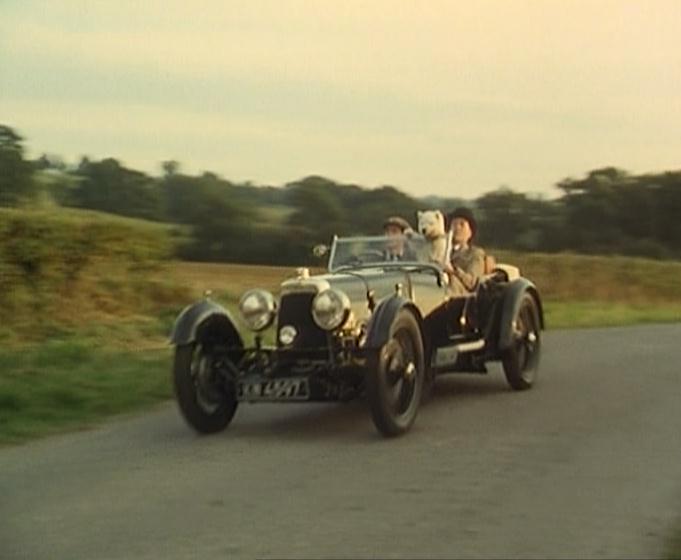
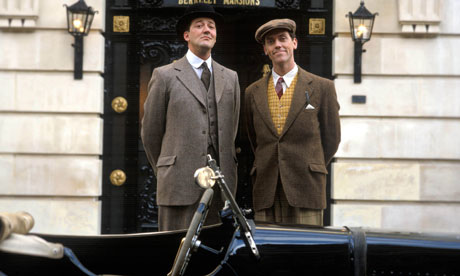
I rather fancy it's time for another Captain Hastings/Style Icon post, but this time with a twist!  I think that, by way of a change, I might focus less on the chaps and more on their cars.   Two chaps and their chariots of choice in fact!  Not just Captain Hastings and his voiture but also the equally arch-Chap Bertie Wooster, as portrayed by Hugh Laurie in Granada TV’s 1990-93 adaptation of P.G. Wodehouse’s Jeeves stories, Jeeves & Wooster (with Stephen Fry as Jeeves, of course!). Both these fine fellows happen to share the same taste in motors, driving cars that perfectly complement their personalities and which share a striking commonality with themselves and the characters who drive them.  The cars in question: the comparable Aston Martin and Lagonda.

Bertie Wooster’s Aston Martin

Wodehouse in his AC 12hp Tourer, outside Hunstanton Hall,
Norfolk, in 1928
To my certain knowledge P.G. Wodehouse never specified the make and model of car preferred by Bertram Wilberforce Wooster. As narrator, Bertie refers to it only as the “old two-seater” or “sports model”. This at least gives the reader carte blanche to imagine any two-seat sports car from the 1920s - although the BBC rather missed the point in their 1965-67 adaptation The World of Wooster, Ian Carmichael’s Bertie Wooster driving a four-seat 1927 Bentley 3-litre. Wodehouse himself owned an early-‘20s AC 12hp two-seater and one can easily see Bertie and Jeeves pootling along to Totleigh Towers or Brinkley Court in just such a model - I wouldn't be surprised if Wodehouse had it (or one of the many sporting cars favoured by the young "drones" of 1920s London) in mind whilst sat at his typewriter tapping out the stories.

In the event, though, the Jeeves & Wooster series went for an Aston Martin instead.  A 1928 Aston Martin 1½-litre International, to be precise.  An inspired choice, since it suits his youthful and excitable character perfectly.

source
Long before Aston Martin became inextricably (and, some might say, tiresomely) linked to James Bond, the company had already built up a strong sporting pedigree pre- the Second World War.  Founded in 1913 (and therefore having recently celebrated its centenary) as Bamford & Martin after owners Robert Bamford and Lionel Martin, their first cars had early successes on the hillclimbing course at Aston Clinton in Buckinghamshire - hence they were renamed Aston Martin (the story further has it that Mrs Martin encouraged the rebranding on the basis that the new name would be near the top of any business listings!).

source
Astons would go on to race at Brooklands and Le Mans throughout the '20s and '30s, setting many endurance records.  Even Bertie's 1½-litre International had a "Le Mans" variant, although one can't imagine him tearing round La Sarthe (then again... maybe there's a story there!  Bertie did in fact drive his car into the ground attempting to beat the train to Deverill Hall in the fourth episode of series three).

Indeed Bertie remains blissfully ignorant of the inner workings of the motor car, knowing only that it runs on something called petrol but not that it has something called an "engine".  These things are best left to Jeeves or the local mechanic, naturally!

source
The 1½-litre International was produced between 1928 and 1932, a very prosperous time for Aston Martin following some lean years and the departure of its founders in the early '20s.  A group of skilled engineers and investors (including the wonderfully Wodehousian-sounding Lady Charnwood) had taken over the ailing company in 1926 and went on to oversee production of some of the most quintessentially British cars of the inter-war era including the 1½-litre, the 1934 MkII "Ulster" and the 1936 2-litre "Speed" model.

Aston Martin 1½-litre MkII

You can just imagine Bertie hearing about this wonderful sporting car company from his chums at The Drones Club and then heading off to the dealer to place his order.  Today you'd still have to be a Bertie Wooster to be able to afford an Aston Martin old or new; 1½-litre cars from the Thirties regularly fetch in the region of £150,000 now - as much or more than most modern Astons!  Certainly Bertie wouldn't be seen dead in the modern equivalent suggested by the Telegraph - a Mini Roadster indeed!  Choh!

source
This 1934 1½-litre Sports model sold last year for £155,500 at a Bonhams auction.

Captain Hastings' Lagonda

Here's the car we all know and love - the incidental yet important player in many a Poirot mystery, whisking our heroes to and from the crime scene.  How many times have we seen it bring some light relief to the proceedings as our favourite chap Captain Hastings talks about it, works on it or just drives it?


As with P.G. Wodehouse, Agatha Christie never mentions the type of car Hastings drives in the books - mainly because he only appeared in eight of the stories and Christie was no doubt more concerned with getting the plot and motive down properly.  It's thanks, as ever, to the expansion of the character in the TV series that we can really enjoy Hastings' hobbies and adventures, especially with his car.  Thus it was that the show's producers gave him one of the ultimate gentleman's cars of the 1930s - a 1931 Lagonda 2-litre Low Chassis Tourer.


Lagonda was founded in 1906 at a time when many companies were setting up to produce the new-fangled motor car, including the likes of Rolls-Royce.  As with so many of its peers it became favoured by the Edwardian aristocracy and increased its reputation through motorsport success, in particular in the 1910 Moscow-St. Petersburg race.  After the First World War it continued to do well; Captain Hastings' beloved 2-litre Speed selling for eight years from 1925 to 1933.  The company faltered in 1935, however and was nearly bought out by Rolls-Royce until another buyer - Alan Good - intervened.  By this time Rolls-Royce had also taken over Bentley and Good was able to poach the man himself - W.O - to work for Lagonda, who designed a new 2.6-litre straight-6-cylinder engine that would remain the backbone of the business well into the 1950s and end up having great ramifications for the future of the company. 

Where would we be without Captain Hastings and his lovely Lagonda, eh?  Where would Poirot be?  Stuck in his flat, that's what - there's only so many taxis he can take after all. Who can forget it breaking down in The Adventure of Johnnie Waverly, or chasing after Mrs Daniels in The Adventure of The Missing Prime Minister?  We'd never get to see half of Hastings' smashing wardrove either, not least his superlative driving outfit.  I still can't believe he nearly chopped it in for an Alfa Romeo (all right, a fictional "Eliso Freccia") in The Adventure of The Italian Nobleman.


I've often wondered where Captain Hastings gets his income from to afford such a car as a Lagonda.  He was The Honourable Arthur Hastings, if I recall aright, so there's probably money and a family estate somewhere.  You'd need to be the son of a viscount or earl to afford one of Captain Hastings' Lagondas today, with good examples going for over £90,000.

Aston Martin plans to build Lagonda saloon, reports say

It may not be long before you can buy a brand new Lagonda again, though, if the latest rumours are anything to go by.  Aston Martin - who bought Lagonda in 1947 purely to get hold of the Bentley engine - have been toying with the idea of reviving the Lagonda brand for several years (its last appearance being on the futuristic Aston Martin Lagonda saloon in 1976).  Thankfully the initial idea to use it on a breezeblock of a 4x4 has been rejected and photos of the new saloon look very promising.  Definitely something I could see Captain Hastings driving around in!

Two top chaps, then, linked by their motors (although one can imagine them hitting it off quite well, too!).  While we may never be able to return to the heyday of pre-war British motoring, Bertie Wooster and Captain Hastings will forever be shining of examples of the Thirties gentleman driver.


**If you enjoyed this post keep your eyes peeled for more of the same in the next issue of In Retrospect, due for æthereal publication on the 1st July!**

Tuesday, 11 February 2014

Captain Hastings - by the sea and on the deck

I was delighted to receive an e-mail yesterday from a reader telling me how much he enjoys my Captain Hastings posts and asking for my advice on the ideal style of braces to create the Hastings look.  Hopefully I've helped to steer him on the right track (little old me being asked sartorial questions!  Golly gosh, I'm flattered!); it reminded me as well that it's been a while since I last did a Captain Hastings post (have I won, girls - has Captain Hastings trumped Miss Lemon in the style icon stakes? :p).  Time to rectify that oversight, methinks!  Since it has been so long since our last encounter (October, I think it was) I'm going to treat you all to a double-bill to make it up.

He's back!

We return to the first series with these two (I still don't think I can bring myself to cover Curtain just yet!) and jump about a bit, since I originally skipped Problem At Sea thinking it didn't have much in the way of Hastings' wardrobe - wrong again!

As the title suggests, the action takes place on a small Egyptian cruise liner.  A holidaying Poirot and Hastings end up investigating the death of one of the passengers, but they still get the chance to do a little sightseeing and exploring.

I've sort of gravitated away from short-sleeved shirts as I've got older (if it's that warm,
just roll up your shirtsleeves say I).  But Captain Hastings proves it's still a valid look when
on holiday, teamed with white slacks and a cravat (plus pretty girl and shotgun).

Hastings takes the time to teach one of the female passengers the finer points of clay pigeon shooting.  One of the many amusing scenes in the early Poirots, as the rather ditsy girl gets carried away with Hastings' instructions to "pull" leaving our hero to quickly attempt a shot!

This is more the kind of thing, though!  The trusty white double-breasted tropical
suit (linen or lightweight cotton, probably), striped shirt and tie all present and correct
Oh, and the hat.  The hat!

(White suits are hard to get away with in Britain, in my experience, even in the height of summer.  One is almost certain to be likened to one of the following - author, B.B.C. reporter and ex-[local] MP Martin Bell (aka The Man in White), The Man from Del Monte or, as previously mentioned, Michael Jackson.  So sadly it is probably best to follow Captain Hastings' lead and reserve this look for foreign climes.)

Oh I do love his expression - so serious!

When on holiday no true Englishman passes up the chance to make a complete fool of himself, and Captain Hastings nobly upholds that tradition not once - but twice!

Note - if you can! - his shoes.  They appear to be brown with some white striping. 
Whether they're co-respondents or some sort of summer shoe I can't tell, but I do like
them and I'm sure they set off his proper outfit splendidly.
Another look at his excellent suit.

Following the murder aboard the yacht, suspicion falls on either the local hawkers or a creepy-looking steward.  All this gives Poirot and Hastings a chance to investigate further.

I'm not normally a fan of the safari suit/jacket but Captain Hastings pulls it off
with aplomb.  The contrasting black trousers are a helpful touch, topped off with
a cravat and Panama hat.
A closer look at the hat.  What I absolutely love about it is that matching blue trim
around the brim.  It's so simple yet it really adds something typically English to it
(it also puts me in mind of one of Michael Redgrave's outfits in
The Importance of Being Earnest
)

With such a dapper associate by his side it's no time at all before Poirot solves the murder - and we get some good ideas for summer/holiday wear.

Returning to chronological series order finds us at The King of Clubs, swapping the tropical climate of Egypt for the damper one of autumnal England.  Hastings takes Poirot to meet his film director friend Bunny Saunders:

That marvellous leather driving coat first seen here, what is probably a blazer underneath
and an absolutely first rate roll neck cable knit jumper.  No wonder he's smiling!

There's trouble afoot between the star and producer, though, and before you can say "Good Lord!" the latter is dead.  With the actress implicated in the murder, it's Poirot and Hastings to the rescue!

Captain Hastings has swapped his coat for something a bit plainer, but still he
makes it look stylish.  The gloves, the contrasting suit trousers, it all works.
Add the brown trilby and Captain Hastings is ready for anything!
A classically '30s double-breasted peak lapel jacket, contrasting pattern tie and a
spearpoint collar shirt.
A closer look at the tie; again a typically lovely Thirties pattern.
Sod Sherlock - look to this man for the perfect turned-up coat collar look!
(I'd forgotten how much I adore his expressions too...!)
A better angle to show off that wonderful spearpoint shirt collar (and small tie knot).

All's well that ends well in the end, of course, and Poirot and Hastings head off to further adventures.

The double-breasted pocket-crested blazer first seen here, beautifully accessorised
with a red pocket square, paisley(?) cravat and grey trilby

I hope that this more than makes up for 4 months of Captain Hastings-less and I promise it won't be another quarter-year before the next instalment - The Dream.  No accompanying video this time I'm afraid - YouTube seems to have had one of its periodical clear-outs and Poirot has suffered.  You'll just have to get the DVDs, if you haven't already (what's the matter with you then?!) and tune in here again soon for another Captain Hastings post!

Followers

Popular Posts