Showing posts with label digital. Show all posts

Friday, 4 September 2020

Edinburgh animator brings vintage photographs to life


Edinburgh animator brings vintage photographs to life in incredible new videos

Digitising old photographs to include colourisation, 3D effects and even animation seems to be the "in" thing at the moment judging by this latest article - the second to feature on this blog in recent months following a similar project in Coventry as reported here.

John Knox House, Edinburgh, c.1865
source - Wikimedia Commons

This time we find ourselves in Edinburgh, where a local film and animation enthusiast has used his skills in 3D and visual effects to bring images of Auld Reekie from across the decades to life.  With support and encouragement from a local history Facebook page, and inspired by the same Youtube videographer I mentioned in the Coventry article who upscales century-old footage of New York, Paris and elsewhere, Scottish filmmaker Steven Jefferies has taken still photographs of his home city from the 1950s all the way back to the 1870s and turned them into moving pictures using modern digital techniques.

Leith Pier, Edinburgh, 1870
source - Monovisions

The result is quite remarkable, blurring the lines between static photography and moving images - in the case of the latter quite a valuable addition inasmuch as it provides quasi cine-footage of the 1870s, a time before such technology existed, thereby adding a new level of immediacy and familiarity to otherwise motionless images.

Edinburgh, c.1870s
source - Monovisions

The footage seems to have gone down well with the people of Edinburgh, as well it should, giving a new lease of life and fresh perspective to these old photos, preserving their memories in a new and exciting way - a way that might hopefully engage with the younger generation, perhaps even encourage some to take a further interest in their local history and - who knows? - maybe pursue a career in [digital] photographic conservation.

The Cowgate arch of George IV Bridge, Edinburgh, 1860
source - Monovisions

In the meantime I congratulate Mr Jefferies on his Living Pictures Project and - as with the Coventry Rebuilt initiative - add my voice to those who have expressed the hope that it is something that will continue to grow (with the assistance of the Lost Edinburgh Facebook page) into a valuable historical asset for the local community.

Thursday, 25 June 2020

Coventry man brings to life old photos to 'give them a home'


Coventry man brings to life old photos to 'give them a home'

Lost photographs and discarded picture albums have been a recurring theme on this blog over the years - from photos of a still under construction Tower Bridge being found in a skip, 5,000 First World War photos rescued from rubbish dumps, to rare images of the British Raj from over one hundred years ago turning up in a shoe box.  On each occasion we have marvelled at the wonderful glimpse into the past these eleventh-hour rediscoveries have afforded us while at the same time lamenting the fact that they have been so undervalued as to have been left forgotten for decades or more, often to the point of their near-destruction.

This latest article is no exception and once again it is thanks to the efforts of one collector that a number of old photographs - primarily picture postcards of his home town of Coventry and studio portraits of its inhabitants - have been saved for posterity.  Peter Knight's attitude towards preserving these "forgotten faces" is one that we can well appreciate - the thought that they might represent all that is left of a person's life, that they are the last surviving visual documentation of their existence and the travesty that would result if they were just left to gather dust (or worse).


What gives this story added inspiration is that Mr Knight has been able to use modern technology to restore the images to a startling degree of freshness, colourising them and in some cases even employing the much talked-of computer trickery that is "deep fake" to slightly animate the photos.  While I am not convinced about the latter technique, the colourisation does go some way to adding to the immediacy of the pictures, to reinvigorating the subject and, indeed, bringing them back to life.  Mr Knight's idea of incorporating these photographs into a virtual online world of an historical Coventry is also an intriguing project and one that I hope succeeds.


There has been some degree of backlash from certain quarters recently regarding how far "restoration" of old photographs and cine-footage should go following the colourisation, addition of sound effects and 4K HD & frame rate upscaling applied to the famous Lumière brothers' 1896 film L'Arrivée d'un train à La Ciotat and other late 19th-/ early 20th-century footage on YouTube.  As a student of history I can well understand the disquiet that is felt at the perhaps unnecessary meddling with things that were products of their time and should be understood and appreciated as such but equally I can appreciate the thinking behind it and in particular the benefits to the originals and their history that may result.  For example, is Peter Jackson's recent excellent WW1 film They Shall Not Grow Old just "showmanship" or a legitimate attempt to modernise important historical footage for a new, 21st century audience?  As I have said we as lovers of times gone by can appreciate black & white pictures and films as windows to the past but to many [young] people it is as alien and as relevant as another planet - noiseless, colourless, oddly-dressed people long since dead.  If adding colour, realistic movement and other modern technological features can help get new generations more interested and perhaps lead them back to the unadulterated original, with a better understanding and appreciation of what it represents, it might well help to avoid further examples of photographic abandonment like those mentioned and ensure the endurance of classic early cinema and historic photographs such as those saved from oblivion by the likes of Peter Knight and others.

***What do you think?  Can film or photographs ever be over-restored?  Let me know your thoughts in the comments below.***

Thursday, 28 May 2020

Talking Pictures celebrates its fifth birthday


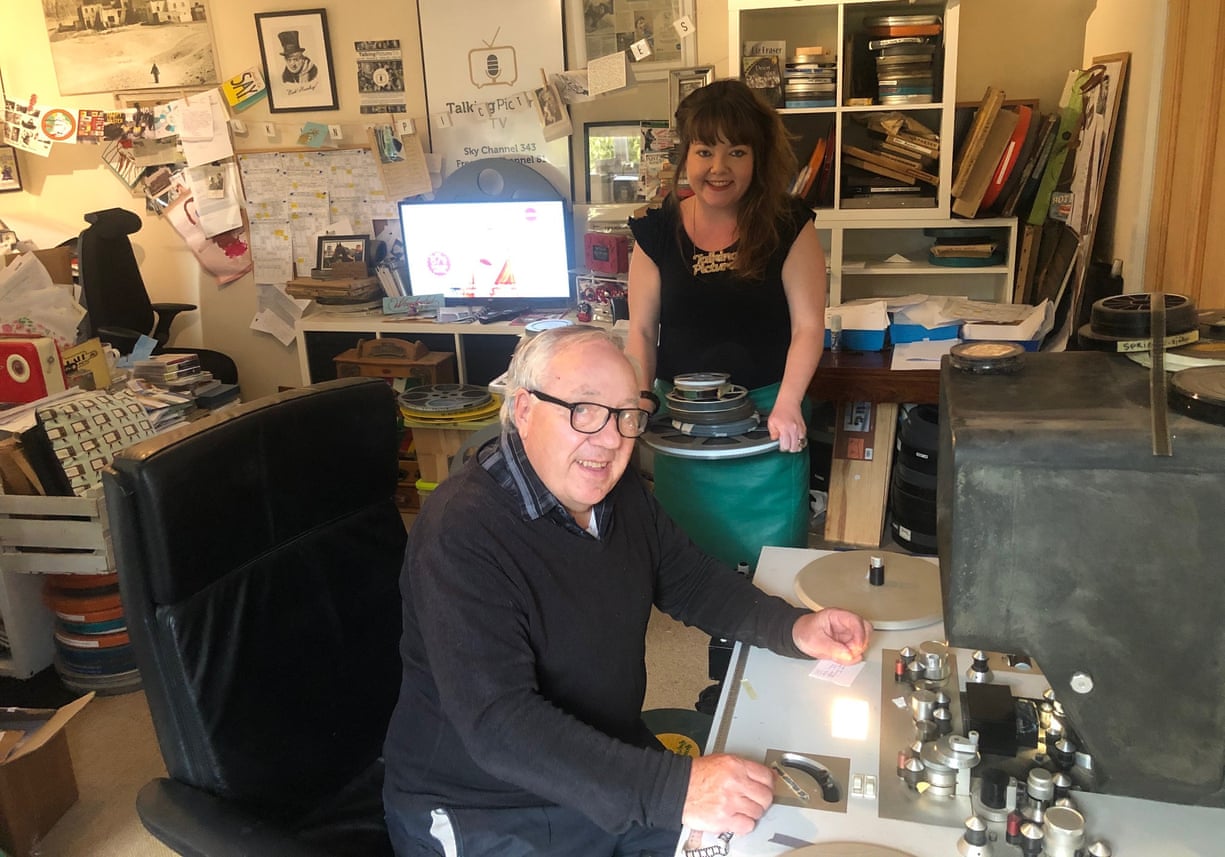
Inside Talking Pictures, the ultimate in lock-down comfort TV

Five years ago on Tuesday saw the launch in the UK of the best TV channel to hit terrestrial television in ages, one that makes all this Freeview business worthwhile and which should be on the radar of every self-respecting vintage film buff - Talking Pictures TV.

I remember thinking when Talking Pictures was first launched in 2015 what a splendid and long-overdue idea it was and I am delighted to see how it has gone from strength to strength in the intervening time period.  What makes it even more remarkable, as the excellent Observer article explains, is that it is all run by a family of four from a house on the outskirts of Watford!  Proof that you don't need a massive budget or have to jump through loads of hoops (except maybe to placate Ofcom when it comes to the old chestnut of historic cultural norms on film) to run a successful TV station.  It is wonderful to note the obvious enthusiasm and experience running through the whole enterprise, which no doubt contributes in no small part to its success, and I am particularly pleased to read of another new Laurel & Hardy fan in the making!

source
Talking Picture TV founders Neill Cronin and Sarah Cronin-Stanley

There really is something for everyone on this channel, from obscure 1930s British B-movies to classic but long-forgotten 1970s TV dramas.  Tie-ups with the Imperial War Museum have resulted in showings of some enthralling public information films and period docudramas and people even send in old home cine footage from the 1950s and beyond, to be given a whole new lease of life.  More modern but no less pertinent stuff also frequently gets an airing - TPTV recently showed the 2016 documentary film The Man Who Gave A Damn, about the life of Leslie Howard, which I had long been wanting to see.  They even sell DVDs and other merchandise through their Renown Film Club subsidiary, which also runs regular film festivals and other such events.


All in all then, a hearty "well done" and "Many Happy Returns" to Talking Pictures TV - long may it continue to grace our television screens.  It is an oasis of joy and nostalgia amid a sea of mediocrity and I am so glad to see it get some recognition in the popular press.  That Her Majesty is allegedly a fan comes as no surprise and is perhaps the greatest accolade TPTV could hope to achieve.  I for one hardly tune in to anything else these days (on the rare occasions I actually watch television - most of the time it's DVDs or some obscure thing on YouTube) and can thoroughly recommend adjusting your set to channel 81 (Freeview), 445 (Virgin), 306 (Freesat), or 328 (Sky).


*** An honourable mention should also go to Sony Movies Classic, which recently replaced True Movies on Freeview channel 50 (Virgin 424, Freesat 303, Sky 319) and which also shows some decent films from the 1940s onwards. ***

Thursday, 8 December 2011

British Library scans 18th and 19th-Century newspapers

British Library scans 18th and 19th-Century newspapers

A bit of old news from last week here, about a lot of old news from 200 years ago. 

Some of you may have read that the British Library now has 4 million pages of newspapers from as far back as the 1700s online, with a further 8,000 pages being scanned every day.  A huge selection of historic British newspapers from all over the country are now available for searching on the Internet.  Of course there is a charge to actually view the papers, but the search function itself is free.  This will at least allow for a speedier discovery of articles of interest for, as the story makes clear, one can type in a search term and find the exact newspaper in which it appears in just a few minutes.  Then, if you're not a subscriber (or simply like to leaf through old newspapers), you have at any rate the reference number which you can use to go straight to the 'paper in question at the British Library.

This is good news in a number of ways, from the increased ease of access for people all over the world to the continued preservation of some ancient and in some cases fragile newspapers.  You can of course still read the hard copy at the British Library site, and I wouldn't blame you if you did.  Like so much history it is all the more evocative if you can hold it in your hands.  But this latest innovation does make it quicker to find first.

Thursday, 14 April 2011

Pop up station for 1930s singer


Pop up station for 1930s singer

This Sunday, the 17th of April, will mark the 70th anniversary of the untimely death of one of the greatest jazz singers of all time and certainly one of my favourite crooners of the 1930s - Al Bowlly.  His classic rendition of The Very Thought of You (above) remains for me one of the great love songs and his voice and style is incredibly redolent of the period.

By way of a commemoration Hampshire-based community radio station Angel Radio, some of whose output includes 1920s, '30s and '40s music, has gone semi-nationwide on the DAB network with a series of programmes showcasing the songs of the period and particularly those of Al Bowlly and the various bandleaders he worked with.

Ever since the advent of digital radio I have been longing for someone to set up a station devoted to early dance band and big band music (plus other related genres), and I'm sure I've not been alone in that wish.  Since the shameful treatment of the late Malcolm Laycock, who used to present Sunday Night at 10 on B.B.C. Radio 2, and the B.B.C. later dropping British dance bands from the programme completely, there hasn't been a single exponent on the national DAB network so far as I could see.  While I will continue to get my dance band fixes from Internet radio stations Soundstage and Radio Dismuke, this new addition to the DAB ranks is a long overdue one.

It's not clear to me whether this is a temporary arrangement to coincide with the anniversary or something more permanent (I hope the latter!) but either way I welcome this new station and look forward to hearing what it has to offer.  If you're in any of the areas mentioned in the article and own a digital radio, my advice is to do a quick re-tune and look for a the station called "Pop Up".  For those of you outside the UK or in areas not covered the programmes are available online at www.popupradio.co.uk.  Happy listening! 

******STOP PRESS******
I have just heard that this station is temporary and will cease broadcasting on the 28th April.  However if you like 70 Years Without Al Bowlly (and I suspect that if you're reading this, you do!) Angel Radio urge you write to them to show your support so that they might "do it again".  Who knows, maybe they'll even be able to make it permanent.  "Every letter counts", they say, so I will be taking up my pen and paper and if you wish to do the same the address to write to is: 

Angel Radio,
17 Market Parade,
Havant,
Hampshire,
PO9 1PY.

Followers

Popular Posts