Showing posts with label Talking Pictures TV. Show all posts

Friday, 23 October 2020

Colonel March of Scotland Yard


We stay with Talking Pictures TV for this next post (indeed one could easily base an entire blog around that splendid channel, such is the appeal of their excellent vintage-centric output, but perhaps that is a project for another time and place...) as their schedules also recently included an obscure 1950s British B-movie that really appealed to me and which - suitably in the run-up to Hallowe'en - starred one of the greatest horror film stars of the 1930s and '40s, Boris Karloff.

source - IMDb
This little gem amongst gems is Colonel March Investigates, an 80-minute feature made in 1953 with Karloff in a rare non-villainous role as the titular Colonel March, the debonair head of Section D.3 of Scotland Yard - otherwise known as the Department of Queer Complaints (and one of the things that hasn't aged so well of course, these days sounding more like the name of a Channel 4 medical documentary(!).  I keep mistakenly calling it the Department of Queer Goings-On, which at least sounds slightly better to my mind).

Colonel March Investigates was in fact a series of three pilot episodes of a new TV series, Colonel March of Scotland Yard, commissioned with an eye for the then soon-to-be-launched British commercial channel ITV, spliced together into a feature-length film (with extra mid-story scenes of Karloff added in to link the stories together) that was also shown in cinemas.  In each case, Colonel March sets out to solve a set of seemingly impossible mysteries - Hot Money sees him investigate a bank robbery where the money disappears after the thief is seen entering a solicitor's office; Death in the Dressing Room involves the strange murder of a Javanese nightclub dancer and The New Invisible Man sees murder committed by a pair of disembodied gloves!  


These initial episodes were originally shot in 1952 following Karloff's return to England from Hollywood earlier that year, his horror film heyday behind him.  At 65 and beginning to suffer from emphysema as a result of a heavy smoking habit Karloff was looking for an interesting yet undemanding project, plus the chance to settle back in his home country, and was attracted to the role and the opportunity to work for a London-based TV studio.  It can be seen from his on-form performance that he clearly relished playing the part of the be-tweeded, eyepatch-wearing (for which no reason is ever given) Colonel - Karloff is a joy to watch, mixing his trademark levels of subtle menace and sinisterness with a wonderful degree of enthusiasm, mysticality, decency and gallantry.  Despite his advancing years and health problems Karloff still enters into the spirit of things with aplomb - there are several incidences of what for the time could easily be termed action sequences and Colonel March even carries a swordstick umbrella such as another later TV hero sports!  Indeed in many ways Colonel March of Scotland Yard could be seen as a sort of forerunner to The Avengers, with in both cases our debonair protagonists investigating strange and outlandish occurrences.

Cecil Street, Carr's inspiration for the
character of Colonel March
The character of Colonel March was the creation of the American mystery writer John Dickson Carr who wrote The Department of Queer Complaints in 1940 under the nom-de-plume of Carter Dickson, one of several pseudonyms he used for the many different detective stories he would write between 1930 and 1971.  Generally regarded as one of the best of the "Golden Age" detective novelists and the master of the "locked room mystery", the Anglophile Carr set most of his stories in England and based some of his creations on real-life acquaintances or other contemporary crime characters (Dr Gideon Fell, for example, was directly influenced by G. K. Chesterton's Father Brown).  The character of Colonel March was inspired by Carr's friend, former Army officer and fellow mystery writer Cecil Street (who also wrote under the aliases of John Rhode, Miles Burton and Cecil Wayne among others).  Regrettably much of both Carr's and Street's work has now been long out of print and is therefore difficult (and therefore expensive!) to come by, which is a great pity especially as I have now a desire to read The Department of Queer Complaints and maybe a few others.  Both authors have however had a couple of their stories reprinted recently as part of the British Library's excellent Crime Classics series, which includes Street's 1930 offering The Secret of High Eldersham (which I have read) and 1936's Death in the Tunnel (which I haven't) along with the first three of Carr's novels - It Walks By Night, The Lost Gallows and Castle Skull.  Some more reading material to be on the lookout for then, at any rate!  


Although the first three pilots of Colonel March of Scotland Yard were made in July 1952 it was not until a year later in 1953 that the series was finally given the green light by ITV executives, with Karloff again returning to England from America where he had been continuing to appear on TV, film and radio.  Even so it was only in September 1955 that the series finally premiered on British television following the launch of ITV that year -  and then just in the London area where it was first available.  Later broadcasts followed when ITV Midlands began in February 1956 - the same time that U.S. broadcasts started - and even B.B.C. viewers were not left out, with the feature-length Colonel March Investigates being shown in September of that year.

Sadly only one 26-episode series of Colonel March of Scotland Yard was made; on release it garnered largely negative reviews (perhaps somewhat coloured by the general antagonism many people had at the time towards the new-fangled "commercial" television channel) with only Karloff's stand-out performance receiving any positive comment.  Today it seems rightly regarded as something of a [forgotten] cult classic, with good reviews on the likes of IMDb.  As well as having Boris Karloff in the lead role many episodes feature the great and the good of British, American & Canadian TV and film from the 1950s and beyond including Christopher Lee, Dana Wynter, Joan Sims, John Laurie, Richard Wattis, Patrick Barr, Patricia Owens and Hugh Griffith.  Karloff is also ably supported by Ewan Roberts as the sceptical, put-upon Scottish Inspector Ames and Eric Pohlmann as March's opposite number Goron of the French Sûreté.  The three episodes that form Investigates were also directed by Cy Endfield, who would later go on to do Hell Drivers and Zulu in the 1960s.

Certainly I have been thoroughly enjoying both the film and any episodes I have been able to lay my hands on.  I'm told all 26 are on Amazon Prime, if that's your sort of thing, but for now I am happily making do with the nine episodes that are currently available on YouTube.  I can heartily recommend it to anyone who enjoys a bit of Fifties TV mystery drama in the mould of The Twilight Zone and now have another new hero in the form of Colonel March, head of Department D.3, Scotland Yard - the Department of Queer Complaints!

***Colonel March Investigates is available to buy on DVD and will be shown again on TPTV weekly from Saturday 7th November 2020 at 5pm (and which they previously ran daily at 7:30pm a few years ago).  Coincidentally a new illustrated reference book - Colonel March of Scotland Yard: The Series - has also recently been published and seems to be well worth a look.***

Tuesday, 20 October 2020

Stop, Look, Listen... And Take Heed!


The excellent nostalgia TV channel Talking Pictures TV, about which I blogged previously on the occasion of its 5th birthday, very often as mentioned shows short archive documentary films and amateur cinefilm - usually between 10 and 30 minutes' duration - in association with the likes of the Imperial War Museum and the British Film Institute.  Recently it has started broadcasting some quaint motoring-related shorts from the 1940s and '50s, some linked to the forthcoming 100th anniversary of the original Austin 7 motor car which was first introduced in 1922 (and which I can hardly believe will shortly be celebrating its centenary, having also blogged about it on the occasion of its 90th birthday).  One that particularly caught my fancy and which has [partly, along with Mim's recent review of a TPTV-aired feature 80,000 Suspects over on Crinoline Robot] inspired this post is the captivating and entertaining (in more ways than one) road safety film from 1947 entitled It Happened Today.

While in places it hasn't dated well (especially Patrick Holt's narration, which has suffered somewhat from 70 years of change and the many pastiches from the likes of comedians such as Harry Enfield) this just adds to its overall charm in my book and it remains a fascinating early example of its type.  One particularly interesting area it focuses on is the then still-new concept of the unsignalised pedestrian crossing, complete with Belisha beacons but yet to feature the now-familiar black-and-white stripes that gave rise to its more common alternative name - the zebra crossing.  

A Belisha Beacon crossing at the corner of Whitehall  and Horse Guards Avenue, 
London, December 1938.
source - Flickr / Leonard Bentley

First introduced in 1935, Belishas were the brainchild of - and were named after - Leslie Hore-Belisha, the Minister for Transport from 1934 to 1937 who was a staunch advocate of improved road safety especially after he was nearly run over on Camden High Street shortly after his appointment.  Part of his Road Traffic Act 1934, which also included the creation of the 30mph urban speed limit, the first official driving test and a comprehensive updating of the Highway Code, the beacons were added to existing "uncontrolled crossings" that had until that point only been demarked by reflective metal studs set into the road.  The distinctive flashing orange globes set atop a black-and-white painted pole, along with the new speed limit and driving test, went a long way to lowering the number of fatalities on Britain's roads from 1934's high of nearly 7,500 (along with 231,000 injuries).  It was not until 1949, however, two years after It Happened Today was made, that the matching stripes were first added to the road surface giving rise to the zebra crossing name that they still bear today (and which was allegedly coined by a young James Callaghan - then a junior transport minister - when he viewed an early prototype at the Transport Research Laboratory in Berkshire).  Now the next big advance looks to be intelligent light-up crossings with warnings built into the kerb to try to catch the attention of the smartphone-addled.   

source - The World of Playing Cards

source - The World of
 Playing Cards
So well-received were the beacons that, in addition to quickly receiving Belisha's name, such was their novelty value they started something of a craze for related ephemera - including an eponymous card game based along the lines of Rummy.  Made by the well-known playing card manufacturer Pepys, the cards feature delightful images of various British landmarks and towns from London to Oban as well as pictures depicting the safe (and not so safe!) use of the road, along with examples of the road signs in use at the time (and which are fully deserving of their own blog post) and different coloured numbers - the idea being to collect sets of either of the latter.  As something of a Pepys collector myself, Belisha (my example's on the left) was one of the first of their games I picked up (from eBay a couple of years ago) and it has proved to be a thoroughly enjoyable and popular diversion (see what I did there?).  The game was updated in 1955 with the addition of an extra level of cards, updated images and new road signs.  Released as Round Britain it nevertheless retains much of the charm of Belisha, although the revised rules and new cards do make it slightly less fun to play (needless to say an example still graces my collection!).


Various road safety films similar to It Happened Today would continue to be made throughout the 1940s and '50s.  Then in 1953 came the character of Tufty Fluffytail, an anthropomorphic red squirrel created by one Elsie Mills as a way of imparting road safety advice to young children in an accessible and understandable way.  This led to the creation of the Tufty Club in 1961, designed to promulgate road and pedestrian safety among the under-5s through simple books and, later, public information films (narrated by the great Bernard Cribbins).  Such was its success that at its peak there were almost 25,000 Tufty Clubs throughout Britain with over 2 million members and the scheme lasted well into the 1980s, outliving several other programmes.


One of those programmes was the "Kerb Drill", which ran concurrently with the likes of the Tufty Club and other road safety policies.  Even Batman got in on the act during one of his rare breaks from fighting crime in Gotham City, as this recently-discovered footage from 1966 proves.


The 1970s saw the introduction of arguably the most well-known and long-lived road safety initiative - the Green Cross Code.  Featuring noted Bristolian Dave Prowse (who would later go on to greater fame as the body of Darth Vader in Star Wars) as the Green Cross Man this series debuted in 1975 and ran for nearly 20 years until the early 1990s (with a brief revival, complete with a then 80 year old Prowse, in 2014) scaring the bejesus out of a generation of dungaree-wearing kids by suddenly appearing out of nowhere, sometimes accompanied by an unnamed robot sidekick, looking very stern and shouty.  While the Green Cross Code Man was eventually retired, the Code itself lives on, although various subsequent attempts to instil road sense in youngsters have, erm, perhaps not been quite so successful.   


So there we have it then - a brief history of road safety from the 1930s to the 1990s (a bit late period-wise for this blog perhaps, but then all things Nineties are considered "vintage" now apparently) inspired by a splendid piece of 1940s film work.  Looking back at these innumerable road safety initiatives and the many dangers still very much inherent on the roads - not helped by modern technology and with 15-19 year olds having among the highest death rates due to traffic accidents - some new safety programmes inspired by the past seem called for.  One could easily see another update of Belisha, with current signs and new pictures, being just the thing to teach the youth of today how to stay safe on the roads.  Hmmn, maybe another lock-down project... 

***It Happened Today is also available to view for free on the BFIplayer*** 

Thursday, 28 May 2020

Talking Pictures celebrates its fifth birthday


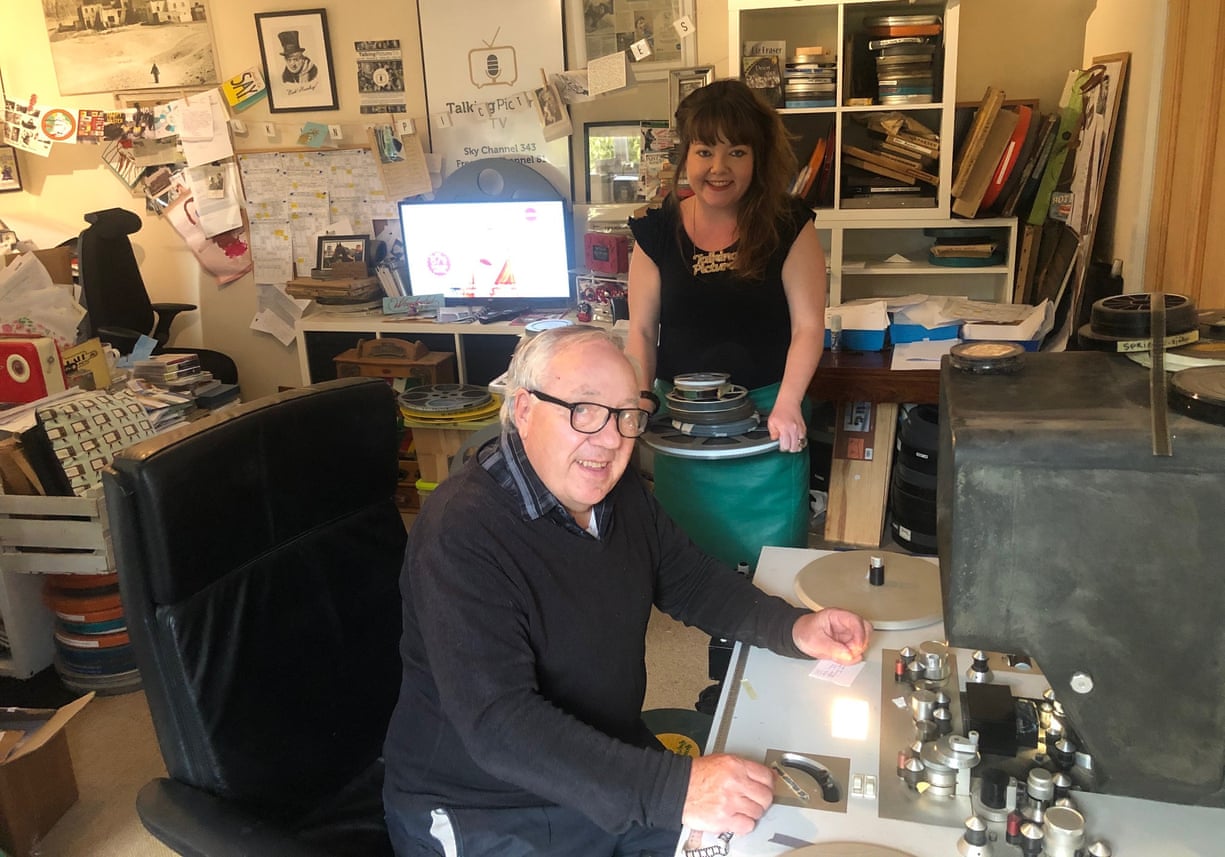
Inside Talking Pictures, the ultimate in lock-down comfort TV

Five years ago on Tuesday saw the launch in the UK of the best TV channel to hit terrestrial television in ages, one that makes all this Freeview business worthwhile and which should be on the radar of every self-respecting vintage film buff - Talking Pictures TV.

I remember thinking when Talking Pictures was first launched in 2015 what a splendid and long-overdue idea it was and I am delighted to see how it has gone from strength to strength in the intervening time period.  What makes it even more remarkable, as the excellent Observer article explains, is that it is all run by a family of four from a house on the outskirts of Watford!  Proof that you don't need a massive budget or have to jump through loads of hoops (except maybe to placate Ofcom when it comes to the old chestnut of historic cultural norms on film) to run a successful TV station.  It is wonderful to note the obvious enthusiasm and experience running through the whole enterprise, which no doubt contributes in no small part to its success, and I am particularly pleased to read of another new Laurel & Hardy fan in the making!

source
Talking Picture TV founders Neill Cronin and Sarah Cronin-Stanley

There really is something for everyone on this channel, from obscure 1930s British B-movies to classic but long-forgotten 1970s TV dramas.  Tie-ups with the Imperial War Museum have resulted in showings of some enthralling public information films and period docudramas and people even send in old home cine footage from the 1950s and beyond, to be given a whole new lease of life.  More modern but no less pertinent stuff also frequently gets an airing - TPTV recently showed the 2016 documentary film The Man Who Gave A Damn, about the life of Leslie Howard, which I had long been wanting to see.  They even sell DVDs and other merchandise through their Renown Film Club subsidiary, which also runs regular film festivals and other such events.


All in all then, a hearty "well done" and "Many Happy Returns" to Talking Pictures TV - long may it continue to grace our television screens.  It is an oasis of joy and nostalgia amid a sea of mediocrity and I am so glad to see it get some recognition in the popular press.  That Her Majesty is allegedly a fan comes as no surprise and is perhaps the greatest accolade TPTV could hope to achieve.  I for one hardly tune in to anything else these days (on the rare occasions I actually watch television - most of the time it's DVDs or some obscure thing on YouTube) and can thoroughly recommend adjusting your set to channel 81 (Freeview), 445 (Virgin), 306 (Freesat), or 328 (Sky).


*** An honourable mention should also go to Sony Movies Classic, which recently replaced True Movies on Freeview channel 50 (Virgin 424, Freesat 303, Sky 319) and which also shows some decent films from the 1940s onwards. ***

Followers

Popular Posts