Showing posts with label Jeeves and Wooster. Show all posts

Friday, 28 August 2020

Back on the road with Bertie Wooster and Captain Hastings

By far and away the most popular post ever published on Eclectic Ephemera was my study of the cars driven by two of our favourite fictional (alas!) chaps - Bertie Wooster and Captain Hastings.  Originally composed in June 2014 it has to date racked up a frankly astonishing 19,516 views and continues to attract comments more than six years after publication.  Clearly it has proved popular with both Wodehouse and Hastings fans the world over and it has been some recent comments from a few of the former that has inspired me to revisit the topic once again.

In my original post I focussed on the shared automotive tastes of Messrs. Wooster and Hastings in the form of the two interconnected marques of Aston Martin (Bertie) and Lagonda (Hastings).  At the time I mentioned that neither character's motor was specified in the books and while that may be true in the case of Captain Hastings ("The Cases of Captain Hastings" - now there's an idea for some fanfic!) it was subsequently pointed out to me that Wodehouse did name-check two makes of car in a couple of his Jeeves books so it struck me as the perfect opportunity to make another post out of the fact and to set the record straight.  (I was also corrected in the matter of the car Plum was pictured in outside a friend's home in Norfolk in 1928, which I had initially [mis]identified as a Morris Oxford Bullnose but which in fact was an AC 12hp Tourer.)

Wodehouse in his AC 12hp Tourer (NOT a Morris Bullnose), outside Hunstanton
Hall, Norfolk in 1928.

Bertie Wooster's Sunbeam

I did say in my initial post that "to my certain knowledge" P. G. Wodehouse never referenced the car Bertie drives and only has him allude to "the old two-seater" or "sports model"; this was I admit based on a brief and slightly hazy recollection of all the Jeeves stories I had read over the years and even then there was a nagging doubt in the back of my mind that somewhere there was a reference to a specific model but short of going back through the whole collected works - a not unpleasant undertaking to be sure but rather a big job for a simple blog post! - I wasn't sure how I was going to go about identifying it.

Thanks however to a comment on the original post from an anonymous Wodehousian a couple of months ago my information was updated and memory jogged so that I was reminded that in the short story "Bertie Changes His Mind" (from the book Carry On, Jeeves) the character of Peggy Mainwairing, a schoolgirl Bertie and Jeeves give a lift to, asks of our hero "What's your car? A Sunbeam, isn't it?".  While no further detail is given either in this or later stories Wodehouse scholars have alighted on the 1925 Sunbeam 20/60 Sports as being the most likely candidate and I can certainly understand why (1925 being the year of Carry On, Jeeves' publication for one thing).

source - ClassicCarsForSale

One could easily see Bertie and Jeeves pootling along in such a car as this - the 20/60 being marketed against the equivalent 20hp Rolls-Royce of the period; available in a number of different bodystyles built by either Sunbeam or various coachbuilders on a standard chassis (as was the practice of the time), the Sports model was offered as a two-seater (with a separate dickey seat in the back) and looks every inch the spiffy vehicle that would have appealed to a chap like Wooster.

source - V&P Classic Cars
The history of the Sunbeam cars is a rather convoluted one and would easily fill an entire blog post alone.  Suffice to say that, like so many early 20th century car companies, Sunbeams roots can be found in late 19th century bicycle manufacture - in this case the creation of Wolverhampton businessman and engineer John Marston.  A keen cyclist, in the 1870s he branched out from manufacturing tinplate into making his own bicycles with the name "Sunbeam" being suggested by his wife Ellen.  As with many Victorian entrepreneurs Marston wanted his machines to of the highest quality and Sunbeam Cycles were soon widely regarded as among the best available, a reputation it held on to until bicycle production ceased in 1936.  The company began making motorcars around 1901-1902 but then in 1905 the business was split up, with the newly-formed Sunbeam Motor Car Company Ltd taking over car production while Sunbeam Cycles continued in the ownership of Marston (with motorcycle production lasting until 1956).

Louis Coatalen in his Sunbeam Nautilus, Brooklands 1910
source - Wikimedia Commons
In the years prior to the Great War the Sunbeam Motor Company grew to become a serious contender in the luxury car market, rivalling the likes of Rolls-Royce, Bentley and Daimler.  Under the auspices of French automotive engineer Louis Coatalen, who joined the company in 1909 as chief designer, Sunbeam branched out into motor racing and Land Speed Record cars; during the First World War it also produced aero engines and commercial vehicles (the latter continuing until the mid-1960s and encompassing buses, trams, trolleybuses and even milk floats!).   Following the war's end Sunbeam merged with two competitors, Darracq and Talbot but each would continue as separate entities.  The 1920s were Sunbeam's heyday with its luxury limousines and sports models like the 20/60 proving popular with the well-heeled set of the time.  The 20/60 was produced from 1924 to 1932 in various bodystyles ranging from large 6-seater limousines, through 4-seater open tourers to rarer examples like this drophead coupe - only three of which still exist, including this one currently for sale (and you know what they say - if you have to ask the price...).

source - ClassicCarsForSale

Sunbeam struggled to survive the Depression of the Thirties; in 1934 after a string of financial losses the company was sold to the Rootes Group, one of the first massive automotive conglomerates which already counted Hillman, Humber and Singer among its brands.  Seeing the way the market was going Rootes repositioned Sunbeam as more of an everyman's car, combining it with the Talbot nameplate to create Sunbeam-Talbot, a situation that lasted until the mid-1950s when the Talbot name was dropped and Sunbeam began making sports cars such as the Alpine and Tiger.

source - V&P Classic Cars
Sadly the decline of Sunbeam began shortly thereafter in the 1960s; over the following 20 years the company was sold to Chrysler Europe (who reintroduced the Talbot sub-brand), before being passed on to Peugeot who eventually pulled the plug on both brands in 1981.  But it is Sunbeam's glory days of the 1920s that we are concerned with here and this 20/60 Super Sports DHC from the middle of that decade is fully deserving of Bertie's attention.

Bertie Wooster's "Widgeon"

The only other car to get a name check in the Jeeves books is in Thank You, Jeeves, where Bertie is noted as driving a "Widgeon Seven".  This is definitely a fictitious vehicle (and nothing to do with his friend and fellow Drones Club member Freddie Widgeon) but is most likely to be based on the Austin 7, that brand's ubiquitous small runabout.  I won't go into the history of the Austin brand here (I've already gone on long enough about Sunbeam) and it is unclear why Plum felt it necessary to change the name (if indeed that's what he did) unless he thought - as has been suggested by Wodehouse scholars - that an Austin was somewhat beneath the likes of the moneyed Bertie.  While this may be true of the standard saloon and convertible models, again - like many cars of its time - the Seven was available in a multitude of bodystyles and its cheap asking price and simple, lightweight mechanicals made it popular as an everyday racer with a number being produced in quite sporty designs.  It's entirely possible that one of these could have appealed to Bertie and this may be what Wodehouse was thinking of when he was writing Thank You, Jeeves.

1933 Austin 7 Nippy 2-Seater Sport
source - Wikimedia Commons 

The most sporting of the Sevens were the two-seater Sports models with such wonderful pre-war names like Nippy (Brum, anyone?), Speedy, Brooklands and Ulster - the latter two taken from those models' many successes at the Ards racing circuit in Northern Ireland and at Brooklands in Surrey - and once again one can readily imagine Bertie and Jeeves whizzing along the country roads of England or around the back roads of Mayfair in just such a car.

1925 Austin Seven Super Sports
source - Car and Classic

Surviving examples of Austin 7 Sports variants are also thin on the ground these days; although perhaps not quite so rare as the Sunbeam, with prices starting at around £25,000 for a decent rebuild replica (a modern-build body on an original chassis) rising to £40k for an original Brooklands.  Definitely the best way into owning a set of Wooster wheels considering the prices of Sunbeams and Aston Martins!

source - Pinterest
Captain Hastings' "Elisio Freccia"

Right, on to Captain Hastings and his "other" car now (don't worry, we're nearly at the end!).  Our hero had always been very faithful to his beloved Lagonda so it came as something of a surprise to learn that in The Adventure of the Italian Nobleman he was seriously considering exchanging it for an "Elisio Freccia"!  "Considering" is the right term, too, seeing as he seemed to spend the first half of the episode vacillating over writing the cheque ("I've got it marked in my diary.  It says 'decide about car.'").

Once again the "Elisio Freccia" is a made-up vehicle and not a real make or model, but the car it is based on is certainly one of the most beautiful and rarefied Italian sports cars of the interwar period - the 1935 Alfa Romeo 8C 2900.

1936 Alfa Romeo 8C 2900A Spider
source - Ultimatecarpage.com 

source - IMCDb / Auto Motor Klassiek
The 8C traces its lineage back to the 2300 model of 1931, which was a pure-bred racing car designed for the famous Italian road race the Mille Miglia.  A few two-seaters were produced for sale to the public, as well as single seater Grand Prix types (known as P3 Monopostos) which were entered in the 1932 Italian GP.  In the following years the model was refined as the 2600 in 1933 and subsequently the 2900 in 1935, which is precisely when Captain Hastings comes in as the 8C 2900A was first shown and advertised for sale at the 1935 London Motor Show.  I can just see the good Captain being in attendance and having his eye drawn by this racy Italian beauty, albeit as the fictional "Elisio Freccia".  I can understand his reluctance to part with the cheque, though, seeing as the asking price for an Alfa Romeo 2300 in 1931 was over £1,000 (£70k in today's money).  Having said that he'd be even less likely to spend out on one today - a 1937 8C 2900B selling for a breathtaking $4 million back in 1999, the result of only 33 such models ever having been produced.


In the event, though, our favourite chap ends up keeping his trusty Lagonda after stuffing "his" Elisio Freccia into the villain's Vauxhall (have no fear, though - no priceless classic cars were injured in the making of this film, a jerry-built mock-up being used for the final crash scene) following what has to be the greatest chase scene in the history of film.  Never mind Bullitt, Ronin and all the rest, Hastings' heroics has everything - a flock of geese, broken crockery, a charabanc full of old ladies, not to mention his fantastic finishing move!

"You SWINE!  That's for Miss Lemon!"
source - Pinterest

So there we have it, then - our two top chaps and three more of their favourite voitures.  I hope you've enjoyed reading this post as much as I have writing it (if you've made it this far); it's even given me an idea for a series of blog posts based around the cars of fictional detectives and literary characters (bearing in mind how well - or not! - I get on with series posts), continuing with Margery Allingham's Albert Campion and Dorothy L. Sayers' Lord Peter Wimsey.  Until then we can carry on delighting in the supreme Thirties motoring that these two splendid coves continue to afford us.

Wednesday, 18 June 2014

On the road with Bertie Wooster and Captain Hastings

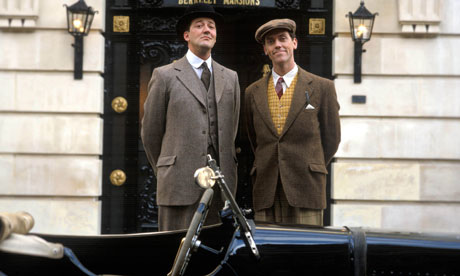
I rather fancy it's time for another Captain Hastings/Style Icon post, but this time with a twist!  I think that, by way of a change, I might focus less on the chaps and more on their cars.   Two chaps and their chariots of choice in fact!  Not just Captain Hastings and his voiture but also the equally arch-Chap Bertie Wooster, as portrayed by Hugh Laurie in Granada TV’s 1990-93 adaptation of P.G. Wodehouse’s Jeeves stories, Jeeves & Wooster (with Stephen Fry as Jeeves, of course!). Both these fine fellows happen to share the same taste in motors, driving cars that perfectly complement their personalities and which share a striking commonality with themselves and the characters who drive them.  The cars in question: the comparable Aston Martin and Lagonda.

Bertie Wooster’s Aston Martin

Wodehouse in his AC 12hp Tourer, outside Hunstanton Hall,
Norfolk, in 1928
To my certain knowledge P.G. Wodehouse never specified the make and model of car preferred by Bertram Wilberforce Wooster. As narrator, Bertie refers to it only as the “old two-seater” or “sports model”. This at least gives the reader carte blanche to imagine any two-seat sports car from the 1920s - although the BBC rather missed the point in their 1965-67 adaptation The World of Wooster, Ian Carmichael’s Bertie Wooster driving a four-seat 1927 Bentley 3-litre. Wodehouse himself owned an early-‘20s AC 12hp two-seater and one can easily see Bertie and Jeeves pootling along to Totleigh Towers or Brinkley Court in just such a model - I wouldn't be surprised if Wodehouse had it (or one of the many sporting cars favoured by the young "drones" of 1920s London) in mind whilst sat at his typewriter tapping out the stories.

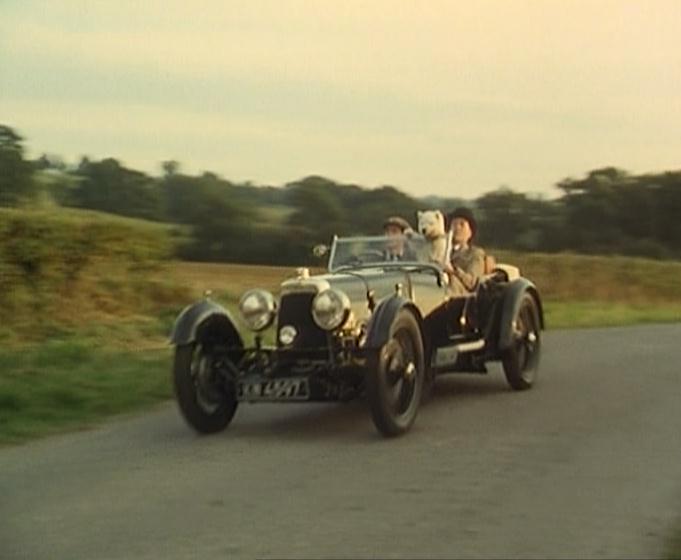
In the event, though, the Jeeves & Wooster series went for an Aston Martin instead.  A 1928 Aston Martin 1½-litre International, to be precise.  An inspired choice, since it suits his youthful and excitable character perfectly.

source
Long before Aston Martin became inextricably (and, some might say, tiresomely) linked to James Bond, the company had already built up a strong sporting pedigree pre- the Second World War.  Founded in 1913 (and therefore having recently celebrated its centenary) as Bamford & Martin after owners Robert Bamford and Lionel Martin, their first cars had early successes on the hillclimbing course at Aston Clinton in Buckinghamshire - hence they were renamed Aston Martin (the story further has it that Mrs Martin encouraged the rebranding on the basis that the new name would be near the top of any business listings!).

source
Astons would go on to race at Brooklands and Le Mans throughout the '20s and '30s, setting many endurance records.  Even Bertie's 1½-litre International had a "Le Mans" variant, although one can't imagine him tearing round La Sarthe (then again... maybe there's a story there!  Bertie did in fact drive his car into the ground attempting to beat the train to Deverill Hall in the fourth episode of series three).

Indeed Bertie remains blissfully ignorant of the inner workings of the motor car, knowing only that it runs on something called petrol but not that it has something called an "engine".  These things are best left to Jeeves or the local mechanic, naturally!

source
The 1½-litre International was produced between 1928 and 1932, a very prosperous time for Aston Martin following some lean years and the departure of its founders in the early '20s.  A group of skilled engineers and investors (including the wonderfully Wodehousian-sounding Lady Charnwood) had taken over the ailing company in 1926 and went on to oversee production of some of the most quintessentially British cars of the inter-war era including the 1½-litre, the 1934 MkII "Ulster" and the 1936 2-litre "Speed" model.

Aston Martin 1½-litre MkII

You can just imagine Bertie hearing about this wonderful sporting car company from his chums at The Drones Club and then heading off to the dealer to place his order.  Today you'd still have to be a Bertie Wooster to be able to afford an Aston Martin old or new; 1½-litre cars from the Thirties regularly fetch in the region of £150,000 now - as much or more than most modern Astons!  Certainly Bertie wouldn't be seen dead in the modern equivalent suggested by the Telegraph - a Mini Roadster indeed!  Choh!

source
This 1934 1½-litre Sports model sold last year for £155,500 at a Bonhams auction.

Captain Hastings' Lagonda

Here's the car we all know and love - the incidental yet important player in many a Poirot mystery, whisking our heroes to and from the crime scene.  How many times have we seen it bring some light relief to the proceedings as our favourite chap Captain Hastings talks about it, works on it or just drives it?


As with P.G. Wodehouse, Agatha Christie never mentions the type of car Hastings drives in the books - mainly because he only appeared in eight of the stories and Christie was no doubt more concerned with getting the plot and motive down properly.  It's thanks, as ever, to the expansion of the character in the TV series that we can really enjoy Hastings' hobbies and adventures, especially with his car.  Thus it was that the show's producers gave him one of the ultimate gentleman's cars of the 1930s - a 1931 Lagonda 2-litre Low Chassis Tourer.


Lagonda was founded in 1906 at a time when many companies were setting up to produce the new-fangled motor car, including the likes of Rolls-Royce.  As with so many of its peers it became favoured by the Edwardian aristocracy and increased its reputation through motorsport success, in particular in the 1910 Moscow-St. Petersburg race.  After the First World War it continued to do well; Captain Hastings' beloved 2-litre Speed selling for eight years from 1925 to 1933.  The company faltered in 1935, however and was nearly bought out by Rolls-Royce until another buyer - Alan Good - intervened.  By this time Rolls-Royce had also taken over Bentley and Good was able to poach the man himself - W.O - to work for Lagonda, who designed a new 2.6-litre straight-6-cylinder engine that would remain the backbone of the business well into the 1950s and end up having great ramifications for the future of the company. 

Where would we be without Captain Hastings and his lovely Lagonda, eh?  Where would Poirot be?  Stuck in his flat, that's what - there's only so many taxis he can take after all. Who can forget it breaking down in The Adventure of Johnnie Waverly, or chasing after Mrs Daniels in The Adventure of The Missing Prime Minister?  We'd never get to see half of Hastings' smashing wardrove either, not least his superlative driving outfit.  I still can't believe he nearly chopped it in for an Alfa Romeo (all right, a fictional "Eliso Freccia") in The Adventure of The Italian Nobleman.


I've often wondered where Captain Hastings gets his income from to afford such a car as a Lagonda.  He was The Honourable Arthur Hastings, if I recall aright, so there's probably money and a family estate somewhere.  You'd need to be the son of a viscount or earl to afford one of Captain Hastings' Lagondas today, with good examples going for over £90,000.

Aston Martin plans to build Lagonda saloon, reports say

It may not be long before you can buy a brand new Lagonda again, though, if the latest rumours are anything to go by.  Aston Martin - who bought Lagonda in 1947 purely to get hold of the Bentley engine - have been toying with the idea of reviving the Lagonda brand for several years (its last appearance being on the futuristic Aston Martin Lagonda saloon in 1976).  Thankfully the initial idea to use it on a breezeblock of a 4x4 has been rejected and photos of the new saloon look very promising.  Definitely something I could see Captain Hastings driving around in!

Two top chaps, then, linked by their motors (although one can imagine them hitting it off quite well, too!).  While we may never be able to return to the heyday of pre-war British motoring, Bertie Wooster and Captain Hastings will forever be shining of examples of the Thirties gentleman driver.


**If you enjoyed this post keep your eyes peeled for more of the same in the next issue of In Retrospect, due for æthereal publication on the 1st July!**

Sunday, 15 September 2013

Agatha Christie sleuth Poirot to return in new novel


Poirot set to return in new novel

In the last few years there has been a spate of new stories featuring beloved literary characters brought back to life by modern-day authors, all with the blessing of the original writers' estates. James Bond was the first to be resurrected, by Sebastian Faulks in 2006's Devil May Care and then Jeffery Deaver's Carte Blanche in 2011. Anthony Horowitz was approached by the Conan Doyle estate to write a new Sherlock Holmes novel and he happily obliged with 2011's The House of Silk, with a second sequel story due be published in October 2014. Even the great P.G. Wodehouse's two most famous characters, Jeeves and Bertie Wooster, have not been immune to this latest vogue with the Wodehouse estate officially announcing earlier this year that Sebastian Faulks would be writing a new Jeeves novel for publication in November.

Hercule Poirot:  Belgian sleuth back from the grave in new book

source
Now it seems that the Agatha Christie estate has jumped on the bandwagon by commissioning a new novel featuring everyone's favourite Belgian 'tec Hercule Poirot, to be written by crime novelist Sophie Hannah.  The as-yet-unnamed story will be set in the 1920s (or "vaguely in the 1920s" according to the press blurb - hopefully this just means there won't be much reference to dates or age-defining elements and not some attempt to "bring Poirot into the 21st century" with strange modern influences) and I'm told, sadly, will not feature Captain Hastings (boo! to that, although we have to remember that we have been spoilt by Hugh Fraser's wonderful portrayal of the character in the Poirot TV series and that in actuality Captain Hastings only appeared in eight of the 43 Poirot stories).

Personally I'm rather ambivalent about these modern interpretations - I will probably read all of the above at some point but am in no real hurry to do so.  In most cases there's more than enough of the original author's canon to keep me happy.  Plus I've often found that when reading another writer's interpretation of a beloved literary character no matter how close they promise to be to the original source there will always be an element of their own writing style, their own views on how the protagonist should act, which invariably means that the story feels all the more emulative to me.

Still, good luck to Miss Hannah with her Poirot novel - I hope she does a good job of it.  Likewise Messrs Horowitz and Faulks.  Obviously the main motivator behind these officially-sanctioned books is money - these estates don't run on air, after all - and in the case of this latest Poirot news in particular it is no doubt to keep interest in the character high (especially as the David Suchet Poirot series is about to come to an end this year - boo! again) but anything that ensures such deservedly long-lived fictional heroes remain popular must be good news.

Friday, 7 June 2013

What ho! Jeeves and Wooster head for West End

source, via The Chap

What ho! Jeeves and Wooster head for West End

Hot on the heels of news that Sebastian Faulks is to write the first "new" Jeeves novel since the death of the incomparable P. G. Wodehouse in 1975 comes the even more welcome announcement of a new play based on one of Wodehouse's best books, The Code of the Woosters and which is to star British TV comedy/drama stalwarts Stephen Mangan and Matthew Macfayden.  Beginning on 10th October, Perfect Nonsense will have a week-long run at the Richmond Theatre, then Theatre Royal Brighton before transferring to the West End at London's Duke of York Theatre.

Fully endorsed by the Wodehouse estate and, by the sounds of things, staying very true to the books this has all the potential of being an absolutely topping production from an experienced pair of writers and theatrical comedy director.  Add in two high-quality actors and a live theatre setting and it could just be the best adaptation since the 1990s Granada TV series starring Stephen Fry and Hugh Laurie.

Indeed - and at the risk of making everyone feel old - as Stephen Mangan points out in the article it has now been 20 years since the Jeeves & Wooster series (!) and perhaps now the time is right for a new acting duo to don the mantles of Bertram Wilberforce Wooster and his gentleman's gentleman, Jeeves.  Could Mangan & Macfayden be the fellows to do it?

source

I will certainly be keeping an interested eye out for reviews come October, maybe even with a view to popping up to the West End to see it for myself.  I can honestly say I have no expectations - Fry and Laurie's portrayals are practically generation-defining and may never be surpassed (truly, as many have said, they were born to play those roles) so in a way it relieves this production of any pressure to measure up, for my point of view at least.  In addition and despite my positive descriptions of the two stars of this new play, the popular works of Mangan and Macfayden have largely passed me by.  In the case of the former I've never seen Green Wing, Adrian Mole: the Cappuccino Years or Dirk Gently (arguably his most well-known roles in the U.K.) and only really know him from guest appearances on panel shows such as Have I Got News For You and Would I Lie To You?, where I admit he did impress.  I also had no interest in Macfayden's turn in Spooks and just plain missed Little Dorrit and Ripper Street (the latter somewhat to my annoyance, admittedly), so I have few preconceptions regarding them as Bertie and Jeeves.  I'd like to think they'll do a good job - they certainly look the part in the press photos I've seen.

All that remains is for me to say "break a leg chaps" and "tinkerty tonk!" in anticipation of a jolly good show!

Sunday, 19 May 2013

Style Icon Extra: Bertie Wooster

Well that's the last time I make any promises about when my next post will be, or joke about hospital visits.  You can probably guess from that where I found myself last week, much to my annoyance and discomfort.  Still all's well again now, so while I settle back in to the daily routine of life here's a post that's been sitting in my Drafts folder for months just waiting to be finished - and now seems to be the perfect time.  Yes, it's an extra Style Icon to finish off a series I began last year and another special "fictional character" edition.  Perhaps the ultimate gentleman's style ideal, it is none other than the great and good Bertram Wilberforce Wooster.

source

Although primarily a literary character, such is the beauty of P.G. Wodehouse's writing - not least the attention to detail lavished on Bertie's clothing (ably directed by Jeeves's discerning eye) and the humorous events that can sometimes result - that the suits, ties, hats and whatnot jump off the page just as well as the incidents and accidents, the fun and games and the people and places poor old Bertie encounters throughout the stories.

Played on film and TV, first by previous Style Icon David Niven in 1935's Thank You, Jeeves, then with Ian Carmichael in B.B.C.'s 1965-67 series The World Of Wooster, Bertie (and Jeeves) received by far their best portrayal - and the one most people know and which will form the basis of this post - by Hugh Laurie and Stephen Fry in the 1990s series Jeeves & Wooster.


The '90s Granada TV Jeeves & Wooster series is rightly regarded as the definitive essaying of these two perfect gentlemanly characters and the sheer high level displayed by the wardrobe department is but one reason the whole programme worked so well.  Bertie's suits, ties, waistcoats and other accessories (not to mention his few fashion faux pas!) are all there just as you would imagine them from the books - the ultimate style of an English gentleman.  Stumbling across the costume warehouse storing all these drool-worthy items of clothing ranks high on my list of sartorial dreams!

source

So where does one begin?  Whether in a brown 3-piece and tweeds for the country, or greys and pinstripes in Town, Bertie Wooster cuts an impeccable dash as he stumbles from one misfortune to another.

source

Not only are the suits wonderfully cut and perfectly fitted but the are accessorised brilliantly, be it with a natty tie, a well-placed pocket square, a splash of colour in the buttonhole (how overlooked is a flower in the lapel these days?!) or topped off with a complementing hat, gloves and cane.  In the books and in the series this is of course thanks in part to the guiding hand of every chap's ideal gentleman's gentleman - Jeeves.  Without him you get the feeling that Bertie might stray from the path of sartorial rightness more often and even I have found occasion to ask myself "What would Jeeves say?" when contemplating some item of clothing or other.

source

A fine proponent of Spearpoint and pin collars, Bertie Wooster has long inspired me to try both types of shirt collar.  I already own two or three pins and collar bars, now it is just a matter of saving up for the shirts themselves - from either Darcy Clothing or The Savile Row Co. for preference.

source

Bertie also proves that the pinstripe is not the preserve of bankers or gangsters, pulling it off nicely in several episodes.  He also illustrates perfectly the correct way to wear gloves with a suit and I often used to use the picture below to try and educate my otherwise ill-informed work colleagues who would take great delight in making nonsense remarks likening them to "serial killer" or "Fascist Nazi" gloves(!).  Honestly, the ignorance I had to put up with sometimes!

source

The double-breasted suit - even occasionally the rarer double-breasted waistcoat - is well represented also and further proof that it can work well on the thinner frame.

source

Even though he constantly finds himself in the most embarrassing and unfortunate scenarios Bertie Wooster always manages by and large to remain well-dressed and debonair.  One often gets the feeling from reading the stories that he is simply a victim of circumstance and actually not at all too dumb.  I find myself more and more often empathising with his predicaments, how he does his best in the face of difficult situations - much as we might try to in the daily cut-and-thrust of the world and with those who inhabit it, seemingly making our lives that little bit tougher when we just want to toddle along minding our own business.  Not to mention trying to deal with certain female relatives and their strange ideas and expectations about us!  Of course having someone like Jeeves in our corner, were he to exist, would certainly make life a whole lot easier.  We can at least try to aspire to Bertie's sartorial splendour, as the epitome of the well-dressed gentleman about town.

Well, "tinkerty-tonk!", as our hero would say, and I hope to be back with more typical Eclectic Ephemera fare before ere long.  Enjoy what remains of the weekend and cheero for now!

Saturday, 8 September 2012

Whither the traditional country fair?

Up until a few years ago I used to attend the annual Essex Country Show, close to where I live(d), and have a great time among the steam traction engines, classic vehicles, heavy shire horses and vintage farming equipment & amusements.

This was the first year I had been able to go back again for some time and I was looking forward to more of the same.  I was slightly concerned to read the official website's positive spin on the Show's expansion in recent times as my in my experience the bigger an event becomes the less specific, the less intimate and the less enjoyable it becomes.  It turned out that I was right to be worried - I'm sorry to say the Essex Country Show has succumbed to commercialism.

Now I know farming is a business and events like these are a great boost to its economy, educating and entertaining the layman in matters agricultural and providing a fillip to local produce. I'd also be a fool not to expect heaving crowds on a hot September Saturday.  But when the very first stand you come to upon entering the grounds is the local SEAT dealership's selection of new cars, you begin to think that something is very wrong in the world of country fairs.  This is how it continued for several rows - stands selling all kinds of odds and ends, such that you could be forgiven for thinking you were at a common-or-garden boot sale.  Every other one seemed to be a purveyor of food - and not just of the specialist variety but also all the usual greasewagons you'd find at many supposedly lesser events.

The craft stalls that had once characterised the Show had been stuffed away in a side-field to make way for this brazen consumerism.  Likewise the display ring where the beautiful horses, dogs, birds-of-prey and the like put on their impressive shows was off to one side and sparsely spectated - certainly more so than I remember.  The fields where the traditional ploughing was taking place could be better seen from the main road!  The whole thing had the feeling of an event that had just got too big for itself and the "captivating atmosphere" was nowhere to be found.  Crowds (which I say again I both expect and accept) milled around moving from one food stall to another it seemed, making photography of the interesting exhibits almost impossible.  Traction engines seemed conspicuous by their absence - I saw maybe only half-a-dozen (some smaller ones trying to make their way through the throngs while pulling trailers of people or hay) which, given that they used to be one of the main attractions for me, was a great disappointment.  Likewise the vintage amusements consisted of one (admittedly charming) large merry-go-round and a suspiciously new-looking steam organ, as well as an assortment of smaller modern stalls (e.g. hoopla, shooting gallery etc.), all dwarfed by several nearby bouncy castles.  Certainly nothing like the vintage arcade machines and rides I seem to recall from previous years.

The few pictures dotted throughout this post are some of the best that I was able to take of the event and I left disappointed, my wallet £12 lighter and with a longing for the simpler, more focussed country fairs of past memories.  Judging by some of the comments I overheard I was not alone either.  I was told that there is a Spring Fair earlier in the year that is smaller and I just managed to make out from the tannoy something about a "Wartime Weekend" at the end of October (although I haven't been able to find out any more about this yet) so it may be that I'll try them in future instead.

In the meantime I will just have to continue to get my fix of traditional country fairs from other sources:


Monday, 23 April 2012

Happy St. George's day 2012

Happy St. George's Day, one and all!  I hope the April showers haven't dampened any celebrations of the event!


Here's a bit of Vaughan Williams-esque Jeeves & Wooster - two of the most characteristically English performances of the 20th Century - to really set the mood for England's saint's day.


And hopefully put you in mind of (sunny!) hills and dales, rural villages and English traditions.  Enjoy the rest of the day!


Tuesday, 24 January 2012

By Jove, it's Jeeves & Wooster!

I'm feeling awfully jolly all of a sudden and in the mood to share a spot of musical fun involving everyone's favourite gentleman of leisure and his faithful valet:


Sartorially, at least, Bertie Wooster (with occasional gentle steering by Jeeves) remains every chap's ideal.


Image courtesy of Allposters.co.uk

Tinkerty-tonk!

Friday, 25 March 2011

Twittering on


You may notice at the end of this and, now, all other blog posts the presence of a "share" button with a few options to pick from to aid in the dissemination of my writings.  (Although quite why anyone would choose to forward on my ramblings is beyond me!).

The omission of this function was kindly brought to my attention by the Idle Historian in my previous post and it struck me as odd, as I was sure I had the facility enabled.  After a quick rummage around in the æther, I've managed to reactive said button (I think Blogger and its templates were to blame, or something; anyway, it wouldn't have happened with a typewriter!) so if you're on the likes of Twitter or Farcebook it should now be easier for you pass on anything you see here, if you so wish.  Personally I'm involved in neither of those places; it's enough that I've got this blog what with my Ludditism!  Still, it gives me the opportunity to include the above little ditty, ably helped along by Mr Bertie Wooster, which I feel could easily be applied to a certain modern-day social network...

Monday, 1 November 2010

Home linked to P G Wodehouse's Blandings Castle up for sale

Home linked to P G Wodehouse's Blandings Castle up for sale

P. G. Wodehouse is one of my favourite authors and although I have to admit that I gravitate more towards the Jeeves stories I was still interested in this article about Apley House in Shropshire, which some Wodehousians believe served as the inspiration for Blandings Castle - the setting of one of Plum's other great series.

Now comes the news that, following recent renovation it is now for sale for the princely sum of £1¾ million pounds(!). As the former president of the UK Wodehouse society is quoted as saying in the article - "for fans of Wodehouse wanting to imitate the life of an aristocrat, this house would do very well indeed". Quite! Although less of the "imitating" and more "living", eh what?! Of course, a million-and-some oncers is far outside your humble scribe's purse so I suppose I shall just have to carry on being like Bertie Wooster where I am now.

Of course, if money were no object my ideal house would undoubtedly be Sir Edwin Lutyens' turn-of-the-century masterpiece Marsh Court, in my ancestral county of Hampshire (below). It only went for about £11,000,000 a couple of years ago...

Sunday, 17 October 2010

Television hit Downton Abbey helps save the real stately home where it is filmed


Television hit Downton Abbey helps save the real stately home where it is filmed

ITV's latest costume drama, Downton Abbey, is fast becoming one of my favourite television programmes and a particular Sunday treat (as I'm sure it is for many of my readers).

Now as well as providing us vintage aficionados with a healthy dose of Edwardiana the series (which, you'll all be pleased to hear, has just had a second series commissioned) has gone some way to improving the fortunes of the stately home where it is filmed.

Eagle-eyed vintage viewers will also recognise Highclere Castle from the early-90s Jeeves & Wooster series, where it played the part of Totleigh Towers. In recent years the building has been in need of some repair but now with the great interest that viewers have taken in it since the broadcast of Downton Abbey the current owners are in a position to embark on the renovation of this historic pile and eventually, it is hoped, open it to the public.
It is splendid to see that there is still such a great interest taken in this country's ancient buildings and architectural history and that TV programmes like Downton Abbey are so popular that they encourage people not only to visit but also, ultimately, to preserve these important historic houses. Well done, everyone, and the best of luck to the owners the Earl and Countess of Carnarvon.

Followers

Popular Posts