Showing posts with label Hugh Laurie. Show all posts

Wednesday, 18 June 2014

On the road with Bertie Wooster and Captain Hastings

I rather fancy it's time for another Captain Hastings/Style Icon post, but this time with a twist!  I think that, by way of a change, I might focus less on the chaps and more on their cars.   Two chaps and their chariots of choice in fact!  Not just Captain Hastings and his voiture but also the equally arch-Chap Bertie Wooster, as portrayed by Hugh Laurie in Granada TV’s 1990-93 adaptation of P.G. Wodehouse’s Jeeves stories, Jeeves & Wooster (with Stephen Fry as Jeeves, of course!). Both these fine fellows happen to share the same taste in motors, driving cars that perfectly complement their personalities and which share a striking commonality with themselves and the characters who drive them.  The cars in question: the comparable Aston Martin and Lagonda.

Bertie Wooster’s Aston Martin

Wodehouse in his AC 12hp Tourer, outside Hunstanton Hall,
Norfolk, in 1928
To my certain knowledge P.G. Wodehouse never specified the make and model of car preferred by Bertram Wilberforce Wooster. As narrator, Bertie refers to it only as the “old two-seater” or “sports model”. This at least gives the reader carte blanche to imagine any two-seat sports car from the 1920s - although the BBC rather missed the point in their 1965-67 adaptation The World of Wooster, Ian Carmichael’s Bertie Wooster driving a four-seat 1927 Bentley 3-litre. Wodehouse himself owned an early-‘20s AC 12hp two-seater and one can easily see Bertie and Jeeves pootling along to Totleigh Towers or Brinkley Court in just such a model - I wouldn't be surprised if Wodehouse had it (or one of the many sporting cars favoured by the young "drones" of 1920s London) in mind whilst sat at his typewriter tapping out the stories.

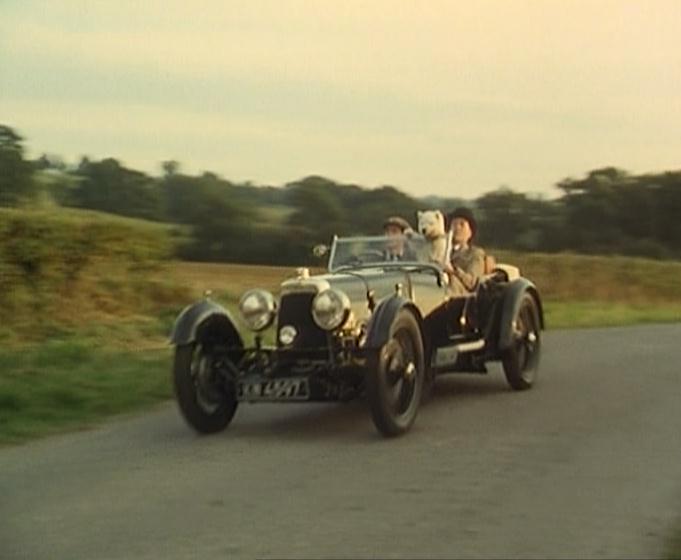
In the event, though, the Jeeves & Wooster series went for an Aston Martin instead.  A 1928 Aston Martin 1½-litre International, to be precise.  An inspired choice, since it suits his youthful and excitable character perfectly.
source
Long before Aston Martin became inextricably (and, some might say, tiresomely) linked to James Bond, the company had already built up a strong sporting pedigree pre- the Second World War.  Founded in 1913 (and therefore having recently celebrated its centenary) as Bamford & Martin after owners Robert Bamford and Lionel Martin, their first cars had early successes on the hillclimbing course at Aston Clinton in Buckinghamshire - hence they were renamed Aston Martin (the story further has it that Mrs Martin encouraged the rebranding on the basis that the new name would be near the top of any business listings!).

source
Astons would go on to race at Brooklands and Le Mans throughout the '20s and '30s, setting many endurance records.  Even Bertie's 1½-litre International had a "Le Mans" variant, although one can't imagine him tearing round La Sarthe (then again... maybe there's a story there!  Bertie did in fact drive his car into the ground attempting to beat the train to Deverill Hall in the fourth episode of series three).

Indeed Bertie remains blissfully ignorant of the inner workings of the motor car, knowing only that it runs on something called petrol but not that it has something called an "engine".  These things are best left to Jeeves or the local mechanic, naturally!
source
The 1½-litre International was produced between 1928 and 1932, a very prosperous time for Aston Martin following some lean years and the departure of its founders in the early '20s.  A group of skilled engineers and investors (including the wonderfully Wodehousian-sounding Lady Charnwood) had taken over the ailing company in 1926 and went on to oversee production of some of the most quintessentially British cars of the inter-war era including the 1½-litre, the 1934 MkII "Ulster" and the 1936 2-litre "Speed" model.

Aston Martin 1½-litre MkII

You can just imagine Bertie hearing about this wonderful sporting car company from his chums at The Drones Club and then heading off to the dealer to place his order.  Today you'd still have to be a Bertie Wooster to be able to afford an Aston Martin old or new; 1½-litre cars from the Thirties regularly fetch in the region of £150,000 now - as much or more than most modern Astons!  Certainly Bertie wouldn't be seen dead in the modern equivalent suggested by the Telegraph - a Mini Roadster indeed!  Choh!

source
This 1934 1½-litre Sports model sold last year for £155,500 at a Bonhams auction.

Captain Hastings' Lagonda

Here's the car we all know and love - the incidental yet important player in many a Poirot mystery, whisking our heroes to and from the crime scene.  How many times have we seen it bring some light relief to the proceedings as our favourite chap Captain Hastings talks about it, works on it or just drives it?


As with P.G. Wodehouse, Agatha Christie never mentions the type of car Hastings drives in the books - mainly because he only appeared in eight of the stories and Christie was no doubt more concerned with getting the plot and motive down properly.  It's thanks, as ever, to the expansion of the character in the TV series that we can really enjoy Hastings' hobbies and adventures, especially with his car.  Thus it was that the show's producers gave him one of the ultimate gentleman's cars of the 1930s - a 1931 Lagonda 2-litre Low Chassis Tourer.


Lagonda was founded in 1906 at a time when many companies were setting up to produce the new-fangled motor car, including the likes of Rolls-Royce.  As with so many of its peers it became favoured by the Edwardian aristocracy and increased its reputation through motorsport success, in particular in the 1910 Moscow-St. Petersburg race.  After the First World War it continued to do well; Captain Hastings' beloved 2-litre Speed selling for eight years from 1925 to 1933.  The company faltered in 1935, however and was nearly bought out by Rolls-Royce until another buyer - Alan Good - intervened.  By this time Rolls-Royce had also taken over Bentley and Good was able to poach the man himself - W.O - to work for Lagonda, who designed a new 2.6-litre straight-6-cylinder engine that would remain the backbone of the business well into the 1950s and end up having great ramifications for the future of the company. 

Where would we be without Captain Hastings and his lovely Lagonda, eh?  Where would Poirot be?  Stuck in his flat, that's what - there's only so many taxis he can take after all. Who can forget it breaking down in The Adventure of Johnnie Waverly, or chasing after Mrs Daniels in The Adventure of The Missing Prime Minister?  We'd never get to see half of Hastings' smashing wardrove either, not least his superlative driving outfit.  I still can't believe he nearly chopped it in for an Alfa Romeo (all right, a fictional "Eliso Freccia") in The Adventure of The Italian Nobleman.


I've often wondered where Captain Hastings gets his income from to afford such a car as a Lagonda.  He was The Honourable Arthur Hastings, if I recall aright, so there's probably money and a family estate somewhere.  You'd need to be the son of a viscount or earl to afford one of Captain Hastings' Lagondas today, with good examples going for over £90,000.

Aston Martin plans to build Lagonda saloon, reports say

It may not be long before you can buy a brand new Lagonda again, though, if the latest rumours are anything to go by.  Aston Martin - who bought Lagonda in 1947 purely to get hold of the Bentley engine - have been toying with the idea of reviving the Lagonda brand for several years (its last appearance being on the futuristic Aston Martin Lagonda saloon in 1976).  Thankfully the initial idea to use it on a breezeblock of a 4x4 has been rejected and photos of the new saloon look very promising.  Definitely something I could see Captain Hastings driving around in!

Two top chaps, then, linked by their motors (although one can imagine them hitting it off quite well, too!).  While we may never be able to return to the heyday of pre-war British motoring, Bertie Wooster and Captain Hastings will forever be shining of examples of the Thirties gentleman driver.


**If you enjoyed this post keep your eyes peeled for more of the same in the next issue of In Retrospect, due for æthereal publication on the 1st July!**

Sunday, 19 May 2013

Style Icon Extra: Bertie Wooster

Well that's the last time I make any promises about when my next post will be, or joke about hospital visits.  You can probably guess from that where I found myself last week, much to my annoyance and discomfort.  Still all's well again now, so while I settle back in to the daily routine of life here's a post that's been sitting in my Drafts folder for months just waiting to be finished - and now seems to be the perfect time.  Yes, it's an extra Style Icon to finish off a series I began last year and another special "fictional character" edition.  Perhaps the ultimate gentleman's style ideal, it is none other than the great and good Bertram Wilberforce Wooster.

source

Although primarily a literary character, such is the beauty of P.G. Wodehouse's writing - not least the attention to detail lavished on Bertie's clothing (ably directed by Jeeves's discerning eye) and the humorous events that can sometimes result - that the suits, ties, hats and whatnot jump off the page just as well as the incidents and accidents, the fun and games and the people and places poor old Bertie encounters throughout the stories.

Played on film and TV, first by previous Style Icon David Niven in 1935's Thank You, Jeeves, then with Ian Carmichael in B.B.C.'s 1965-67 series The World Of Wooster, Bertie (and Jeeves) received by far their best portrayal - and the one most people know and which will form the basis of this post - by Hugh Laurie and Stephen Fry in the 1990s series Jeeves & Wooster.


The '90s Granada TV Jeeves & Wooster series is rightly regarded as the definitive essaying of these two perfect gentlemanly characters and the sheer high level displayed by the wardrobe department is but one reason the whole programme worked so well.  Bertie's suits, ties, waistcoats and other accessories (not to mention his few fashion faux pas!) are all there just as you would imagine them from the books - the ultimate style of an English gentleman.  Stumbling across the costume warehouse storing all these drool-worthy items of clothing ranks high on my list of sartorial dreams!

source

So where does one begin?  Whether in a brown 3-piece and tweeds for the country, or greys and pinstripes in Town, Bertie Wooster cuts an impeccable dash as he stumbles from one misfortune to another.

source

Not only are the suits wonderfully cut and perfectly fitted but the are accessorised brilliantly, be it with a natty tie, a well-placed pocket square, a splash of colour in the buttonhole (how overlooked is a flower in the lapel these days?!) or topped off with a complementing hat, gloves and cane.  In the books and in the series this is of course thanks in part to the guiding hand of every chap's ideal gentleman's gentleman - Jeeves.  Without him you get the feeling that Bertie might stray from the path of sartorial rightness more often and even I have found occasion to ask myself "What would Jeeves say?" when contemplating some item of clothing or other.

source

A fine proponent of Spearpoint and pin collars, Bertie Wooster has long inspired me to try both types of shirt collar.  I already own two or three pins and collar bars, now it is just a matter of saving up for the shirts themselves - from either Darcy Clothing or The Savile Row Co. for preference.

source

Bertie also proves that the pinstripe is not the preserve of bankers or gangsters, pulling it off nicely in several episodes.  He also illustrates perfectly the correct way to wear gloves with a suit and I often used to use the picture below to try and educate my otherwise ill-informed work colleagues who would take great delight in making nonsense remarks likening them to "serial killer" or "Fascist Nazi" gloves(!).  Honestly, the ignorance I had to put up with sometimes!

source

The double-breasted suit - even occasionally the rarer double-breasted waistcoat - is well represented also and further proof that it can work well on the thinner frame.

source

Even though he constantly finds himself in the most embarrassing and unfortunate scenarios Bertie Wooster always manages by and large to remain well-dressed and debonair.  One often gets the feeling from reading the stories that he is simply a victim of circumstance and actually not at all too dumb.  I find myself more and more often empathising with his predicaments, how he does his best in the face of difficult situations - much as we might try to in the daily cut-and-thrust of the world and with those who inhabit it, seemingly making our lives that little bit tougher when we just want to toddle along minding our own business.  Not to mention trying to deal with certain female relatives and their strange ideas and expectations about us!  Of course having someone like Jeeves in our corner, were he to exist, would certainly make life a whole lot easier.  We can at least try to aspire to Bertie's sartorial splendour, as the epitome of the well-dressed gentleman about town.

Well, "tinkerty-tonk!", as our hero would say, and I hope to be back with more typical Eclectic Ephemera fare before ere long.  Enjoy what remains of the weekend and cheero for now!

Tuesday, 24 January 2012

By Jove, it's Jeeves & Wooster!

I'm feeling awfully jolly all of a sudden and in the mood to share a spot of musical fun involving everyone's favourite gentleman of leisure and his faithful valet:


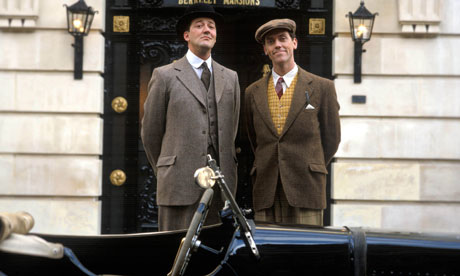
Sartorially, at least, Bertie Wooster (with occasional gentle steering by Jeeves) remains every chap's ideal.


Image courtesy of Allposters.co.uk

Tinkerty-tonk!

Followers

Popular Posts