Showing posts with label China. Show all posts

Wednesday, 27 April 2011

Reports of the death of the typewriter have been greatly exaggerated

Some of you may have read or heard over the news wires that the "last" existing manufacturer of mechanical typewriters - India's Godrej & Boyce - has stopped producing its typewriter and has only a few hundred left in stock.

End of an era as last mechanical typewriters are sold

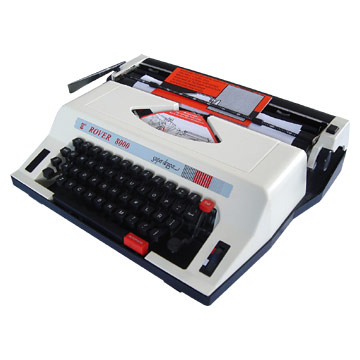
But fear not, my fellow vintage fans, because it is not true!  Well, the bit about Godrej & Boyce stopping production is, unfortunately, but not the bit about their being the last manufacturer of mechanical typewriters.  No, I have it on good authority that there are at least 3 companies still producing mechanical typewriters, all of them based in the Far East but using the familiar QWERTY layout and available for export.  Three cheers for Marshall Ind. and Chee-May (Goh's) of Taiwan for their MT-99 and Kota models, and the Shanghai Weilv Co. of China who still manufacture licensed versions of an old Olivetti design under the name (ironically for us Brits) of Rover(!).

The Shanghai Weilv Rover 8000
That's not to mention the fact that their are also several companies continuing to make electric typewriters (which are not quite the same, I grant you, but still not far off!) so there is more than a little life left in the device yet!  And of course being a good, old-fashioned piece of sturdy technology the mechanical typewriter is built like nothing else.  My 56-year-old Imperial feels like it could withstand a nuclear blast - at which point we'd need mechanical typewriters again because all the electronics would have stopped working! ;-)

Yes, it's in a disgraceful condition but it's nearly 60 years old.  Plus... it still works.  Good for another 60 years too, I'll warrant.

So typewriters both new and old look to be around for a long time to come, proof that even the all-embracing computer cannot kill a simple, enduring design (and indeed, through the QWERTY keyboard if nothing else, PCs owe a lot to the humble typewriter).  As long as there are companies willing to produce typewriters and their associate parts (that reminds me - anyone know where I can get some ribbons?) and people to use them, appreciate them and keep them working then the typewriter will live on!
Monday, 4 October 2010

Another round: Shanghai reopens 110ft bar fabled for colonial decadence

Another round: Shanghai reopens 110ft bar fabled for colonial decadence

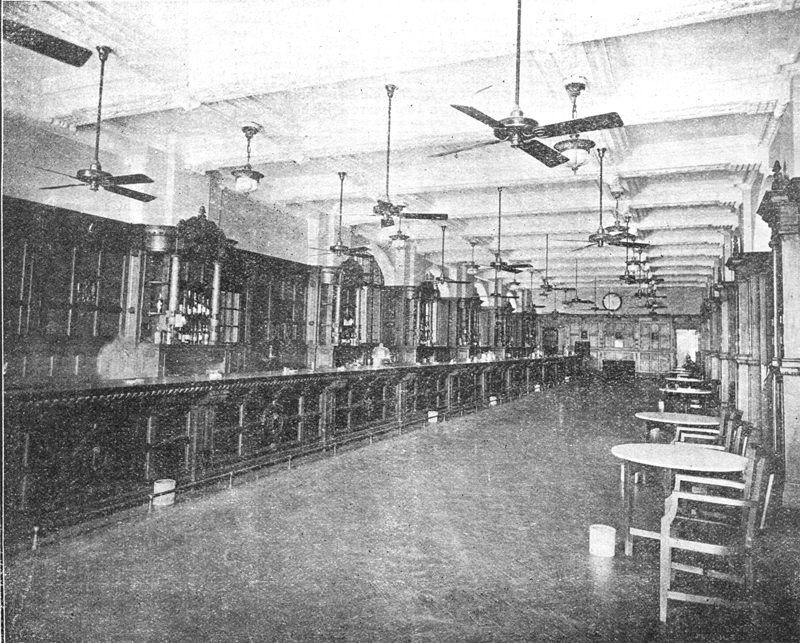
Welcome news here of the renovation of an historic piece of colonial nightlife - the Long Bar, once part of the Shanghai Club but soon to become part of a new Waldorf-Astoria hotel on the Bund (Shanghai's waterfront district).

The epitome of pre-war style and elegance, like so many things the Long Bar was a victim of the Second World War and it is only now that it has been restored to its former glory having suffered many ignominies over the last 70 years - not least having to share space with a KFC!

Thanks to the thorough work undertaken by local craftsmen the Long Bar has once again become the jewel in the crown of the new hotel and the surrounding area. Special mention should go to the Shanghai government officials who quite rightly insisted that the décor and material should be an exact match to the original bar. All in all it sounds like a delightful venue; one could easily imagine Noel Coward at the bar making witty remarks!

Monday, 13 September 2010

Rare 1897 Chinese stamp sells for £300,000

Rare 1897 Chinese stamp sells for £300,000

Further proof here of the increasing "commercial collecting" of stamps and the sudden explosion of serious prices being paid in emerging markets such as China.

One can understand such a high price being paid for a very rare, 113-year-old stamp but it is strange to see such large amounts of money changing hands for more recent issues. I suppose "speculate to accumulate" about sums it up; today's stamps will be tomorrow's valuable collectibles, I imagine.

The 1897 stamp is a nice-looking piece, however, and once again we see that a printing error and the subsequent rarity value attached to a production run of just 32 commands a high price. I'd love to have it in my collection but again, I can't afford £300k! It will most likely have sold to a wealthy Chinese collector, who I am sure will appreciate it and continue to patronize the growing Chinese philatelic market, which in the wider stamp-collecting world is a welcome addition to the top-end collecting boom.

Friday, 6 August 2010

Giant bus which drives over cars planned in China


Giant bus which drives over cars planned in China

The headline makes this sound like some sort of monster bus, more akin to the one in the previous post, crushing smaller vehicles in its path as it drives through down-town Beijing. In fact, it is a very novel approach to reducing overcrowding on the roads of China's cities.

Personally-speaking, on the one hand I think it is a fantastically futuristic idea that could have come straight out of the pages of a retro-futurist pulp comic or the like and I applaud the Chinese for considering it. However on the other hand I can't help but wonder about a couple of things that make me question the feasibility of the concept. For one thing it relies on the drivers of the cars beneath the bus keeping their heads and knowing what they have to do when the bus passes over them or when they pass underneath it. If Chinese drivers are anything like some of the drivers here in Britain I would worry about the accident rate were these vehicles to be introduced. From what I understand there would be built-in fail-safe measures to mitigate accidents and incidents but, as I am rather fond of saying sometimes - nothing is fool-proof. Secondly if they end up running on rails in the road (rather than with sensors following painted lines), surely there will be a huge amount of disruption while the roads are being dug up to fit them? In that case they might as well build an elevated railway or a monorail, methinks.

Whether or not these machines come to pass the world has been brightened a little by the suggestion of such an advanced idea that once again shows the seemingly infinite variety of which mankind is capable.

Friday, 18 June 2010

'Switchover' bridge revealed


'Switchover' bridge revealed

Here is a remarkable and unusual design for a bridge connecting Hong Kong with the Chinese mainland, dreamed up (perhaps unsurprisingly) by a Dutch architectural company NL Architects. Unusual in that it takes a novel approach to dealing with an obvious difficulty - China drives on the right-hand side of the road whereas Hong Kong, being a one-time British colony still drives on the left. So at either end of any normal bridge or tunnel between them there would need to be a roadside change-over. The remarkable thing about this design is that the change is effected mid-way across by having one side of bridge directed underneath the other and so to the other side of the road before the mainland is reached, thus negating any confusion at the end(s) of the bridge. It is a truly original solution to the problem and as a design study is most interesting and elegant, but whether it would work in reality is open to question. Nevertheless I admire the Dutch architects for their approach to the commission and a lot of the philosophies outlined on their website appeal to my aesthetic nature. In my heart of hearts I doubt we will ever see such an unorthodox design made a reality but I would dearly love to see it and I congratulate the people involved on their vision.

Thursday, 4 February 2010

Photo exhibition shows life in China in 1870s

Photo exhibition shows life in China in 1870s

News here of a fascinating-sounding exhibition that is being run up in Liverpool. Fascinating because it chronicles a landscape and way of life that has long since vanished and preserves it for our (and future generations') enjoyment and edification. It is also interesting to read of the way in which the photographer went about capturing his images. All too often when we see or hear of stories involving Victorians visiting foreign countries we automatically envisage some form of evil imperialism; the subjugation of the native population, the stripping of natural resources and so on. But here is a pleasant reminder that it was not always like this and that the photographer treated his subjects and their country with respect and admiration, which makes the pictures all the more enjoyable in my opinion.

Followers

Popular Posts