A web log, an æthereal scrap-book if you will, with a somewhat vintage flavour. News items, occurrences, experiences, thoughts and opinions related to Victoriana through to Fifties Americana can all be found here.
Is what this blog is in danger of becoming. Ray Noble & his Orchestra featuring Al Bowlly do indeed pose the pertinent lyrical question.
But don't worry, folks! With luck vintage news will pick up again in the coming weeks and autumn is just around the corner - my favourite season and a chance to dig into my more substantial "A/W" (as the fashion houses would call it!) wardrobe.
A week has passed since my 30th birthday and I hope before too much longer to have an extensive post written up to do it justice - as soon as mater gets photos of the day to me (and finishes off her present!) and the Royal Mail deliver some remaining gifts (the perils of a bank holiday weekend!). Until then here's a little taster of where I went the Sunday before my birthday - and it was a lot busier than this!
source
The Crooked Billet/ Osborne's Cafe, Old Leigh[-on-sea] Essex
This article from a couple of weeks ago, which I had originally intended to post at the time(!), details the tantalising prospect of a once-major London landmark making a reappearance in its old location. That landmark? The Crystal Palace!
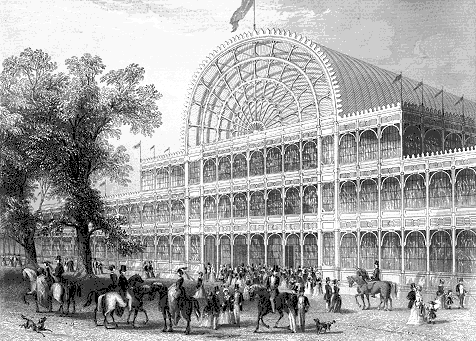
The original façade; The Great Exhibition 1851
Built in Hyde Park in 1851 to house the Great Exhibition (a sort of Victorian World's Fair), The Crystal Palace was a symbolically massive 1,851ft long and 128ft high and made out of the then new cast plate glass. Although originally intended to be a temporary structure, the architect Joseph Paxton's use of innovative materials and modular design - not to mention the vast size of the building - meant that at the end of the 6 month Exhibition it was decided that The Crystal Palace would be dismantled and rebuilt on Penge Common at Sydenham Hill in Bromley, south-east London (eventually lending its name to the park and the surrounding area). In the event it was not only rebuilt but also substantially extended and redesigned, to become the building we remember today.
Over the next 82 years The Crystal Palace would play host to many hundreds of expositions, shows, concerts, exhibitions, festivals and meetings; it moonlighted as a Royal Navy training base during the First World War and played host to the original Imperial War Museum from 1920 to 1924.
Having been saved from potential destruction in 1913 when the original owners declared bankruptcy and restored to its 19th century glory in the 1920s, disaster struck on the night of the 30th November 1936 when an explosion in a ladies' cloakroom caused an initially small fire in one of the offices. A combination of high winds, wooden flooring that ran throughout the building and the many flammable objects - including fireworks - stored within meant that very quickly the whole place was ablaze and despite the best efforts of 400 fireman and 89 fire engines the entire structure burned to the ground in a matter of hours. Contemporary reports show that the glow from the flames could be seen in eight counties; 100,000 people - including Winston Churchill (who later said "This is the end of an age") - turned up to watch the battling firemen trying to save it. Unfortunately the building's insurance cover was not enough to meet the proposed cost of rebuilding, which was put at £2,000,000 (£111,000,000 in today's money). Only the north water tower escaped destruction (the south tower also survived the fire but was dismantled shortly thereafter when it was discovered fire damage had made it structurally unsafe) - at least until 1941 when it was demolished for reasons unknown, although it was thought to possibly offer a handy landmark to German bombers. The grounds were also used to house radar manufacturing facilities.
Now, in 2013, there seems to be a chance (albeit slight) that an exact copy of The Crystal Palace may rise Phoënix-like, as it were, on the original site thanks to a Chinese developer. Quite what their angle is in all this (beyond the money) I'm not sure - I'm usually slightly dubious about Far East-backed concepts like this (hence the reason, apart from the somewhat questionable taste of it, that I haven't featured the proposed "Titanic II" replica stories that have been doing the rounds on the Internet in recent months). Still it would seem that Crystal Palace Park is in need of redevelopment and the glass-and-iron wonder that gave it its name, glinting in the sunlight atop Sydenham Hill once again (I can just imagine it!) might be just the ticket (although it's early days yet, still something to keep an eye on)!
Apologies for another long period of radio silence (what is it this time, 3 weeks - but who's counting?). A little hiccough rendered me slightly indisposed again but now normal service can resume, although regrettably health will probably not permit my attending this weekend's Barrelhouse Stomp - still, there will be other events of that I have no doubt.
In the meantime here's a jolly little 1932 ditty by Roy Fox & his band featuring Al Bowlly and Nat Gonella, a favourite of mine which poses the musical question I'm often asked (and ask of myself). Cheerio for now!
For the next in my series of Captain Hastings-themed posts I've decided to stick with the chronological order of the episodes; despite what I may have said before about The Third Floor Flat not being the best episode for Captain Hastings sartorially (it isn't the best episode for him automotively either, but more of that later!) it's still a cracker of a story and the good Captain sees a fair bit of action so I'll try to cover a bit of that instead.
"Oh mon Dieu!"
The episode opens, as so many do, at Poirot's residence - "Whitehaven Mansions". (Incidentally featured - in its actual guise of Florin Court, Charterhouse Square - in Miss Marie's latest blog post, where I see it had a recent lucky escape from serious damage(!) thanks to the efforts of the threatened-with-closure Clerkenwell Fire Brigade. Read more at Love Letter from London.)
We're introduced to some of the main players in this particular drama - new resident (and soon to be victim!) Mrs Ernestine Grant, two young girl friends in the flat above and, of course, Poirot! (Miss Porcelina has expertly covered the ladies' fashions in this episode in a previous post of hers so I direct you to her blog Porcelina's World on that score.)
"C'est suffit!"
Poor old Poirot has a stinking cold - although with typical fatalism exaggerates it into dying brain cells due to three consecutive weeks without a case - despite Miss Lemon's best efforts with the Friar's Balsam.
In the only scene where Hastings is not in evening wear we see the good old
checked suit, with a splendidly subtle layered effect. Three-piece too, of course,
and topped off with a lovely gold-and-black spotted tie.
Still he rallies himself enough to go out (suitably wrapped up) and post a letter, whereupon dear old Hastings arrives and nearly gives him a heart attack by sounding his car's horn at him(!).
To try and take his mind of his cold, Hastings invites Poirot to give his "little grey cells" a workout on the murder mystery play he has two tickets for. To sweeten the offer, he bets Poirot £10 that he won't be able to identify the "murderer" before the play's end.
Brown suede shoes with grey trousers?! He's a bounder!
Meanwhile the real life murder begins to unfold as Mrs Grant receives a mystery visitor. The action then switches to the theatre, where the two young girls from Poirot's building are also in attendance with their beaus. Poirot finds the play tediously predictable, until a ridiculous last-minute plot twist ends with him losing the bet!
I love his expressions just as much as his wardrobe!
Back at Whitehaven Mansions Poirot aims to honour his debt, despite Hastings' discomfiture and protestations.
Things move quickly after that and I won't laden this post with picture after picture of people in evening wear chasing a murderer around a block of flats. Here's a few of the wonderful Captain doing his bit to apprehend the villain, though:
Hastings decides to investigate for himself
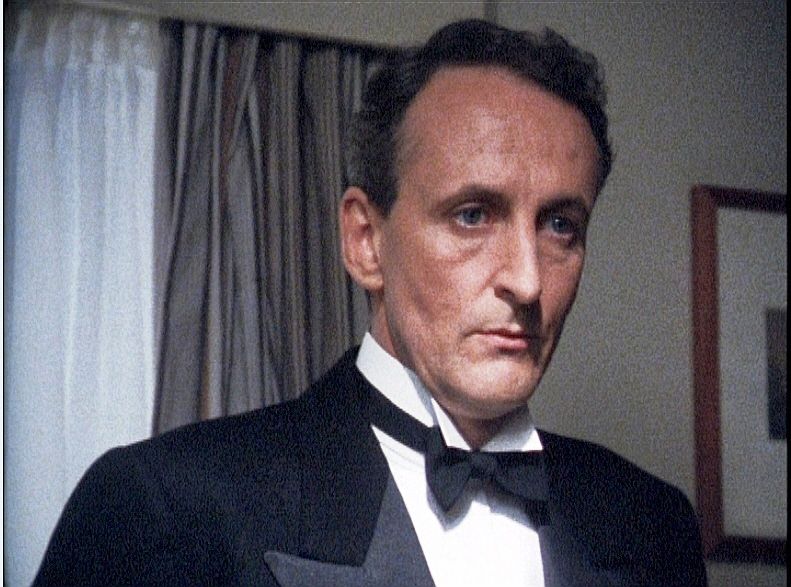
(looking very dapper, as always, in black tie)
Out in the street looking very serious, but no sign of the escaped murderer.
The Captain's efforts end up with him trying to stop the criminal from escaping in his own beloved Lagonda, causing the car to swerve and crash into a wooden trailer! Our hero ends up all of heap in the gutter, his car a wreck!
Still looking smart even after diving into the road.
By now it's dawn and with the evil-doer safely in the hands of the police, Hastings (along with Poirot and Japp) surveys the damage. Feeling better for having stretched his mind on a real murder case, Poirot magnanimously gives Hastings £10 for help with the repairs.
It seems a shame to leave poor old Hastings on a downer but fear not for he and the Lagonda will return for many more episodes - and fashion posts! The next one being Problem at Sea which, like Four and Twenty BlackbirdsI have recently rediscovered as having much more sartorial goodness in it than I remembered. For now, though, here is the episode just discussed in full:
And it goes without saying that so should you, if you're out making the most of this summer weather. Boaters, Panamas, pith helmets - but not baseball caps! - it doesn't matter so long as your bonce is covered.
Health advice dispensed, it's time for me to move on to the meat of this post. Summer has most definitely arrived here in Britain and is making up for lost time by posting several consecutive hottest days of the year. What better time then, in the lack of any other interesting news at the moment, to post a few of my favourite sunny, summery songs from the 1930s.
The song that lends itself to the title of this post, The Sun Has Got His Hat On is still well-known as a nursery rhyme but was originally written by Noel Gay and Ralph Butler in 1932 and recorded by two of the top British bandleaders of the time - Bert Ambrose and Henry Hall (the latter well-known for his child-friendly nursery-rhyme recordings). The lyrics have, unfortunately, in one place in particular not dated well as you will undoubtedly hear (I shouldn't have to tell you to remember, of course, the time in which this song was recorded and the different attitudes and sensibilities that existed then but I will mention it just in case...!) and in later versions the offending line was changed to "roasting peanuts".
The Henry Hall recording remains my favourite of the two but they're both still jolly good fun!
Another jolly solar-themed recording from 1932 (was that also a "hottest year", I wonder? Looks like it was a bit) is this cracking number by Jack Payne & His Band. Easily matching the pep of The Sun Has Got His Hat On this tune fairly trots along!
What summer soundtrack would be complete without the great, inimitable Noël Coward and his wonderful song Mad Dogs and Englishmen. Recorded here in November 1932 (again!) it was written the year before and first performed by Beatrice Lillie before Coward incorporated it into his cabaret act and made this version with the Ray Noble Orchestra.
Sadly I'm not much of an Englishman in this regard as I'm not overly fond of the heat and tend to avoid the blazing sun at its zenith (in all seriousness, for those of you in London and its environs the Department of Health has just officially declared this a Level 3 heatwave and advised people to stay out of the sun as much as possible between 11am - 3pm) and even now I'm finding it almost too hot to type!
Red Sails in the Sunset is another firm favourite and a popular song of 1935, since when it has been recorded by a multitude of artists including Guy Lombardo, Bing Crosby, Al Bowlly and Vera Lynn. Once again I find myself drawn to the Ambrose version, though, and the images it conjures of stylish, relaxing summer evenings on holiday at the likes of Burgh Island, Cannes, or Le Touquet.
On the other side of the Atlantic, Glenn Miller recorded several songs with "Sun" in the title including Sunrise Sunset, Sunrise Serenade (originally written by Frank Carle and first performed by Glen Gray and the Castle Loma Orchestra in 1939 it was successfully recorded by Miller the same year as a companion "B-side" to Moonlight Serenade) and Sun Valley Jump. Sunrise Sunset isn't on Youtube but the other two are and as I can't put a pin between them for preference here they both are:
Sunrise Serenade I always find particularly evocative, lending to my mind's eye images of "sunrise on the farm" in some little American homestead - the first rays just peeping over the barn, cockerels crowing and the farmer starting out for his fields on a tractor, that sort of thing.
I'll finish with a song that extols you to keep On The Sunny Side of the Street. First written and performed in 1930 (its Depression-era roots are even more apparent in earlier, slower versions like this one by Ted Lewis) it became a more up-tempo jazz standard by the end of the decade and is performed in this instance by Lionel Hampton & His Orchestra:
Regardless of whether you enjoy this level of heat or not (and with apologies to those of you who might not be enjoying such sunny conditions where you are) I hope you all continue to walk "on the sunny side of the street" - with your hats on, of course! - and have a great summer.
To Birmingham (via Suffolk/Norfolk) in 1935 we go now, thanks to this recently-discovered footage of the Saltey School, Birmingham - found in that establishment's library archive while an 85th anniversary celebration was being arranged.
The footage contains remarkable images of 1930s school life including P.E. classes and summer holiday camps, with happy smiling children (and teachers!) seemingly enjoying breaks to the Suffolk/Norfolk countryside. Perhaps more noticeable, to our modern eyes, is the synchronised movement that formed part of the school's physical education. A healthy and coordinated body was held up very highly as an ideal in 1930s, as so many documentary films of large groups of men and women exercising in perfect harmony go to show (and not to mention its ultimate perversion into the idea of eugenics), but there is something startlingly immediate and mesmeric in seeing a class of young children running, jumping and bending in perfect unison.
Today's Saltey School pupils certainly appear to have found this glimpse into the past an impressive one, with considered comments and opinions aired. The unearthing of this cinefilm looks to be a welcome addition to Saltey's 85th birthday celebrations and I'm very pleased to see it take pride of place in the annals of the school's history after having lain dormant for so long.
Over the course of the last week various news sources have reported on two films in the early stages of development that I know will be of interest to this blog's readers.
First to be on the receiving end of the Hollywood treatment is a man widely regarded as one of the triumvirate of 1930s pulp fiction characters (and proto-superheroes) along with The Shadow and The Phantom - Clark Savage Jr, otherwise known as Doc Savage. First appearing in pulp magazines from 1933 onwards, Doc Savage was perhaps one of the first typical "human" superheroes having been "trained from birth to the peak of physical ability". Adept at martial arts, knowledgeable about earth sciences and a master of disguise with a strong desire to do good and help others, you can see why this would appeal to one of the major film studios - particularly with superhero movies like The Dark Knight Rises and Man of Steel doing such brisk business at the box office. Why not get in on the action (literally!) with the granddaddy of them all?
Attached to the project as director is Shane Black, who has recently had incredible success with Iron Man 3 (which I have to sadly admit I've yet to see) and whose screenwriting credits include Lethal Weapon, Predator and The Long Kiss Goodnight. He certainly sounds like the kind of chap who could take Doc Savage places!
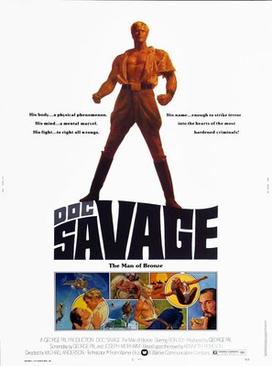
This won't be the first time Doc Savage has made it to the big screen, however. Those of you with long (and some might say masochistic!) memories may recall the 1975 film Doc Savage: Man of Bronze, starring Ron Ely in the title role. Foreshadowing somewhat the similar reception of pulp hero films The Shadow and The Phantom twenty years later, Doc Savage: Man of Bronze is generally regarded as excruciatingly awful. I won't even bother to dignify it with a link - I'll leave it to you to decide if you want to find out about/be reminded of it (although here's a picture)! However with Mr Black at the helm I feel sure the new Doc Savage film will be a far, far better affair. Already I'm liking the sound of the 1930s period setting and the "Frank Capra/Jimmy Stewart action hero" slant.
Although rumours of this new film have been circulating since 2010 it is only recently that Shane Black has begun talking about it to the entertainment press, so I would not expect to see it in cinemas until well into 2014 at the earliest. Still, something to look forward to! Who do we think should take the role (I've already seen Daniel Craig's name mentioned)?
The other film to look forward to is an adaptation of a recently-written novel entitled The Other Typist, the debut book of author Suzanne Rindell. The story is set in 1920s New York, with two contrasting young women on a police precinct's typing pool befriending each other and by the sound of things getting up to all sorts of mischief in the Prohibition-era Big Apple.
Confirmed to play one of the two lead roles is Keira Knightley, but no other cast or crew details have been confirmed at this time so once again we're probably looking at a 2014 release date. I get the impression that Miss Knightley has a polarising effect on people (particularly women - "flat/square/horse face" and "too thin" being among the comments I have heard some ladies mutter!) but I've always found her to be a decent enough actress. I'll be interested to see who will be joining her on this project.
Quite apart from the fashion aspect of the film, for me and my fellow Typosphereans it will hopefully be an excellent chance to sate our passion for vintage typewriters with several 1920s types surely to be in evidence! What do we think, chaps & ladies - Remingtons, Underwoods, Royals? What would the NYPD be using in the Twenties?
The book on which this film will be based was published in Britain last month and should be, as the saying goes, available in all good bookshops. Reviews have been positive, so we can only hope that the film will achieve as much. Furthermore, for those of you living in the British Isles B.B.C. Radio 4 Extra has just this week started broadcastingThe Other Typistas an audiobook and the first part can be heard here. Hopefully it will give us a small idea of what to expect from the film.
What films are you looking forward to in the next 12 months - anything else interesting I've missed?