Showing posts with label ITV. Show all posts

Friday, 23 October 2020

Colonel March of Scotland Yard


We stay with Talking Pictures TV for this next post (indeed one could easily base an entire blog around that splendid channel, such is the appeal of their excellent vintage-centric output, but perhaps that is a project for another time and place...) as their schedules also recently included an obscure 1950s British B-movie that really appealed to me and which - suitably in the run-up to Hallowe'en - starred one of the greatest horror film stars of the 1930s and '40s, Boris Karloff.

source - IMDb
This little gem amongst gems is Colonel March Investigates, an 80-minute feature made in 1953 with Karloff in a rare non-villainous role as the titular Colonel March, the debonair head of Section D.3 of Scotland Yard - otherwise known as the Department of Queer Complaints (and one of the things that hasn't aged so well of course, these days sounding more like the name of a Channel 4 medical documentary(!).  I keep mistakenly calling it the Department of Queer Goings-On, which at least sounds slightly better to my mind).

Colonel March Investigates was in fact a series of three pilot episodes of a new TV series, Colonel March of Scotland Yard, commissioned with an eye for the then soon-to-be-launched British commercial channel ITV, spliced together into a feature-length film (with extra mid-story scenes of Karloff added in to link the stories together) that was also shown in cinemas.  In each case, Colonel March sets out to solve a set of seemingly impossible mysteries - Hot Money sees him investigate a bank robbery where the money disappears after the thief is seen entering a solicitor's office; Death in the Dressing Room involves the strange murder of a Javanese nightclub dancer and The New Invisible Man sees murder committed by a pair of disembodied gloves!  


These initial episodes were originally shot in 1952 following Karloff's return to England from Hollywood earlier that year, his horror film heyday behind him.  At 65 and beginning to suffer from emphysema as a result of a heavy smoking habit Karloff was looking for an interesting yet undemanding project, plus the chance to settle back in his home country, and was attracted to the role and the opportunity to work for a London-based TV studio.  It can be seen from his on-form performance that he clearly relished playing the part of the be-tweeded, eyepatch-wearing (for which no reason is ever given) Colonel - Karloff is a joy to watch, mixing his trademark levels of subtle menace and sinisterness with a wonderful degree of enthusiasm, mysticality, decency and gallantry.  Despite his advancing years and health problems Karloff still enters into the spirit of things with aplomb - there are several incidences of what for the time could easily be termed action sequences and Colonel March even carries a swordstick umbrella such as another later TV hero sports!  Indeed in many ways Colonel March of Scotland Yard could be seen as a sort of forerunner to The Avengers, with in both cases our debonair protagonists investigating strange and outlandish occurrences.

Cecil Street, Carr's inspiration for the
character of Colonel March
The character of Colonel March was the creation of the American mystery writer John Dickson Carr who wrote The Department of Queer Complaints in 1940 under the nom-de-plume of Carter Dickson, one of several pseudonyms he used for the many different detective stories he would write between 1930 and 1971.  Generally regarded as one of the best of the "Golden Age" detective novelists and the master of the "locked room mystery", the Anglophile Carr set most of his stories in England and based some of his creations on real-life acquaintances or other contemporary crime characters (Dr Gideon Fell, for example, was directly influenced by G. K. Chesterton's Father Brown).  The character of Colonel March was inspired by Carr's friend, former Army officer and fellow mystery writer Cecil Street (who also wrote under the aliases of John Rhode, Miles Burton and Cecil Wayne among others).  Regrettably much of both Carr's and Street's work has now been long out of print and is therefore difficult (and therefore expensive!) to come by, which is a great pity especially as I have now a desire to read The Department of Queer Complaints and maybe a few others.  Both authors have however had a couple of their stories reprinted recently as part of the British Library's excellent Crime Classics series, which includes Street's 1930 offering The Secret of High Eldersham (which I have read) and 1936's Death in the Tunnel (which I haven't) along with the first three of Carr's novels - It Walks By Night, The Lost Gallows and Castle Skull.  Some more reading material to be on the lookout for then, at any rate!  


Although the first three pilots of Colonel March of Scotland Yard were made in July 1952 it was not until a year later in 1953 that the series was finally given the green light by ITV executives, with Karloff again returning to England from America where he had been continuing to appear on TV, film and radio.  Even so it was only in September 1955 that the series finally premiered on British television following the launch of ITV that year -  and then just in the London area where it was first available.  Later broadcasts followed when ITV Midlands began in February 1956 - the same time that U.S. broadcasts started - and even B.B.C. viewers were not left out, with the feature-length Colonel March Investigates being shown in September of that year.

Sadly only one 26-episode series of Colonel March of Scotland Yard was made; on release it garnered largely negative reviews (perhaps somewhat coloured by the general antagonism many people had at the time towards the new-fangled "commercial" television channel) with only Karloff's stand-out performance receiving any positive comment.  Today it seems rightly regarded as something of a [forgotten] cult classic, with good reviews on the likes of IMDb.  As well as having Boris Karloff in the lead role many episodes feature the great and the good of British, American & Canadian TV and film from the 1950s and beyond including Christopher Lee, Dana Wynter, Joan Sims, John Laurie, Richard Wattis, Patrick Barr, Patricia Owens and Hugh Griffith.  Karloff is also ably supported by Ewan Roberts as the sceptical, put-upon Scottish Inspector Ames and Eric Pohlmann as March's opposite number Goron of the French Sûreté.  The three episodes that form Investigates were also directed by Cy Endfield, who would later go on to do Hell Drivers and Zulu in the 1960s.

Certainly I have been thoroughly enjoying both the film and any episodes I have been able to lay my hands on.  I'm told all 26 are on Amazon Prime, if that's your sort of thing, but for now I am happily making do with the nine episodes that are currently available on YouTube.  I can heartily recommend it to anyone who enjoys a bit of Fifties TV mystery drama in the mould of The Twilight Zone and now have another new hero in the form of Colonel March, head of Department D.3, Scotland Yard - the Department of Queer Complaints!

***Colonel March Investigates is available to buy on DVD and will be shown again on TPTV weekly from Saturday 7th November 2020 at 5pm (and which they previously ran daily at 7:30pm a few years ago).  Coincidentally a new illustrated reference book - Colonel March of Scotland Yard: The Series - has also recently been published and seems to be well worth a look.***

Friday, 15 November 2013

Goodbye to the splendid 1930s world of Poirot


Goodbye to the splendid 1930s world of Poirot

And goodbye to the man himself!

I trust those of you who were able to tune in and watch Wednesday's episode have recovered - as much as anyone can recover! - from seeing the final adventure of the great Hercule Poirot?  What do we do now?!  No more M. Poirot.  No more Captain Hastings!  No more beautiful 1930s splendiferousness to jealously drool over.

The last in particular is the subject of this nicely-written article on the B.B.C. Magazine website (jolly sporting of them, considering Poirot was an ITV production), which focusses on two (of many) aspects that made this series a cut above the rest and possibly the best adaptation there's ever likely to be of Agatha Christie's work - the sets and the locations!

Florin Court, aka Whitehaven Mansions
source

The stunning Art Deco buildings that featured throughout Poirot added wonderfully to the period feel, as well they might, and certainly helped the stories along on many an occasion.  That lovely feeling of being right there back there in the 1930s was in no small part due to the locations used and it's a testament to the producers that they were able to find and use so much period architecture (thanks also in no small part to the likes of English Heritage and the many volunteers and enthusiasts who helped ensure these gems were saved from ignominy).  I've always marvelled at how it was possible to create such an authentic look on location - but I suppose that's the beauty of London where many examples of Art Deco design still exist, plus our ongoing love affair with stately country houses.

Midland Hotel, Morecambe
source
I'm glad - and not really surprised - to see that Poirot itself has ensured that the public interest in Art Deco and Streamline Modern design remains high, which must surely bode well for the future of many original buildings.  If it carries on giving the likes of you and me our required fix of '30s glamour as well then so much the better!  It's also delightful to know that, thanks in part to the series, modern architects are being influenced by the Art Deco movement and incorporating some of its motifs into today's new designs.  You can never have too much Deco, say I!


Then there were the sets!  Oh, I think we all would like to live inside Poirot's flat wouldn't we?  (Could we all fit though?  We'd have to draw up a rota and stay at Burgh Island, or the Midland Hotel in between times.  You can tell I've seriously thought about this...)  Once again the quality of the set decoration is second to none and again I'm delighted but not surprised to see that so many props and other pieces were obtained from various sources including David Suchet himself!

source

There it is, then.  The end of an era for British television.  I've said it before and I'll say it again - I think we've just been witness to a generation-defining portrayal not just of a character but also the world he inhabits.  Thank goodness for DVDs is all I can say, where we can relive the wonderful world of Poirot again and again to our hearts content.  On that subject, Captain Hastings posts will continue to appear here for some time to come (I'm only up to Series 1 Episode 8, after all!) with maybe another special diversion to Curtain, which features far more Hastings than The Big Four did.  It's been a bit Poirot-centric around here lately, I know, but with good reason.  I shan't let this turn into a Poirot-only blog (although it wouldn't be the end of the world!) if only because there already is one and I don't want to tread on the chap's toes.  But I can't let it pass without saying this.  Thank you, ITV, for sticking with it for 25 years.  Thank you, David Suchet, for such a stellar performance. Au revoir.

Saturday, 26 October 2013

Poirot: The Big Four; or, The Big Two-and-a-half...

... that being the rating, out of four, that I would give last Wednesday's Poirot.  The Big Four?  More like The Big Disappointment for this blogger, I'm afraid.

Still, by popular demand - especially from overseas readers - here follows a vague outline (so as not to spoil it for those of you who haven't yet seen it!) of the episode, focussing particularly on the welcome return of series stalwarts Japp, Miss Lemon and Captain Hastings!

Well, focussing as much as possible considering one of the biggest problems with Wednesday's episode - after all the fanfare of their much-anticipated return Miss Lemon and Captain Hastings appear in this two-hour drama for all of about 10 minutes.  Japp fares better - being the policeman he is with Poirot for most of the investigation but really, to build up a chap's (or chappette's) expectations and then give us the barest serving of Lemon & Hastings - especially when the latter is so crucial to the plot of the original book - just isn't bally well fair!  Giving us an opening shot of Hastings on his hacienda and having him utter his immortal catchphrase as the first words of the drama certainly created the impression in my mind that he was going to play a major part in this adventure.  Oh well.

Hastings seems to have settled down to the life of an Argentinian rancher...
As befits a working landowner, Hastings sports a combination of checked tattersall
shirt, spotted neckerchief and matching waistcoat and felt sun hat.
All together now... "Good Lord!"

Things seemed to progress nicely, albeit to the more sombre scene of someone's funeral, with all three of the old supporting characters together again - even though it be in sad circumstances (possible spoiler alert ahead!).

Miss Lemon!  Best shot I could get of this dress, which begins a line of simple,
patterned tea dresses(?) with a nice neckline
Japp (Philip Jackson) has aged well and his wardrobe has improved too, as befits
his new rank of Assistant Commissioner
Traditional funeral attire for Miss Lemon and Captain Hastings

At the wake and some of the old magic glints through the sadness as everyone is in Poirot's flat again.

Not much to add about Captain Hastings' black [pinstripe] suit. 
Miss Lemon's outfit has a few nice touches around the neck and sleeves.
It all gets a bit too much for Hastings.  Awww!

And that for much of the episode is all we see of Miss Lemon and the good Captain, as the action moves swiftly on to the main meat of the story.  Which, sadly, bears little resemblance to the original novel.  This is a great pity, as The Big Four has long been one of my favourite Poirot novels with its cases of international espionage and high adventure all held together by the thread of the mysterious "Big Four".  I admittedly haven't read it for some time but it has always stuck in my memory as a particularly thrilling book in which Hastings had much to do, some of it quite dangerous as I recall.  Much has been written already, including by fellow blogger Porcelina, of the difficulties inherent in adapting a convoluted series of cases into a 90-minute TV drama (Mark Gatiss himself has called the original plot "an unadaptable mess") but I still think they could have done better than the disjointed parody that has resulted.  They certainly could have and should have used Captain Hastings more prominently!

Anyway, for a good while there wasn't much worthy of comment so here are just a few general shots of the episode that I felt could be included here:

Japp's wardrobe, as mentioned, is at it's best ever.  He even looks halfway decent
in white tie (although still not a patch on Poirot)!
Quite a nice suit for the Assistant Commissioner
The old brown trilby and overcoat make a welcome return, though.

Some things that thankfully haven't changed too much are the production values.  Certainly like all Poirots since the series' 2003 "re-imagining" everything has been filmed in much darker, tenebrous style which can still take a bit of getting used to after the lighter tone of the earlier episodes.  As a result the fashions on show tend to be a bit duller and more limited, as was the case in The Big Four.  A couple of the effects were a bit ropey too.  The props were splendid, though, as were the locations (despite being less wide-ranging than those in the novel).

Poirot has a beautiful Art Deco chess set (of course!).  Which, I'm delighted to
see, you can buy an example of yourself.

For the ladies, these were the best shots of the few fashions that cropped up during the episode:

Madame Olivier seems to favour checked suits...

This particular adaption also seemed to have been cursed with the inclusion of an annoying, gabby actress (Flossie Munro, played by Sarah Parish) and an annoying, arrogant newspaper reporter (Mr Tysoe, played by Tom Brooke), neither of whom endeared themselves - or the plot - to me very much.  The episode was also extremely hamstrung, in my opinion, by a disappointing Big Reveal.  Even taking into account the smaller scale of this version, the unmasking of the villain turned out to be not only unexpected but also unbelievable.  He was completely without menace and had a motive so flimsy and far removed from the novel's dénouement that it made the previous 75 minutes seem rather disconnected and, dare I say it, almost hardly worthwhile.

Let's not end on such a sour note, though.  Part of the way through, Miss Lemon, Japp and Captain Hastings return [briefly] as we find ourselves back at the funeral/wake that began this story:

A highlight of Captain Hastings' wardrobe, limited as it is in this outing, is this
wonderfully well-fitted double-breasted overcoat.
Back at Poirot's, Hastings is determined to do what he can to catch The Big Four
I mean, he's really determined.  Remember that time he decided he'd solve the
case in Double Sin?  Even more determined than that.
He even has strong words with Japp.  I haven't seen him this angry since he
punched Miss Lemon's ex-boyfriend in The Adventure of the Italian Nobleman.
Once outside he calms down and stops to think.  In quite a poignant moment he is
heard to quietly ask "What do I do now, old chap?".

Here is where the could have introduced a bit more Captain Hastings - had him trying to follow leads, meeting with the reporter, the actress, Mme. Olivier.  But no, we don't see him again until about a minute before the end.  Thanks for that. (As an aside, it's struck me that no-one - from the Christie estate or otherwise - has thought to do a story or two with Captain Hastings as the main character.  Wouldn't that be great?  Adventures from his side of a case, or away from Poirot, or in Argentina.  Someone should really do that.  Are you listening, the Christie Community?)

A better look at Miss Lemon's black blouse

So having teased us half way through with another brief appearance of Hastings and Miss Lemon, we now have to wait until the very end to see them all together again.

Miss Lemon sporting a simple red dress with some nice collar detailing again.
Japp back in his [now usual] three-piece, and another look at Miss Lemon's dress.
Hastings burst in, having not been seen since he stormed out half an hour previously.
The episode ends not ten seconds later.  Still, every second with Hastings is a joy...

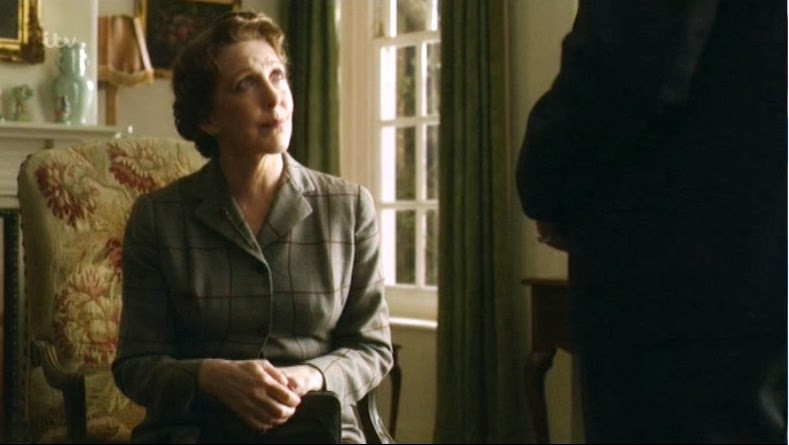
By and large then a fairly mediocre affair, saved only by the presence - however fleeting - of three beloved supporting characters from the past and David Suchet's consummate portrayal of Poirot.  There were a couple of gems in the dialogue - when confronted with a "Death" tarot card found on a victim's body Japp ruminates "Mrs Japp was dealt one just like that on Southend Pier.  'Gypsy Meg'.  Three weeks later the cat died".  We also get to see Poirot run for perhaps only the third time in the entire, well, run.  But for me the whole episode was neatly summed up by Poirot himself.  When his friends gather round at the end, he remarks "Where is Hastings?  Where is Captain Hastings?!".  It was a question I'd been asking myself for most of the preceding two hours...
Friday, 18 October 2013

The return of Captain Hastings (and the end of Poirot!)


If you live in the UK and own a television set then the chances are you'll have already started seeing the trailers for the final Poirot series, the first episode of which begins next Wednesday the 23rd of October.  ITV has been plugging it at every opportunity and for once I quite agree with them - Poirot has been a jewel in their crown for nearly 25 years and the [sad] fact that it is coming to an end deserves all the notice it can get.  Putting aside the fandom for a minute, I would go so far as to say it is a landmark moment in the history of British television.  I'm struggling to think of another TV period drama series of recent memory that has endured for a quarter of a century, with the same lead actor giving a definitive performance (from the very first episode, I think you'd agree) in what would fully deserve to be his enduring legacy.  David Suchet has been the Poirot parfait and, much like Jeremy Brett's Sherlock Holmes or Fry & Laurie's Jeeves and Wooster, I doubt I shall see a better portrayal in my lifetime.

HEADLINE: "Last series of Poirot begins next week.  Nation in mourning."

In Poirot the main character(s) have become loved by the viewing public; we've travelled the years with them and although we may already have read the original novels there has been something about each adaptation that draws us in and makes us enjoy the story anew.  Agatha Christie's undoubted genius at writing detective fiction is of course a main ingredient of Poirot's success but thanks must also go towards all the actors who have appeared down the years (some big names in there further adding to the series' stature) and of course the top class scriptwriters (who have included luminaries such as Clive Exton, David Renwick, Anthony Horowitz and Mark Gatiss), not to mention the production staff who have done such a wonderful job with the sets, props and - of course - the clothes!  It could be argued that the series took a darker turn, which may not have suited some tastes, after the departure of supporting characters Chief Inspector Japp (Philip Jackson), Miss Lemon (Pauline Moran) and Captain Hastings (Hugh Fraser) but even these solo episodes are still suitably atmospheric murder mysteries.  It is a further mark of the series that these three characters proved so popular that they were used in far more stories than they ever actually appeared in in the books.

Miss Lemon!  Japp!  Poirot!  CAPTAIN HASTINGS!!  Just like old times.

We're about to be in for a real treat, though, with the first of these final four episodes -  The Big Four (SPOILER WARNING).  For it marks the return to the series (for the first time in twelve years) of those beloved character Chief Inspector (now Assistant Commissioner!) Japp, Miss Lemon and this blogger's favourite - Captain Arthur Hastings!  Oho, I can't wait!  I'm only a little worried that they won't get much screen time and that the actors won't have aged as well as their fictional counterparts (by my reckoning only 4 or 5 years should have passed during the entire series - excepting The Mysterious Affair at Styles and The Adventure of the Chocolate Box which were both set earlier in Poirot's career) although judging by the splendid picture above I don't think the latter will be too much of a problem!  More importantly, what are half of the vintage blogosphere, myself included, going to talk about once it's all over?!  It can't end, it just can't!

Now, finally, a question for you all.  We're about due another Captain Hastings post, I reckon.  In light of this upcoming event, would you like me to cover the welcome return of Captain Hastings in The Big Four or continue my chronological journey through the earlier episode with Problem At Sea?  Let me know in the comments below!

Friday, 25 March 2011

Downton Abbey creator Fellowes to write Titanic TV epic

Downton Abbey creator Fellowes to write Titanic TV epic

Julian Fellowes is rapidly turning into a one-man period drama powerhouse.  Not content with giving us the really rather good Downton Abbey (not to mention Gosford Park, Vanity Fair and The Young Victoria) it seems that he is now turning his attention to one of the greatest dramas of the Edwardian period - the sinking of the Titanic.

I think it can go without saying that we are in for a treat, one of fantastic costumes and fashion ideas - not to mention intrigue and action spread over 6 episodes.  Some big names look to be involved and it will be a timely reminder and commemoration of the centenary of the disaster.

Mr Fellowes seems to have the Midas touch when it comes to this sort of programme so I'm sure I will not be alone in anticipating this quite highly.  The story of the Titanic is an enduring one and in 2012 it will have been fifteen years (!) since the James Cameron film, so what with that, the 100th anniversary and Mr Fellowes' recent successes this series could indeed well be "the must-see original drama", as ITV put it.

Tuesday, 18 January 2011

Christmas special of Downton Abbey to be screened

Christmas special of Downton Abbey to be screened

Following the spectacular success of the first series of Downton Abbey on ITV1 it was a no-brainer that a second series would be commissioned pretty quickly, a fact that was confirmed quite soon after the first run.

Now not only do we have a rough time frame of when the second series is due to be shown but also the announcement of a Christmas special!

It seems strange to be talking about Christmas specials in January (as if autumn isn't long enough to wait for the second series!) but at least it's something to look forward to. An Edwardian Christmas sounds just the ticket and sitting inside watching Downton Abbey on a cold autumnal night doesn't sound bad either!

Sunday, 17 October 2010

Television hit Downton Abbey helps save the real stately home where it is filmed


Television hit Downton Abbey helps save the real stately home where it is filmed

ITV's latest costume drama, Downton Abbey, is fast becoming one of my favourite television programmes and a particular Sunday treat (as I'm sure it is for many of my readers).

Now as well as providing us vintage aficionados with a healthy dose of Edwardiana the series (which, you'll all be pleased to hear, has just had a second series commissioned) has gone some way to improving the fortunes of the stately home where it is filmed.

Eagle-eyed vintage viewers will also recognise Highclere Castle from the early-90s Jeeves & Wooster series, where it played the part of Totleigh Towers. In recent years the building has been in need of some repair but now with the great interest that viewers have taken in it since the broadcast of Downton Abbey the current owners are in a position to embark on the renovation of this historic pile and eventually, it is hoped, open it to the public.
It is splendid to see that there is still such a great interest taken in this country's ancient buildings and architectural history and that TV programmes like Downton Abbey are so popular that they encourage people not only to visit but also, ultimately, to preserve these important historic houses. Well done, everyone, and the best of luck to the owners the Earl and Countess of Carnarvon.

Followers

Popular Posts