Showing posts with label opinion. Show all posts

Thursday, 10 September 2020

Living in the past: lifestyles from bygone eras - thoughts and views


Living in the past: lifestyles from bygone eras

This is another blog post I've been keeping back for a while with a view to publishing it when I would be incommunicado in hospital but with things on that front still uncertain and the subject in question of particular interest to the likes of us I feel that now is the time to share it with the rest of the vintage blogosphere.

The two articles featured in this post are equally gratifyingly in-depth studies of an area of our lives that we are all very familiar with - the vintage lifestyles that we all wholeheartedly embrace to one degree or another.  I use the word "gratifyingly" as so very often pieces such as these incline at best towards the gently mocking and tend to make my blood boil with their inherent misunderstandings - often implying that we're all a bunch of rabid right-wing leaning Conservatives longing after the return of an imperialist yoke, of women "knowing their place" in the home, of a strict social order and a world that was generally far more hidebound than the one we live in today.  It is for this reason that I rarely feature such critiques on here and why the one in the Guardian was an especially pleasant surprise to read, as in my experience they have a habit of scorning anything old-fashioned - with the traditional being an anathema to that particular organ, which is more often keen to try and point out - however tenuously - the negative aspects of the past (as in this recent, rather meandering and largely specious piece on men's suits in [spy] films).

Indeed this frequently pervading attitude that I'm sure we've all encountered - that we're wearing rose-tinted spectacles and desperately trying to live warts-and-all in a past that never truly existed - is something that I have blogged about a couple of times previously (once in 2010 and again in 2011); both of which obviously struck a chord with my readers judging by the number and type of comments I received.  I don't intend to repeat everything I said in those posts here again as they remain as valid today as they were ten years ago, although in light of these two recent commentaries I do think it worth revisiting some of the overarching views I expressed at the time.

source - The Observer / Guardian

Both editorials (but the Guardian's in particular), whilst being largely positive about the subject, do touch upon the idea that by engaging in nostalgia and living a vintage lifestyle we are somehow embracing every aspect of our preferred era both good and bad.  This is a view that for the life of me I have never been able to understand - a myopic, one-dimensional perspective that insults us by suggesting that we are unable to recognise the reprehensible aspects of our favoured time or are more than happy to include them in our lives.  Within this is also the view that we should be grateful for all the changes - both social and technological - that have occurred in the modern age and that by supposedly turning our backs on the present we are somehow denigrating the achievements we have made in the last century or so.  (Which we're not, as I've said before - many of us, myself included, just want to take the best of our chosen era and marry it to the best the 21st century has to offer.)  This belief has always struck me as a something of a double standard - to accuse us of liking all aspects of a previous era while at the same time insisting that it is in some way unnatural of us not to look forward and embrace all that the present has to offer is in many ways just as deprecating to the memory of the past.  I made the case in my 2011 post that in many respects we do appear to have thrown the baby out with the bathwater over the last fifty years or so - a view echoed by at least one of the Guardian interviewees and one that I still stand by.  To use a further analogy, how is it seen as "weird" for those of us with a penchant for a certain era to dress in the fashions of that time - fashions that can be æsthetically pleasing, sustainable and sympathetic to all body types - yet perfectly acceptable for middle-aged, overweight men (for example) to wear the artificial, ill-fitting football strip of their favourite team?  Where is the difference?  Why is one seen as "normal" and the other not? 

This attitude is also reflected in the somewhat negative terminology used by these commentators to describe us, both in the Guardian article and elsewhere.  "Retromania[cs]" is a particularly derogatory phrase in my book, once again tacitly ascribing the characteristics of a mental illness to our choice of lifestyle.  "Refuseniks" is another term that seems to be gaining currency, which continues to suggest that we are being actively obdurate and vehemently opposed to certain aspects of modern life.  Here again we see the use of injurious language to describe a group whose perfectly harmless way of living is in some way incomprehensible to those keen to pass judgement.  What's wrong with a more unbiased term like "vintagista" - or why not just use existing nonpartisan words such as "vintage enthusiast"?

source - biggles.info
From my own perspective I am reminded of an ethos that is very appropriate in respect of the above; one I have always striven to live by, given to me by a most unlikely of sources but which has always stood me in good stead and should really be the credo of all right-thinking people:

"While men are decent to me I try to be decent to them, regardless of race, colour, politics, creed or anything else.  I've travelled a bit, and taking the world by and large, it's my experience that with a few exceptions there's nothing wrong with the people on it, if only they were left alone to live how they wanted to live."
Biggles, from "Biggles Delivers The Goods", 1946 

However I am pleased to see that - in line with my own encounters with fellow "living historians" - every single one of the interviewees in each column come across as intelligent, educated individuals who are as keen as we all are to put these misconceptions to bed.  I was particularly pleased to see more than one respondent explain - as I did back in 2010 - that many of us like to take the best facets from both worlds and how there is nothing wrong with that.

Vintage ladies breathing new life into auld claes

Indeed let's focus more now on the positive bits of these two news items - and they are many - from the pleasure of a dozen vintage enthusiasts happily discussing their lifestyles and fashion choices to the interesting and in some cases insightful socially scientific theories expounded by the scholars.  Although we may not entirely agree with all of the latter it is nevertheless thought-provoking to see them laid out in a largely unbiased fashion for a change and as hypotheses more than as accusations.

source - The Edinburgh Reporter

Then of course there is the pure enjoyment in seeing well-dressed individuals taking pride in their appearance and embracing the eras of their choice, one or more of which we can appreciate ourselves.  Unsurprisingly what especially comes across is the feeling of camaraderie and community that the entire vintage movement fosters - the support, encouragement and almost familial sense of togetherness that often results when a group of like-minded people share a common interest and which is thrown into even starker relief in the face of some of the more negative remarks we have to put up with.  It's good to see the benefits of modern technology also highlighted, particularly the positive aspects of social media which allow us to engage with other vintagistas maybe half a world away whom we might never actually meet - something that I have blogged about previously and which I'm sure we're all grateful for.  The irony in this is of course that it pours further cold water on the idea that we are all technophobes who use nothing more advanced than a Bakelite telephone (well, sometimes we do I suppose!).  And we haven't even touched upon the æsthetic and ecological properties of the clothing, accessories and furnishings that can be intrinsic to the vintage lifestyle, as mentioned in both papers.

To finish on that last point, as this is rapidly turning into another essay and I'm alive to the fact that it links to two other long-read stories, I will just add my own view to those espoused by several of the vintagistas on the subject of "mixing things up" and going for your own style over attempting a specific period-accurate look.

I consider myself to have been a vintage aficionado since my early twenties, so we're talking nearly 15 years now (yikes!), but my wardrobe actually contains precious few items that one would consider properly "vintage" (and in relation to clothing that is quite an elastic term, as we know - I mean some people are calling stuff from the 1990s "vintage" for goodness' sake! - but for the purposes of this discussion let's say anything that's over 50 years old, i.e. pre-1970).  Taking that as a basis I in fact have only one piece of clothing that I can definitively date to within that period and that is my 1940s Kaufmann wool overcoat (above) gifted to me by an aunt a few years ago.  I have a few jackets, such as a Harris Tweed job from Dunn & Co, that were picked up from vintage fairs over the years but of course that is no guarantee of age these days and I suspect they were probably made after my self-imposed 1970 cut-off.

The truth is most of my wardrobe is sourced from modern clothes shops - those found on the high street like Marks & Spencer and Debenhams as well as the various online emporia listed on the top left of this blog.  I realise I am fortunate, as a chap, that men's fashion has in essence changed little over the decades (and certainly since my specific era of interest, the interwar years of the 1920s & '30s) so I am able to approximate the period look I crave to my satisfaction without having to resort to purely vintage garments.  In other words, just like with so many vintagistas such as those in these articles, I mix and match modern - sometimes "vintage-style" - clothes with the few more valued retro items I own.  As an example (and at the risk of frightening the horses), this more recent photo (right) has me sporting what is perhaps my favourite look - a 1930s chappist vibe that is achieved using only one truly "vintage" item.  That is the jacket, which is a St Michael (M&S) job - an '80s-does-'30s type, I'd say - that I picked up in a charity shop in Canterbury a couple of years ago.  Everything else is modern - the trilby from Village Hats, the bow tie from Tieroom, the shirt from Charles Tyrwhitt, the trousers from BHS (sadly missed) and the shoes (brown Oxfords, unseen) from Clarks.  I hope this goes to show that one doesn't need deep pockets, nor have to spend hours trawling the likes of eBay (unless that's your sort of thing, of course, and I own it can be fun and rewarding sometimes), to get a look that will pass muster on the vintage scene.  This particular outfit has garnered many a positive comment at various events, if I do say so myself (as well as admiring glances from little old ladies, much to my fiancée's chagrin!) and I hope this positive reaction is encouraging to anyone just starting out on the path to vintage enlightenment; you don't have to go all-out for vintage items straightaway - everything is attainable if you know where to look and how to put various items together.  As the Auld Holyrood girls say - there are no rules and nothing wrong with throwing different things together to get a successful look as you work your way towards a fully vintage wardrobe, however long that might take.

source - Wikimedia Commons

The only difficulty in sourcing vintage-style clothing currently is the lamentable state of both high street clothes shops and some online stores - all of which are understandably struggling in these covid times but in the case of some like M&S and Debenhams are not helping themselves by making it unclear what market they're in, trying to go after the youth department in a misguided attempt to appear "relevant" only to alienate their existing [older] customer base and lose sales from both camps.  Interestingly there was an article in the Daily Telegraph recently that suggested M&S should reintroduce the St Michael label (defunct since the late '90s/ early 2000s ) in light of its popularity among the vintage set.  It is sadly rare now that I find anything suitable from either of these stores.  Unfortunately, as a result of covid hitting sales by encouraging people to work at home in their pyjamas (I mean why, for God's sake?!  If only more people would realise the [mental] health benefits of dressing smartly, especially in the middle of a pandemic - something that has also been highlighted in both stories and which has previously been commented on here and elsewhere) we are also seeing the demise or decline of several once-great men's outfitters.  Already T.M. Lewin have permanently closed all their physical stores and moved to online only, with Moss Bros. looking to follow suit (no pun intended!), while in America the likes of Brooks Brothers and Jos A. Bank have been teetering on the verge of bankruptcy for the last few months.  This kind of thing doesn't bode well for the future of more traditional menswear but I'm still optimistic that there will remain a decent selection of gentlemen's outfitters where one can find the sort of vintage-style clothes that we can employ in achieving the look we desire - it's just that many more of them will be online-only (which brings with it its own set of difficulties - getting the right fit, for example - none of which cannot be overcome however).

That's enough to be going on with for the moment, though, I think.  I'm not normally in the habit of doing that many massive posts but something about these articles has again clearly had an effect on me and I hope they have made an impression with you too.  If you've made it this far - well done! - and I'd be delighted to read your comments, whether you agree or disagree with what I've written or not, and what you think of both commentaries.

Thursday, 19 December 2013

Plus fors - and againsts

What ho, everyone!  I trust we're all fully in the festive spirit now and having a tip-top time of things?

In the vintage blogosphere I do believe things have never been better and I myself have an idea for a couple of what I hope will be cracking posts before Christmas and the New Year, involving classic Yuletide tunes and recently-acquired knitting patterns(!).

I'd like to take a moment first, though, to apologise for any technical problems you, dear readers, may have encountered lately when trying to leave a comment.  You see, I recently finished creating a Google+ account for m'self and linked this blog to it.  Seeing as Google appear to own most of the Internet (and who knows where that will end...?), particularly my usual haunts of Blogger, YouTube and Google Search, it seemed a good idea at the time to have a profile to keep them all in one place.  Little did I know that by linking this blog to my Google+ profile I would be changing the commenting system to Google+ Comments, for which apparently anyone wishing to leave a message must have a Google+ account themselves.  Took me a while to cotton on to the fact too, seeing as I'm still very much an amateur when it comes to the internal workings of Blogger.

I then spent a day or so toying with the idea of leaving Google+ Comments in place until I decided yesterday evening that it is not for me to force anyone into creating a Google+ account just to post a comment and despite that firm's ubiquity there are probably more people reading this with just a good old Blogger account (or similar) then there would be on Google+, so to cut a long story short Blogger Comments have made a welcome return to Eclectic Ephemera.  Of course during that time of confusion and indecision some of you had left comments using Google+, which have now disappeared into the æther (they must be floating around somewhere, because if I switch back again they magically reappear and some of them are on my Google+ page) and I wanted you to know that I haven't forgotten them and that I value every one.  Jessica, garofit, Mim, Jennie, anyone else I've missed - sorry for faffing you about and I hope you will continue to comment in the future.

In fact, I hope everyone and anyone feels welcome to continue to comment.  I can't tell you the kick I get out of seeing "n message(s) awaiting moderation" when I open my Dashboard and reading the wonderful thoughts you've been kind enough to share with me.  In fact, there's another reason why I went back to Blogger comments, plus I can see all the messages in one place (and moderate them if - very rarely - necessary) which is something - unless it's passed me by - you can't seem to do so readily with Google+.

I will still be keeping my Google+ profile and posts published here on Blogger will continue to appear automatically on Google+, so please feel free to leave comments here or there.  I read and appreciate them all and they make writing this blog all the more worthwhile.  Sorry again for any bother; normal service has now been resumed!

Monday, 25 November 2013

Brace yourselves to suspend[er] disbelief... (2)

source
Part Two of "Braces with Bruce" (the first of which can be found here) starts on the slightly less contentious notes of colours and style.  Colours are still a point of discussion but again are largely a personal preference and while I wouldn't touch gaudy or heavily novelty-patterned braces with a barge pole if you've got the nerve and personality to pull it off then more power to your elbow (although be warned that wearing matching braces and [bow] tie is generally considered "naff").  Remember, of course, that braces were originally designed to be worn under waistcoats, pullovers and the like - i.e. never to be seen in public.  That's less of a factor these days, it must be admitted, but there's still something inherently "right" about a well-tailored three-piece suit with the trousers suspended by braces.  That's another thing in favour of braces by the way, in that trousers supported in this fashion always hang better than with a belt.  Again as something of a traditionalist I prefer muted colours like browns and greens, usually striped, or occasionally solid colours like red, blue or gold.  Once again Darcy Clothing and Tom Sawyer I find best for such hues, in both clip- and button-on styles.

Be aware that if you do plump for brightly-coloured or novelty braces you will almost certainly be labelled "eccentric".  In fact, let's face it, if you choose to wear braces at all you're likely to be called "eccentric" - or worse.  Even plain colours are not immune from notice by others - any shade of red in particular will tend to draw comparison with bankers (and yes, in both senses of the word).  But I say this - Gordon Gekko may have eventually been caught with his metaphorical trousers down but I bet he never once had to adjust his actual trousers.  Anyway, to judge a chap by the colour of his braces is just ridiculous and should be ignored along with all the other negativity we have to put up with from time to time.  I myself have a pair of wine red jobs and I'm about as far removed from a city financier as it's possible to get.

source
A final word on fixings - it is also possible
to get braces that have/accept both types
On the subject of style there are two aspects - size (width) and layout.  Although I wrote yesterday that "skinny" braces - that is, ones no more than 2½cm wide - are usually the preserve of the hipster or the younger generations who have adopted them as the fashion (and what's with wearing them off the shoulders, just hanging by the sides of the trousers?!), they should not be discounted.  You may prefer them for comfort, or other reasons.  They do the job as well as their wider counterpart, although they tend to come in fewer colours and almost always as clip-ons only.  The more traditional 3½cm width is better suited to the vintage look, however, spreads the load a little more and is available in a whole host of patterns, most with leather ends.  In my experience they also tend to be a little harder-wearing than the narrower variety.

source
Braces can also come in two main designs - the X-back and the Y-back.  These refer to the rear fixing strap(s).  As the names imply X-back braces have two rear straps, thereby giving the braces an X shape at the back.  This style seems to be more commonly found in the narrower clip-ons (right) - two fastenings giving a securer purchase, should one fail.  The Y-back, again considered the more traditional, is usually reserved for the wider, button-on braces.  It is better at ensuring the straps remain in place on your shoulders and, especially with high-waisted trews, gives a better holding effect.  That's not to say you can't get 3½cm X-backs or skinny Y-backs, but such variations are rarer.

source
It can only end in tears...
Attitudes that one encounters as a braces wearer are largely as follows.  Some people - children mainly although sometimes even fully-grown, otherwise respectable adults - will want to twang your braces as if you're a walking double bass.  This is more of a risk with clip-ons, although still annoying regardless of the type of braces you're wearing.  Best to just grin and bear it (it quickly loses its appeal, it seems); if they get a face-full of clasp/button it's their own fault.

We've touched upon the "eccentric" moniker already but I have also heard opinions ranging from "clownish" and "unnatural"(!) to "I didn't know you could still buy them".  (I knew my last job was doomed when a female co-worker made the "clownish" remark and another, when I tried to point out how preferable braced trousers are to a belt with rolls of fat spilling out over the top, was heard to say "yes, but that [the latter] is more natural, isn't it?".  By that logic, surely we should do away with clothes altogether?!  The muffin top/beer belly "more natural"?!  Has the world finally gone mad, I ask?)

source
Thanks to the success of a certain Time Lord we also have to put up with comparisons to [the outgoing] Doctor Who.  This is a small price to pay, however, for the successful reintroduction into the public consciousness of braces (albeit clip-ons), not to mention bow ties, tweed jackets and the fez!  If the best/worst comment people can think to throw at me is "Oi, Doctor Who!" then I consider I've got off lightly.

source
Some final words now on a couple of different forms of braces.  One I like the idea of, the other I don't; neither of them have I had any experience of, however.  The first is the sock suspender, an almost extinct form of brace these days and subject to even more ridicule than normal braces but still with a very real, useful purpose.  Many's the time I've pulled my socks up while yearning for a pair of these.  Like trouser braces they should really never be seen (and much of the comedy surrounding them is from their sudden appearance) but just go about doing their job of holding your socks up quietly and without fuss.  I've earmarked a pair of these to try one day; again not as difficult to get hold of as one might think with most of the online shops mentioned on the left stocking examples.

source
The other type I'm less sure about - the shirt stay.  Seemingly becoming more talked-about in recent years, I just don't get them.  What happens if you need to sit/crouch/bend down?  Won't it produce an odd angular effect at the knees?  God forbid the lower clasps should snap off, eh chaps?  Unlike with trouser braces or sock suspenders, I've never thought to myself "blasted shirt keeps getting untucked, I wish there was something I could do to stop it".  On the rare occasions my shirt tails make a bid for freedom it is the work of a moment to tuck them back in again.  Shirt stays?  Not for me.

source
source
Ladies need not feel left out, either.  Girls can  look just as good, if not better, in braces as the chaps.  Much, much better in the other type of suspender too, ahem!  With high-waisted trousers, particularly in the 1930s style so often beloved of the vintage gal, braces are a jolly nice addition especially if you want to channel some Marlene Dietrich/Katherine Hepburn style.  You ladies also have another alternative not open to us gentlemen - suspender skirts, almost a sine qua non for that Forties/Fifties look.  Some lovely suspender skirts are out there that I've seen and a splendid look it is too.

There we have it then.  Practically everything you wanted to know (or didn't want to know, perhaps) about braces, suspenders etc.  I do hope you've enjoyed my whimsical (windy!) take on those accessories. 

Sunday, 24 November 2013

Brace yourselves to suspend[er] disbelief... (1)

It occurred to me this morning, as I was knotting my tie in the mirror, that a blog post could easily be made out of my experiences with that most noble form of trouser suspension - braces (or suspenders, as our North American cousins call them).

Like most young lads I grew up knowing only of the common belt (or, sartorial gods forgive me, the elasticated waistband) in its standard leather or occasionally cloth form.  Until my vintage conversion braces were something my grandfather's generation wore, or were seen used to comedic effect in the Laurel & Hardy films that eventually helped to steer me on to my current path.

Although I'd long held the desire to try a pair of braces for myself - subsequent to my interest in vintage - it wasn't until my declining health in 2007 and the abdominal surgery which resulted that I took the plunge and invested in a pair.  By that time I was motivated as much by the need for the comfort that belts no longer afforded me as I was by sartorial considerations.  Still, I imagine I would have ended up gravitating to them even without medical intervention so I can't really quibble too much about the way I came to embrace them.  So with braces now a staple part of my wardrobe, it strikes me as the time to be writing a bit about them and the various forms they can come in.

source
The most commonly-found braces tend to be of the "clip-on" variety - that is, ones with metal clips on the end that attach to the trouser waistband.  Clip-ons tend to be largely vilified in the vintage world and not without reason.  Their biggest flaw is also their major aspect - the clips themselves.  Over time they will end up damaging the cloth around the waistband.  Some better quality examples may have inner plastic grips to try and lessen this problem but it can never be entirely eradicated.  If the clips do not have a firm grip on the fabric they will also have the unfortunate tendency to come adrift from the trouser.  While this doesn't result in the trouser-dropping embarrassment so beloved of comedy films, nor cause you to lose an eye, it is blimmin' frustrating as one side of your pantaloons begins to list and you struggle to readjust them, tuck in your shirt and reattach the errant clip all at the same time.  Equally the action of the clip coming away from the cloth and the need to re-establish a secure fastening simply exacerbate the first fault mentioned.

The top two factors in favour of clip-ons are their ubiquity and low prices.  Although they can be found in most high street clothing emporia they are still a rare breed there, usually consisting of the standard evening wear black, white or (occasionally) gold, the somewhat lamentable novelty patterns and the "skinny" varieties favoured by hipsters and the like.  More on those points later.

Practically every online [vintage or vintage-inspired] clothes retailer will have a decent selection of clip-on braces, however.  I tend to use Tom Sawyer Waistcoats or Darcy Clothing but you may have your own preferred source and indeed any of the shops in the Classic & Vintage Clothing & Accessories list to the left should offer something for all tastes and purses.  Yes, that's right - most of my braces are clip-ons, in spite of all I have said against them.  Of course I would ideally like proper leather-ended button-on braces and that is still my goal but if, like me, you have limited funds and several pairs of belt-looped high street trousers then there is still a lot to be said for clip-ons.

They are not the only avenue open to those of you unwilling or unable to stretch(!) to button-on braces, however.  It is possible, for example, to buy clip-on buttons, which work in exactly the same way as clip-on braces but allow for the use of leather-ended braces that are usually the preserve of properly-tailored trousers.  The downside is they still have all the negative qualities of clip-on braces as covered earlier.

source
Actual buttons for braces can also be bought separately and sewn on to the waistband of your existing trousers.  Beware, however - the trews must have a fitted waistband (that is, sewn into and properly attached to the trousers) and not just a folded over loose type, which will only result in the braces pulling the buttons/waistband in and up creating an ugly effect.  In my experience the buttons are also hard to come by unless you're willing to spend time rummaging around in the buttons bin at your local second-hand shop.  The only place I've been able to find that sells them separately online is a shop called Kleins.  (Bromleys also sell them with their braces, however)  Although theoretically any old buttons should do the job, proper braces buttons ideally need to be specially shaped to facilitate the holding in place of the leather straps (see above).

There's much discussion about the placing of buttons too.  General consensus seems to be on the inside of the trouser at the front and outside at the back (the former giving a clean appearance, the latter lessening any chance of discomfort from buttons digging into your back), although I've seen many a different variation (my recent Darcy acquisition, for instance, has all the buttons on the outside.  Exactly where to put them for the best fit can depend on your body shape and is usually a case of whatever feels best, although there is advice out there which tells of ideal distances from pleats, seams etc.

The next attachment option I absolutely beg you not to take, as I simply cannot believe anyone could honestly think they are a good idea.  I only mention them for the sake of completeness and, more importantly, as a warning.  Ladies and gentlemen - the Instant Buttons for Braces.  (I know, I apologise!)  I first came across these some months ago and I'm still struggling to come to terms with the idea that anyone could seriously advocate hammering a screw through the waistband of your trousers.  It is so, so wrong on every conceivable level.  I don't need to tell you what that will do to the fabric of your trews.  I daren't ask you to imagine what will happen if they're subjected to lateral forces, the kind of which might be applied by, oh I don't know, a tensioned length of elasticated fabric...  Honestly, if you take only one thing away from this post, it's this - avoid these!

source
From the ridiculous to the sublime now; the only true way to attach your braces - with fitted buttons!  No damage to your trousers.  No braces coming away unexpectedly.  Only secure, integrated attachments that allow you to make full use of traditional, proper leather-ended braces.  They may be harder to find, they may cost more than the alternatives but by Jove! they're worth it in the long run.  Teamed with a pair of high-waisted/fishtail back trousers they're nigh on unbeatable.  One day my wardrobe will be full of them only!  Darcy's again are my go to shop for these, although many other online outlets will offer similar at various prices.  Be sure to look out for the name Albert Thurston, which is generally agreed to be the Rolls-Royce of braces - and why not, considering the original Albert Thurston invented the things (as we know them today) in 1820. 

That's more than enough to be going on with for now, I think.  This post is already threatening to become a bit of a monster, so I think I'll split it into two.  I shall return with the second part of Braces with Bruce(!) - hmmn, not a bad alternative title - in a few days' time, when I will focus on the different colours and styles of braces available, plus some of my own daily experiences as a wearer of them.

But for now, Tinkerty-tonk!

Sunday, 22 September 2013

The Great British Moan Off

As I sit here waiting for the Great British Weather to make up its mind as to whether we're going to have an Indian Summer or not, it strikes me that now is as good a time as any to respond to the latest "blogger tag" that has been bestowed upon by that fine fellow of the North, G.M. Norton.  Less of an award and more of a sharing experience, it involves the somewhat different - albeit typically British - trait of moaning.

Mr Norton has highlighted three things that he would consign to his own personal Room 101.  Good manners, or rather lack thereof, naturally makes it to his list and can also be found amongst the gripes of others who have been tagged and quite right too.  The three I have chosen could be said to encompass common courtesy, but all I think share a similar thread.

Insularity and the death of community

source
Like it says on the top right...
If there's one thing guaranteed to make me miserable, it's walking to the shops or around the local park and trying to engage with people I pass on the way.  I should know by now that it will usually end in disappointment.  The local uniform of grey jogging bottoms and sweatshirts, the grim faces, the downward/straight ahead look - they should all tip me off that saying "hello", "good morning/afternoon" is a waste of breath.  Yet, ever the optimist (this post is certainly not my usual fare) I still do it.  Although to be honest these days it's more often a mumbled "hiyathereyouallright", which I always mentally kick myself afterwards for the slovenly cop-out it is.  Still it's better than nothing, I suppose.  And heaven forfend I should ever smile and nod at someone for I seem always to be met with a look of shocked disgust and confusion, as if I'd just slapped them round the face with a wet kipper.  Try keeping eye contact for more than 3 seconds and you can almost hear "How dare you look in my general direction, you strangely well-dressed man?!  Weirdo."  (As a single man, who may appear to others as being slightly differently dressed, the spectre of being thought a sinister deviant is always at the back of my mind, especially when it comes to children, which is a sad indictment of modern society in itself).  Occasionally you'll be gifted with the odd person(s) who will respond positively (and I can bet they generally won't be younger than the Baby Boomer generation, who seem the last to have been brought up to recognise this courtesy - present company excepted, of course!) and when it happens it truly does feel like a special occasion, a day-maker, so rare is it otherwise.  And that's the beauty of passing greetings on the street - it shows you recognise the equal importance of the other party (not to mention simply acknowledging their very existence) and have good will enough to pass the time of day with them.  Better that than the attitude of suspicion that seems to pervade most places these days.  This, then, is my first moan - the demise of day-to-day community spirit and the insularity of modern society. 

Apathy and the death of personal responsibility/common sense

source
Take it to the tip yourself or call the council, before someone
comes along and sets fire to it...
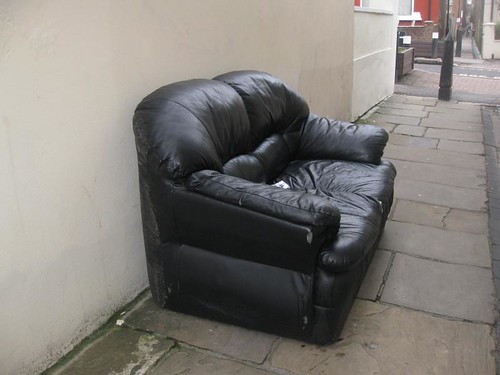
To use a personal example - so, Mr Fellow Resident, having gouged lumps out of the newly-plastered walls in the communal entrance hall with your clumsy removal skills you're now just going to leave your old sofa dumped outside, eh?  Not your problem anymore, I suppose?  The refuse workers will just pop it in the dustcart with the black bags, you think?  Even after it's been out there for three weeks?  The fact that someone else nearby did the same thing and then had their house burned down when arsonists came a-calling doesn't bother you, I imagine?

There, then, is a microcosm of an epidemic that has swept the nation - the abdication of personal responsibility and an apathetic attitude to others (and even, I would venture to suggest, themselves - it would certainly help explain the appearance of some I see around here).  How can these people not have even a twinge of conscience, of selfless thought to do what would often be the simplest action to make things better for everyone?  It is left to the authorities and the likes of you and me to do what they will not, which in the long run can only compound the problem ("someone else'll do it").  It's a thorny issue with no quick fix but something needs to be done to rid these folks of their apathy.  In the meantime I continue to shake my fists at them in frustration.

Swearing in front of children

Even I might utter the odd oath under my breath from time to time, but only when provoked and never in company.  Swearing in public in general is a particular bugbear of mine and I have nothing but admiration for those people with the courage to speak up to the perpetrator.  But one aspect that makes my already steaming blood boil is when people do it in the presence of children (e.g. on the bus, in shops etc.).  And within that aspect is another...

source
Now I don't usually get involved much on the subject of modern parenting; being a single chap myself I know I'm not particularly qualified - any observations I make still tend to be along the lines of "when I was a boy...".  Generally it is up to the parent to bring up the child as they see fit and to their credit most do a good job of it.  Bad parenting on the other hand is a wide-ranging issue and the subject of many a social commentary or government policy, if not worse.  I won't attempt to cover the whole issue here but only one small, particularly irksome aspect which I'm afraid I sometimes encounter.  I really do hope any responses to this will be along the lines of "I don't know what you mean, Bruce" or "Nope, never come across that before".  I refer to those parents who walk around with three or four children in tow, double buggies etc., smoking like chimneys and swearing like sailors.  My overwhelming feeling upon encountering these groups is utter pity, mixed with helplessness/hopelessness (plus a little extra antipathy for the parents), for these poor children who will grow up thinking that is the norm.  "There's another generation lost", I can't help but think, and there are times I've even wondered how far the child cruelty laws extend...  As mentioned earlier the whole subject of proper, healthy parenting can be a hideously complex issue, encompassing both personal responsibility and government provision.  I won't even begin to go down that road here; I think I've gone on quite long enough as it is!

As is often the way with rants, I seem to have ended up writing a mini essay - apologies!  If you've made it this far, well done, and I hope you've nodded in agreement at least somewhere along the way.  I won't pass this on, if you don't mind - I think I've spread enough doom and gloom with this as it is, things that Eclectic Ephemera was expressly set up to banish, but do feel free to add your own thoughts and pet hates here if you want.  Let me end on a happy note by wishing you all a happy and frustration-free week!

Tuesday, 14 August 2012

Plenty of books but not much service

Tea-th
Barely one month since my visit to the optician for a new pair of specs (actually the same pair of specs, just different lenses) I was back in town for my biannual dental check-up.  I can hear many of you shuddering at the thought of the dentist but personally I have always been very lucky (touch wood) when it comes to the old gnashers (apart from my teenage years when I had half-a-dozen removed and a brace fitted - but didn't everyone?).  A quick polish and a scrub up and everything was tip-top for another 6 months, although the suggestion for minimising the need for such polishing - drink less tea - wasn't met with great enthusiasm I can tell you.  If the cost is just a twice-yearly polish and buff-up then I'll keep having my cuppa, thank you very much.

Nice noir-ish cover art too!
Then it was off to trawl the charity shops, which sadly this time did not yield as many goodies as before.  I did manage to pick up a brand new - and I mean brand new, as in only published 5 months ago - copy of an Erle Stanley Gardner Perry Mason mystery: The Case of the Crooked Candle.  I'm a big fan of the Perry Mason stories, as you probably know, not to mention the TV series starring the late Raymond Burr.  The few books I have are of varying ages; most are the early 2000s House of Stratus reprints (funnily enough all sourced from library sales) although I do have one 1942 fourth edition of The Case of the Shoplifter's Shoe.  This latest title isn't, sadly, part of a new reprint of all of Gardner's work but rather one of a selection of "once famous but now neglected talents" of crime fiction including Margery Allingham, Francis Durbridge and D. M. Devine from publishers Arcturus.  Still, this was a title I hadn't got in my collection and at £1 for a book in the same condition as one that would retail for £6.99 I snapped it up.

It was at the library that I really hit the jackpot, however.  But before that... I'd gone in to return some books and pick up a reserved copy of R. J. Mitchell: Schooldays to Spitfire, a biography of the great aircraft designer written by his son Gordon Mitchell.  (After yet another viewing of The First of the Few starring Leslie Howard I felt moved to read more about the man, and at a cursory glance I can tell I shan't be disappointed with this book!).  It was at this point however that I encountered what I consider to be one of the banes of modern living.  The automated service.

No.
Yes.
Now, I know the thing exists because I walked past it on my way to the counter but - call me a Luddite - I hate automated system whatsits.  I use cash machines, but that's as far as I go (and if that makes me a hypocrite, so be it).  I don't know whether it's an extension of my - for want of a better word - old-fashionedness but I prefer to be served by a human being rather than a machine.  Don't even get me started on self-service tills!  The ones with two members of staff hovering nearby poised to offer assistance whenever the inevitable happens ("unexpected item in bagging area!") when they could be put to much better - and more efficient - use by, oh I don't know, sitting at a till scanning products through for the customer.  It's the same with this automated library system.  I remember when it was first introduced the mixture of pity and amusement I felt watching person after person struggling to work the touchscreen and the scanner, placing their books in front of this faceless box of bolts like worshippers offering up gifts to a mechanical god, before finally waiting for the librarian to come over and complete the process for them.  Upon which the machine spits out a receipt (which you have to keep with the book because it has the return date on it - apparently this is somehow better than a librarian with an ink date stamp) printed on paper the quality of which I'd be embarrassed to have in my bathroom.

Is this too much to ask?
So I ignore this waste of space and always head up to the counter (or a manned till, if I'm in a supermarket).  I hadn't been steered back to the self-checkout area for some time so when this happened:

Librarian:  "Can I show you how to use our automated check-in system?"

I remembered my previous responses to this question, drew myself up and said as politely but as firmly as possible:

Me: "I'd really rather you didn't, if it's all the same to you."

I have to admit that after that the atmosphere dropped by several degrees but really! what is it with this blasted self-service culture?  What annoys me even more is the fast-increasing view that by having these machines installed the library/supermarket/hospital is somehow doing us all a favour and that we should all be queueing up in excitement and appreciation, eager to use them and wondering how we ever got by just talking to another person.  Well they aren't and I'm not.  Honestly, they'll be expecting us to stack the shelves next.  Machines were envisioned to help (and maybe even replace) us in unpleasant and difficult tasks but instead they have been hijacked by penny-pinching corporations and used in unnecessary situations, forcing people into using them and putting customer relations (not to mention jobs) in jeopardy.  How soon before there is a whole generation who will never have experienced person-to-person interactions outside of their own home?


Anyway, rant over (and apologies, but this is something I feel very strongly about - I know that my readership includes one or two librarians so perhaps we shall also hear a contrasting view); let me show you all the books I got!  The same two tables and one shelf unit from my previous visit were still there but they had been replenished and joined by two boxes full of some really quite good (and in good condition) titles.  I ended up with an armful of five books.  Five!  For £2.20!  None older than ten years (and some again hardly withdrawn).  They are: Mr Bojangles: The Biography of Bill Robinson, A Land Girl's War by Joan Snelling (I must admit in my head I had Charly 'LandGirl's' voice - not that I've ever even heard it! - shouting "buy that!"), Elizabeth The Queen Mother by Hugo Vickers, Empire of Sand (a fictional story but using the character of T. E. Lawrence ["of Arabia"] and set in the Middle Eastern theatre of the First World War) and the biographical Joan Crawford: Not the Girl Next Door.

I'm really going to have to limit my book intake for the next few months now, I think.  Certainly I've got enough to keep me busy for a long time.  At the rate things are going my local library will soon be out of books and I'll have to open up my own library.  And I can assure you there wouldn't be a self-service machine in sight. 

Wednesday, 13 June 2012

Lookin' good but feelin' bad...


With vintage news again thin on the ground (has something happened - not only are my daily page views right down, but some of the vintage fora that I frequent are very quiet too?) my mind is turned once more to some thoughts and opinions related to vintage, which I have come across recently.

Charlotte over at Tuppence Ha'penny has written another excellent post about an attitude we vintage aficionados face every so often and you can read my own views on the debate here.  Suffice to say we continue to agree on the definition of a "vintage lifestyle".

Around the same time two other vintage bloggers, the lovely Veronica Vintage and Old Fashioned Susie, have written two interesting posts about living the vintage life while afflicted with serious health problems and it is this aspect that I intend to focus on today. As some of you may remember I disappeared for 4 months a year ago when a straightforward abdominal surgery went wrong leaving me in hospital between May and August.  My health has not been at its best in recent years, but I am feeling near to as well as I can be at the moment having recovered from that last hiccough.

I haven't for one minute let these problems interfere with my wearing of vintage-inspired clothing.  As a matter of fact I find vintage garments, particularly the high waist/rise and braces (suspenders) of vintage trousers, far more comfortable than modern cuts - a welcome example of sartorial serendipity.  I continue to find that dressing smartly and taking pride in my appearance helps to occupy my mind and makes me feel better about myself on the days when I might not be feeling so hot.

"...and if you ask me you're too well-dressed to be ill."

By and large the compliments I receive are welcome and generally along the lines of "you've recovered well" or the classic "you look a lot better".  Among those positive remarks, though, I've come across a few times now a somewhat negative attitude linked to my vintage appearance.  I am sometimes told "you don't look ill" with the inference clearly being that I somehow dress too well for someone with health issues.  It has even been suggested that by dressing as a chap and a gentleman I am perpetuating a fraud and "fooling people" into thinking that I'm healthier than I might be.

A constant ringing in his ears, but does that stop him
wearing a suit, tie and pocket square...? ;)
I can't help it if the clothes I choose to wear lead people to make assumptions about me and I think such attitudes are downright silly - it's practically suggesting that I should wear jeans, a dirty t-shirt and three days' worth of stubble every time I go to see my doctor.  Part of the problem, of course, is that most people wear such an outfit even when they're not sick - expectations (and standards) have therefore dropped to an all-time low.  Another reason might be linked to a generational paradigm shift.  People who lived through great hardships such as the war (basically people from the eras we are interested in and have an affinity with) made light of their difficulties and "muddled through" without wishing to make a fuss or draw attention to themselves.  Ask my 86-year-old nan (whose ailments are too many to list) how she is and the instant reply is "Oh fine thanks, dear".  My similarly stoic approach to ill-health can no doubt trace its roots to my love of times past.  Nowadays although the "don't trouble the doctor" attitude is still very much in evidence so many people don't bother with their appearance even when they're well that when they're not it readily shows and throws my dapper appearance into even starker relief.  Having said that, and to tie in with Charlotte's (and my earlier) post, let me reiterate that I am eternally grateful to be living in a time when medical advancements mean that I am able to live a normal life and there's absolutely no way I'd want to live in the 1930s (when my condition had only just been discovered!).

It's a shame that such attitudes as I describe exist, but perhaps I should not be so surprised given the various similar opinions that are handed to us when someone sees the way we dress.  Thanks to Veronica and Susie for their thoughts on this aspect of vintage - I'd be interested to hear yours!

Monday, 7 November 2011

Vintage: "an unhealthy fantasy-world"...?!

Do I look unhealthy to you?
I've been involved in debates recently with some people who don't quite "get" the vintage idea, culminating in the comment that forms the title of this post.  They have been perfectly amiable; a frank exchange of opinions among friends with no malice intended on either side, even if we don't fully accept each other's point of view.  As all good discussions should be, in fact.  Those discussions have been at the forefront of my mind for a time now, as a matter of fact, and it struck me what a fine blog post they might make.  It is often good to put these things down in writing and for others to read and comment on, and I can think of no better group of people whose own thoughts on the matter I would rather read than those of the vintage blogger community.  The fact that Penny Dreadful and Tuppence Ha'Penny have both written blog posts about similar attitudes that they have encountered recently makes my own experience all the more pertinent.

It started off with the usual argument that I still for the life of me can't understand - that if we like certain positive aspects of our particular favourite time period (which for the purposes of this post will be my 1920s-30s bent) we must perforce have and accept all the bad aspects as well.  "You can't expect to have the good manners, the nice clothes and the art & design without the terrible poverty, racism and colonialism that went on then as well.  You just can't have one without the other; it's part and parcel of that time period.  You must accept that with the good comes the bad."

Look, for the hundredth time I do not want to live in the 1930s.  I'm fully alive to the hardships that would have been endured in that time and I'm well aware that there were aspects of that era that in hindsight are reprehensible.  I know I wouldn't have been living in a rambling country house or a large London penthouse, going out to my club or the local nightspot every evening (a pity, I know!).  I'd have probably been in some menial clerical position, or even doing some sort of manual labour in a factory while living in a run down tenement.  In fact, I probably wouldn't even have survived at all.  I'm very grateful for the advancements that have been made over the past eighty years, which have allowed me to live my life better than my 1930s counterpart.  And there are many modern inventions and designs that I admire and employ on a daily basis; I'm not advocating a wholesale return to the 1930s or the writing out of eighty years' worth of progress and improvement.  That's not to say the 21st Century is perfect though; we still have our problems and bad points, just as every decade has.

But who in their right mind wants the worst of something?  What I seek is the best of the 1920s and 1930s, married to the best of the 2010s.  And I truly believe it is possible.  Not just possible in fact, but downright popular.  Just look at the number of vintage fairs and events that go on all year round; see how vintage fashion is all the rage right now (some may say that it is just the latest bandwagon that all today's clothes designers and their followers have jumped on and it may well be out of fashion by this time next year, but I'd like to think that the current economic climate and the disillusionment felt by many of the younger generation in regards to this modern world may give vintage the edge for some time to come).  The rise of steampunk and dieselpunk.  I could cite a dozen examples where vintage style has met modern technology with great success.  There are scores of everyday household appliances that can be had in the retro style, from chromium toasters and Aga cookers to digital radios and even television sets.  And if it can only be had in boring black or uninspiring silver, chances are there's someone out there who creates a wonderfully embellished version.

source
This is what I'm talking about.  21st Century technology (CD, digital radio) with flowing Art Deco aesthetics.  Far better than your average anonymous silver box any day. 


The Times critic Richard Morrison wrote a fantastic column a few years ago about this sort of thing, citing a local Victorian pumping station as an example.  The Victorians decorated buildings that the general public might never even see; nowadays every office building is a study in drabness.

Would you rather work in this...
...or this?

And of course it's not just design and mechanics we're talking about here.  I think everyone would agree that social conduct was in many ways better eighty years ago than it is today.  People didn't swear every other word.  There was a good deal more respect (in the proper sense of the word).  I could go on, but you all know what I mean, I feel sure.  Is not politeness, good manners and general gentlemanliness (which can be ascribed to both sexes) something we should all wish to return to?  Is that not one of the foundations of this government's "Big Society" pledge?

Which brings us to the next level.  When presented with this last counter-argument, the response is:  "Yes, well it's too late now, isn't it?  We won't be able to get back to how things were, the rot's been set in for too long now.  Might as well get used to it and make do with things how they are.".

Now, unlike some I'm not a pessimist.  I guess you could describe me as an optimistic realist.  Yes, things are bad and there is no quick fix.  But to say there's no hope of getting back to some semblance of a social ideal?  That we ought to just shrug our collective shoulders and say "Oh well..."?  Not on your nelly!

It might take a generation or two, but I truly believe that if enough people stand up, set an example and really press our elected officials then we can certainly overcome this yob culture of today.  To add myself to the myriads who (mis)quote Edmund Burke, "All that is necessary for the triumph of evil is that good men do nothing".  This, once again, is the serious agenda behind the foppish, Wodehousian facade of The Chap movement.  If you look at the original "Chap Manifesto" you'll probably, like me, find yourself nodding in agreement as well as laughing quietly to yourself.  It's humorous, but at the back of it all there's a kernel of truth about it:

Society has become sick with some nameless malady of the soul. We have become the playthings of corporations intent on converting our world into a gargantuan shopping precinct. Pleasantness and civility are being discarded as the worthless ephemera of a bygone age - an age when men doffed their hats to the ladies, and small children could be counted upon to mind one's Jack Russell while one took a mild and bitter in the local hostelry.

Instead, we live in a world where children are huge hooded creatures lurking in the shadows; the local hostelry has been taken over by a large chain that specialises in chilled lager, whose principal function is to aggravate the nervous system. Needless to say, the Jack Russell is no longer there upon one's return.

The Chap proposes to take a stand against this culture of vulgarity. We must show our children that the things worth fighting for are not the latest plastic plimsolls but a shiny pair of brogues. We must wean them off their alcopops and teach them how to mix martinis. Let the young not be ashamed of their flabby paunches, which they try to hide in their nylon tracksuits - we shall show them how a well-tailored suit can disguise the most ruined of bodies. Finally, let us capitalise on youth's love of peculiar argot only replace their pidgin ghetto-speak with fruity bons mots and dry witticisms.

It is time for Chaps and Chapettes from all walks of life to stand up and be counted. But fear not, ye languid and ye plain idle: ours is a revolution based not on getting up early and exerting oneself - but a revolution that can be achieved by a single raised eyebrow over a monocle; the ordering of a glass of port in All Bar One; the wearing of a particularly fetching cardigan upon a visit to one's bookmaker. In other words: a revolution of panache. We shall bewilder the masses with seams in our trousers that could cut paper, trilbies angled so rakishly that traffic comes to a standstill; and by refusing the bland, watery substances that are foisted upon us by faceless corporations, we shall bring the establishment to its knees, begging for sartorial advice and a nip from our hip flasks.

And should anyone say that this "Old England" (for want of a better term) never existed, that the afternoon cricket matches on the village green, the corner tea houses, the young boys in short trousers tugging deferentially on their caps, the uniformed policeman walking the beat ready to give a swift cuff around the ear to whoever might test the law, the general "good day to you sir/ madam!" nature of the man in the street are all just concoctions or rose-tinted, wistful half-memories then they should be referred to me and I will begin their re-education by showing them this advertisement from the 1933 copy of Modern Boy that I mentioned in a previous post:

Just one glance at the gifts on offer in this ad, and the way in which the language is couched, should leave you in no doubt that the Twenties and Thirties were a different (and some, myself included, might say a more wholesome) time.  "A real model of a dashing speed-boat -- a willow bladed cricket bat that will hit crisp fours" - you can just see young Johnny and his friends at the local park, playing a game of cricket before trying out the toy boat on the nearby pond.  And I doubt Nestlé, or anyone else for that matter, would even dream of giving away a 3" sheath knife with bars of chocolate these days!  How has it happened that in 1933 a boy can be trusted with a steel blade whereas a boy in 2011 is discouraged to go near anything remotely pointed, for fear that they might stab themselves or someone else?  The cry goes up - "Is that progress?!". 

And so we come to the zenith (or nadir, depending on your point of view) of the argument, this "unhealthy fantasy-world" that all we vintage aficionados are apparently living in.  We're all refusing to face up to the modern world and seeking "protection" in a past that never was, or was at least a lot worse than we're willing to accept.  Those of us who like to wear vintage fashions and take pride in our appearance are "wearing a disguise" so that we "don't have to engage with the world of today".  In fact, what we get up to is "a lot like a religion - taking comfort in a belief, a warming influence that provides a crutch and envelops".

Well, I'm not going to get too much into the religious aspect.  It could be argued that religion and society go hand-in-glove and that the general decline in standards could be linked a more secular society.  But to say that liking vintage has a quasi-religious bent to it is missing the point.  I'm not trying to "convert" people, and I'm sure you're not either.  The wish to return to a more refined age is not a crusade, it's just good sense.  I like vintage, dress vintage and do my best to act "vintage", yes because I feel more comfortable doing so, and naturally it follows that I will have a greater affinity with my chosen time period than I do with today.  But I'm not using it as a "crutch" - if anything it's the other way around.  To a certain extent I like to think I'm using vintage to prop up a society in moral and cultural decline, and I'm sure that's at least partly the attitude of a good few others as well.  My clothes are not "a disguise" - I feel more at home in them than I've ever done in modern things, it raises the standard and encourages others to raise theirs, I like to think.  I've not been brainwashed into liking this stuff, it's come on naturally over time and in no way am I saying it is categorically better in every respect to now.  It just comes back to what I was saying earlier - you can have the best of both worlds.


So there you have it.  Are we all in fact just unoriginal nutcases who wear old clothes and wander about the place going "what ho, old chap!" and so on?  What is your reaction to this summary of our interests?

Followers

Popular Posts