Showing posts with label Brooklands. Show all posts

Monday, 4 March 2024

Alvis resurrects 1920s Grand Prix racing car


Alvis resurrects 1920s Grand Prix racing car

Nearly 14 years ago now (yikes, where on earth has the time gone?!) I reported on the then-new owners of the classic British motoring manufacturer Alvis and their simply wonderful scheme to put some of their vintage models back into [limited] series production at their workshop in Kenilworth, Warwickshire - including the stunning 1935 Bertelli Sports Coupé and 1938 Lancefield Concealed Hood in addition to the original Vanden Plas.  Since that time Alvis have also broadened out into some of their post-war models such as the Park Ward Drophead Coupé and the Graber Coupé/Cabriolet but for their most recent project (a definite one-off this time) they have returned to their pre-war motorsport days thanks to the remarkable rediscovery of a truly unique, much-storied racing car that very nearly ended up on a scrapheap - the 1927 Alvis Grand Prix.

With driver George Duller in the cockpit, Number 2 Alvis is readied
for the 1927 Junior Car Club 200 Miles race at Brooklands

The Alvis GP caused a stir right from the start thanks to its then-innovative mechanical layout, being front-wheel drive at a time when almost all cars, both for road and racing, were driven from the rear.  But this was not its most notable technical advance - the front axle, instead of being the solid variety (that is, connecting the wheels with a rigid beam), was composed of four independently-mounted elliptical leaf springs allowing for an equally remarkable eight-cylinder, 1.5-litre supercharged engine to be placed lengthways behind the gearbox thus giving the car an unusual (for the time) long-nosed appearance.

Alvises Numbers 1 & 2 (bottom centre), their distinctive low-slung stance and
long bonnets contrasting noticeably with the other cars', head off at the start of the
1927 JCC 200 Miles at Brooklands, October 1927

Two cars were produced with the intention of both being entered in eligible events of the period, however the advanced engine in particular suffered from reliability issues right from the beginning.  After both failed to make the start of the 1927 British Grand Prix at Brooklands on the 1st October, they took part in the 1927 Junior Car Club 200 Miles race at the same track two weeks later; both cars qualified well - the Number 2 car lapping in excess of 120mph in the hands of experienced racer George Duller to start second, while the similarly proficient Maurice Harvey would be third on the grid in car Number 1.  Initially setting an impressive pace (Number 2 being in the lead at the start before dropping back to third due to a spark plug change) both cars experienced crippling mechanical failures, with Duller having to retire with a shattered conrod (below, now on display at Alvis' in-house museum) on the 52nd lap.


Having removed the engine to diagnose the problem back at the factory, Alvis kept Number 2 in storage for over 10 years, never to be reunited with its original powerplant.  In the late 1930s they decided to cut their losses and sell the car to Coventry-based scrap merchants Roach Brothers, with the firm instruction that it had to be broken up and not sold on.  Thankfully someone at Roach Bros. completely ignored this order and sold the car intact to Bill Pitcher, a motorcycle dealer and Alvis enthusiast from Rugby.  Pitcher's intention was to convert the car to rear-wheel drive - he sourced a 1929 Alvis TT or Le Mans engine and gearbox for the purpose but ended up having to sell the car on in the mid-'50s following the failure of his business.  Another FWD Alvis enthusiast, Nic Davies, picked up the reins and toured the world with the GP before embarking on a full-scale restoration project in 1990.  It took until 2003 for the car to be in a condition to run under its own power for the first time in nearly three-quarters of a century; three years after that it was acquired by current owner of Alvis Alan Stote and Tony Cox, an authority on FWD Alvises.


It has taken a further 17 years, with many an advance in CAD and manufacturing techniques to help along the way, but now I am delighted to see that Alvis GP Number 2 has been fully restored to 1927 racing trim - including a newly-built period-correct engine and gearbox!  Rightly taking pride of place among Alvis's already exceptional collection of original and recreated cars, the GP was publicly revealed at the Automobile Council in Chiba City, Japan in April 2023 with the intention being to have it fully completed and running at Brooklands in time for its 100th birthday in 2027.  All the more reason, I think, to start planning my long-overdue return to that great race track.  A hearty well done to everyone involved in this mammoth project and I hope to see it in the metal in a few years time!

With its designer Captain G. T. Smith-Clarke in 1927 (left) and fully-restored
today (right)

Saturday, 21 February 2015

Brooklands race track to return to use with £4.7m grant


Brooklands race track to return to use with £4.7m grant

Well, this has just about made my year and no mistake!  I doubt there'll be any more welcome [vintage] news in 2015 to trump this, and we're not even a quarter of the way through the year.

Yes, this is the overwhelmingly joyous news (which had me bouncing off the walls in excitement, I can tell you!) that the Brooklands race track in Weybridge, Surrey - first constructed in 1907 but defunct as a motor racing ciruit since the start of the Second World War in 1939, when it was largely built over and used for aircraft production - has been awarded nearly £5,000,000 in Heritage Lottery funding for use in restoring some of the track to its original 1930s condition.


Although efforts have been underway for some time now in this regard, confirmation of the Hertiage Lottery Fund's £4.7million contribution means that the projected overall costs of £7,100,000 have very nearly been met and work will begin soon.  This will involve dismantling the Grade II listed Bellman Hanger (erected by Vickers Aviation in 1940 for the production of Wellington bombers and more recently used to exhibit some of the Brooklands Museum's wonderful aeroplanes) and moving it, plus all its contents, several hundred yards where it will be rebuilt and restored to once again house many aeronautical exhibits.  Once this is done the next exciting part of the work can begin - the restoration of the start-finish straight (above).  Unseen and unused since Vickers built their production facilities over it in 1940, it will once again echo to the cheers of spectators and the roar of racing engines for the first time in 75 years.  Connected to the surviving banking at the north-east corner of the circuit it will provide the longest section of usable track since Brooklands' heyday in the 1920s and '30s.


Alas, despite the somewhat misleading B.B.C. article the entire track will not be returned to use since in the intervening decades a retail park and housing estate have been built over other sections.  Still, this is the best news that could have happened for Brooklands and will certainly return the track to as close to its pre-war glory as is possible.  And with this work, who knows what may be in store for the future?  Maybe we will see a complete circuit yet?


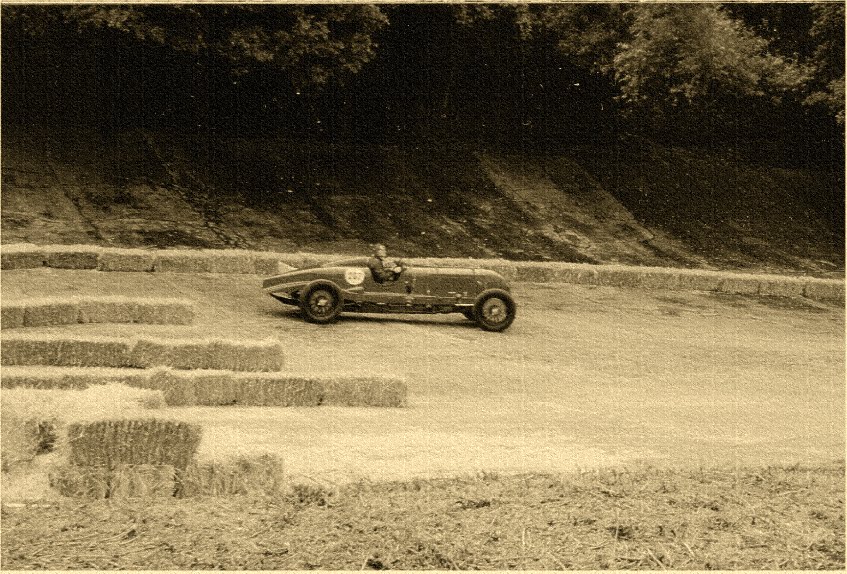
I last went to Brooklands in 2007 when the circuit was celebrating its centenary and what a fantastic day out that was.  Period outfits were worn and famous Brooklands racers including John Cobb's Napier-Railton and the later Napier-Bentley (above).  The Brooklands Musuem put on a fantastic event and is well-worth the visit and, although I didn't have the time or money to experience it on the day, the Mercedes-Benz World complex within the track is reputedly well worth a look-see.  Mercedes' contribution to the circuit's revival should not be overlooked and we owe them a debt of thanks for assisting the Museum in keeping the "Brooklands spirit" alive.


Personally I can't wait to see the results of the "Re-engineering of Brooklands" once it is complete, hopefully by the summer of 2016.  I'm sure it will breathe a whole new lease of life into an already fantastic place and my return there is only a matter of time.  With luck there will be some [period] special events to celebrate the reopening (already Brooklands plays host to many annual events and meetings, including the Double Twelve and 1940s Weekend - which I keep meaning to get along to) and I look forward to seeing the fruits of the restoration - Brooklands 1930s-style!

Monday, 2 July 2012

Goodwood Festival of Speed: Vintage Bentley sells for £5 million


Goodwood Festival of Speed: Vintage Bentley sells for £5 million

At the beginning of March I blogged about an upcoming automobile auction at the Goodwood Festival of Speed in which an historic 1929 Bentley 4½-litre "Blower" built and raced by my personal hero Sir Henry 'Tim' Birkin was expected to become the most expensive Bentley ever sold.  Well I can report that not only did it succeed, at £5,000,000, in smashing the previous record of £2,800,000 paid for the 1929 Speed Six Bentley "Old Number 2", but it also becomes the most expensive British car sold at auction.  I hope whoever bought it values it for more than just the money he paid for it and that it can be kept in Britain and shown for generations to come.

All images courtesy of Supercars.net

Bonhams have produced a wonderful video of the Bentley, found at the top of this post, that perfectly captures the majesty of this magnificent race car and the heroism of the man who created and drove it to record speeds.  It is all the more welcome since so little footage exists of 'Tim' Birkin himself.  His autobiography Full Throttle is, as I have said before and will say again, well worth hunting down.


The sale of this significant racer at the world-renowned Goodwood Festival of Speed marks a high point in the British motor racing schedule - with the Grand Prix at Silverstone pending and of course the Revival back at Goodwood in September.  The latter I hope one day to be able to attend - the ultimate Mecca for a vintage motoring enthusiast!


I'm given to wonder what 'Tim' Birkin would have made of today's motor racing scene.  He was vociferously scathing about Brooklands, a fact which he devotes a large portion of his autobiography to, but only due to unswerving patriotism.  (The chapters he devotes to England's racing woes of the time is a masterclass in apologetic criticism).  We look at [what's left of] Brooklands today relishing and marvelling at what went on there 80+ years ago but as Birkin makes clear by the early 1930s it was no longer suitable for the cars that were raced on it.  Birkin deplored the lack of a more modern track (so I think he would be pleased with the proliferation of race circuits today - a legacy of the Second World War, many of them evolving from disused airfields) and, as the Thirties progressed, a British car with which to race - Bentley having withdrawn from all forms of motorsport upon their acquisition by Rolls-Royce in 1931.  His own career reached a nadir in 1931 when he was forced to drive an Alfa Romeo in order to win at Le Mans, an achievement made all the more bitter when he received a congratulatory telegram from Mussolini claiming it "a win for Italy".


I think 'Tim' would have been happy, if a little bemused, to see his beloved "Brooklands Battleship" still running and still creating such a thrill today, at such an incredible price.  It is truly a piece of British history and if it helps to keep the marque Bentley, and 'Tim' Birkin's fantastic achievements, in the public's consciousness (or at least this member of the public's consciousness!) then it is worth every penny.

Friday, 2 March 2012

1929 Bentley 4½ Litre Supercharged set to be the most expensive Bentley ever

Image courtesy of Supercars.net
1929 Bentley 4½ Litre Supercharged set to be the most expensive Bentley ever

One of the cars driven by a true hero of mine (and not just as a racing driver) is due to go to auction at Goodwood during the Festival Of Speed in June, according to these reports.

source
Sir Henry 'Tim' Birkin was one of the famous "Bentley Boys" who drove during the golden age of motor racing and which included such daredevil sophisticates as South African diamond magnate 'Woolf' Barnato, record-breaking aviator Glen Kidston and pearl-collector Bernard Rubin among many others.  The life stories of all these men would fill many books, but it is Birkin on whom I shall focus the attention of this post.

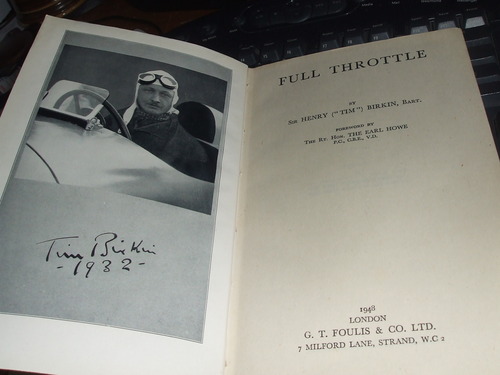
Twice winner of the Le Mans 24 Hours endurance race, first in 1929 and again in 1931, Birkin's name has remained inexorably linked to Bentley Motors.  His racing escapades are the stuff of legend and if you can track down his autobiography Full Throttle I heartily recommend you read it.

A 1948 edition, the spread otherwise identical to my '34 edition
(I was fortunate enough about 10 years ago to obtain a 1950s reprint through an inter-library loan from Maidstone, Kent, after first reading about Birkin in an article from Autocar.  So enthralled was I that I wrote to the journalist asking if he would point me in the direction of a bookshop that might have a copy to buy - it being rare and out of print for many years.  Imagine my surprise when the very next week he used his Autocar column to plead for a copy for me!  A splendid old boy who lived literally around the corner from me responded saying that I could have his 1934 fourth edition for free and I spent a lovely hour chatting with him about the early years of motorsport and his hobby of marshalling at GPs in the '50s where he saw the likes of Fangio and Moss race.  I will always fondly remember the wonderful concatenation of events that led to my coming in to possession of that book!).  Full Throttle was also made into a 60-minute drama for the B.B.C. in 1995, with Rowan Atkinson as Birkin.  To the best of my knowledge it has never been repeated and although available on DVD is, like the book, almost impossible to track down.  I was extremely fortunate to record the original broadcast and then later transfer it to disc.  

Birkin raced extensively for Bentley at such tracks as Le Mans, Ulster and Brooklands, which is where in 1932 he set a lap record of 137mph in Monoposto - the very car that will be auctioned later this year.  Fiercely patriotic (a fact that readily comes across in his autobiography) Birkin was always keen to push to the limit of his cars and beyond.  W.O. Bentley himself noted that there was "nobody before or since who could tear up a piece of machinery so swiftly and completely as Tim."  However Bentley would go on to say that "he [Tim] was a magnificent driver, absolutely without fear and with an iron determination who - while there was anything left of his car - continued to drive it flat out and with only one end in view."

Birkin (left) with Woolf Barnato
source


Outside of racing Birkin was every inch the playboy, living in a Mayfair flat in an area that became known as "Bentley Corner" due to the high density of Bentley drivers living locally.  W.O. Bentley recalled that "he [Tim] lived equally furiously off the track, his fondness for the dramatic and unexpected having surprising and often excruciatingly funny results.  Life was never dull with Tim around, if only because of the abundance and wide variety of his girlfriends."  (Birkin was married once between 1921 and 1927, and had two daughters).  Birkin himself was very self-deprecating and wrote little about himself in his autobiography, stating that "I have very seldom spoken in public; it bores me as much as my audience, I cannot remember what I was going to say, and when I can, forget how to say it; nor is my confusion aided by a stammer.  If this information disappoints my younger readers, if they had pictured me as tall and broad and clear-cut, barking out instructions in a voice like a knife, I am heartily sorry; I am quite small, and I do stammer."  As befitted a man of his social stature, though, he dressed well as can be seen in the few contemporary photographs that exist of him out of overalls.

His characteristic polka dot tie has become known as the "Birkin Spot" and Bentley, keen to cash in on its heritage, continues to offer accessories in this style.  The silk cravat and bow tie, not to mention flying helmet and goggles, are still available from the Bentley Collection but at prices only the likes of Tim could afford.  Of course, if you can stretch to a Bentley and want the authentic Winged B emblem on your clothing then you're probably not going to baulk at the cost but if your steed is more lawnmower than Bentley Blower I can point you to some more affordable equivalents that would still allow you to satisfy the inner Bentley Boy (or Girl).

Spotted silk bow tie, £16 from Darcy Clothing (Navy/White currently unavailable)
The Bentley bow may boast a Petersham adjuster and foulard silk but for my money the examples at Darcy Clothing are the equal of it, and for almost half the price!

John Comfort Classic Polka Dot silk cravat, £20 from Country Clothing
Likewise the official Bentley cravat may have top-quality folded silk and the exclusive Birkin Spot, but this John Comfort Classic from Country Clothing is a decent alternative.

Spotted silk scarf, £24 from Darcy Clothing
In one of his few notes about clothing, Birkin states "I cling to idiosyncrasies of dress, and should not like to drive without my blue and white scarf, or the crash helmet with my old St. Christopher in it, that I have had since 1927."  So it's surprising to see that the Bentley Collection [currently] doesn't include a polka dot scarf.  Luckily, Darcy Clothing does.

Leather flying/driving helmet £56, goggles £54 from Darcy Clothing
Finally, no racing driver would be complete without helmet and goggles.  While you are undoubtedly paying for the brand provenance with those in the Bentley Collection, the ones available at Darcy Clothing look to be no poor relation even at less than half the price.

Will 1929 ‘Birkin’ Bentley Fetch $6 Million at Auction?

Tim Birkin in the single-seat Blower Bentley, Brooklands 1932

As it happens it was the 4½-litre Supercharged Bentley that created something of a rift between Bentley and Birkin.  W.O. was entirely against supercharging his engines, being of the opinion that "to supercharge a Bentley engine was to pervert its design and corrupt its performance" and that it "was against all my engineering principles."  Birkin remained convinced that it was the better way to obtain more power from an engine (as opposed to Bentley's preference which was to increase the displacement).  Birkin struck out on his own and, with racehorse owner and philanthropist Dorothy Paget, co-financed the building of five "Blower" Bentleys before convincing Woolf Barnato (who was by that time Chairman and de facto owner of Bentley Motors) to build a run of 50 in order for the model to be eligible for Le Mans.  Going up against German driver Rudolf Carraciola in the supercharged 7-litre Mercedes SSK the 1930 event has gone down in the annals of racing history as an epic race, with Birkin in one of two Blowers harrying the Mercedes until it retired - at the cost of both his cars - allowing the remaining Speed Six Bentleys to win.

1929-'32 Bentley Poised To Become Most Expensive Bentley Sold at Auction

Image courtesy of Supercars.net
Despite W.O. Bentley's scathing opinion and the fact that it never won a race due to its mechanical fragility, the racing pedigree surrounding this model has led to it becoming the most sought-after and valuable Bentley in the history of the company, of which this particular example may soon become the most expensive ever sold.

Months Before Auction, a 1929 Bentley Strikes an Aristocratic Pose in Midtown

Image couresy of Supercars.net

Like many of his contemporaries, 'Tim' Birkin lived fast and died young.  By 1933 Bentley had been taken over by Rolls-Royce and no longer raced.  Birkin, already practically bankrupt from funding the Blower, was forced to race for Alfa Romeo and later Maserati.  It was while driving the latter at the Tripoli Grand Prix in 1933 that, in a moment of absentmindedness he reached for his cigarette lighter and burnt his arm on the open side exhaust of his car, thinking that he was still in his beloved Bentley.  He played the injury down, to such an extent that it turned septic.  This combined with a flare-up of malaria, which he had first contracted during the First World War when he served with the RFC (RAF) in the Middle East, left him seriously ill and he died in London on the 22nd June 1933 aged thirty-seven.

The Legacy of Sir Tim Birkin.  Taken at Brooklands in 2007 by yours truly

Thankfully the exploits and achievements of Tim and his colleagues are still remembered to this day, thanks in no small part to the continued existence of the cars they drove.  It will be worth every penny of whatever this Bentley ends up going for if it helps to propagate the thrilling escapades of Sir Henry 'Tim' Birkin.

Monday, 31 May 2010

The driving force of British motorsport

The driving force of British motorsport

A wide-ranging article from the B.B.C. which serves as a nice reminder that Britain is still a world-leader in the field of motorsport, having been one of the founders of the sport. If you ever get the chance to visit the old Brooklands track (and this coming weekend's Double Twelve would be the perfect opportunity) I urge you to do so, for it is drenched in history and full of pioneering automobiles and racing memorabilia; well worth the trip.

Britain has a strong presence in every form of motorsport around the world. Not least in Formula 1, where we have produced the two most recent World Champions and have - as the article mentions - ¾ of all current F1 teams based in this country including some of the top runners. We even have competitive drivers in the likes of the American IndyCar formula.

Once again we see the British flair for engineering and innovation put to good use in an industry that is continually advancing and coming up with new ideas and inventions that will one day find their way on to the cars that the general public can buy. It is heartening to see that, even in these times of economic and supposedly environmental crises, the motorsport industry is riding out a rough patch, looking ahead and going from strength to strength.

Followers

Popular Posts