Friday, 17 July 2020

It's not a dream, it's Captain Hastings!

Yes, he's back again!!

Now that I've returned to blogging on a regular basis I feel ready to resurrect one of my favourite series of recurrent posts - the fashions and foibles of Captain Arthur Hastings, as played by Hugh Fraser in the excellent TV series Agatha Christie's Poirot.  Judging by this blog's stats page and the number of comments I've received over the years posts featuring the good Captain are well-liked by you the reader too so, by overwhelmingly popular demand, we return now to the adventures of Captain Hastings!

I covered Hastings's all too-brief appearance in The Big Four when it first aired in 2013 and although I have received requests to do Curtain next I have only just come to terms with what happened in that episode and the fact that it was the series finale(!).  More to the point I don't actually have it to hand to screencap at the moment, my Poirot DVD box set being an older edition only going up to series 10 (which is fine by me since Captain Hastings - plus Miss Lemon and Inspector Japp - don't appear after series 8 and the episodes from that point onward veer too much towards the darker end of the spectrum for my taste).  I will keep a lookout for Curtain - it is bound to be repeated on ITV3 at some point - with a view to featuring it on here later.  In the meantime we return to the early days and the next chronological episode to feature our favourite chap, which, it having been so long since I've done one of these, is the series 1 episode (so still lots more to come, hurrah!) The Dream.  Anyway, enough waffling from me - we want Hastings!

In this long shot we can just make out his splendid-looking half-belted sports
jacket and, what is that Miss Lemon's wearing?  Could it be...?
Yes, it's that ruddy bow cardigan again that started it all.  Never mind that, though,
we're here for Captain Hastings and he doesn't disappoint.  One of his best outfits
so far, in fact - a wonderful combination.  Shirt, tie, cardigan, jacket - it all works.

There's so much going on actually that one caption isn't enough to do it justice, so I'll add my thoughts to this outfit here.   I love the blue, red and cream check of the cardigan (which gets further outings in future episodes, so watch this space!), set off against the splendid colours of the striped tie and finished off by the understated grey sports jacket.  Then there's the shirt with its small, understated spearpoint collar and - a nice touch - working single cuffs with cufflinks.  In short, the archetypal 1930s look and one every right-thinking chap should - and could - aim for.  On the subject of cuffs I've encountered conflicting opinions over the years, the general consensus in my experience being that double (or French) cuffs are more formal and therefore more representative of the period, while single cuffs are more informal (except when worn starched with formal evening wear) and the preserve of country attire.  But then I see things like this - Hastings rocking the single cuffs with links - and I begin to see things in a different light.  What we're looking at here is a typical Thirties informal look, so single cuffs are perfectly acceptable especially when set off with a pair of cufflinks.  The trouble is single cuff shirts with the facility for links (as opposed to just button fastenings) can be hard to come by these days.  The only one in my wardrobe is a rather summery Bengal striped number from Peter Christian; other modern makers such as Savile Row Co. also offer the facility for cufflinks with single cuffs, otherwise you're looking at the more "period" suppliers like Darcy Clothing or Revival Vintage.  That's enough about shirt cuffs though - back to the action!


A nice close-up of the jacket, collar and tie combo.

We open the scene with Hastings helping Miss Lemon with the morning mail.  Our man is amused and intrigued by an offer of 'Home Phit' ("That's funny - 'Phit' spelt with a 'ph'".) leather shoes; sadly we never find out if he avails himself of a pair.  Miss Lemon is unamused by the antics of her typewriter - left in the flat by a previous tenant, much to the delight of the thrifty Poirot - which keeps jamming (and am I the only one who constantly mishears her annoyed and terse exclamation of "Bother!" as something rather stronger?!).

Something for the typewriter fans as well - can you identify the recalcitrant model
from this picture (all will be revealed at the end of this post)?  (Note we also get to
see Poirot's full address and telephone number courtesy of this shot.)

The next letter is from a Hugo Cornworthy, private secretary to noted industrialist and pie-maker Benedict Farley, requesting that Poirot comes to his offices so that he may consult him.  The Farley's Food factory is of course in reality the Hoover Building, which has featured on this blog before (and also in the previous episode as the "Parade" film studio - the production company must have done some back-to-back filming there, I think!  As an aside, someone once told me that all the exterior shots of Florin Court (aka Whitehaven Mansions) were done over the course of one long weekend and then simply interspersed throughout every episode, but I cannot vouch for the veracity of that.).

Even in the dark our man's style stands out like a beacon of rightness.  Hat,
belted coat with effortlessly turned-up collar and scarf - oh yes, he's back all right.
No-one pulls off the turned-up collar look better than our Captain Hastings.
The muted earth tones of the scarf set off nicely against the coat, hat and gloves.

Hastings (and Poroit, to be fair) is disappointed to be told that the invitation does not extend to him, so it's back to the car to wait for Poirot to come out.  Poor old Hastings!


Back at the flat the next morning and Miss Lemon takes Poirot to task over the troublesome typewriter, backed up by the good Captain.

A better look at that wonderful knitted waistcoat and, just for the girls, Miss
Lemon's delightful emerald green dress with contrasting asymmetric collar/cuffs
(fellow blogger Porcelina has previously looked at the other fashions in this episode). 

Needless to say it isn't long before there's a corpse to deal with but in the following days Poirot is unable to get a grip on the case, much to his frustration.  Hastings helps out by doing the crossword.

Just as Miss Lemon's bow cardigan is a wardrobe staple in early episodes, so too
is Hastings' grey Prince of Wales check suit it seems. 

When Poirot starts to lament that his little grey cells are dying due to too much "fast living" Hastings is there to (sceptically) comfort him.


Thanks to a second tisane and Miss Lemon nearly breaking her neck looking out the window to check the time Poirot has an epiphany and he and Hastings dash off to Farley's Foods to unmask the murderer.

I do love how a simple change of tie can completely reinvigorate the ubiquitous
PoW three-piece.

Poirot's theory requires Hastings' assistance in quite an exciting manner - our hero is about to swing into action!


While Poirot gathers everyone together for the classic dénouement, Hastings waits for his moment:

The green tie sets off nicely against the grey of his suit.
"The name's Hastings.  Arthur Hastings."  Seriously, why hasn't somebody in the
Poirot fanfic community done this?!  I  may have to do something about it myself...
Single cuffs with links again and a smashing rectangular Thirties wristwatch as our
hero takes aim.

Hastings really does have a lot to do in this episode.  Having so ably helped Poirot to prove his theory, the killer is unmasked and makes a bolt for it (WARNING: if you haven't seen this episode - then what's wrong with you?! - here be spoilers) but once again everyone's favourite chap is on the case.


Alas after what must have been a bruising struggle down a marble staircase, the villain escapes our man's clutches and dashes out into the factory grounds.  Kudos at this point must go to the character of  Herbert, the fiancée of Farley's daughter (Joely Richardson), who turns up on motorcycle and sidecar - suitably dressed in full flying leathers, goggles and scarf - intending to elope but who instead is just in time to chase the murderer down in dramatic fashion.  Captain Hastings would be impressed!


With the case solved it's back to business as usual at Poirot's flat.  Miss Lemon is still battling with the typer when Poirot arrives bearing a suspiciously typewriter-shaped box.

I do love Poirot's expressions in this episode.  One can never get enough of Hastings'
suit, either.  I'm beginning to understand the obsession with that bow cardigan now.
I promised you a closer look at the troublesome typewriter.  Yes, it's an Underwood,
and given its back story, the period setting and four-bar keyboard I'm going with it
being a Number 5.  Would you agree?

You'll have to watch the episode to see if Miss Lemon does finally get a new typewriter out of Poirot(!).  This has turned into quite a monster post - whew!  Well done if you've made it this far but, well, you did ask for it (and I'd forgotten how much I enjoy composing them).  For now we'll finish with a few more gratuitous shots of Captain Hastings and his superlative three-piece suit as we bid farewell to him, Poirot and Miss Lemon until the next time, when we'll return to find them in - Peril at End House.

Wednesday, 15 July 2020

Northumberland village heritage group seeks to restore old signposts


Northumberland village heritage group seeks to restore old signposts

A further example now of civic pride and an appreciation of history helping to rescue and preserve local landmarks in this lovely story from the Northumberland village of Glanton.  In this case the structures in question are the traditional finger post signs that were among the standard road sign designs in the United Kingdom during the first half of the twentieth century, prior to the comprehensive reform of Britain's traffic signage as part of the Worboys Committee of 1963 that resulted in the styles we know today. 

source - Wikimedia Commons
Fortunately, and in spite of the wide-ranging changes instigated by Worboys, many original finger posts survive - mainly in rural locations where their welcome presence adds to the area's bucolic charm - but some of them have seen better days and are at risk of disappearing altogether as they continue to decay and get swallowed up by nature.  Not so in north Northumberland though, I am pleased to note, thanks to the efforts of the Glanton Heritage Group. 

In the ten years since it was formed this small local group have adopted and restored their village's red telephone box - something also close to this blogger's heart - as well as publishing a local history book.  Lately their attention has turned to the renovation of the area's finger posts and, after a few early hiccoughs and false starts, they have successfully restored two examples to their former glory and are now looking to replace two more.

source - Northumberland Gazette

Their efforts are to be applauded as the results look absolutely fantastic and seem certain to ensure these beautiful signposts' continued existence for years to come.  As with many a heritage group I find myself in accord with their commendable views on the subject and the fact that they have involved local ironmongers, plus through their actions encouraged other nearby communities to look into restoring their own finger posts, is just the icing on the cake.

I am reminded of a similar article I covered way back in 2012, when Norfolk County Council successfully applied for the Grade II listing of a rare 1904-vintage road sign in the village of Overstrand.  At the time I expressed the hope that more prewar signposts would be preserved in a similar manner (hopefully in the eight years since there have been other incidences that have gone unreported) and despite the passage of time it is wonderful to see that there are still groups out there willing and able to save these delightful reminders of an earlier age for both visitors and future generations of the community alike.

Monday, 13 July 2020

'Stunning' Doncaster Victorian landmark building saved from demolition

source - The Demolition Register

'Stunning' Doncaster Victorian landmark building saved from demolition

One of the few periodicals that I regularly subscribe to is the satirical/ current affairs news magazine Private Eye, which takes a critical look at fortnightly events in both British and international politics and society in general.  Since my college days I have long found it equal parts amusing, insightful, revelatory and provoking as well as being a good counterbalance to the reporting of the mainstream media (all of whom come in for their fair share of stick in its pages).  My grandfather was often fond of saying that anything you read in the papers is, essentially, one person's interpretation of events and that is a view that has never left me.  I always try to make a point of reading the news from various sources and am frequently struck by how the same story can be reported so differently depending on whether it is by, say, the conservative right-wing Daily Telegraph or the more left-wing, Labour-oriented Guardian.  Indeed it seems to me that in the last few decades the news has become increasingly politicised, although maybe it has always been the case and it is just something I've noticed as I've got older.

Anyway, although it doesn't always do my blood pressure much good, among many of the interesting columns to be found within the Eye is a regular half-page spread called Nooks & Corners, which focuses on all too common abuses of building and planning regulations and various travesties related to historic buildings throughout the British Isles.  It was through this, about six weeks ago, that I was first made aware of the plight of the remarkable building mentioned in the Doncaster Free Press article.

At the time its fate seemed all but sealed, with approval in principle for demolition and the ubiquitous modern development of flats due to go up in its place.  The shortsighted views of the developer and Doncaster council - that the building was not of "sufficient interest" and would therefore be left to fall into a state of even further disrepair (a rather dubious statement open to interpretation in my book) - were not shared by campaigners including the Doncaster Civic Trust and The Victorian Society, the latter of whom have been successful in applying to Historic England (formerly English Heritage) for Grade II listed status.  Although its future is still far from assured this does at least mean it is no longer at risk of being torn down, which is wonderful news and gives hope that for other buildings facing the same misfortune. Here's hoping that it will also encourage the developer to consider his options in the renovation of this striking and important local landmark.

source - The Guardian

This story has reminded me of several similar incidents from down the years - a couple quite close to home - beginning with the tragedy that was the Firestone Tyre Factory in Brentford, in the west London Borough of Hounslow.  Designed and built in 1928 by the noted architectural company Wallis Gilbert and Partners, who were responsible for many beautiful Art Deco inspired buildings including the nearby Hoover Factory (still standing albeit now as a Tesco supermarket and recognisable in a couple of early episodes of Poirot) it stood for over half a century as the Firestone Tyre Company's UK head office.  All that changed in November 1979 when Firestone announced it would be closing the factory and selling the building, which was subsequently bought by a British conglomerate, Trafalgar House Plc.  Mindful of its historical importance to an area rich in Art Deco industrial design, in August 1980 the then-planning minister Michael Heseltine moved to have the building listed but was obliged to inform Trafalgar House in advance of the impending decision.  What happened next was the worst sort of underhand cultural vandalism.  With the listing due to come into effect at the end of August, Trafalgar House simply got the bulldozers in over the Bank Holiday weekend and before anyone could do anything about it had demolished this stunning building, leaving only the entrance gates as any sign of its existence.  Outrage quite rightly followed, with the then-fledgling Thirties Society (now The Twentieth Century Society) up in arms at what had happened.  Heseltine wasn't best pleased either and in conjunction with the Civil Service introduced legislation which made sure that such a disgraceful occurrence could never happen again; the Hoover Factory was quickly listed as a result.

source - Yesterday's Racers

Fifteen years later and a similar and equally lamentable occurrence took place - albeit on a much smaller structural scale - in my old home town of Canvey Island.  Overlooking Canvey Lake for the best part of one hundred years was the quaint architectural oddity known to all and sundry as the Oysterfleet Lighthouse.  While its resemblance to such a building was obvious, it was in fact a little one-up one-down cottage built in the traditional 17th-century Dutch style common to the area (Canvey having been reclaimed from the Thames Estuary by the Dutch in the 1600s) by a Captain Gregson in the late 1880s.  He lived in the house on the left of the picture, below, and supposedly designed the Lighthouse for his mother-in-law to live in!

The Oysterfleet Lighthouse
source - The Original Canvey History Website

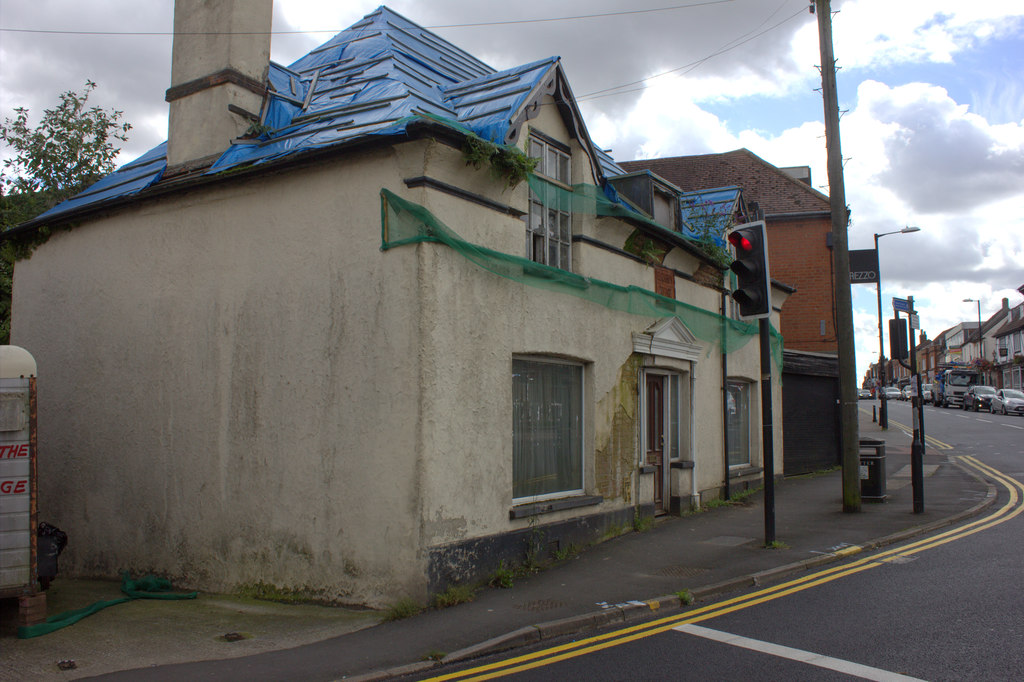
This charming local landmark stood unmolested for the best part of a century and was just on the verge of having a preservation order applied to it when - well, you can guess what happened next.  The land it was on had been purchased by a developer with his own ideas for the site and in the night leading up to the day the listing was due to come into force the bulldozers moved in and by the morning all that was left was a pile of rubble.  The shock and sadness felt by everyone in the community is still fresh in my mind over two decades on.  A large pub-hotel complex now stands on the site, with its "Lighthouse" restaurant the only nod to the little piece of local history that was sacrificed for its existence.

Elizabeth Cottage, Billericay, prior to its restoration
source - geograph (Robert Eva)

To end on a happier note a similar incident to that in Doncaster took place in Billericay, a town near me, involving a charming early 20th-century cottage that stands in a conservation area along the main high street.  Elizabeth Cottage has a fascinating history, but the story of its last 20 years has been rather tortured.  More or less left to decay over that time by its elusive foreign owners, it made local news (and appeared in the Eye) in 2017 when it emerged that mysterious builders had begun demolishing the roof - this three years after the owners' original planning permission for shops and flats had expired.  The local heritage society swung into action and to their credit Basildon Council acted swiftly to serve an injunction on the absent owners but were eventually forced to take over ownership and protect the structure from any further damage.  Subsequently the property was sold at auction to a local developer who I am pleased to say is obviously more sympathetic to the cottage and its importance to the local conservation area, having renovated it into several apartments while keeping the traditional frontage.

While there will always be wily owners and investors keen only to make quick money without giving thought to the historical or architectural importance of a building, it is thanks to groups like The Victorian Society and The Twentieth Century Society - as well as local community history groups - keeping the pressure up on councils and planning inspectorates that we are seeing more and more historically beautiful designs preserved and restored, to be given new life for future generations.  Although there is still some way to go in protecting significant traditional buildings from the ravages of decay or the attentions of unscrupulous developers, I do believe that we are as a society becoming more appreciative and protective of our communities' early buildings and I very much hope this means we will see more good news stories like this one from Doncaster in the future.

Friday, 10 July 2020

Lego Ideas announces typewriter set

source - LEGO IDEAS

LEGO Ideas announces LEGO Typewriter set

One imagines that typewriter aficionados like myself were - and probably still are - fans of Lego as well (indeed aren't most of us?), since it no doubt appeals to the mechanically-minded and the imaginative in much the same way as typewriters do.  Certainly I remember fondly the massive box of assorted Lego bricks I had growing up, the myriad different designs I built up out of them and especially the Lego Pirates sets that I spent many a happy hour building and playing with.  While all of that is now long gone I still find myself marvelling and coveting many of the more mature "Creations" series that Lego occasionally put out between the more traditionally child-friendly sets.  Their Sopwith Camel, for instance, now sadly discontinued and very hard to come by (and subsequently very expensive) is one I'd especially like to own!

source - Lego.com

Now comes the excellent news that one of the forthcoming sets to be produced in the Lego range - having garnered over 10,000 votes in Lego's fan-based Ideas community - is a typewriter and on initial viewing I can safely say that it joins the Camel on my bricklist (see what I did there...?).  Certainly its creator Steve Guinness, who I am pleased to see hails from the UK, is to be applauded for building such an accurate-looking machine out of largely standard Lego bricks.  Alas he does not mention in the accompanying interview which model of typewriter inspired his design so I will leave it to my fellow typosphereans to hazard a guess!  Regardless of what exact model it is meant to represent I have to say it is a splendid facsimile in spite of the limitations imposed and the attention to detail is mightily impressive.  One could almost be forgiven for thinking it a working example.

source - LEGO IDEAS

Mr Guinness's wider enthusiasm for his medium is obvious and his desire to use Lego creatively as a means of educating and inspiring youngsters through workshops in association with local schools and museums is entirely laudable.  I find myself in complete agreement with him when he speaks of his wonderful set "bringing nostalgia to adult fans[...], and wonder and curiosity to younger fans who might not have ever seen a real typewriter!".  He definitely sounds like a kindred spirit judging by that comment and if his Lego typewriter can engender the feelings he describes in the younger generation - particularly to the point of getting them interested in real typers - then so much the better.  In the meantime I shall keep a look out for this set in the shops (where hopefully it will not be as wallet-crippling as the Camel) with a view obtaining an example for myself!

Tuesday, 7 July 2020

Captain Tom Moore: Veteran's motorbike found by Bradford museum

source - Telegraph & Argus

Captain Tom Moore: Veteran's motorbike found by Bradford museum

By far and away on of the best things to come out of the coronavirus crisis and the story that just keeps on giving is that of the emergence of centenarian Captain Sir Tom Moore, whose incredible fund-raising 100 laps of his garden resulted in a staggering total donation of £33m for the NHS.  For this heroically altruistic effort he was rightly honoured with a knighthood, the Yorkshire Regiment Medal (as well as the rank of Honorary Colonel of Army Foundation College), the Freedom of Keighley (his home town) and of London, Honorary [Life] Membership of the England Cricket team and the M.C.C., a birthday flypast by the BBMF's Spitfire & Hurricane - not to mention having several trains, buses, boats and even animals named after him.  On top of all that he also became the oldest person to have a UK Number One single with a cover version of You'll Never Walk Alone sung with Michael Ball.  The man once even appeared on Blankety Blank, for heaven's sake!


This is before one even takes into account his military service during World War Two in the Burma Campaign, one of the harshest theatres of the war, where he served in Royal Armoured Corps and survived getting Dengue fever.  Truly his has been a remarkably well-lived life and never was the phrase "cometh the hour, cometh the man" more apposite - clearly even approaching 100 years old he still had his mark to make.

source - KentOnline

Motorbike once ridden competitively by Captain Tom discovered in Bradford museum collection 

One of the many photographs brought out to show his varied life (soon to be in print as an autobiography) shows him - properly suited and moustached, of course - astride a vintage 1920s motorcycle which he used to indulge in one of his favourite hobbies when a young man in the 1950s, that of competitive club racing.  Judging by the trophies he's holding he was rather good at it too!

Captain Tom's motorbike in pride of place at museum

Now comes the marvellous news that this same motorbike has been discovered sitting in a Bradford museum, having been loaned to its collection by the son of a former owner.  The history of the motorcycle and in particular its manufacturer - the locally-based Scott Motorcycle Company - is as equally fascinating as to how to came to pass through Captain Tom's ownership, on to another enthusiast and thus to his son before eventually coming back to prominence in this wonderfully serendipitous manner.  One can well understand the obvious pride displayed by the Bradford Industrial Museum in now being able to update its history to include ownership by a local and national hero and I'm sure it will now take pride of place in its collection, as part of the endlessly rewarding story of one man's remarkable life.

Saturday, 4 July 2020

Sanitiser maker's links back to Victorian cough cure

source - BBC News

Sanitiser maker's links back to Victorian cough cure

Perhaps unsurprisingly there has been very little in the way of interesting vintage-inspired news to come directly out of the coronavirus crisis so this article about an historic company making hand sanitiser for the NHS is a rare and welcome example.  There are many facets of this story that make it worthy of inclusion here, not least the historical interest surrounding the Victorian "cough cure" that started the company in question on the road to where it finds itself today, taking inspiration from its founder and helping to provide much-needed equipment for those dealing with Covid-19 in hospitals up and down the country.

source - Flickr

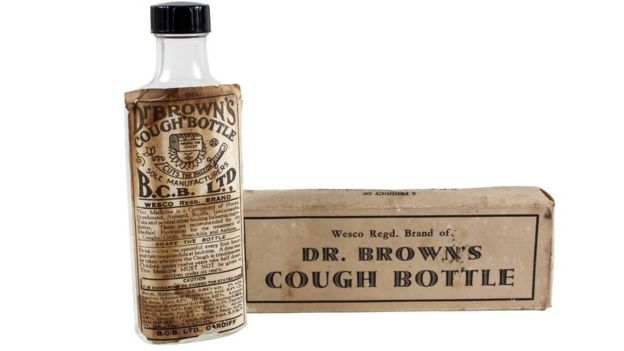
As with so many all-purpose medicines that began to appear in the 19th century, Brown's Cough Bottle included among its ingredients several classic Victorian standbys such as laudanum (opium + alcohol), cannabis and chloroform.  The result, as was to expected, was a rather addictive drug as the accompanying article explains.  The classic style of advertisement from the time (above) using its alternative and more accurate name of Chlorodyne, shows just what wide-ranging a treatment it was marketed as - able to treat anything from a simple cough right up to gout and rheumatism (probably would have shined the furniture up a treat, too).
source

Nevertheless it was obviously doing something right (beyond getting the user hooked on opioids!) as despite changes to the content causing an initial downturn in its popularity the medicine still lives on today - albeit under the control of a different company - as J. Collis Browne's Mixture for coughs and stomach complaints (and with a slightly less addictive 1mg of morphine).

BCB International, which can still trace its origins back to Collis Browne and his cough medicine (BCB originally standing for Brown's Cough Bottle), now owes more to his other major interest - yachting and open air pastimes - by manufacturing adventure equipment and emergency supplies, with the cough mixture now produced by a separate but still family-owned branch of the business.

source - BBC News

Now BCB has stepped up to the crease during the pandemic and used its facilities and experience in producing emergency equipment to swiftly start production of hand sanitiser and PPE for use in hospitals and by key workers.  In a fine tribute to the man who started it all for them 172 years ago - and who I'm sure would be proud and astounded were he around today - they have branded the hand gel Dr Browne's Hand Sanitiser.  All in all then a splendid piece of good news for these trying times, with a vintage twist; I take my hat off to BCB International for taking inspiration from their past in helping to produce equipment that will help ensure many people's future.


To finish on a somewhat humorous note the name J. Collis Browne was not unknown to me before this news item appeared on my radar, although from a rather different source quite unrelated to its actual origin.  Without doubt one of the more bizarre CDs in my music collection, Collis Browne's Jamboree contains an eccentric selection of songs and performances by the creator of The Chap magazine Mr Gustav Temple and some of his chums.  Produced back in 2003, when The Chap movement was but a mere 4 years old, it was originally only available to order through the magazine but I was able to pick up a used copy online a few years ago.  It truly is an eclectic mix of ukelele covers (Champagne Charlie and The Kinks' Dedicated Follower of Fashion among others) and weird recitals such as Collis Browne's Recipe, above.  Quite where Mr Temple and his cohorts got their inspiration for this frankly weird record from I don't know but clearly they must have come across the name J. Collis Browne somewhere along the way (I sometimes wonder if they found a stash of Dr Browne's original mixture, necked the lot and came up with the CD in an opium-fuelled stupor one afternoon...).  The result is this strangely appealing disc, which is a valued part of my chappist musical collection and my first introduction to the name of Collis Browne.

Wednesday, 1 July 2020

Lockdown look back #3: July 2017 - Thurrock Thameside Nature Reserve, Mucking, Essex

As most of us continue to slowly - and hopefully permanently - emerge from lock-down (although with those like myself still having to shield until the 1st August) it's occurred to me that it's been a couple of months since the last in my series of "Lockdown Look Back" posts featuring some of my escapades in the 3½ years I was absent from this blog.  So without further ado (or further adon't) let me take you back three years to the day to the 1st July 2017, where we find ourselves in the somewhat different but no less interesting surroundings of Thurrock Thameside Nature Reserve on the banks of the Thames Estuary and just outside the hamlet of Mucking in Essex.

source - Essex Wildlife Trust

The history of this nature reserve is a fascinating and convoluted one.  Like so much of this area bordering east London and the river it started life as a gravel quarry (although its ancient history can be traced all the way back to a Stone Age settlement) before becoming a landfill site for 50 years.  In 2012 it was finally closed as a tip and work began to return it to nature under the auspices of The Cory Environmental Trust, DP World Port and the Essex Wildlife Trust.  The 100ft-high piles of waste - half a century's worth of household rubbish from six London boroughs - was first covered over by a layer of thick clay (fortunately also found in abundance in this part of the world) before fresh soil and suitable plants were added.  A varied landscape of grassland, woodland, ponds and reedbeds has been created, with the seawall at the east end of the site being deliberately breached to allow the area to revert to marshland.

source - Essex Wildlife Trust

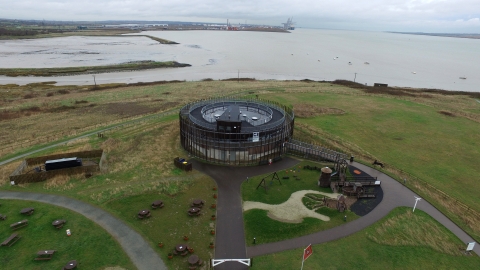
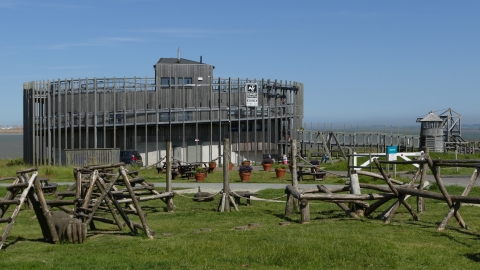
An ingenuously-designed visitor centre was also built in 2013 - wood-clad and circular in shape it has wonderful views of the entire reserve as well as the estuary, not least from the 360º viewing platform on its roof, and sits on hydraulic jacks that allow for the movement of the rubbish beneath as it continues to settle.

I can certainly attest to the excellence of the visitor centre, which as well as the aforementioned views contains a wealth of informative displays plus the obligatory EWT shop and a decent cafe.  I first visited the place with my parents shortly after it first opened, which was how I knew of its existence and thought of it as a worthwhile place to take my then-new lady friend.

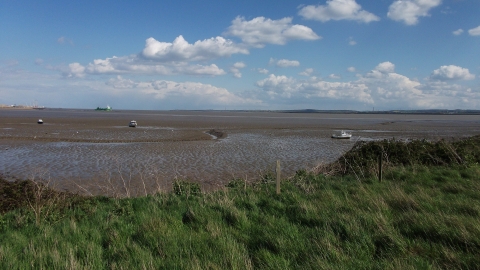
Looking east out into the estuary
source - Essex Wildlife Trust

As I recall it was a mild if slightly blustery day - not unusual on that exposed part of the estuary - as we parked up and commenced walking around one of the myriad pathways that reach out in all directions from the visitor centre.  The entire reserve is currently about 120 acres in size (although the aim is for that to increase to a massive 845 acres - twice the size of Regent's Park) and forms part of the Thames Estuary Path which runs along the coast practically uninterrupted for 27 miles from Tilbury all the way to Leigh-on-sea.  Needless to say we contented ourselves with staying to within a mile or so of the centre but there was still plenty to see.

Looking towards Stanford-le-Hope/ Horndon-on-the-Hill on the Essex coast

Sailing boats over on the Kent (Cliffe) side of the river took advantage of the breeze

Unfortunately I am never going to win the Wildlife Photographer of The Year and as we were busy walking around, taking in the sights and enjoying each other's company I had little time or opportunity to take much in the way of photos.  The two above and three below therefore constitute the best of a poor bunch, but I hope they give a little idea of the splendid variety of wildlife and the fantastic effort that has gone in to turning a once barren and industrial wasteland into a beautiful and thriving nature reserve.

Thistles amidst the grassland
A close-up of a cardinal beetle taking a break atop a thistle 
More thistles and some unidentified purple flowers (I'm afraid I'm no horticulturist
either so if any green-fingered readers want to enlighten me I'll happily update this
caption!)

After our circuit of some of the shorter routes we repaired to the visitor centre for a light snack in the cafe (quite passable) and an enjoyable wander around inside and out (access to the rooftop viewing platform is via a circular ramp that runs around the outside of the building, which allows for good views as you make your way to the top).  One other thing the visitor centre had, which appealed to us more as bibliophiles than naturalists it has to be said, was a small selection of second-hand books tucked away in the corner of the cafe.  While unsurprisingly most are of an environmental or horticultural bent there are often quite a number of other genres both fiction and non-fiction so to finish off this post here are two acquisitions from that stall (although neither of them came from this particular visit).


The Friendless Sky was actually my most recent find from a return visit and is exactly what it says on the cover; it joins my already-burgeoning collection of World War One literature but was a jolly good read and complements my library well.  Likewise Captain Starlight by Percy F. Westerman, a contemporary of Biggles author W. E. Johns and while maybe not quite as well-rounded still a ripping adventure yarn.  This came out of my very first visit with my parents and served as an introduction to Westerman's work, further examples of which I have since added to my collection.

I have no doubt that we will return to Thurrock Thameside Nature Reserve again (and not just for the books!) and can wholly recommend this - still sadly somewhat hidden - gem should you ever be in the area.

Followers

Popular Posts