Babbage Analytical Engine designs to be digitised
The creation of a full-size replica of noted Victorian engineer Charles Babbage's Analytical Engine, as reported in these pages previously, is one step closer to becoming reality now thanks to this latest piece of news.
It may still be early days, and a target date of 2021 seems a long way off, but the London Science Museum is to be commended for agreeing to convert Babbage's handwritten sketches and plans into an easy-to-access digital format. This will surely be of great use to the team behind the campaign, making their job that little bit easier and ensuring that the project stays alive.
When completed the Analytical Engine will be an enormous machine (we're talking double-decker bus scale here) so it's just as well that Babbage's notes, while not complete, can be easily accessed and analysed before being applied to a computer model and then, finally, a complete and accurate facsimile.
Ten years will be a long time to wait but I'm sure that it will be well worth it, and this blog will continue to report on the progress of this remarkable undertaking. Carry on, you fellows!
Monday, 26 September 2011
Babbage Analytical Engine designs to be digitised
Labels:
19th Century,
Analytical Engine,
Charles Babbage,
museum,
science,
technology
Tornado steam locomotive sets new record
From pedal power to steam power now, and guaranteed to get to Scotland far quicker than any penny-farthing could, Tornado the modern-build steam engine has further added to its laurels.
Striking a blow for the steam locomotive in what must be a great vindication for its creators, 60163 Tornado proves that it has what it takes to go the distance (literally!) and easily overcome the two of the most difficult railway gradients in the British Isles during this record-breaking inaugural trip to Glasgow. Not to mention weather that, as you can see, while as typically British as the scenery would be a challenge to any train.
There it once again captured the hearts and minds of all who saw her, bringing back happy memories for many and providing everyone involved with a marvellous experience.
I have a distinct feeling that this will not be the last 40-year old steam engine record that the mighty Tornado will break and I for one look forward to reading of its next great achievement. Well done, chaps!
Sunday, 25 September 2011
Penny farthing 'back on the production line'
My favourite kind of news story, this - an historic and unusual device making something of a comeback. In this case it is the magnificent penny-farthing, the instantly-recognisable Victorian bicycle.
Although there have long been penny-farthing designs available (if you know where to look), these have always been scale versions of the real thing - little more than a novelty; a modern-day pastiche of the classic design complete with BMX-style wheels.
This one looks to be a different kettle of fish, however. Practically the same as the original, by all accounts, but with all the bonuses modern industry can bring. There again we see that great ideal of which I have spoken before - vintage aesthetics married to 21st-Century mechanics. Perfect!
Roger Lovell (above, left), the chap behind their reintroduction, sounds like just the kind of thoroughly decent fellow who would espouse the cause of these machines - not surprising really as he races them for a hobby (a sport I have blogged about previously). He is to be commended for bringing these wonderful bikes back into production, not to mention giving the local economy in Leicester a small boost and maintaining an historic link with the area's manufacturing history.
A splendid win-win situation, then. Who knows, soon we may again all be whizzing about on Leicester-built penny-farthings. Whee!
Labels:
19th Century,
bicycle,
Leicester,
Penny-farthing
Thursday, 15 September 2011
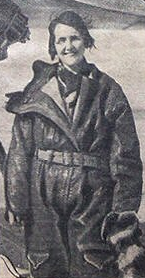
Documentary showcases woman pilots of the 1920s
Proving that anything men can do women can do equally as well, if not better, this second aviation story of the week focuses on the pioneer aviatrices of the United States.
| Ruth Nicols |
The accompanying article gives us a delightful taste of what went on during those 9 days and seventeen stop-overs and the details of this new documentary certainly sounds fascinating - a pity then that it looks to be confined to the US/Region 1 for it covers what was indeed a pivotal moment in the aviation history not of America but also the wider world and so really deserves a wider audience. If it wasn't for this film producer stumbling across the story it might have remained untold for another 80 years!
As it is the story of this event has been saved for another generation, and for us to marvel at the sheer guts and determination of these early aviatrices - particularly in the face of attitudes to women at that time.
Labels:
1920s,
aeroplane,
air derby,
air race,
Amelia Earhart,
America,
aviatrix,
documentary,
pilot,
Ruth Nicols
Wednesday, 14 September 2011
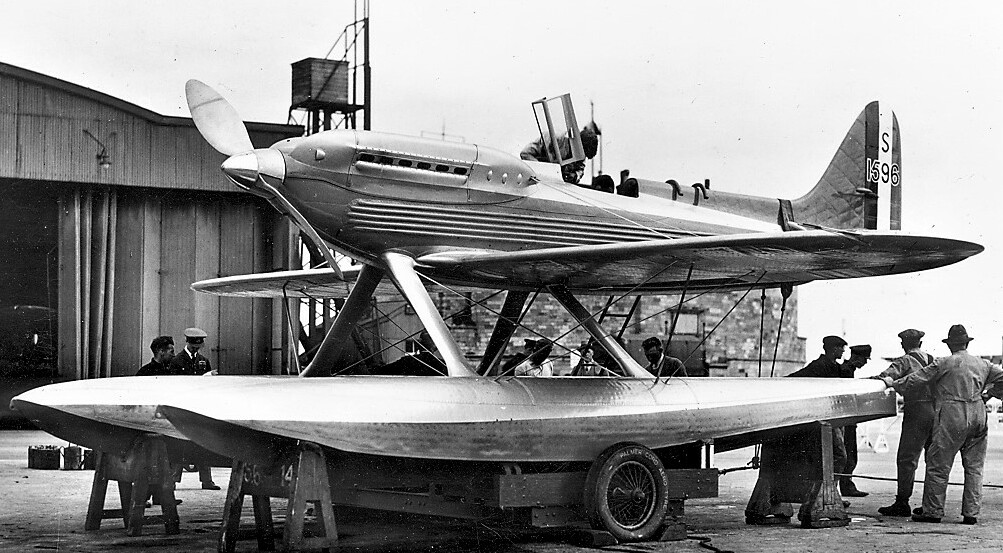
Seaplane flypast marks 1931 Schneider Trophy victory
I touched upon the Schneider Trophy air races of the 1920s and early Thirties back in March when the Spitfire, the ultimate descendant of the Supermarine S-series seaplanes that took part in them, celebrated it's 75th anniversary.
Yesterday, however, marked the 80th anniversary of the last Schneider Trophy race which was held at Southampton Water in Hampshire and was won for the third time in succession by Great Britain. This feat allowed the British team to keep the trophy for all time and signalled the end of the competition. The Supermarine S.6B that won did so at a record-breaking speed of 379mph, later raising it again to 407mph and as has been said setting the template for the famous Spitfire fighter. The original Schneider Trophy and the S.6B now both reside in the London Science Museum.
As many as half a million people crowded on to the beaches around the Solent to watch the 1931 race and what that must have been like one can only imagine. That the idea behind the Schneider Trophy - of advancing the field of aeronautical engineering - was so widely embraced not only by the aircraft manufacturers but also by the general population of no less than 4 nations (Great Britain, France, Italy and the United States all took part) shows how much aviation enthralled people during that period. I've featured it before but footage of the 1929 event bears reshowing; the roar of the Rolls-Royce and Napier engines, the sheer speed of the aircraft and the hundreds of thousands of spectators cheering them on is something that sadly may never be recaptured.
Today, as the accompanying article explains, two modern seaplanes (and the death of the seaplane has been greatly exaggerated, by the way!) have flown the same course as in 1931 by way of commemoration. It seems a small act in comparison to the majesty of the original races and the important part they played in eventually ensuring the continued existence of this country, but at least they are being remembered in some fashion. We may never be able to recreate the evocative images and thrills associated with the Schneider Trophy races but this certainly gives us a chance to look back and marvel at those magnificent men (pilots and designers) and their flying machines who went before.
Labels:
1920s,
1930s,
aeroplane,
anniversary,
Isle of Wight,
R. J. Mitchell,
Schneider Trophy,
seaplane,
Solent,
Southampton,
Supermarine
Wednesday, 7 September 2011
Boardwalk Empire Is Bringing Back Old School Subways
| Image courtesy of Gothamist |
A wizard wheeze from HBO, makers of the hit U.S. television series Boardwalk Empire, who have brought an actual 1920s subway train out of retirement and with the assistance of the New York Transit Authority are running it on a limited basis on one of the Manhattan lines for every weekend throughout September!
| Image courtesy of Gothamist |
Incidentally has anyone actually seen Boardwalk Empire yet? Is it as good as I hear? I'm amazed the first series hasn't already been snapped up by Channel 4 or someone. For the likes of me who refuse to further line the pockets of the Murdoch empire it is most frustrating! I want my Twenties fix! ;-)
~~~~~~~~~~~~~~~~~~~~~~~~~~~~~~~~~~~~~~~~~~~~
*While searching the Interweb to confirm my memory of the LU/London Transport Museum heritage runs, I've discovered there's another one this Sunday, the 11th September, up at the end of the Metropolitan line between Harrow-on-the-Hill, Rickmansworth and Amersham. The museum's 1938 train and locomotive are being given an airing and there's even a competition for the best period-dressed passenger! It may be a little late in the day (certainly is for me, not to mention a little bit of a trek for me at the moment) but I thought I'd bring it to your attention anyway. Details here.
Labels:
1920s,
Boardwalk Empire,
HBO,
London Transport Museum,
London Underground,
Manhattan,
New York,
New York Transit Authority,
subway,
train,
transport,
travel,
underground
Monday, 5 September 2011
Cord's grandson honours his work
This year marks the 75th anniversary of what, in my humble opinion, is the most beautifully-designed [American] car there has ever been - the 1936-37 Cord 810/812SC.
As always, there is a healthy fan-cum-drivers club in America today as well as a museum and it is the former which has this year organised its annual run around the Cord 810. I also like the great idea of baseball-style cards being handed out to the local youths of Auburn, Indiana where the cars were originally produced. It's an inspired way of connecting them with an important aspect of [their] motoring history, in a fun and tangible way. Well done to Mr Hummel, and here's hoping the 2011 Auburn Cord Duesenberg reunion was a great success.
The Cord Corporation built it's first car in 1929 - the L-29. This ground-breaking automobile had a front wheel drive layout at a time when every other car in the States was driven from the rear; indeed it was the first such car in America ever and with the exception of the later Cords fwd would not be seen again on a US car until the 1966 Oldsmobile Toronado. The L-29 was produced for 3 years until 1932 before a break of another 3 years whereupon the 810 arrived.
Founder of the Cord Corporation, Erret Lobban Cord, had already bought the Auburn Automobile Company and Duesenberg during 1925-26. Until their untimely demise in 1937 Auburn, Cord and Duesenberg (under the design direction of Gordon M. Buehrig) produced some of arguably the best looking cars of the decade, such as the Auburn 851 Speedster and Duesenberg Model J (below).
The Cord 810 was another innovative design. Front-wheel drive again, it was the first car anywhere in the world with retractable "pop-up" headlights (which were actually originally landing-lights from a light aircraft, and were operated by two hand cranks inside the car). Other pioneering features included electrically-operated variable-speed windscreen wipers and a radio as standard (the latter offering not seen again for another 20 years).
The next year, 1937, saw the introduced of the supercharged 812, which would prove to be the last hurrah for E.L. Cord's empire. No other car so perfectly captures the 1930s aesthetic of Art Deco/ Streamline Moderne and the glitz & glamour that such designs continue to evoke. An example of the Cord 810 was later displayed in the New York Museum of Modern Art, surely forever answering the question "Can a car be art?".
*These two fine examples, below, are probably about as close as I'll ever get to having my own Cord 812SC and Auburn 851 Speedster ;-)*
Labels:
1920s,
1930s,
anniversary,
Art Deco,
Auburn,
car,
classic car,
Cord,
design,
Duesenberg,
E.L. Cord,
Gordon M. Buehrig,
Indiana
Subscribe to:
Posts (Atom)
Followers
Popular Posts
-
I rather fancy it's time for another Captain Hastings/Style Icon post, but this time with a twist! I think that, by way of a change, I ...
-
The starting of a new job seems to have coincided with a bit of a downturn in vintage news (not to mention my third cold in as many months!)...
-
Supermarine S5 replica project gets under way Staying with the 1930s aviation theme in this post we move from one end of the aeronautical...
-
Classic car firm Morgan building new three-wheeler after gap of 60 years Morgan is by far and away my favourite motor manufacturer so it was...
-
Second in the style icon stakes after Fred Astaire must surely be Mr Archie Leach - a.k.a Cary Grant. All images courtesy of Doctor Macr...
-
Model of new Routemaster London bus unveiled A few months ago I blogged the news that the winning design for the new London Routemaster b...
-
Rare photographs of comedian Stan Laurel are auctioned I make no secret of my love for the films of Laurel & Hardy, so it was with great...
-
Coming to you a week later than intended (sorry about that!), the third of the Film Friday: Gangsters series - Howard Hughes gritty prod...
-
Vintage Rolls-Royces honour Spirit of Ecstasy by itnnews Another car manufacturer, another anniversary. This time it is the renowned lu...
-
source - Wikimedia Commons / Hurtan-club.de Shop Makes Modern Jeep Wranglers Look Like Weird 1930s Off-Roaders Well, as I sit out in the dap...