Showing posts with label science fiction. Show all posts

Saturday, 14 May 2016

Museum hopes to rebuild UK's first robot


Museum hopes to rebuild UK's first robot

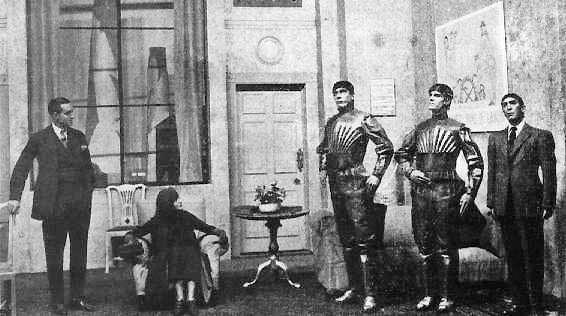
In today's fantastic age of automation and advanced robotics, with creations like Honda's ASIMO, human-looking androids and unmanned drones posing the question of where this technological development may ultimately lead us, it is easy to forget that the beginnings of modern robotics date back almost a century.  Indeed the very term "robot" was only coined in 1921, when it appeared in the Czech play R.U.R (Rossum's Universal Robots) - an early piece of science-fiction that like so many since depicted a future mechanical uprising by intelligent machines.
source
A scene from the 1921 Czech play R.U.R., written by brothers
Josef & Karel Čapek


Within a decade (perhaps, as some social commentators have suggested, as a response to the remarkable level of mechanization seen in the First World War) robots had evolved in all-metal humanoids, the most famous in fiction being the Maschinenmensch "Maria" in Fritz Lang's 1927 sci-fi epic Metropolis.


source
A year later, in 1928, came one of the first real-life robots (as we would know them today) to be built in Britain (and maybe even the world), the rather unthreateningly-named Eric.  Constructed primarily from aluminium (yet still weighing in at a hefty 45kg), Eric was able to stand, move his arms, legs and head, "blink" his eyes and - supposedly - speak (although this last was really a bit of trickery involving someone off-stage) thanks to two 12-volt electric motors, eleven electro-magnets and about 3 miles of wiring hidden beneath his armour-like exterior.  Amazingly all of this was put together at very short notice for the 1928 London Exhibition of the Society of Model Engineers, by Captain Willian H. Richards (the society's secretary) and his friend Alan Reffell, after the Duke of York (later King George VI) pulled out of giving the opening speech.  Thus Eric the Robot made his inaugural appearance, drafted in to give the Duke's speech - surely one of the first instances of a robot being brought in to do a man's job!

It's fascinating to read of the response of the crowd to this unexpected guest speaker, as described by Popular Science Monthly, and how in so many ways it still chimes with our own hopes and fears about the future of technology nearly 100 years later:

"The Thing's enormous size and the stark immobility of his face gave him a really terrifying quality... [the crowd] returned his lifeless gaze.  They felt subconsciously that here was some strange symbol of relentless Fate itself."

Personally I like the idea of a machine that would "Rid the World of Drudgery" and, despite the rather frosty initial reception, it seems that audiences of the time agreed as Eric went on tour to technology fairs around the world throughout the rest of the 1920s and early 1930s.


However Eric's ultimate fate remains a complete mystery; no trace of him exists after about 1932.  Whether he was dismantled, destroyed or is still sitting in someone's shed somewhere waiting to be rediscovered we may never know, but now comes the exciting news that the London Science Museum intends to build a full-size replica of the original Eric to become one of the main attractions of its 2017 Robots Exhibition.

It sounds an intriguing project, all told, and I feel sure that the Science Museum will be able to raise the funds to build the new Eric.  I look forward to reading more about his reconstruction and seeing this important early milestone in the history of robotics in London in 2017 - just as long as he doesn't go mad and try to overthrow humanity!

**The Science Museum's Kickstarter campaign "Rebuild Eric: The UK's First Robot" can be found here**

Sunday, 21 December 2014

Britain's first ever sci-fi film 'Message from Mars' restored


Britain's first ever sci-fi film 'Message from Mars' restored

You could be forgiven for thinking I had decamped to Mars myself, such has been the silence emanating from this blog over the past 6 weeks.  Exile to the Red Planet would be no less than I deserve for neglecting this place for so long; once again I find that work (plus the ubiquitous Christmas Cold, which struck last weekend but thankfully had worked its way through me by the Monday) has taken up more of my time than I realised.  Devoting more time to Eclectic Ephemera will definitely be a New Year's resolution, methinks!

Anyway, all these Martian metaphors are the result of this latest vintage news item - the completion of six months' restoration work on an historic British film:  this country's first full-length science fiction adventure!

The turn of the 20th century saw the birth of modern science fiction as we know it today; with the likes of Jules Verne and H.G. Wells leading the way, whose novels and short stories have passed into literary history, taking their place as written masterpieces of the genre still enjoyed and adapted by people today.  Its should be no surprise that, with moving pictures emerging during the same period (a real-life example of science fiction becoming science fact!), these wondrous new stories should be acted out on screen by the pioneering cinematographers - the Lumière Brothers, Georges Méliès and others.

source
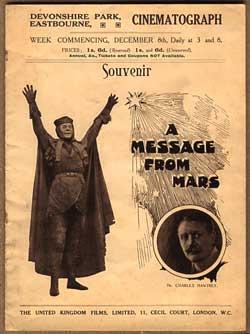
It took until 1913 for Britain to get in on the act with the hour-long feature film A Message from Mars.  Adapted from a 1903 New Zealand stage play, which itself had successful runs in the U.K. and the Antipodes for 30-odd years, it was in fact the second dramatisation - the first was a 20-minute short film made in New Zealand in 1903 (and actually New Zealand's first ever movie - now sadly considered lost).  The British version of ten years later starred the famous actor-manager of the time, Charles Hawtrey (no relation to the later Carry On actor, who was born George Hartree and took the same stage name), and the story is remarkable for two reasons other than its science fiction bent.  It is rather Dickensian in its plot for a start (quite suitable for this festive season, eh?), with a miserly old codger being shown the error of his ways (except with a Martian replacing the Spirits!) and the alien being benign and helpful - a noticeable contrast to the likes of Wells' War of the Worlds or Méliès' Le Voyage dans la Lune. 

For decades the film languished in the vaults of the British Film Institute, existing in two parts - the latter damaged and incomplete.  This year, however, sterling work was undertaken by the Institute's restoration team to bring A Message From Mars back to its original condition, thanks in part to another print in the archives of the New York Museum of Modern Art.  The process of copying, repairing and retouching has obviously been a painstaking one but the result is magnificent.  You can see for yourselves, in fact, as the BFI - in conjunction with B.B.C. Arts - made the entire film available to watch for free on their respective websites.


Now this important milestone in British and science fiction film history can once again be seen just as it would have appeared on release one hundred and one years ago, ready to be enjoyed by [movie] history buffs and sci-fi fans old and new.  I take my hat off to the BFI for this and all the other hard work they undertake to preserve and restore our nations cinematographic history, as I sit down to watch the fantastic A Message from Mars.

Followers

Popular Posts