Showing posts with label Eric the Robot. Show all posts

Saturday, 27 August 2016

Back In The Cockpit - With Robots, Czechs & Secret Codes

Well, hullo there!

Dear me, has it really been three months since my last post?  I suppose there's no getting away from the fact that I've had something of an impromptu blogging break, but here I am - like the proverbial bad penny - turning up again and I must say it's already beginning to feel like I've never been away.  Let's hope I can sustain that feeling, get back to a post every once in a while and not become stuck in another rut!


So, what has caught my vintage eye (I actually have two you know) in the last few weeks?  Read on to find out!

Secret German WW2 code machine found on eBay


In my local seaside town, no less, came the discovery at the end of May of a part of the hugely important and super-rare coding machine used by the Germans in the Second World War - the Lorenz encryptor, bigger and even more complex brother of the famous Enigma machines.  Discovered, in of all places, eBay!  Misidentified as a telegraph keyboard, and up for auction at a mere £9.50, it was only sheer luck that the National Museum of Computing at Bletchley Park came across it - sitting in the seller's garage under a pile of junk!  Surely this must rank as one of the ultimate eBay "finds"?!  Well done to those eagle-eyed museum chaps for spotting this important part of computing and Second World War history, even if it is incomplete.  Proof, if proof were needed, that there are still treasures to be found on that site - and on that note, while we're all searching around for that next bargain, keep an eye out for the Lorenz's motor, which is still yet to be found.

Secret WW2 wireless station in Norwich gets heritage protection

In related news a Second World War messaging post, one of 30 set up at the behest of Churchill in the face of the expected invasion of Britain in 1940, has been given listed status following its rediscovery in a disused Norfolk country house in 2012.  One of only twelve so far discovered, it was sadly damaged by fire in 2014 but with this latest news and the encouraging noises being made by Historic England (previously English Heritage) one hopes that it can be restored and opened to the public as a museum detailing that pivotal point in our nations history and the important part these "In Stations" and there civilian operators would have played had the worst happened.

Czech World War Two pilot flies Spitfire once again


One man doing his best among hundreds to ensure the worst did not happen was Czech fighter pilot Emil Bocek, who trained as a teenage ground mechanic in 1940 before going on to earn his wings and fly Spitfires in combat from 1944.  Later rising to the rank of General and now aged 93, he returned to Biggin Hill last month to fly a dual-control Spitfire over the skies of South London - the first time he's taken the controls of that wonderful aircraft in 70 years.  Dobré pro vás, General Bocek!

Work begins on Eric robot resurrection

Work continues apace on the reconstruction of Eric, the world's first functioning robot (as previously reported here).  It sounds as though both the Science Museum and the chap building the replica are unsure of just how things will turn out, so it sounds like the plans that have been found are either incomplete or not detailed enough.  Nevertheless I look forward to hearing of Eric's reawakening, in what will no doubt be the closest form to the original that the existing information will allow.

source

War hero's plane to fly at RNAS Culdrose Air Day after being restored by his grandsons 

This last article is an absolute pip, just the kind of feel-good vintage news story I enjoy featuring on the blog.  In this four-year centenary of the First World War there have been - and no doubt will continue to be - many such stories of descendants of Great War combatants uncovering fascinating accounts or honouring their relatives in some way (and rightly so!).  This story of two brothers recreating the very aeroplane their grandfather flew in the Royal Naval Air Service during the Gallipoli campaign is a particularly stirring example and I'm delighted to see them make a success of it in time for a local air display.  A more perfect way of honouring their grandfather's memory and providing an important glimpse into his life and exploits in the RNAS I couldn't imagine.  Well done chaps!

That's me done for this post, then, but I sincerely hope and intend it not to be my last for another three months!  I'm looking forward immensely to getting back into this blogging racket and with stories like these to choose from I certainly shouldn't be short of inspiration.  Until next time folks, tinkerty-tonk!

Saturday, 14 May 2016

Museum hopes to rebuild UK's first robot


Museum hopes to rebuild UK's first robot

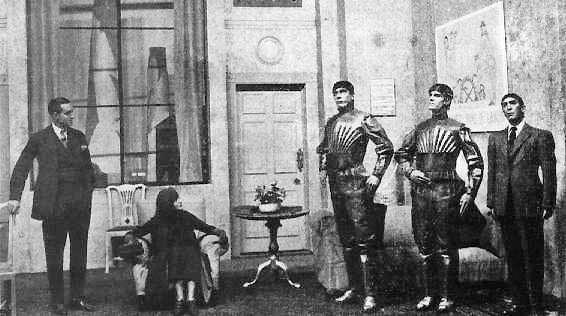
In today's fantastic age of automation and advanced robotics, with creations like Honda's ASIMO, human-looking androids and unmanned drones posing the question of where this technological development may ultimately lead us, it is easy to forget that the beginnings of modern robotics date back almost a century.  Indeed the very term "robot" was only coined in 1921, when it appeared in the Czech play R.U.R (Rossum's Universal Robots) - an early piece of science-fiction that like so many since depicted a future mechanical uprising by intelligent machines.

source
A scene from the 1921 Czech play R.U.R., written by brothers
Josef & Karel Čapek


Within a decade (perhaps, as some social commentators have suggested, as a response to the remarkable level of mechanization seen in the First World War) robots had evolved in all-metal humanoids, the most famous in fiction being the Maschinenmensch "Maria" in Fritz Lang's 1927 sci-fi epic Metropolis.


source
A year later, in 1928, came one of the first real-life robots (as we would know them today) to be built in Britain (and maybe even the world), the rather unthreateningly-named Eric.  Constructed primarily from aluminium (yet still weighing in at a hefty 45kg), Eric was able to stand, move his arms, legs and head, "blink" his eyes and - supposedly - speak (although this last was really a bit of trickery involving someone off-stage) thanks to two 12-volt electric motors, eleven electro-magnets and about 3 miles of wiring hidden beneath his armour-like exterior.  Amazingly all of this was put together at very short notice for the 1928 London Exhibition of the Society of Model Engineers, by Captain Willian H. Richards (the society's secretary) and his friend Alan Reffell, after the Duke of York (later King George VI) pulled out of giving the opening speech.  Thus Eric the Robot made his inaugural appearance, drafted in to give the Duke's speech - surely one of the first instances of a robot being brought in to do a man's job!

It's fascinating to read of the response of the crowd to this unexpected guest speaker, as described by Popular Science Monthly, and how in so many ways it still chimes with our own hopes and fears about the future of technology nearly 100 years later:

"The Thing's enormous size and the stark immobility of his face gave him a really terrifying quality... [the crowd] returned his lifeless gaze.  They felt subconsciously that here was some strange symbol of relentless Fate itself."

Personally I like the idea of a machine that would "Rid the World of Drudgery" and, despite the rather frosty initial reception, it seems that audiences of the time agreed as Eric went on tour to technology fairs around the world throughout the rest of the 1920s and early 1930s.


However Eric's ultimate fate remains a complete mystery; no trace of him exists after about 1932.  Whether he was dismantled, destroyed or is still sitting in someone's shed somewhere waiting to be rediscovered we may never know, but now comes the exciting news that the London Science Museum intends to build a full-size replica of the original Eric to become one of the main attractions of its 2017 Robots Exhibition.

It sounds an intriguing project, all told, and I feel sure that the Science Museum will be able to raise the funds to build the new Eric.  I look forward to reading more about his reconstruction and seeing this important early milestone in the history of robotics in London in 2017 - just as long as he doesn't go mad and try to overthrow humanity!

**The Science Museum's Kickstarter campaign "Rebuild Eric: The UK's First Robot" can be found here**

Followers

Popular Posts