Showing posts with label coin. Show all posts

Saturday, 11 April 2020

Classic car unearthed in Yorkshireman's back garden


Classic car unearthed in Yorkshireman's back garden

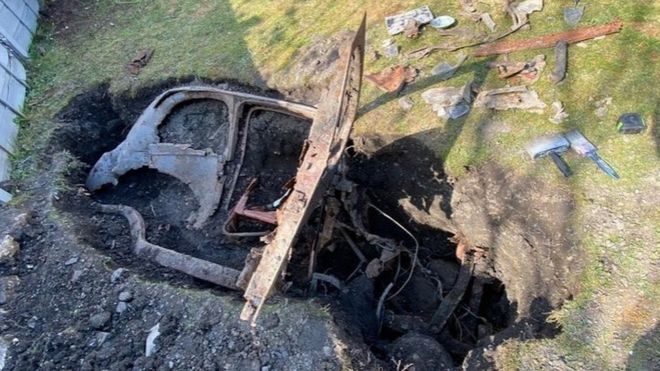
Those who are fortunate enough to have their own gardens have rightly been taking advantage of this to get outside - especially in the lovely Spring weather we're experiencing this Easter - and do a bit of horticultural pottering, but I bet this chap in West Yorkshire wasn't expecting to discover a car when he went to dig his garden! 

source

source
That though was the surprising find as reported in this article - a 1950s Ford Popular that had somehow wound up completely buried in a suburban back garden.  Quite how or why it got there is anyone's guess, although the military vehicle theory is as good as any.  Ford Pops would have likely been used as basic runabouts by the postwar armed forces - perhaps this one went AWOL and was hidden away to be retrieved later.  Such incidents are surprisingly commonplace with pre-war cars whose owners - fearing their potential destruction in bombing raids during WW2 - buried them in their gardens to be retrieved after the hostilities were over only for them to be forgotten until unearthed decades later, but this is a rarer instance of a post-WW2 car being found in such a way.  This is assuming it is a Ford Popular, which I have no reason to doubt, although it would be something if it were to found to be an older vehicle.


Either way it is an amazing (and amusing) find and definitely brightened up my day when I first read about it, hence its inclusion here.  If nothing else it ought to encourage the green-fingered amongst you to get out in to your garden, if you have one, and start digging.  If it sounds too much like hard work you don't even have to rip up your lawn to uncover fascinating treasures, as this similar story from Stoke-on-Trent proves:

Medieval coin found in Stoke-on-Trent garden raspberry patch

It always astounds me to think how these historical artefacts can just resurface (quite literally) after centuries underground, as the movement and cultivation of the earth slowly brings them back to ground level again, to be rediscovered in the sometimes most bizarre of circumstances.  It gives one to wonder just what other treasures are still waiting to be uncovered - perhaps in your own back garden!

A 19th(?) century clay pipe that was dug up in the family back garden in the '90s by
our pet dog Toby(!).

What's the strangest thing you've unearthed in your garden?  Let me know in the comments and if you haven't found anything yet - get your spades on!

Friday, 21 March 2014

Threepenny bit design to replace vulnerable £1 coin


Threepenny bit design to replace vulnerable £1 coin

As my UK-based readers will doubtless be aware, Wednesday saw the Chancellor of the Exchequer deliver the government's annual Budget for the year ahead.  Rightly or wrongly the item that garnered the most press attention was the unveiling of a proposed new £1 coin, to replace the existing 30-year-old design in 2017.  Putting aside the politics, the news is nonetheless interesting on a number of levels. 

source
Firstly, this is the most comprehensive redesign of a frequently-used piece of British currency in almost a generation.  You have to go back to the early/mid-1990s and the resizing of the 5p, 10p (1992) and 50p (1997) coins to find the last time the money in our pocket was so drastically altered.  From that point of view alone it is of course a newsworthy subject and one of the main aspects most news agencies have focussed on.

For numismatists (that's our code-speak for us coin collectors!) like myself there is an extra layer of excitement since it means that the old £1 coin will become even more of a collectors item from 2017.  The general excitement of a coin undergoing such a sea change is also heightened, since we value the behind-the-scenes processes, history and time-honoured traditions attached to the coin and its design(s).

The biggest change (pun not intended!) however, the thing that has got we nostaligists (and the press) jumping up and down in excitement, is the switch to a twelve-sided (that's dodecagonal, in case you're wondering) shape - just like one of Britain's old pre-decimal coins, the threepence piece!  The one pound coin is already similar in size and thickness to the old threepenny, so this major alteration will render it even more like a coin that hasn't been seen in British pockets for over 40 years. 

source

The twelve-sided brass threepenny was introduced in 1937 at the start of George VI's reign (twelve pre-production examples were minted with Edward VIII details; the whereabouts of six of these are unknown and one recently sold for £30,000, so keep an eye out!).  Prior to that point, the threepence was a silver coin, very small - less than the size of a modern 5p (or a dime) - hence its nickname, the "thruppenny bit".  Created in 1547 under the reign of Edward VI, by the 1930s its diminutiveness meant it was becoming unpopular in England (although less so in Scotland) and in 1937 the new, larger and heavier nickel-brass threepenny was introduced (although paradoxically it retained its original nickname).

Silver threepennies continued to be produced, albeit in far fewer numbers, alongside the new brass variety from 1937 to 1945 (again, if you find a 1945 silver thruppence hang on to it, for almost all of that year's production was later melted down).  Technically they are still minted today, for use in Maundy money.   The newer twelve-sided coin was subsequently produced every year from its creation in 1937 until just before decimalisation, in 1967 (with some proof sets minted in 1970; rare dates are 1946 and 1948-51).  It, along with the other pre-decimal coinage, ceased to be legal tender in 1971.  George VI examples feature three thrift plants on the reverse (which I must admit I prefer); Elizabeth II variants switched to a Tudor portcullis.

source

Now, though, the brass threepenny is due to live on in spirit as the inspiration for the new 2017 £1 coin.  While the new coin, as already mentioned, will bear more than a passing resemblance to its forebear it will of course feature a few modern design flourishes plus some not unimpressive security features.  Chief among these new touches is the bi-metallic construction, as already found on the £2 coin.  Advanced, British-designed technology by the name iSIS means the coin will be infused with some special coating (dermatologists can rest easy, it doesn't come off on the skin apparently) to combat counterfeiting - the bane of the existing £1.

Some differences then, a fair bit of modernity - but using a traditional design that by all accounts will be making a welcome return.  You and I can get involved as well, since there will be a competition in the summer to find a design for the reverse (tails) side of the new coin (keep checking The Royal Mint website).  Hmmn, have to put my thinking cap on, I reckon!  In the meantime, I've dug out my old coin collection in order to reacquaint myself with this charming coin, in anticipation of its spiritual successor's arrival in three years' time.

**Do you like the new £1 coin?  What do you think should go on the reverse side?  Let me know your thoughts below!**
Tuesday, 28 February 2012

My two penn'orth

On Sunday I went to my first antiques fair for, I am ashamed to say, three or four years (although that enforced absence was in no small part due to circumstances outside of my control) - the Runnymede Hall Antique & Collectors Fair in Benfleet, Essex.

Picture by Martin Hayhurst ©                                          Pictures of England.com

It was nice to be back amongst some really rather nice vintage bits and bobs, items like classic rotary-dial telephones in varying age and condition, silverware (snuffboxes, cigarette/card cases, lighters etc.) 1930s cigarette cards, but mainly jewellery and china.  The event proved popular with a full car park and a large crowd attending; I spotted one or two vintage guys and gals amongst the throng.

What took me aback, though, and highlighted just how out of touch I have become with antiques fairs were the prices.  The last fair I went was before vintage and retro became fashionable again so prices were on the low side but on Sunday, with a few exceptions, most items started at double figures!  Granted there were quite a few examples of really sought-after names, like Clarice Cliff and Lalique - in fact there was a fair share of high-end stuff on display - but bargains were practically non-existent.  I was not altogether surprised, however, as my natural interest in vintage (and programmes like Antiques Road Trip or Put Your Money Where Your Mouth Is) has meant that I've been aware of the rising price of antiques but to actually see it in the raw was still a bit of a shock.  I've been to a few antiques shops and arcades more recently where the prices have been less eye-popping, so perhaps there's a chance this was an aberration.


As a result I very nearly came away with nothing (which wouldn't have been the end of the world, I only went there for a look 'round and the off-chance of picking something up).  We'd wandered about, myself and my parents with whom I'd met up for the day and who pained me by commenting on practically every other item "we/ your grandparents used to have that, but gave it to the charity shop when we moved" and were getting ready to leave when I had one final rummage through a box of old pennies by the door.  Most were in such bad state that they were little more than scrap but I managed to find two rather unusual ones in good condition.


Dated 1935 and 1936 they consist of a Republic of Ireland 1d. coin and an old penny from the then Union of South Africa, which was still a British dominion at the time.  I've not got many pre-decimal coins from outside the British Isles, so they will be a welcome addition to my collection and for a paltry 20p I couldn't say no.  (Brief investigations on eBay show similar examples starting around the £1 mark, so not bad).  Around 5½ million 1935 Irish pennies were minted so they're by no means ultra-rare; the South African penny I'm less sure about.

Essex Vintage Fair

So that's literally my two penn'orth from my latest antiques fair experience(!).  There's another due to be held on the 1st April which I shall probably head along to as well.  It looks from the flyer as though it may be even bigger and better than Sunday's one; I shall look forward to finding out.

Saturday, 5 February 2011

How Britain converted to decimal currency

How Britain converted to decimal currency Another anniversary that is fast approaching is the 40th anniversary of D-Day. No, not the invasion of France on 6th June 1944 but "Decimal Day" - the end of centuries of pounds, shillings and pence (or L.s.d) and the introduction on the 15th February 1971 of "New Pence", 100 of which would make £1. This article from the B.B.C. gives some fine detail behind the decision to do away with pre-decimal currency and the effect the change had on the nation. We take the simplicity of 100p = £1 in our stride today, but I'm sure I am not alone in having parents and grandparents who remember with ease 12 pence to 1 shilling and 20 shillings (or 240 pence) to the pound. Sometimes even I wonder how they knew to work it all out but no doubt it was as easy to them as the modern system is to us. It is interesting to see how the changeover was handled, too. I have an example of the "introductory pack" (above) that was found in many homes of the time to help ease the transition, but it must have been a remarkable thing to have experienced. Of course being something of a vintage obsessive, not to mention a dyed-in-the-wool coin collector, I rather envy them their experience of using old British sterling. Our coinage today seems so limited by comparison - the farthing, ha'penny, old penny, thrupenny bit, sixpence, shilling (one bob), florin, half crown and the 10-bob note all seem more favourable than the stuff we have today. All we get now are 8 little pieces, the odd redesign and a few commemorative £2 coins!

The link this old money provides to a bygone age and the images it conjures up are no doubt part of the attraction, although I would like to think that I could work things out using the old system (heaven knows I've been collecting the money for long enough!). Sadly (for the likes of us) this anniversary is proof of the decimal system's sense and longevity so it looks like its here to stay(!). Ah well, there's always my collection to look at...

Wednesday, 21 July 2010

The world's most beautiful coins

The world's most beautiful coins

A pleasing little montage from the Daily Telegraph of various coinage from around the world. Once again we find that beauty is subjective; personally I only find a few of those selected to be beautiful (for the record they are images 9 [Czech 50k], 11 [Mexican 100 peso], 13 [NZ$1], 15 [CH 2F], 16 [¥500] and 17 [Polish 5zl]. Doubtless you will also have your favourites, either from amongst those featured, your own collection if you are a numismatist like myself, or maybe just from the odd bit of currency brought back from a foreign holiday. I'd be interested to hear your suggestions. Having looked through my own collection I was saddened to note the lack of beautiful designs in current overseas coinage. In particular I was disheartened to see so many pretty European designs from several years ago - the Spanish peseta, the Maltese lira and the Finnish markka amongst others - which have since been lost when the Euro was introduced. Some of my current favourites from the rest of the world include:


The Canadian 10¢ (or dime), featuring the schooner Bluenose;


The Argentine peso;


The Colombian 500 pesos.

Wednesday, 16 June 2010

World's largest coin goes on sale in Vienna

World's largest coin goes on sale in Vienna

A mightily impressive creation here from the Canadian Mint as they produce what is both the largest and highest-denomination coin in the world. Too big (and too expensive!) for my collection I'm afraid! Too big and expensive for the company that originally commissioned it too, it seems. I suppose though that it's just as good as gold bars and is certainly a novel use for 100 kilograms of top grade bullion. I'm sure it will make a good conversation piece for whoever ends up buying it, although I don't think they'll be using it to buy their groceries!

Friday, 8 January 2010

Liberty Head 1913 nickel sells for £2.3m

Liberty Head 1913 nickel sells for £2.3m

Coin collecting (or numismatics, to give it its proper name) has long been a hobby of mine so it was with great interest that I read this story of a rare American 5¢ coin. Of course, anything that is made in such small numbers is bound to be uncommon and therefore deemed valuable. We in Britain have a similar situation with regards to the 1933 penny, only 7 being known to exist (although nowhere near the price paid for this nickel; a '33 penny is still valued at approximately £40,000 today). It is always fascinating to note how such a simple decision or mistake such as a design change/error can influence a coin's value but as I, and any other collector, would no doubt tell you it is this very fascination, the variety and history, which all adds to the interest and excitement of numismatics. Whoever bought this nickel should be proud to have it in their collection, as I'm sure they are.

Followers

Popular Posts