Showing posts with label British Film Institute. Show all posts

Sunday, 21 December 2014

Britain's first ever sci-fi film 'Message from Mars' restored


Britain's first ever sci-fi film 'Message from Mars' restored

You could be forgiven for thinking I had decamped to Mars myself, such has been the silence emanating from this blog over the past 6 weeks.  Exile to the Red Planet would be no less than I deserve for neglecting this place for so long; once again I find that work (plus the ubiquitous Christmas Cold, which struck last weekend but thankfully had worked its way through me by the Monday) has taken up more of my time than I realised.  Devoting more time to Eclectic Ephemera will definitely be a New Year's resolution, methinks!

Anyway, all these Martian metaphors are the result of this latest vintage news item - the completion of six months' restoration work on an historic British film:  this country's first full-length science fiction adventure!

The turn of the 20th century saw the birth of modern science fiction as we know it today; with the likes of Jules Verne and H.G. Wells leading the way, whose novels and short stories have passed into literary history, taking their place as written masterpieces of the genre still enjoyed and adapted by people today.  Its should be no surprise that, with moving pictures emerging during the same period (a real-life example of science fiction becoming science fact!), these wondrous new stories should be acted out on screen by the pioneering cinematographers - the Lumière Brothers, Georges Méliès and others.
source
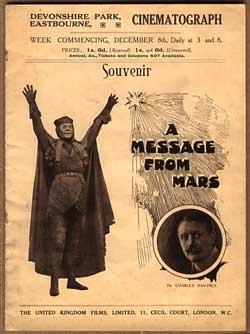
It took until 1913 for Britain to get in on the act with the hour-long feature film A Message from Mars.  Adapted from a 1903 New Zealand stage play, which itself had successful runs in the U.K. and the Antipodes for 30-odd years, it was in fact the second dramatisation - the first was a 20-minute short film made in New Zealand in 1903 (and actually New Zealand's first ever movie - now sadly considered lost).  The British version of ten years later starred the famous actor-manager of the time, Charles Hawtrey (no relation to the later Carry On actor, who was born George Hartree and took the same stage name), and the story is remarkable for two reasons other than its science fiction bent.  It is rather Dickensian in its plot for a start (quite suitable for this festive season, eh?), with a miserly old codger being shown the error of his ways (except with a Martian replacing the Spirits!) and the alien being benign and helpful - a noticeable contrast to the likes of Wells' War of the Worlds or Méliès' Le Voyage dans la Lune

For decades the film languished in the vaults of the British Film Institute, existing in two parts - the latter damaged and incomplete.  This year, however, sterling work was undertaken by the Institute's restoration team to bring A Message From Mars back to its original condition, thanks in part to another print in the archives of the New York Museum of Modern Art.  The process of copying, repairing and retouching has obviously been a painstaking one but the result is magnificent.  You can see for yourselves, in fact, as the BFI - in conjunction with B.B.C. Arts - made the entire film available to watch for free on their respective websites.


Now this important milestone in British and science fiction film history can once again be seen just as it would have appeared on release one hundred and one years ago, ready to be enjoyed by [movie] history buffs and sci-fi fans old and new.  I take my hat off to the BFI for this and all the other hard work they undertake to preserve and restore our nations cinematographic history, as I sit down to watch the fantastic A Message from Mars.

Sunday, 5 October 2014

Sherlock Holmes silent classic uncovered in Paris vault

Sherlock Holmes silent classic uncovered in Paris vault

source
A couple of months ago the British Film Institute issued one of its occasional calls for us all to be on the look-out for its top 75 "Most Wanted" lost films - titles from the dawn of moving pictures right up to the 1970s that have seemingly vanished from archives, film libraries and national collections around the world.  In this particular instance it was a request for everyone to turn "Great Detective" and keep their eyes peeled for a copy - or a clue to a copy - of the first ever film adaptation of a Sherlock Holmes story.

A Study in Scarlet, the initial Holmes story that introduces us to "the world's only consulting detective" and his trusty friend Dr Watson, was adapted into a film in 1914 by a British concern called the Samuelson Film Manufacturing Company - a name long since forgotten among the many businesses that attempted to get involved in the new and lucrative moving picture business at the turn of the last century.  James Bragington, who worked at Samuelson's (but not actually as an actor!), was chosen for his resemblance to Holmes (as described in the books) and by all accounts made a remarkably good fist of it - aided by some on-the-job training and the slightly florid acting style demanded by silent movies of that era.  Filming took place at locations including Cheddar Gorge.  The director, George Pearson, would go on to make 1923's Love, Life and Laughter, another previously lost film whose rediscovery earlier this year was also featured on this blog.

source
James Bragington as Sherlock Holmes
Despite positive reviews and showings at picture houses around the country, the first film version of A Study in Scarlet has since slipped into obscurity and been considered lost for decades.  Sadly a separate American production of the same story made and released almost concurrently with the British version, plus Samuelson's own 1916 follow-up The Valley of Fear, are also considered lost.  A fourth 1910s Sherlock Holmes film, simply called Sherlock Holmes, also made in 1916 by the American Essanay Film Manufacturing Company (best known for producing Charlie Chaplin films during 1915) and starring William Gillette - who had become the quintessential stage Holmes following the successful tours of his theatrical amalgamation of various stories and upon which the film was based - similarly was long thought lost by film and Holmes experts.

source
A Study in Scarlet (1914)

Cinémathèque Française discovers 1916 Sherlock Holmes film

Until now, that is, with the wonderful news of the discovery of a French-subtitled copy of the Gillette film in the archives of the Cinémathèque Française in Paris.  Once more giving hope in the search for the other 75 most wanted lost films, Sherlock Holmes had been mislabelled before it was consigned to Cinémathèque Française's shelves decades ago - a mistake that has only now come to light.  With luck many more previously lost films may be rediscovered in like manner - incorrect labelling and private collections still being the most promising sources.

This find is doubly important not only for adding to and increasing our knowledge of the early years of Sherlock Holmes on film (prior to the great Basil Rathbone) but also because it is the only moving picture William Gillette ever did.  We will now, therefore, be able to see for the first time in one hundred years his performance - widely lauded at the time, even by Conan Doyle himself - as the Great Detective and one generally considered to be generation-defining.  It will be interesting to finally be able to compare him to Rathbone, Peter Cushing and Jeremy Brett.

Cinémathèque Française, in collaboration with the San Francisco Silent Film Festival, are currently undertaking what sounds like a thorough restoration of the fragile negatives - hopefully in time for a premiere at the former's own film festival in Paris during January 2015.  Then, who knows, perhaps the BFI will get involved and oblige us with a limited release in the UK - perhaps even a DVD.  I'm really hoping we get to see it somehow!

Saturday, 12 April 2014

Silent Betty Balfour film 'masterpiece' found in Holland


Silent Betty Balfour film 'masterpiece' found in Holland

As something of a silent film aficionado it is always a great delight for me to see the recognition that these products of the early years of cinema deserve and the general renaissance they have undergone in recent years (precipitated, it could be argued, by 2011's Oscar-winning The Artist).  This is only tempered by the sad knowledge that time is not kind to old 35mm film stock, which was invariably nitrate and not only flammable but also subject to decay over time, leading to many a silent film being missing presumed lost.

So it is an even greater joy when a previously "lost" silent film is discovered, usually after languishing for years in a private collection (and/or a mislabelled tin).  Such has been the case with Love, Life and Laughter, a British comedy-drama film from 1923 that starred silent actress Betty Balfour.  (I must admit despite being a fan of the silents that I was ignorant of Betty Balfour, who was a huge star of British cinema in the Twenties - "the British Mary Pickford", as she was known at the time.  I had vaguely heard of her most famous film series, Squibs - from 1921, its sequel the following year and the 1935 remake, from which the accompanying song is taken.  Sadly the advent of talkies marked a downturn in her career; she made sporadic appearances throughout the 1930s and her last performance was in 1945.  She passed away in Weybridge, Surrey, in 1977 aged 74.)


For decades no extant copy was known of Love, Life and Laughter, with only half-a-dozen stills and a couple of publicity documents surviving to attest to its existence.  That is until two weeks ago, when a complete copy was identified in The Netherlands by the Dutch film museum EYE.  Apparently it had lain undisturbed in a small, old cinema in the Dutch town of Hattem until 2012.  When the building underwent redevelopment its contents were sent to EYE for cataloguing, with the identity of this film having only just been established earlier this month.

source
Despite lacking its original English inter-titles it sounds as though this copy is in good condition, with its new custodians the British Film Institute - whose list of "75 Most Wanted Films" included Love, Life and Laughter - promising a public screening later this year.  Something to look forward to!

Something also to give us hope that more "missing" films from the silent era of cinema may still be in existence, just waiting to be found.  Although the march of time makes such discoveries increasingly unlikely, this most recent and classic example reminds us that it is still eminently possible.  Unlabelled cannisters, private copies on hardier 16mm or 75mm film - they may well still be out there waiting to be found.  It's interesting to note that this discovery was made in the Netherlands, for it seems that that country is an inordinate source of lost film footage.  As a Laurel & Hardy fan I know that I great deal of previously-lost film related to their work has come via Holland and its seems that Betty Balfour's popularity there has also played no small part in this film's survival - dank u, Nederland!

Friday, 31 January 2014

Rare footage of 1901 tram ride down Belfast's Royal Avenue recovered


Rare footage of 1901 tram ride down Belfast's Royal Avenue recovered

It's always a source of amazement and delight to me that it is still possible for cine-footage from over a century ago to be rediscovered in viewable condition after lying dormant for so many years, but that is just what has happened recently in Belfast, Northern Ireland, as this article explains.

Who knows how much longer this fascinating footage would have lain undiscovered had it not been for one person browsing through the archives?  As it is a remarkable period in Belfast's history is now able to be viewed by a whole new generation, 113 years after it was filmed.

Belfast tram trip back in time: Recovered footage from early 1900s depicts city streets bustling

What absolutely captivating scenes they are too!  Part of the Mitchell & Kenyon Collection, which many of you may remember from the B.B.C. series of a few years ago and which is now safely in the hands of the British Film Institute, the footage was originally part of the film company's advertising stock.  I wonder if they could ever have imagined it surviving for so long, to become a source of great interest for historians and enthusiasts such as ourselves?  What were the people shown therein thinking and what were they doing that day, one wonders?

source
It's simply marvellous to see a busy Belfast town centre in May of 1901.  The horse-drawn trams, the ladies in their full-length skirts and boaters, the men hurrying to and fro and the shop fronts filled with people.  Yet in many ways little has changed - drive down any high street on a Saturday and you will still see the shops, the throngs and the traffic, with just a difference in technology and the overall appearance of the people.  No doubt our own records of life in 2014 will be of equal interest to historians one hundred years hence.  This then is the joy and wonder of social history, and I'm off now to immerse myself in this engrossing footage all over again.

Friday, 14 September 2012

World's first colour film unveiled


World's first colour film unveiled 

In recent years early examples of colour film have, I think it's fair to say, become more established in the public consciousness thanks to their discovery, preservation and most importantly their showing on national television and in theatres.  I'm thinking of examples like Claude Friese-Greene's work in the 1920s (which was featured in the Dan Cruickshank series The Lost World of Friese-Greene on the B.B.C. back in 2006 having been expertly restored and preserved by that magnificient institution, the BFI) and the perennial film favourite that is the 1939 Wizard of Oz.


Colour cinematography was aspired to almost immediately after the moving picture camera was first invented but the technology needed to achieve it simply did not exist.  Many turn-of-the-century "colour" films consisted of each individual frame being hand-painted in order to provide the necessary effect.  The technique used by pioneering British cinematographer Edward Turner is generally agreed to be the first true colour film - and it was shot in 1902, fourteen years before the invention of Technicolor!  Alas Turner's method was a dead-end, he died suddenly a year later aged only 29 and his place in film history was forgotten.  Colourisation continued to progress, albeit slowly, and went on to provide some incredibly impressive and more advanced films (below, for example) but Turner was undoubtedly there first.


World's first colour film footage viewed for first time

Now thanks to the tireless efforts of the National Media Museum Turner's colour footage can be seen again for the first time in over 100 years just as he intended it to look.  Having been aware of the films' existence in their archives for some time and after working "behind the scenes", as it were(!), with the oddly-formatted reels the museum's curators were finally able to restore the stock and transfer it to the screen minus the imperfections that curtailed its development.  The result, as you can see in the first clip, is beautiful.

The team at the NMM are to be congratulated for persevering with the preservation of this historically important first step in colour cinematography, which will hopefully restore Edward Turner to his rightful place in the annals of moving picture history.  Colourisation of moving pictures made at a time when most film stock was black-and-white always imbues the subject with a remarkable sense of immediacy but to see colour footage from over a century ago is truly extraordinary and I am so very pleased to see it saved for future generations (not to mention proving to be a talking point in today's media).

Followers

Popular Posts