Monday, 24 December 2012

Have a jolly Christmas!


To all my fellow bloggers, followers, readers and everyone everywhere I wish you a  
very Merry Christmas!

Saturday, 22 December 2012

Stuntman Santa got lucky when jump landed him in Chelmsford field

[UPDATED - BROKEN LINK: Stuntman Santa got lucky when jump landed him in Chelmsford field]

At first glance you may well wonder why such a headline as the one above is appearing on a vintage blog like this and I wouldn't blame you.  I think I can speak for most areas of the country (and maybe even the world) when I say that those who write for local newspapers tend not to display the same journalistic talents as your average Telegraph or Times reporter(!).

This particular local story then, which caught my eye despite its editorial shortcomings, hasn't taken place in the present but rather one hundred years in the past.  However elements of the incident have a certain modernity about them and the main protagonist could be said to be something of a pioneer - how often now do we hear of people parachuting or doing some other daredevil activity for a charity or promotion and think nothing of it?

But in 1912, when manned flight was still very much a talking point and parachutes in their infancy, adventurers and thrillseekers throwing themselves out of balloons (and aeroplanes) was quite the novelty.  We may think of base-jumping and skydiving as fairly modern activities but in truth very similar attempts were being made a century ago.  One such trailblazer is the subject of this article - Australian balloonist Victor Patrick Taylor.

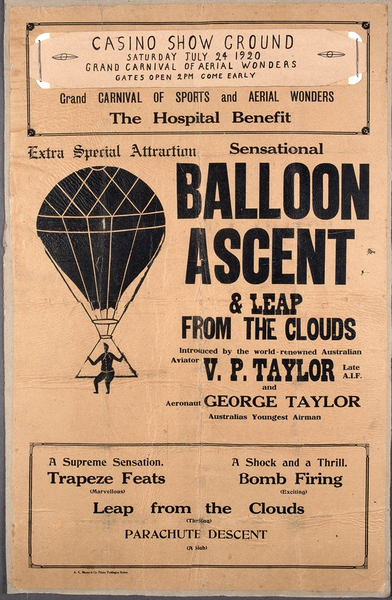
source - Naval Historical Society of Australia
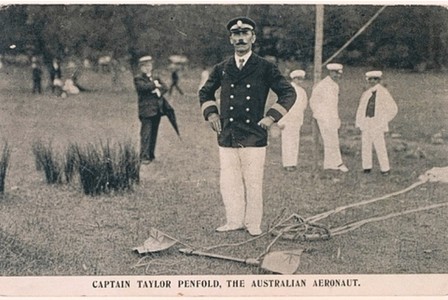
Hailing from Sydney Victor Taylor, fascinated as many were by early attempts at flight and particularly lighter-than-air craft, discovered the art of parachute jumping while working in America in 1906.  Pretending to be an already-established Australian parachutist (using the name "Captain Penfold", which would remain his professional soubriquet for most of his subsequent career) he befriended a local San Franciscan specialist and - despite never having actually jumped before in his life - quickly learned how.  He spent the next two years in San Francisco, heavily involved in light-than-air travel (culminating in he and a friend dropping firecrackers from an airship on to the US Fleet moored in San Francisco Bay!), before he returned to Australia in 1908 to start a career in ballooning and parachuting.  There he undertook many balloon flights across the Australian Bush and, in an early example of fundraising, was sponsored by local government and businesses to the tune of £25 a day (with 33% going to local hospitals) to do balloon ascents and parachute jumps - the latter often dangling precariously from a trapeze mounted outside the basket.

In 1912 Taylor travelled to England and became the 376th person to obtain a pilot's licence and Royal Aero Club certificate.  It was shortly after this achievement that he was approached to perform the jump featured in this article.  As a publicity stunt Sandow's Chocolates requested that he jump out of a balloon over Hyde Park in London dressed as Father Christmas and hand out bars of their chocolate to any children present.  As the accompanying account tells the weather had other ideas and Taylor, the balloonist & co-owner Frank Spencer (Ed. to UK readers - I know!) and Gaumont cameraman (and later polar explorer) Hubert Wilkins were caught out by the winds and found themselves speeding over the outskirts of Chelmsford, Essex - 35 miles from London - almost before they knew it.

Taylor, in his Santa costume, prepares for take-off in Hyde Park
As you can read Taylor, anxious to get down, jumped out when a hole in the clouds showed them to be over open country and although his parachute opened properly he still managed to hit his head on landing, momentarily knocking himself out!  When he came to he found himself surrounded by curious locals and their children.  Quite what they made of the whole business I can scarcely imagine!  Not to be defeated Taylor gathered himself together and promptly handed the sweets out to the Chelmsford children instead!

source - Naval Historical Society of Australia

After this partial success Taylor went on to become possibly the first person to perform what we now term a BASE jump in Australia, parachuting 150ft off a Sydney bridge in 1914.  During the Great War he served in the Australian artillery, being wounded and invalided out the Army in 1917 with shell shock.  In 1918 he returned to America where he continued his aeronautical exploits for another twelve years.  He died in 1930, aged 56, from digestive illness the causes of which were never determined.

I was delighted to discover the history of this eccentric chap, who billed himself as "the Australian Aeronaut", and hope you have enjoyed it too.  It is good to see that his exploits have not been totally forgotten, particularly his link with my county town - not 15 miles away - which involved as it did a remarkable festive aerial adventure that took place almost exactly 100 years ago.

Friday, 21 December 2012

Curators discover first recordings of Christmas Day


Curators discover first recordings of Christmas Day

Phew, just where has the last week gone?!  Between the last rush of work before Christmas and the preliminary preparations for a somewhat less welcome forthcoming event (of which I will say more about nearer the time) this poor little blog has been a trifle neglected.  Now, however, in the last few days before the festivities I can publish the first of two Yuletide stories that have been sitting in my drafts folder.

We go back approximately 110 years to Christmastime at the Wall household (above) in North London in this wonderful article from the B.B.C. website in which it is actually possible to hear recordings of a typical London family's festive gatherings in the 1900s - perhaps the first of their type ever made!

Following the chance discovery - and survival - of a number of wax cylinders (the turn-of-the-last-century precursors to gramophone records) in the Cambridgeshire home of one the family's descendants we can for the first time listen to a Christmas Day party c.1904 style.  I have to say it doesn't sound like much has changed in the last century!  What loving, relaxed and homely celebrations they seem - just like today.


Wall Family Phonograph Recordings | Museum of London

Thanks to the hard work by curators at the Museum of London, where these cylinders now reside when it became apparent that they originated from North London, an important record of British social history has been saved and restored for future generations.  Not only is it truly heartwarming and reflective to hear an average British family of 100-odd years ago at Christmas and how little has altered but it is also amazing to think that these fragile wax cylinders - which were soon replaced by a format that lasted for decades, leaving them to soldier on only in the world of the secretary and business executive - managed to survive for all this time, to yield their audio treasures only now.  They're a wonderful discovery and a splendid addition to the museum's archive.  I wonder if historians of the future will be saying the same about our Christmas recordings in a century's time...

Friday, 14 December 2012

Battle of Britain Memorial Flight unveils new Spitfire


Battle of Britain Memorial Flight unveils new Spitfire

While work continues to locate and unearth the potential squadron of Spitfires buried in Burma, another example has rejoined the airworthy ranks thanks to the tireless (and less reported) efforts of a group of volunteers.

Spitfire TE311 is of a similar vintage to those supposedly languishing beneath the Burmese jungle, being also a late model Griffon-engined MkXVI.  Built in 1945, however, it was just too late to see action and spent the following nine years as a training/display aircraft before being largely forgotten about.

Now after several years of hard work on the part of some RAF engineers and enthusiasts and with funds raised by the Lincolnshire Lancaster Association (try saying that five times through quick!) TE311 returned to the skies yesterday for what by all accounts was a very successful flight - as you can see!
It bodes well for the however-many Spitfires waiting to be discovered half a world away that there are still so many enthusiasts and experts willing to lend their time in the restoration of one of these marvellous machines.  Even if the Burma Spits are found to be in poor condition chances are at least some of them will be salvageable and it is people like these who will hopefully perform the same magic that was worked on TE311.

Both they and the wider public will soon get many chances to see first-hand the fruits of their labours as this newly-restored aeroplane is now on its way to join a very special outfit - no less than the Battle of Britain Memorial Flight, where it will become the display's sixth operational Spitfire.

source

What with the Burma Spitfires and now this MkXIV returning to the skies where she belongs 2012 looks to have been a vintage year for the venerable Spit.  Whether singly or by the dozen the increase in the aircraft's population is always welcome and proof of this beautiful machine's enduring popularity and longevity, which has been thoroughly well-earned.

Monday, 10 December 2012

It's beginning to sound a lot like Christmas

We're well in to December now, the tree's up and decorated and if the weather forecast is to be believed the snow is just around the corner - so what better time for another selection of Christmas tunes?! I'd like to think this could become a festive blog tradition, but I'll hold off making it that yet in case I run out of songs next year! For now, though, here are some that I didn't cover in previous years. We start with some blues - not perhaps a genre usually linked to Christmas, but in this case I think an exception can be made especially when the singer is the delightful Bessie Smith. There's something quite upbeat and celebratory about her rendition of At The Christmas Ball, recorded in New York on the 18th November 1925 with Fletcher Henderson at the piano, despite its obvious blues tempo. Back in my first Christmas selection of 2010 I mentioned a 30th June(!) 1930 recording of the Savoy Christmas Medley, which I have on CD. I couldn't find the actual Ray Noble and the New Mayfair Orchestra version so used the original 1929 Debroy Sommers one instead but now someone has obliged and put up the Ray Noble/New Mayfair version, so here it is! Jumping forward almost four years - 17th April 1934 to be precise (what is it with so many festive songs being recorded in the middle of Spring/Summer?) - we get to spend Christmas Night in Harlem with Jack Teagarden, Johnny Mercer and Paul Whiteman's' Orchestra. The inimitable Artie Shaw doesn't disappoint with this cracking wintry arrangement from 1936. While searching for these music videos I stumbled across a bandleader new to me - Eddy Duchin. Quite popular in the 1930s and '40s, I've a feeling we would have heard more of him if his life hadn't been tragically cut short in 1951. As it is he and his band recorded two seasonal tunes (which unfortunately I can't date, although When Winter Comes might be from as late as 1947). Woody Herman and his Orchestra produced two cracking versions of classic Yuletide songs - Santa Claus Is Coming To Town from 1942 and Let It Snow another 3 years later. That's it for this year - I have to keep some in reserve for 2013, pre-1950s Christmas music is rare enough as it is!  Once again I couldn't have found half of these without the aid of YouTube and it's been a pleasant surprise to stumble across some more Christmas ditties that are new to me (and, I hope, to you). Here's wishing you all a jazzy Christmas!

Tuesday, 4 December 2012

Daring World War II pilot's medals auctioned

Bristol Beaufighter, 1943
source

Daring World War II pilot's medals auctioned

 "A real 'Boy's Own' hero" is how the pilot at the centre of this story has been described and never was a truer word spoken!

In fact the recent auction of the late Wing Commander Ken Gatward's World War II medals seems almost incidental to the history of how they were earned, as part of an operation that could have come straight out of a Biggles book.

The RAF pilot who dropped the Tricolor on occupied Paris 

Only now, nearly 15 years after his passing and with the selling of his decorations, have the full details of the story come to light - and what a story! Although in the grand scheme of the war probably a minor mission (however deemed, somewhat redundantly, "unsafe") its morale value was obviously considered enough to make it worthwhile, as it did indeed turn out to be. In fact minor this action was not, requiring incredible flying skills, accuracy and above all bravery - to fly down the Champs-Élysée in enemy-occupied Paris at ridiculously low level and drop a French flag on the Arc de Triomphe, then shoot up Gestapo HQ. I can still hardly credit it, even several days after first reading about it! Fantastic is the only word for it.


Daring World War II pilot Ken Gatward's medals auctioned for £41,000

It should come as little surprise, then, that Wing Cdr Gatward's medals and associated souvenirs far exceeded the initial £8,000 pre-auction estimate when they were sold last week - eventually making five times as much!  While it is something of a shame that the medals weren't passed on to one of Mr Gatward's family (perhaps there were no close relations) or a museum (unless the buyer was such - no mention is made of it) the fact that it sold for so much more than the estimate hopefully proves that the new owner, whoever he is, recognises the value in how they were earned.

source
For the rest of us there is the delight in having read, after 70 years, the amazing exploits of Wing Cdr Gatward (and the extra bonus fact from my point of view of him being a local Essex lad!) that are truly in the best traditions of the service and prove truth really is stranger than fiction.  Biggles would have been proud!

Sunday, 2 December 2012

Janus Motorcycles capture 1920s style

Source: visordown.com via Bruce on Pinterest


Janus Motorcycles capture 1920s style

From America now comes news of a spiffing new motorcycle - the Janus Halcyon 50.

It may resemble the early lightweights of the 1910s and '20s - always the intention of the company's vintage motorcycle enthusiast creators - but only the æsthetics are old-fashioned.  In yet another welcome example of time-honoured design married to up-to-date technology the Janus Halcyon uses all-modern mechanicals - electric kick start, a 6-speed gearbox and fuel-efficient engine - to provide the best of both worlds.

Interestingly the Halcyon also stays true to the simple cruiser philosophy of the small-engined Twenties' machines, with another concession to modernity.  The engine is a 50cc unit - the same size as all those anonymous little Peugeot and Piaggo scooters you see L-plated 16-year olds whizzing about on.  If it weren't for the fact that the Halcyon, as a US-built machine, can do 55mph rather than the 31mph British law insists upon it could almost be classed as a moped/scooter.  In an ideal world youths would be zooming about on Halcyons instead of annoying little buzzboxes, but that is just this author's pipe dream and Janus is more likely to find customers among the similarly retro-minded riders of traditional machines.  You may be surprised, like I am, to think that a small-engined motorcycle like the Halcyon could do well in a land where "hogs" like Harley Davidson are kings of the road but the company owners seem to think there is a market and both available models seem to be competitively priced.  I have heard that more modest machinery is gaining in popularity in the States and Janus 'bikes certainly have the charm and nostalgia to succeed, so who knows?  

source
Janus Motorcycles thinks big with small displacement

I also like the fact that they're employing local Amish people to help hand-build some of the metalwork.  There's one way to ensure a true vintage look, certainly!  Having met Amish people and seen their handiwork first hand I have no doubt that Halcyons' frames will be beautifully constructed to a high standard.  I'm delighted that they're involved and impressed that Janus have thought to approach them.

Will Janus motorcycles ever make it across the Atlantic?  Well, they're still a young company and currently only ship within the continental USA (although I suppose there's nothing to stop someone travelling out there, buying one and shipping it back themselves).  In the longer term I'd love to see them over here (of course!).  I think they would prove to be very popular, particularly here in the UK where vintage motorcycle enthusiasts abound and where so many motorcycle companies - whose early machines the Halcyon clearly resembles - once thrived.  The engine is a Spanish unit, so Janus would also have the advantage of not having to do too much to meet European emissions standards.  The company has a noble and realistic philosophy that as and when they achieve it in the United States they may well start to look further afield.  I wish them luck and hope to see and hear more of them in the future. 

Followers

Popular Posts