A web log, an æthereal scrap-book if you will, with a somewhat vintage flavour. News items, occurrences, experiences, thoughts and opinions related to Victoriana through to Fifties Americana can all be found here.
A nice little article now, the last of my 2020 drafts and a pleasing showcase of a fellow vintage aficionado from Brooklyn who lives a full 1930s life with her partner.
As the accompanying video also explains, Rose Callahan has not only embraced the Thirties lifestyle and fashions but has also incorporated it into her work as a professional photographer and author. One can clearly see both her enthusiasm for the era and its fashions and the way in which her photography is imbued with the same degree of passion. That she as found in her husband Kelly Bray someone so in tune with her own interests and way of life is really lovely to see and much of what she says regarding the appeal of the interwar years, including the clothing and general style of the period, once again strikes a chord with this blogger (and I suspect, a good many other vintagistas). Their books on the subject of dandies sound most intriguing and I have a feeling I must look them up with a view to adding them to my library! In the meantime I wish Rose and Kelly continued success with their way of life and journalistic endeavours, both of which I think it safe to say are a welcome addition to the international vintage scene.
Digitising old photographs to include colourisation, 3D effects and even animation seems to be the "in" thing at the moment judging by this latest article - the second to feature on this blog in recent months following a similar project in Coventry as reported here.
This time we find ourselves in Edinburgh, where a local film and animation enthusiast has used his skills in 3D and visual effects to bring images of Auld Reekie from across the decades to life. With support and encouragement from a local history Facebook page, and inspired by the same Youtube videographer I mentioned in the Coventry article who upscales century-old footage of New York, Paris and elsewhere, Scottish filmmaker Steven Jefferies has taken still photographs of his home city from the 1950s all the way back to the 1870s and turned them into moving pictures using modern digital techniques.
The result is quite remarkable, blurring the lines between static photography and moving images - in the case of the latter quite a valuable addition inasmuch as it provides quasi cine-footage of the 1870s, a time before such technology existed, thereby adding a new level of immediacy and familiarity to otherwise motionless images.
The footage seems to have gone down well with the people of Edinburgh, as well it should, giving a new lease of life and fresh perspective to these old photos, preserving their memories in a new and exciting way - a way that might hopefully engage with the younger generation, perhaps even encourage some to take a further interest in their local history and - who knows? - maybe pursue a career in [digital] photographic conservation.
The Cowgate arch of George IV Bridge, Edinburgh, 1860 source - Monovisions
In the meantime I congratulate Mr Jefferies on his Living Pictures Project and - as with the Coventry Rebuilt initiative - add my voice to those who have expressed the hope that it is something that will continue to grow (with the assistance of the Lost Edinburgh Facebook page) into a valuable historical asset for the local community.
An article that combines two of this blog's bread-and-butter stories now - the discovery of a century-old time capsule and the use of a period method to reconstruct an aspect of the past.
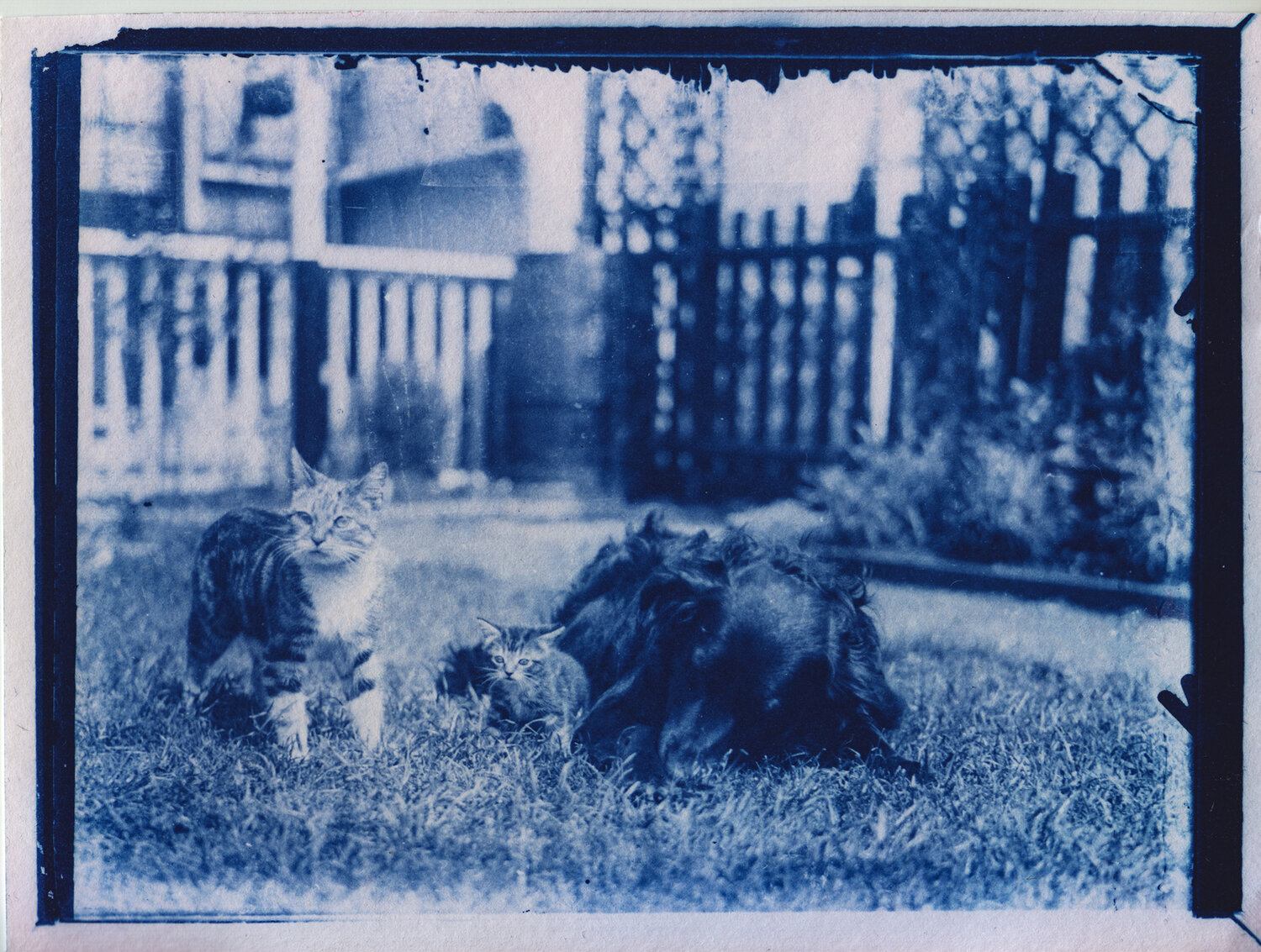
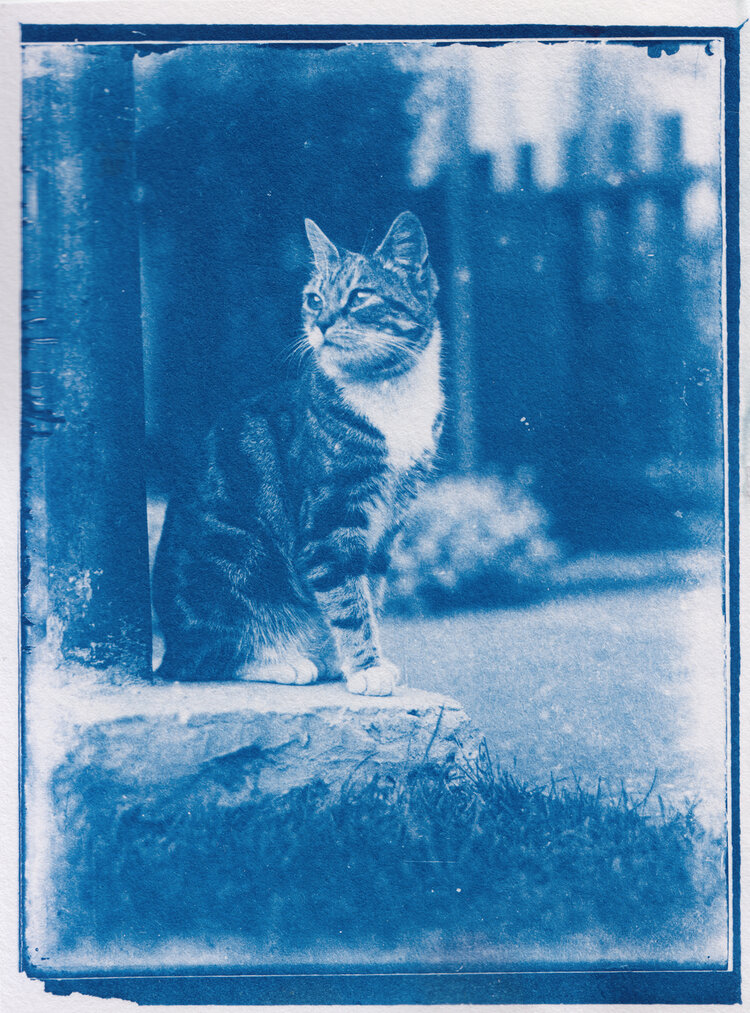
In this instance the hidden box was found in the family home of French photographer and video-maker Mathieu Stern and which somewhat serendipitiously contained several glass negative photographic plates. Inspired by these previously-unseen slides M. Stern has made full use of his photographic know-how to recreate the images therein using a traditional 19th century process called Cyanotype, to produce a couple of charming pictures that offer a literal snapshot into a little piece of 1900s life.
The life was that of a little girl (age unknown) who, judging by what is shown in the accompanying video, clearly took the concept of a time capsule to heart by including all sorts of ephemera from the turn of the last century such as paper cutouts, a coin/medal, pillbox, nib pen and sea shell - not forgetting the aforementioned glass plates. The contents of the charming little box - which is equally as beautiful - offer a fascinating glimpse into the existence of a young child at the beginning of the 20th century. Clearly all these things were of great importance to this young girl that she kept them so safe and in such good condition; just as obvious is the emotional attachment of the photographs' subject matter - her pet cats and dog.
As M. Stern and others commentators have stated, these images are a wonderful reminder that pets - and especially cats - have been an integral part of [young] people's lives for centuries and the concept of capturing their likenesses for posterity is nothing new - only the medium and devices used have changed in the last 120 years. One has to wonder if historians in 2140 will be able to look back at images taken on iPhones and the like with quite the same degree of appreciation as us looking at this girl's efforts (or will things get increasingly worse in the next 120 years...?).
In any event M. Stern is to be applauded for preserving these delightful photos and their lovely subjects for posterity while using a photographic technique appropriate to the time and one that would not have been unknown to the original photographer when she took these remarkably contemporary pictures of her beloved companions. One hope that he will cherish not only the pictures but also the other contents and that this particular time capsule will not be forgotten for another century.
Lost photographs and discarded picture albums have been a recurring theme on this blog over the years - from photos of a still under construction Tower Bridge being found in a skip, 5,000 First World War photos rescued from rubbish dumps, to rare images of the British Raj from over one hundred years ago turning up in a shoe box. On each occasion we have marvelled at the wonderful glimpse into the past these eleventh-hour rediscoveries have afforded us while at the same time lamenting the fact that they have been so undervalued as to have been left forgotten for decades or more, often to the point of their near-destruction.
This latest article is no exception and once again it is thanks to the efforts of one collector that a number of old photographs - primarily picture postcards of his home town of Coventry and studio portraits of its inhabitants - have been saved for posterity. Peter Knight's attitude towards preserving these "forgotten faces" is one that we can well appreciate - the thought that they might represent all that is left of a person's life, that they are the last surviving visual documentation of their existence and the travesty that would result if they were just left to gather dust (or worse).
What gives this story added inspiration is that Mr Knight has been able to use modern technology to restore the images to a startling degree of freshness, colourising them and in some cases even employing the much talked-of computer trickery that is "deep fake" to slightly animate the photos. While I am not convinced about the latter technique, the colourisation does go some way to adding to the immediacy of the pictures, to reinvigorating the subject and, indeed, bringing them back to life. Mr Knight's idea of incorporating these photographs into a virtual online world of an historical Coventry is also an intriguing project and one that I hope succeeds.
There has been some degree of backlash from certain quarters recently regarding how far "restoration" of old photographs and cine-footage should go following the colourisation, addition of sound effects and 4K HD & frame rate upscaling applied to the famous Lumière brothers' 1896 filmL'Arrivée d'un train à La Ciotatand other late 19th-/ early 20th-century footage on YouTube. As a student of history I can well understand the disquiet that is felt at the perhaps unnecessary meddling with things that were products of their time and should be understood and appreciated as such but equally I can appreciate the thinking behind it and in particular the benefits to the originals and their history that may result. For example, is Peter Jackson's recent excellent WW1 film They Shall Not Grow Old just "showmanship" or a legitimate attempt to modernise important historical footage for a new, 21st century audience? As I have said we as lovers of times gone by can appreciate black & white pictures and films as windows to the past but to many [young] people it is as alien and as relevant as another planet - noiseless, colourless, oddly-dressed people long since dead. If adding colour, realistic movement and other modern technological features can help get new generations more interested and perhaps lead them back to the unadulterated original, with a better understanding and appreciation of what it represents, it might well help to avoid further examples of photographic abandonment like those mentioned and ensure the endurance of classic early cinema and historic photographs such as those saved from oblivion by the likes of Peter Knight and others.
***What do you think? Can film or photographs ever be over-restored? Let me know your thoughts in the comments below.***
As the 100th anniversary of the start of the First World War moves ever closer (a fact I still struggle to fully comprehend, cf. this earlier post) we will doubtless start to see many stories and articles commemorating the centenary. Will we see one as fresh and remarkable as this, though?
Over the course of this blog we have seen photographs discovered in shoe boxes, in rubbish skips and in long-forgotten archives. Now we can add an antique camera itself to that list, as this story of another blogger's discovery tells.
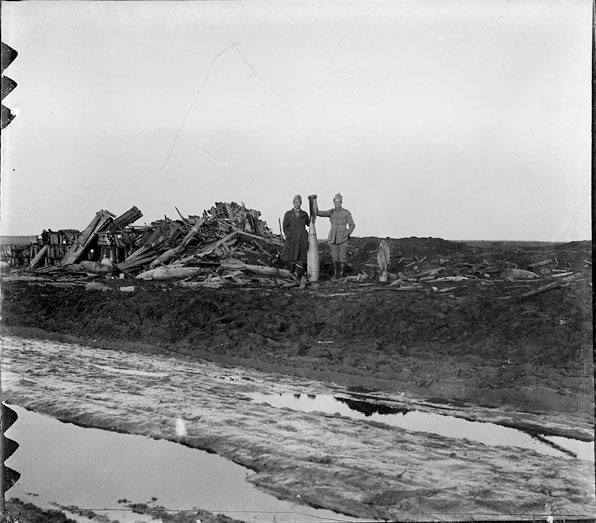
If I understand it correctly the glass-plate negatives found inside this 100-year old camera, picked up at an American antique shop, had previously been processed (otherwise we would not have been able to see them today) but then kept in the camera - where for all we know they may have remained ever since. Certainly this must be the first time they have been seen for decades - maybe even the first time by people other than the original photographer. We may never know who took them, or precisely when and where in France they were, but the fact that they have survived all these years is welcome enough news.
Whatever the history of these pictures they couldn't have ended up in better hands. Photographer Anton Orlov, on whose blog The Photo Palace you can see the full selection of images (as well as some equally fascinating and perhaps even more historically important shots of the same vintage taken in Russia, China and Japan), is clearly a big fan of old-fashioned analogue photography. So much so, in fact, that he has purchased an old yellow school bus with the aim of touring America as a sort of mobile museum/dark room - not only exhibiting the pictures and cameras but also giving talks and running workshops on the early techniques that were used, in the hope of ensuring that knowledge of and interest in non-digital print photography is not lost but rather encouraged.
Both these and the Eastern photos must surely rank among the top exhibits and I wish Mr Orlov every success in seeing through his endeavour to make them a part of his educational and inspirational scheme.
Last year I blogged about the beginnings of English Heritage's latest project Britain from Above which, as the name suggests, features several thousand images of Britain taken from the air. Interesting enough, but the clincher is the fact that these photographs were taken between 1919 and 1953. Now the dedicated website is live and you can see parts of the British Isles from the air in a totally new and different way - in the past!
Just one year after the end of the First World War and only 16 years after the first powered flight, pilots Francis Lewis Wills and Claude Grahame-White founded Aerofilms Ltd. and took to the skies to photograph the United Kingdom from a never-before-seen vantage point - the air. It is simply fascinating to see locations - areas one can be familiar with today - looking so very different during the 1920s and '30s, in their first appearance from an aerial platform. Already I've found images of local places, such as my local railway station, that give a glorious insight into the life of the area during the first half of the 20th Century.
Wickford railway station - from where for 10 years I commuted to London - in 1928.
Image courtesy of Britain from Above.
Truly this is a remarkable resource and one I feel sure I shall continue to delve into for a long time to come. There really is something for every amateur (and, dare I say, professional) historian here - I can almost guarantee that there will be at least one picture of a place near you - and things aren't finished yet as barely 20% of the 95,000 images in the 1919-53 collection have been digitised so far. Over the course of the next four years English Heritage aim to turn the project into one of the premier sources of early British aerial photography, and I for one can't wait!
Southend seafront, Marine Gardens, pier entrance, Palace Hotel and the High Street, 1920.
Image courtesy of Britain from Above.
We can help in the creation of this ultimate collection too by sharing memories and knowledge of locations, many photos of which have little or no information attached to them. One can sign up for free, join groups, annotate pictures and even download them! This is one of the most magnificent archives I've come across in recent years, deserves to flourish and is possible thanks to Heritage Lottery and other private donations for which we should be inordinately grateful. Happy browsing!
More historic photographs now, this time made available by the New York City Municipal Archives, consisting of over 800,000 images of the Big Apple taken over the course of one hundred years from the 1880s to the 1980s. All sorts of things are represented from the magnificent to the macabre and the collection looks to be of great interest to history buffs like us.
This selection of shots is just a small part of the New York Department of Records' 2.2 million images taken down the decades (and it makes you wonder how many millions of photographs are lying unseen in government archives around the world) but it's enough to be going on with for now at least and plans are well under way to put more images online in time.
As with all the best vintage pictures scenes of long-forgotten people, incidents and locations are contained within many of the images, giving a glimpse into the past of a great city. The NYC Municipal Archives Online Gallery is yet another welcome addition to the growing ranks of Internet-accessible historic photography and I look forward to browsing through its many thousands of images.
Just as I read of one amusing animal story, along comes another! This one features a bird everyone loves - the penguin. Or rather two penguins, who to our eyes look for all the world as though they deliberately posed for the picture accompanying the article. Their behaviour prior to the photograph being taken makes the subsequent snap all the more hilarious. Once again it shows how endearing we find these funny little animals and the bizarre way in which our minds imprint human characteristics onto other creatures.
A rare animal-related post here. Normally such things do not interest me, but the humorous aspect of this story so tickled my funny bone that I had to include it. Top marks to the photographer for catching such a fantastic image, but then if you see a zebra with its head in a hippopotamus's mouth you're bound to want to take a picture of it I suppose. Rather a strange to-do all round, eh what? OK, so the hippo gets a clean pair of gnashers, but what's in it for the zebra? Food? Interesting company? A dentistry qualification? Very odd indeed, and proof that there is still much about the animal kingdom that remains unknown to us.
News here of a fascinating-sounding exhibition that is being run up in Liverpool. Fascinating because it chronicles a landscape and way of life that has long since vanished and preserves it for our (and future generations') enjoyment and edification. It is also interesting to read of the way in which the photographer went about capturing his images. All too often when we see or hear of stories involving Victorians visiting foreign countries we automatically envisage some form of evil imperialism; the subjugation of the native population, the stripping of natural resources and so on. But here is a pleasant reminder that it was not always like this and that the photographer treated his subjects and their country with respect and admiration, which makes the pictures all the more enjoyable in my opinion.
Proof that a disability need not stop one doing the things they enjoy. Here we have a chap overcoming the physical blow that has befallen him, continuing to enjoy a life-long passion for photography and producing some jolly pleasant pictures for public display and appreciation into the bargain. A truly inspiring story about the human ability to surmount the most difficult afflictions and carry on living a normal life doing all the things one loves and, in this particular case, sharing the results with others.