Showing posts with label SE5a. Show all posts

Friday, 18 September 2020

My heroes: Leutnant Werner Voss (German Air Service) 1897-1917

For this post I thought I would do something a bit different and publish a little essay I first wrote nearly 17 years ago, on the 23rd November 2003.  Done purely for my own personal enjoyment (long before I became aware of such a thing as blogging) and to keep my writing - and handwriting, it originally having been handwritten - skills from college honed, it was one of two pieces I composed for a planned series based on people I considered my heroes and which features as its subject one of my abiding interests - aerial warfare in the First World War.  I'm on a particular kick in that direction at the moment and as it happens to be close to the 103rd anniversary of this chap's death on the 23rd September 1917 I thought it would be quite apposite to give it the light of day here (and possibly continue the series in future).  So without further ado I give you:

Leutnant Werner Voss (German Air Service),
13th April 1897 - 23rd September 1917

source - Wikipædia

To some people, my choosing as a hero a man responsible for shooting down so many aircraft and sending many gallant Allied pilots to their deaths during the First World War may be seen as odd and unpatriotic.  However I hold many Allied fighter pilots in equally high regard; [Lanoe] Hawker, [Louis] Strange, [James] McCudden, [Arthur] Rhys-Davids and [Albert] Ball to name but a few.  In fact, I have the greatest respect and admiration for all the pilots of both air services, British and German, who took part in those early aerial combats.  Voss’s story in particular, though, is the stuff of legend.

I do not intend to go into great detail regarding Voss's military career, but merely give a brief résumé of his war service up until the awe-inspiring dogfight in which he died.


Voss was only sixteen when the war began in 1914, but he managed to join the German cavalry (Uhlans) and saw action against the Russians on the Eastern Front (later earning him the nickname "The Krefeld Hussar").  The Eastern Front was a notoriously tough battlefield (though not nearly as hellish as the Western Front) being a snow-covered frozen wasteland, with no trench system to speak of; attack and counter-attack alike being constantly made by either side's cavalry.  For a 16-year-old to be mixed up in this kind of warfare is quite impressive.

In 1915 Voss transferred to the German air service, no doubt attracted by the newness and excitement surrounding this emerging type of warfare.  Like many of his peers he began by flying in two-seat reconnaissance aircraft, before becoming a scout pilot and joining [Oswald] Boelcke's Jasta 2 in November 1916.  This squadron was a breeding ground for hero aces; aside from Boelcke, Manfred von Richthofen was also present, and soon befriended the young Voss.

By April 1917 Voss had shot down 28 Allied aircraft, a feat that earned him the coveted Pour le Merité (also known as the Blue Max), an award also gained by Richthofen.  At the latter's personal request, Voss was given command of his own squadron, Jasta 10, in July; Jasta 10 being part of Richthofen's much larger Jagdgeschwader, or "Flying Circus".   All of this while he was still only 19.

source - Tumblr
His rate of scoring slowed at this point as the pressures of command were felt by him, but he soon received a boost in the form of the latest type of fighter aircraft, the Fokker D.R.1 triplane, which began to replace the ageing Albatros and Pfalz machines.  Voss's, in fact, was one of only two pre-production models, delivered to him in August.  Richthofen, who now also flew the new Fokker, found it slow and difficult to fly, but Voss revelled in its amazing manoeuvrability and fantastic rate of climb.

This differing opinion regarding the Triplane helps to show the different personalities and temperaments of von Richthofen and Voss, despite their friendship.  Von Richthofen's dislike of the new aircraft probably stems from his tactics, that of the hunter – cunning and analytical; hit and run, don't take on what you can't handle and make the enemy fight on your terms, not theirs.  Voss's methods were markedly different.  Like the British aces Albert Ball and Arthur Rhys-Davids, Voss would attack regardless of the odds.  He was a great believer in breaking up formations of enemy aircraft; fighting at close quarters so that the pilots would be more concerned about the risk of colliding with, or shooting down, one of their own rather than the silver-grey Triplane of Voss.  His style of fighting played to the strengths of his aircraft, that of manoeuvrability and climb rate.  Voss's attitude was gung-ho, atypical and the opposite of von Richthofen's.  Who is the better fighter pilot is a matter of opinion; each had their strengths and weaknesses.  Voss's tactics, however, stir the imagination more.

It was these tactics that enabled him to pile on another 20 kills by the end of September 1917, bringing his total score to forty-eight, a mere 13 less than von Richthofen.  Indeed, von Richthofen called him "my most redoubtable competitor" – high praise from Germany’s top-scoring ace of World War One.

source - Twitter / Ron Eisele
Voss was due to go on leave on the 23rd of September, but was desperate to reach the half-century before he did so.  He flew a patrol in the morning, when he shot down his 48th victim.  Some pilots were fearful of flying when they had leave imminent, believing it to be tempting Fate and therefore bad luck.  Voss evidently did not believe this, for he took off again that evening, a little after 6 o'clock, in his Fokker Triplane with two Pfalz DIII scouts for company.  There was a great deal of aerial activity that evening, with several British squadrons flying.  It was the rearmost flight of one of these, 60 Squadron flying the fearsome SE5a, which first spotted Voss's formation.  This flight included two up-and-coming aces, Captain Robert Chidlaw-Roberts and Lieutenant Harold Hamersley.  Avoiding the two Pfalz they dived in to attack Voss, whose amazing aerobatic skills now became apparent.  Manoeuvring free of the attack, Voss turned the tables, firing on the two SEs and scoring hits.  As he drove the enemy back towards the lines, Voss's antics attracted two flights of the well-documented 56 Squadron, also flying SE5as.  With Captain James McCudden leading and Lieutenant Arthur Rhys-Davids also in attendance they tore down after Voss at close to 200mph.


Voss was not unaware of the danger, so he turned to face it.  Flying at McCudden, firing as he came, he scored several hits before he flashed past.  The British pilots, unable to understand what had just happened, swung round to get after him, only to find that Voss had also turned and was coming back at them.  Firing once more, he scored several good hits on Keith Muspratt’s machine, irreparably damaging the engine and forcing him to land.

By this time Voss was by himself, the Pfalz pilots having departed.  He too could have left at any time, the climb rate of his Fokker being superior to that of the SEs'.  He elected to stay and fight on, confident in his ability to out-manoeuvre his antagonists.  Whilst some people may put this down to typical German arrogance, I rather think it was an act of the greatest bravery and selflessness to take on such overwhelming odds.  Said Bowman after the fight, "that left him in the middle of six of us, which did not appear to deter him in the slightest."

source - Tumblr
Time and again the British pilots were forced onto the defensive by Voss's tactics; another SE5a was forced to retire, a write-off, thereby giving Voss a claim of 50 aircraft destroyed.  Slowly but surely, however, the fight was drifting westwards, towards the Allied lines.  At this point, a red-nosed Albatros joined the fight, and eleven more enemy scouts were seen at high altitude, but six Spads and four Sopwith Camels were keeping them otherwise engaged.  McCudden was afforded a brief chance for another attack, but as he did so Voss had already lined up and was firing in return.  Another SE attacked at the same moment as McCudden, yet Voss was able to manoeuvre free from both attacks.  Arthur Rhys-Davids persistently tried to dive into attack Voss, yet each time the Triplane dodged his bullets.  After one such occurrence Voss appeared at a broadside position to another SE pilot, Flight Commander G. H. Bowman.  Bowman tried to press home his attack, but in an outstanding move Voss applied full rudder, slewing sideways and firing on Bowman, much to his amazement.  This manoeuvre, however, took up much of Voss's concentration.  Enough, in fact, for him not to notice that Rhys-Davids had managed to get on to his tail.  For a distance of thirty yards Rhys-Davids emptied an entire drum of ammunition into the Triplane, fatally wounding its pilot.  "Oh", said Rhys-Davids after the event, "if only I could have brought him down alive!"

source - eBay
Every pilot who faced Voss that day held him in the highest esteem.  Bowman wrote, "It was not until later that we actually heard that it was Voss in the Triplane.  Our elation was not nearly so great as you would imagine."  McCudden's diary entry says it all, and is in many ways a fitting epitaph:

"As long as I live I shall never forget my admiration for that German pilot, who single-handed fought seven of us for 10 minutes.  His flying was wonderful, his courage magnificent, and in my opinion he was the bravest German airman whom it has been my privilege to see fight."


Friday, 27 June 2014

Chocks away at the South Essex Armed Forces Day

Since 2009 there has been a special Armed Forces Day in Britain, with events held around the country to honour the men and women of the British armed forces past and present.  While not an official national holiday it certainly seems to have become an annual event, observed nationwide usually in the last week of June (to coincide with the anniversary of the first ever Victoria Cross).

Chances are there's an event or three near you (if you're UK-based), be it a simple town centre march-past or a weekend of packed commemorations.  Both of the above are occurring locally to me this weekend (28th/29th) but it is an earlier experience that will form the basis for this post today.

One of the biggest events - THE biggest, in fact, according the promotional material - in Essex took place last weekend at my local showground, Barleylands in Billericay.  I first became aware of the event as long ago as February, when the tickets began going on sale, and bought my entry there and then.  (This didn't stop TicketWeb and/or the Royal Mail trying to thwart me by losing my ticket - cue much frantic 'phone-calling in the week leading up to it and the last-minute sending of a replacement e-Ticket... only to find they were being sold on the gate after all!).  One thing in particular had ensured my attendance - the Great War Display Team would be making an appearance (OK, so the Spitfire and Hurricane attracted me too, of course)!

Three fields to the east of the car park were nothing to write
home about.  The field to the south and the green marker were
the places to be.
Come the day itself I availed myself of the free bus service and found myself at the Barleylands ground shortly after 11'o'clock.  I really had no idea what to expect from the day, having never been to an Armed Forces Day event before, but I kept my hopes suppressed following my previous less-than-positive experience a couple of years ago.  As it turned out it was probably for the best, for the overall layout could best be described as your standard funfair with a bit of militaria tacked on.  In one corner of a field there was a very interesting display of military vehicles - of which more momentarily.  But then one had to walk through three fields of the usual merry-go-rounds, shooting galleries and ice cream vans, past a music stage empty and audience-less save for a fat man in jeans and a short-sleeved shirt who was belting out (admittedly in good voice) 1950s Rock'n'Roll numbers, just to get to the display area - which was encircled by innumerable burger vans (which at £4 for the cheapest burger-in-a-bun were a prime example of playing to a captive audience) and sunglasses sales tents.

I did a couple of circuits just to make sure I didn't miss anything, stopped for a cup of tea and my own lunch and then headed back to the first field where I - very happily as it turned out - spent the rest of the day.  Why happily?  Well, that one field was worth the £10 price of admission in my book.


To start with, there was a Spitfire sitting bang in the middle of it!  Although only a static replica (built over 20 years by a father and son team, using an old airframe and various parts) it was still beautiful to behold.  It was possible to get quite close to it (for £2 one could look - but not sit - inside the cockpit) and having not been so near a Spit for quite some time I'd forgotten just how big an aircraft it is.

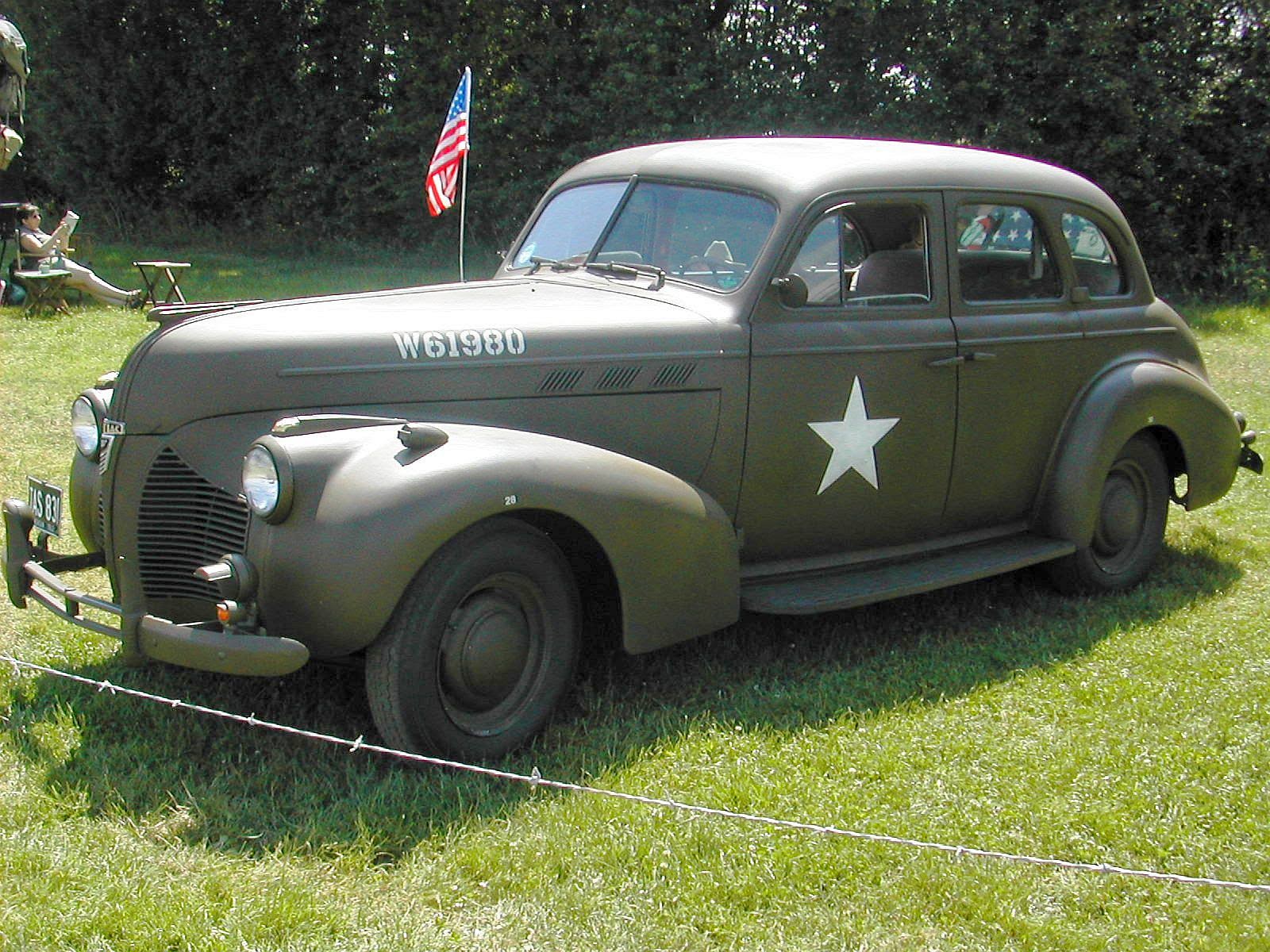
Around the perimeter of this field (and the small adjacent one) were the majority of the military vehicles (and armed forces', associations' and charities' stands).  Two of the more interesting vehicles were a 1942 Cadillac staff car and 1950s Austin Champ jeep.

At one end was a group of Second World War re-enactors, representing the 2nd Battalion Essex Regiment and complete with Jeep and tents, while at the other end was the fascinating display of the Great War Society.  Despite having only enough room for two pitches their re-enactment was striking in its simplicity and gave a good idea of conditions for, in this case, an RFC officer and a cavalry veterinarian.  The RFC johnnie was done up to the nines splendidly - complete with swagger stick, a beautiful pipe (with equally lovely-smelling tobacco) wind-up gramophone playing music hall numbers and a framed photo of Lady Edith!

Who parked that German staff car there?!
He recognised in me a fellow Chap (I think it might have been my cravat!) and we had a good long chat (he both in and out of character!) about the re-enactment scene, the centenary and my particular interest in the period and late 19th/early 20th century socio-cultural history in general.  If you're reading this, Trevor, good show!

The cavalry vet also had a few handsome displays on show in the form of three pack mules, representing the equine aspect of the First World War.  These three imposing beasts happily stood for being stroked and petted and were really quite beautiful animals.  When you think of mules you might think of little donkeys and suchlike, but these three fellows were proper American-bred - such as the type that was used in the Great War to carry and pull all manner of things from provisions to artillery pieces - and stood an impressive 15-16 hands high!  Very docile they were, though, and one in particular was only too pleased to pose.

Turn, aaand... smile for the camera!

At around 1:30pm the Hurricane suddenly appeared, announcing its arrival by roaring overhead.  Here I found myself in a fortunate position, quite literally, away from the crowds and main display area on the perimeter of the public area - and right next to the field over which the Hurri was flying!  I was one of maybe only half a dozen people who found this sweet spot and it was like having your own personal airshow!  Even with my ancient, worse-than-a-smartphone digital camera I was able to get some half-decent shots, although they don't show the wonderful proximity of this and later displays.


Suitably buoyed I hung around the same patch of grass sitting and enjoying the glorious June weather (and ruing not having brought a fold-up chair - the lack of seating except around the main display area being another nuisance) until 2:30, when looking to the eastern horizon this stirring sight met my gaze:


What happened for the next twenty minutes I won't forget in a hurry.  The last time I saw First World War 'planes (replicas) in the air was nearly 20 years ago, at the nearby North Weald Aerodrome with my dad, when there were only two or three airworthy examples.  Back then they flew so high and far away that it was really impossible to make them out clearly, let alone get a sense of speed and immediacy.  Added to that they did a mock bombing raid that meant they were hundreds of yards the other side of the 'drome.  Well, there were no such problems this time!

British and American SE5as
Sopwith Triplane
Junkers CL.1
Fokker and Sopwith Triplanes
BE2c and Sopwith Triplane

I literally didn't know where to look next.  The Great War Display Team (for 'twas they) put on one hell of a show.  They must have choreographed it with military precision but it all looked so "natural" that my heart was in my mouth more than once.  It was likely the closest I'll ever get to seeing a proper dogfight.  I must have taken over 100 photos in those twenty minutes and it was a struggle to pick out which ones to feature in this post.  Considering I was just pointing and shooting with a fifteen year old 5x zoom camera I'm delighted how few of them I had to delete (I must admit to being a trifle embarrassed when I noticed nearby two young teenage girls both with proper professional-looking zoom lens cameras - oh for the day when I can afford a new box brownie!).

What with them and the GWS my existing passion for the Great War - and particularly the air war - was enhanced even more and I've now made it my mission to get to the original Stow Maries WWI aerodrome in mid-Essex, the restoration of which I wrote about in an earlier blog post and at which the Great War Display Team sometimes appears.  Perhaps an August birthday treat...?


The afternoon was topped off in style at 4'o'clock when the Spitfire turned up and proceeded to wheel and bank over our heads for the next 15 minutes.  By that time I was aching, suntanned and a bit hungry so as the Spit disappeared to the west I hopped back on the bus and was home in time for tea, feeling well satisfied with the day and with renewed appreciation of the armed forces from all eras.

**Are you going to an Armed Forces Day event this weekend?  Let me know in the comments below and I'll look forward to reading any subsequent posts!**

Tuesday, 1 June 2010

Pensioner is Britain's oldest stunt pilot at 87

A truly heart-warming article here about a man still enthusiastically enjoying his wonderful hobby even in his advancing years. Proof, if proof were needed, that age is no barrier to doing anything, particularly if you take as much pleasure in it as this fellow seems to in his flying. It really is wonderful to see someone delight in their pastime after so many years, let alone still be able to do it at all at 87 years of age. I guess if you love doing something that much it keeps you feeling young. That he has such a gentlemanly outlook on his flying and performing for crowds is simply an added bonus. I take my hat off to him (and wave it)!

Followers

Popular Posts