I came across this short film yesterday (and again, apologies to those of you outside the British Isles who may not be able to view it) which reminds us that 2010 is the 75th anniversary of Monopoly. Inspired by this and Tickety Boo Tupney's series on traditional family games I thought I would base a post around this King of board games.
Monopoly has long been one of my favourite board games (I love the '30s vibe I get every time I play it) which makes it all the more galling that no-one else in my family enjoys playing it ("It's too boring and long-winded" seems to be the general consensus. Booo!). I'm lucky if I get the chance to play it more than once or twice a year with friends (*sob*). As a family we used to have a donkey's years old basic version - board held together with sellotape, banknotes torn, that sort of thing - which was originally one of 3 that my grandparents had for some reason.
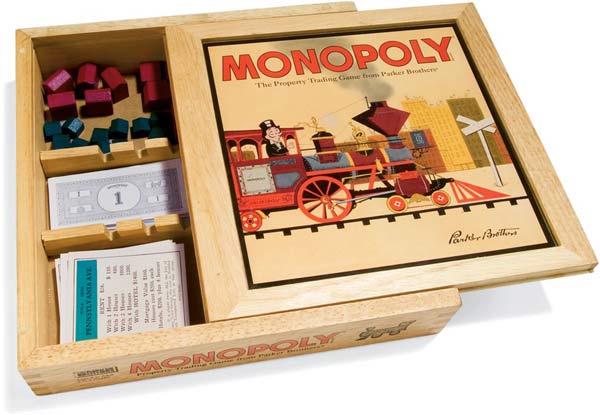

 A few years ago I treated myself to my own new Monopoly set, the wonderfully traditional (and austere!) Nostalgia Edition (or, as the teenage girl behind the Argos counter called it, "Noss-, noz-... Nosaltalger Edition? Yeah, whateva!") - a half-price bargain at only £10! As you can see it comes in a lovely wooden box (complete with little grooves to hold the money), simple wooden houses and hotels and little brass tokens, including a steam train in lieu of the battleship. Although most of the Chance and Community Chest cards are familiar, a few are brilliantly of the period and always make me smile.
 Of course, my dream Monopoly set would undoubtedly be the 70th Anniversary Edition from five years ago, which is a beautifully Art Deco rendering of this classic game. The board is suitably embellished, the hotels look more like skyscrapers and the tokens are gorgeous (right). I can't say I care much for the modern redesign (a circular board, digital counter, property prices in the millions? - pah!) or the myriad themed versions that seem to spring up every other week but then, I am a traditionalist (in case you hadn't guessed!).
It is understandable though, as the film makes clear, that board games - and particularly Monopoly - have to move with the times and reinvent themselves if they are to hold the attention of the Playstation generation. Just so long as they keep producing the original version and designs like those mentioned above, I shan't complain. As the report also suggests, Monopoly's continued popularity may be down to the fact that, however much London may have changed in the past three-quarters of a century, the streets and landmarks still exist in one form or another and so provide a tangible link to the game. (When Waddington's bought the European rights to Monopoly from Parker Bros. in 1935, the managing director and his secretary toured the streets of London to come up with British equivalents. For a humorous yet fascinating insight into the history of Monopoly and its London locations I recommend the book Do Not Pass Go: From the Old Kent Road to Mayfair by travel writer Tim Moore). Plus, in these cash-strapped times who wouldn't like to own an hotel on Mayfair? As long as there are recessions, there will be a place for Monopoly, I feel. Now all I need to do is find someone to play it with!


